

CCSD code G5100: Bypass of duodenum billing guide
CCSD code G5100 bills a bypass that leaves the duodenum in place CCSD code G5100...

Last Updated: Oct 16, 2026
L1100 is the HCPCS Level II code for a ring flange addition to a CTLSO or scoliosis orthosis. The flange is plastic or leather, and it is not molded to a patient model. Medicare pays it only when base code L1000, the Milwaukee CTLSO, sits on the same claim.
The molding is what separates L1100 from L1110. A stock or prefabricated flange bills as L1100, while a flange built over the patient's cast or scan bills as L1110.
Let Pabau's smart automation suggest the right codes, reduce claim denials, and keep your practice compliant—effortlessly.
Automate repetitive tasks and focus on what matters most—your patients.
Reduce coding errors and ensure compliance with the latest regulations.
Clean claims, fewer denials, and faster reimbursements.
Powerful insights and reporting to help your practice thrive.
HIPAA compliant SOC 2 certified GDPR-compliant Trusted by 4,000+ clinics worldwide

HCPCS code L1100 covers a plastic or leather ring flange added to a CTLSO or scoliosis orthosis, not the brace itself.
CTLSO means cervical-thoracic-lumbar-sacral orthosis, such as the Milwaukee brace billed under base code L1000.
L1100 and L1110 describe the same ring flange. L1110 is molded to a patient model, and L1100 is not.
L1100 is an addition code, so Medicare denies it as not separately payable unless L1000 is on the same claim.
Practice management software like Pabau pre-fills claims from the patient record and checks required fields before submission.
HCPCS code L1100 pays for one component of a scoliosis brace. That component is a ring flange in plastic or leather, added to a CTLSO or scoliosis orthosis and not molded to a patient model.
CTLSO stands for cervical-thoracic-lumbar-sacral orthosis. The code sits in HCPCS Level II, which the Centers for Medicare and Medicaid Services (CMS) maintains. The table below sets out the attributes billers check first.
Two rows in that table decide most L1100 claims. The base code has to be L1000, and the flange must not have been molded to the patient. Get either one wrong and the line fails, however well the rest of the claim is built.
A ring flange is a plastic or leather flange added to one of the rings on a scoliosis brace. It widens the surface where the ring meets the body, which spreads pressure and helps the brace sit in position.
The best-known CTLSO is the Milwaukee brace, a custom-fabricated brace with a pelvic section, uprights, and a ring at the neck. It is prescribed for curves that sit too high for a brace ending below the armpit.
The scoliosis orthotic range runs from L1000 through L1120. L1000 is the base device, and the codes from L1010 to L1120 are additions that attach to it. Confirm each descriptor against the CMS HCPCS quarterly update rather than a third-party summary.
Every addition in that run shares the same opening words. The component named after them is what separates one code from the next, and for L1100 and L1110 only the molding clause differs.
L1100 is payable alongside L1000, the CTLSO base code. The DME MAC and PDAC correct coding guidance for scoliosis orthoses ties the L1010 to L1120 additions to L1000. A claim that omits L1000 is denied as not separately payable.
A second rule works from the other direction. Five scoliosis base codes are all-inclusive: L1005, L1006, L1007, L1300 and L1310. Their allowance already covers the pads and interfaces fitted to them, so an L1100 line beside one of them counts as unbundling.
Put the two rules together and every L1100 line passes through the same two checks, shown in the chart below.
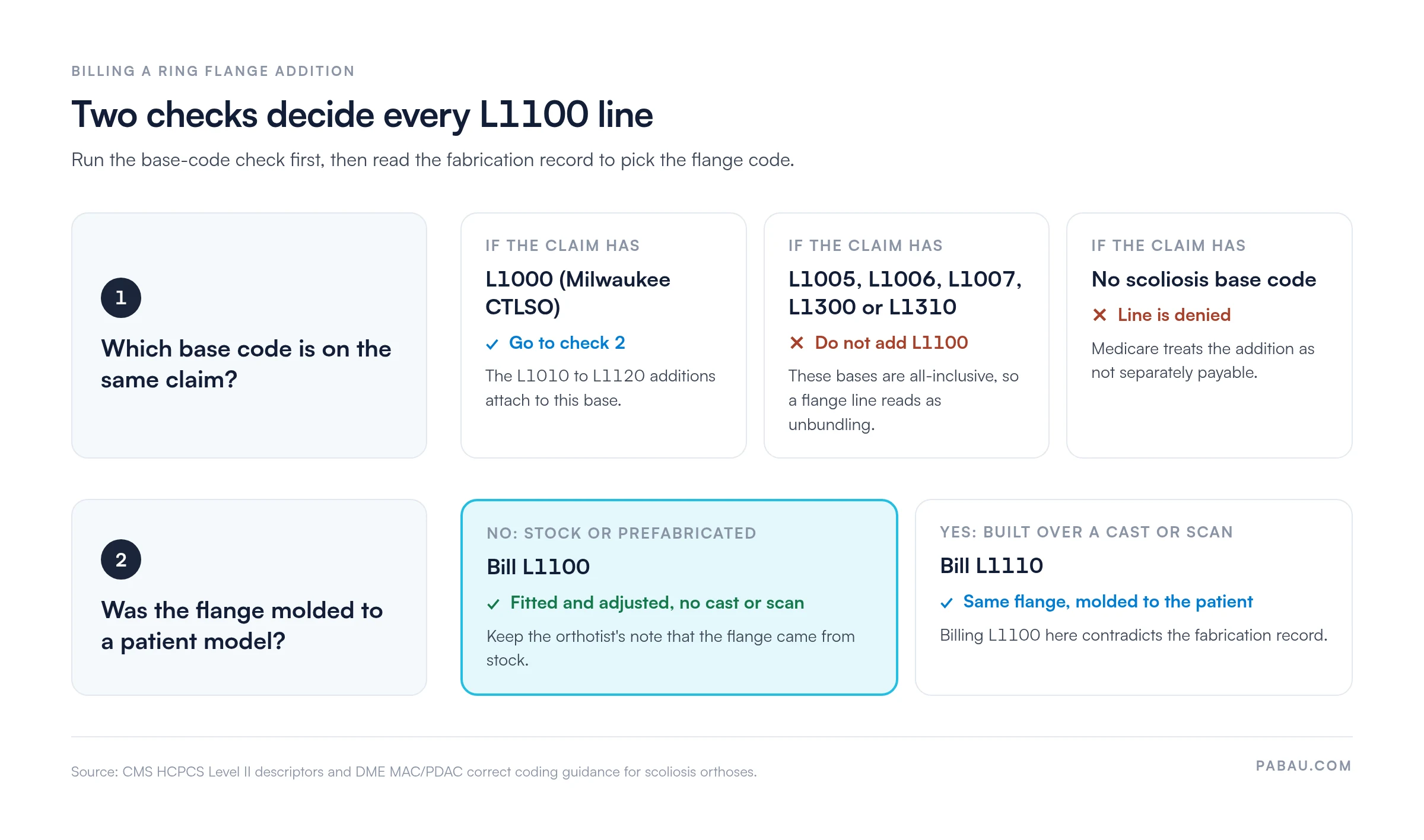
L1100 and L1110 describe the same ring flange, and only the fabrication separates them. L1110 carries the extra phrase molded to patient model. L1100 carries no molding clause, so it covers a stock or prefabricated flange.
Match the code to the fabrication record, not the order alone. If the orthotist took a cast or scan and built the flange to it, bill L1110. If the flange came from stock and was fitted to the brace, bill L1100.
When the order and the delivery note disagree, ask the orthotist to clarify in writing before you submit.
Ask the orthotist to state in the delivery note whether the flange was stock or molded. That one line settles the L1100 or L1110 choice at billing, and it answers the first question a reviewer asks about the flange.
Medicare Part B covers L1100 under the braces benefit, and the four DME MACs process the claims. Coverage depends on medical necessity, a compliant written order, and a paired L1000 line.
Jurisdictions A and D go to Noridian Healthcare Solutions, and Jurisdictions B and C go to CGS Administrators. Each MAC publishes its own articles and documentation guidance, so check your MAC’s current policy before billing.
Medicaid coverage for orthotic additions varies by state. Some states follow Medicare policy, while others set their own medical necessity criteria or require prior authorization. Check your state Medicaid program’s orthotic policy separately.
Medicare pays L1100 from the CMS DMEPOS fee schedule, not the Physician Fee Schedule. Allowables are set by state, updated each January, and can change mid-year. A single national dollar figure would mislead, so pull the current rate for your jurisdiction.
Pull the L1100 and L1110 allowables for your jurisdiction from the CMS DMEPOS fee schedule each January. Keep both figures on file with the date you pulled them. When an auditor questions a flange line, you can show which rate you relied on and why the code fit.
Every L1100 claim carries at least one ICD-10-CM code explaining why the brace and its flange were needed. The M41 scoliosis series does most of that work.
Code to the specificity the record supports. If the physician documented a thoracic idiopathic curve, M41.24 carries that detail and M41.9 throws it away.
Traditional Medicare does not list L1100 on the DMEPOS Required Prior Authorization List as of 2026. CMS updates that list through rulemaking, and spinal orthoses have been added before, so recheck it each year.
Other payers set their own rules. Before fabrication or delivery, work through these steps:
Delivering a flange before a required authorization is in place usually leaves the claim unpayable, with little room to appeal.
Documentation decides whether an L1100 payment survives review. Auditors look for the same core records on every orthotic addition claim.
Keep the file for at least seven years from the date of service, or longer where state law requires it. Review contractors can request orthotic records years after payment.
Modifiers on an L1100 line tell the DME MAC what the supplier knows about coverage. Check your MAC’s current policy article for which ones it expects.
Treat KX as an attestation. Appending it without the supporting records on file is a false statement on the claim.
L1100 denials cluster around a short list of errors. A pre-submission check catches nearly all of them.
Tracking denials by reason code shows which of these repeats. Our guide to denial codes in medical billing explains the ones you will see most often.
Run these steps in order, starting at intake rather than at billing.
A claim built this way meets the requirements for a clean claim submission on the first pass.
An orthotics practice may bill several brace additions in a week, each with its own order, fabrication note, and delivery receipt. Manual claim entry is where a missing L1000 line or the wrong flange code slips through.
Practice management software like Pabau keeps each claim tied to the patient record it came from. Pabau’s claims management software pre-fills the diagnosis, the items, and the dates of service from that record.
Required-field checks flag an incomplete claim before it goes out, and each claim’s status stays visible after submission. Choosing the base code, the flange code, and the modifiers stays with your biller.
Signed orders, fabrication notes, and delivery receipts attach to the same patient record. When a reviewer asks for an L1100 file, your team can find it in minutes.

Pabau’s claims management software pre-fills claims from the patient record and checks required fields before you submit. Each L1100 line then stays tied to its order and delivery records.

An L1100 claim rests on two documented facts. The ring flange was added to an L1000 CTLSO on the same claim, and it was not molded to the patient’s model. Miss either one and the line is not payable.
That puts the work before billing. Record whether the flange was stock or molded, get the written order signed, and code the curve the physician documented.
Pabau helps orthotics and DME teams build those checks into the order-to-claim workflow. Book a demo to see how it handles HCPCS billing for your practice.

Need a reference for handling claim denials systematically? Denial management in healthcare covers how to build a structured denial tracking and appeal process for your billing team.
Want to understand how the broader billing process fits together? What is medical billing walks through the full revenue cycle from eligibility through payment posting.
Looking for clean claim best practices? Clean claim submission outlines the requirements every DMEPOS claim must meet before it reaches the payer.
Billing the base brace as well? HCPCS code L1000 covers the Milwaukee CTLSO that every L1100 flange line depends on.
Was the flange molded to a cast or scan? HCPCS code L1110 explains the molded ring flange and its documentation.
HCPCS code L1100 covers a ring flange in plastic or leather, added to a CTLSO or scoliosis orthosis. The flange is not molded to a patient model. It is an addition code, so it is billed with base code L1000 rather than on its own.
No. The official descriptor names a CTLSO, which is a cervical-thoracic-lumbar-sacral orthosis, or a scoliosis orthosis. The classic example is the Milwaukee brace, billed under L1000. Cervical-thoracic orthoses sit in a different part of the L-code range.
Both codes describe a plastic or leather ring flange added to a CTLSO or scoliosis orthosis. L1110 adds the phrase molded to patient model, so it covers a flange built over a cast or scan. A stock or prefabricated flange bills as L1100.
L1100 pairs with L1000, the CTLSO or Milwaukee brace base code. The scoliosis additions from L1010 to L1120 belong to L1000. Adding L1100 to an all-inclusive base code, such as L1005, L1006, L1007, L1300 or L1310, counts as unbundling.
Traditional Medicare does not list L1100 on the DMEPOS Required Prior Authorization List as of 2026. That list changes through rulemaking, so check it each year. Commercial and Medicare Advantage plans set their own rules, and many require authorization for orthotic additions.
Most denials come from a missing L1000 line or a pairing with an all-inclusive base code. Others come from a molded flange coded as L1100. A late standard written order and vague ICD-10 coding cause most of the rest.



