

CCSD code G5100: Bypass of duodenum billing guide
CCSD code G5100 bills a bypass that leaves the duodenum in place CCSD code G5100...

Last Updated: Oct 16, 2026
L1050 is the HCPCS Level II code for addition to CTLSO or scoliosis orthosis, sternal pad. It covers the padded anterior contact surface fitted at the sternum on a scoliosis brace.
L1050 never stands alone on a claim. It must be submitted alongside a base scoliosis orthosis code such as L1000 or L1001. A claim carrying L1050 without a base code is denied automatically.
Let Pabau's smart automation suggest the right codes, reduce claim denials, and keep your practice compliant—effortlessly.
Automate repetitive tasks and focus on what matters most—your patients.
Reduce coding errors and ensure compliance with the latest regulations.
Clean claims, fewer denials, and faster reimbursements.
Powerful insights and reporting to help your practice thrive.
HIPAA compliant SOC 2 certified GDPR-compliant Trusted by 4,000+ clinics worldwide

HCPCS code L1050 is an addition code for a sternal pad on a CTLSO or scoliosis orthosis.
L1050 must sit on the same claim as a base code such as L1000 or L1001, or it is denied.
Medicare Part B may cover L1050 when medical necessity is documented and the KX modifier is appended.
A covered ICD-10-CM scoliosis diagnosis and a Detailed Written Order must be on file before delivery.
Practice management software like Pabau keeps the order, the diagnosis and the claim on one patient record.
HCPCS code L1050 sits in the L1000-L1120 Scoliosis Orthotic Devices range within HCPCS Level II. The Centers for Medicare and Medicaid Services (CMS) maintains that code set for DMEPOS products and services. The table below captures the attributes billers need before submitting a claim.
L1050 is not a base device code. It is one component, the sternal pad, added to an already-prescribed orthosis. Confirm active status each year, since CMS updates the HCPCS Level II code set each January. Use the AAPC HCPCS Level II code lookup to verify the current descriptor and status before submitting.
A sternal pad is a padded contact surface fitted to the anterior sternum region of a CTLSO or scoliosis orthosis. It provides a corrective pressure point that works with the frame to manage spinal curvature in scoliosis patients.
L1050 applies when you add a sternal pad to any of the following base devices:
Suppliers do not bill the sternal pad separately as a standalone supply. They bill it only as an addition to a base orthosis already on the claim. If an existing orthosis needs a replacement pad, ask your MAC which modifier applies. A repair or replacement modifier may fit better than a new L1050 line.
Billing L1050 correctly means pairing it with a base code and meeting DMEPOS enrollment requirements. Missing either step results in denial. Here is what CGS Medicare’s correct coding guidance for scoliosis braces and CMS DMEPOS policy require:
Medicare Part B covers L1050 when the claim meets medical necessity criteria, carries a covered base orthosis code, and includes appropriate modifiers. Coverage is subject to MAC-specific Local Coverage Determinations (LCDs), so requirements differ between CGS Jurisdiction B, Noridian Jurisdictions A and D, and other MACs.
Key coverage principles for L1050 include:
Reimbursement rates: CMS publishes DMEPOS fee schedule rates by locality. Rates for L1050 vary by location, and CMS updates them each year. Do not rely on dollar figures published on third-party sites. Check the current rates in the CMS DMEPOS fee schedule for the relevant locality.
Medicare requires a covered ICD-10-CM diagnosis for reimbursement of L1050. The diagnosis must appear on the claim, and clinical documentation in the patient record must support it. The codes most commonly paired with scoliosis orthosis claims fall within the M41.xx series.
Confirm the ICD-10-CM codes that apply against your MAC’s current LCD for scoliosis orthoses before submitting. MACs update LCDs regularly, and a code one jurisdiction covers may not carry coverage in another. Code to the highest degree of specificity the documentation supports, rather than defaulting to an unspecified code.
DMEPOS orthotic claims require modifiers to indicate ownership status, coverage conditions, and laterality where applicable. Submitting L1050 without the correct modifier combination is one of the most common causes of denial for orthotic add-on codes.
The KX modifier carries compliance risk. Appending it without supporting documentation in the patient file is a false claim. Use KX only when the Detailed Written Order and clinical notes confirm this beneficiary meets the MAC’s LCD criteria.
CMS DMEPOS documentation rules require specific records to be in place before billing, not gathered after the fact. If a MAC audits a supplier, the supplier must produce these documents on request.
Before delivering any L1050 sternal pad addition, print the required documentation checklist from your MAC’s LCD and confirm every item is on file. A missing Detailed Written Order is one of the most common triggers for post-payment audits on orthotic add-on codes.
L1050 is an addition code that only has meaning alongside a base scoliosis orthosis code. The split below decides whether a claim is payable. Two codes in this range can stand alone, and the rest cannot. The Milwaukee brace is one of them, billed as L1000.
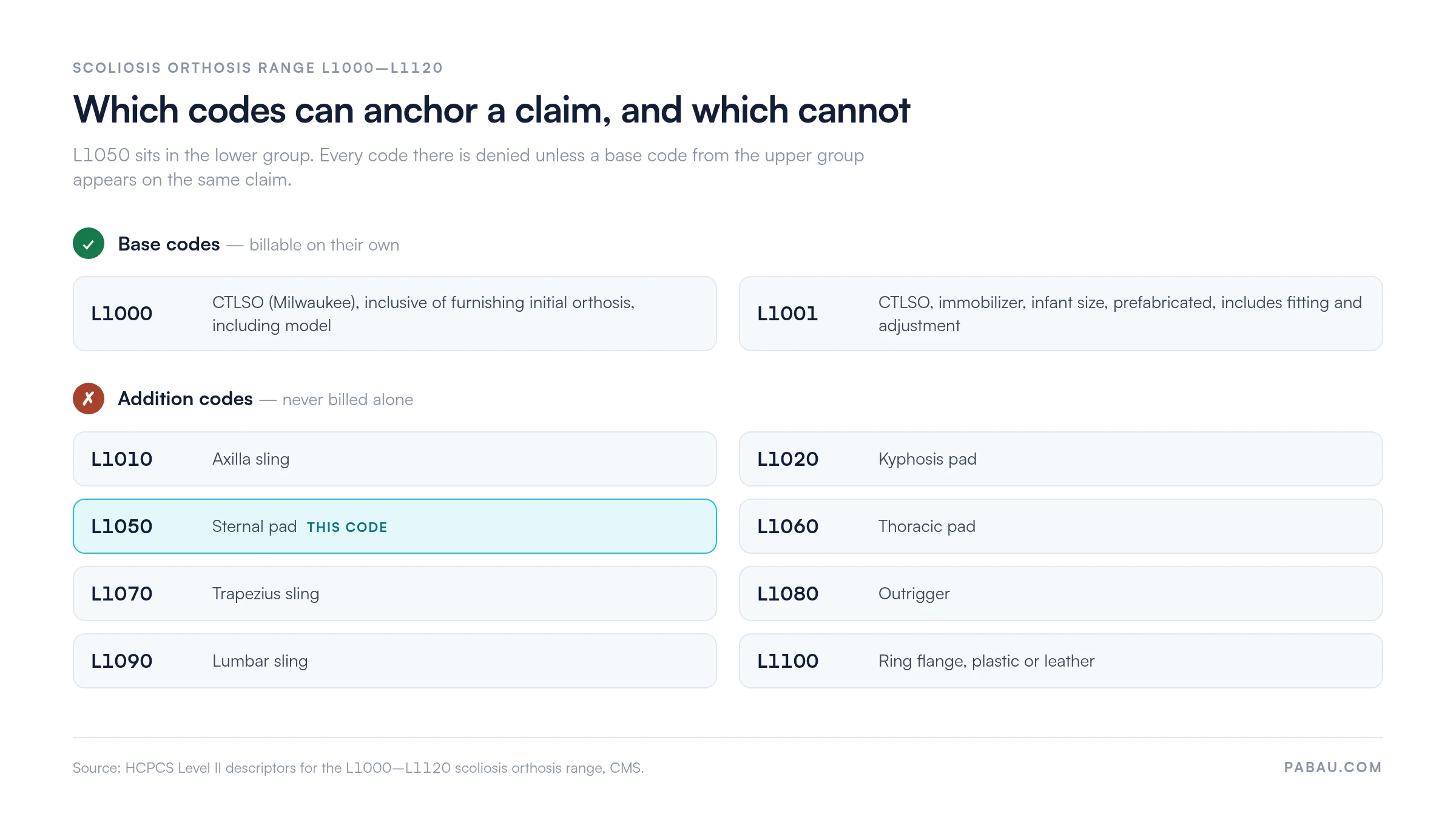
The table maps the most commonly used base and addition codes in the range, with the official descriptor for each.
When a claim requires multiple additions, bill each addition code on the same claim alongside the single base code. Each addition line needs the same modifier set as the base code. Never substitute L1050 for a more specific addition code. A kyphosis pad is L1020 and a thoracic pad is L1060.
Most L1050 denials trace back to one habit. Billers treat the code as a standalone supply rather than an addition to a base orthosis. Cross-check every add-on line against its base code before submission. The most frequent errors:
A pre-bill checklist for every L-code add-on claim catches most of these errors before submission. Confirm the base code, the modifier, the diagnosis code, and the DWO date, then submit. For a full reference on the codes payers return, see our guide to denial reason codes.
Run a pre-submission audit on every L1050 claim. Confirm the base code is present and the modifier matches the documentation on file. Then check that the ICD-10 code is the most specific available and the DWO date precedes the date of service.
An orthotic supplier billing L1050 today usually checks the pairing by hand. Someone opens the patient record, finds the base orthosis code, checks the DWO date, then types both lines into the claim. When someone skips one of those steps, the denial arrives weeks later.
Practice management software like Pabau keeps the clinical record and the claim in one system. The Detailed Written Order, the delivery receipt and the scoliosis diagnosis sit on the patient’s file. The biller can confirm the base code and the order date without leaving the record.
Pabau’s claims management software then tracks each submitted line and its status. Pabau flags a rejected add-on line within days rather than at the end of the month.
The outcome is fewer add-on lines going out without a base code. Your team also spends less time reworking denials a pre-submission check would have caught.
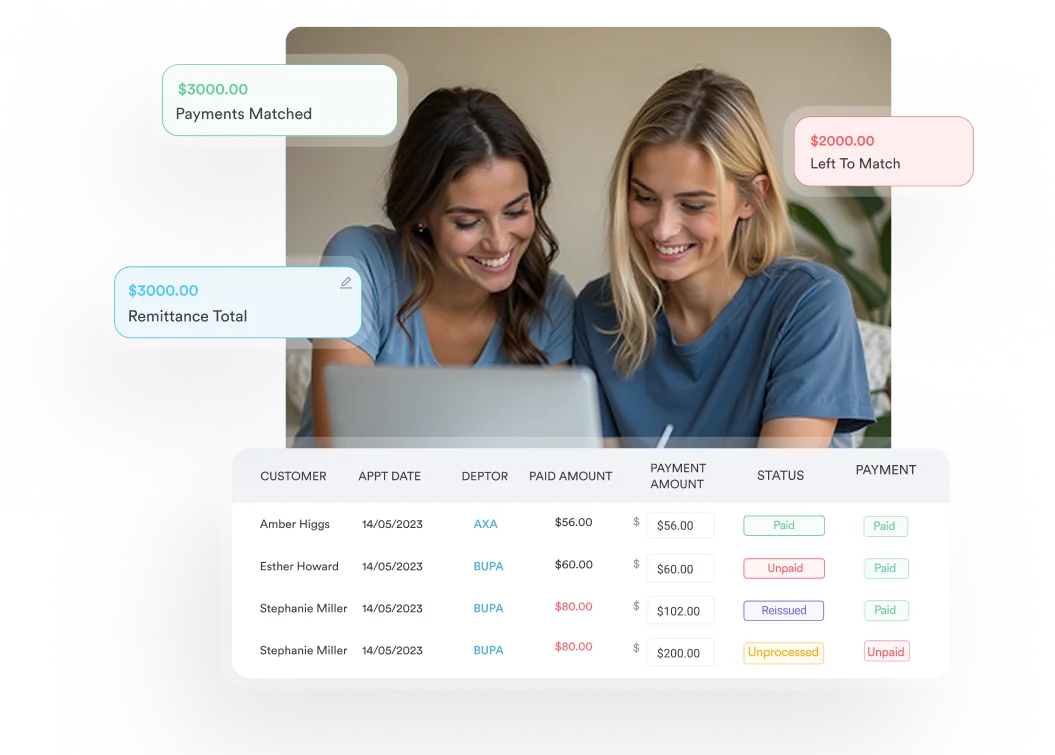

Pabau links the Detailed Written Order, the delivery receipt and the diagnosis to the patient record. Billers can check an L1050 line against its base code before the claim goes out.

HCPCS code L1050 is a straightforward add-on code, provided billers handle the pairing requirement as part of the code itself. Suppliers who treat it like a standalone supply are the ones who watch payers deny it.
Getting it right comes down to three habits. Have the DWO in place before delivery, and apply the KX modifier only where documentation supports it. Then match the ICD-10 diagnosis to the specificity the record allows.
The trade-off worth remembering is time. Four checks before submission cost far less than one appeal cycle. Book a demo to see how Pabau keeps orthotic documentation and claim lines on one record.

Need to understand the full DMEPOS billing framework? What is medical billing walks through how DMEPOS claims fit into the broader revenue cycle.
Receiving denials you can’t decode? Denial management in healthcare covers systematic workflows for resolving and preventing claim denials.
Want a reference for the most common denial reason codes? Denial codes in medical billing lists CARC codes and what each one requires for resolution.
Checking compliance before you submit? Medical billing compliance sets out the record-keeping rules that audits test.
HCPCS code L1050 is used to bill the addition of a sternal pad to a CTLSO or scoliosis orthosis. It is an add-on code, so it must be submitted alongside a base scoliosis orthosis code from the L1000-L1120 range. A claim carrying L1050 without that base code will be denied.
The modifiers most often required for L1050 are KX, NU, RR, UE, GA, GY and GZ. KX confirms coverage criteria are met and documentation is on file, while NU, RR and UE describe new, rented and used equipment. GA, GY and GZ cover the ABN, statutory exclusion and expected denial situations. For a standard new-equipment Medicare claim that meets coverage criteria, NU and KX are the typical pair.
Yes, Medicare Part B may cover L1050. The claim needs a covered base scoliosis orthosis code, a covered ICD-10-CM diagnosis, and medical necessity established by a Detailed Written Order. Coverage is subject to MAC-specific Local Coverage Determinations, so criteria vary. The KX modifier confirms that those coverage and documentation requirements have been met.
L1050 requires a Detailed Written Order signed and dated before delivery, plus clinical notes supporting the scoliosis diagnosis and the need for a sternal pad. You also need proof of delivery signed by the beneficiary and a face-to-face encounter record with the ordering physician. A Certificate of Medical Necessity may be required depending on MAC jurisdiction. Every document must be on file before the claim is submitted.



