

HCPCS code E0198: Water pressure pad billing guide
HCPCS code E0198 is a water pad for a standard mattress HCPCS code E0198 is the ...

Last Updated: Oct 13, 2026
L0113 is the HCPCS Level II code for a prefabricated cranial cervical orthosis of the torticollis type. The device may carry a joint and a soft interface material, or neither, and the fee includes fitting and adjustment.
Coders confuse L0113 with the cervical orthosis codes around it, because those descriptors differ by how the device is built. L0112 is the custom fabricated code for congenital torticollis, and L0120 is a plain foam collar. A claim denies when the device supplied does not match the descriptor, or when the ICD-10 diagnosis falls outside the LCD-covered list.
Let Pabau's smart automation suggest the right codes, reduce claim denials, and keep your practice compliant—effortlessly.
Automate repetitive tasks and focus on what matters most—your patients.
Reduce coding errors and ensure compliance with the latest regulations.
Clean claims, fewer denials, and faster reimbursements.
Powerful insights and reporting to help your practice thrive.
HIPAA compliant SOC 2 certified GDPR-compliant Trusted by 4,000+ clinics worldwide

HCPCS Code L0113 covers a prefabricated torticollis-type cranial cervical orthosis, and its fee includes fitting and adjustment.
L0112 is the custom fabricated congenital torticollis code, so a prefabricated device belongs under L0113.
Medicare Part B covers L0113 as Durable Medical Equipment when medical necessity is documented and the applicable LCD criteria are met.
Modifier KX is required to confirm LCD criteria are satisfied; GA is required when an Advance Beneficiary Notice is on file.
Pabau’s claims management software keeps clinical documentation and billing records together, so an L0113 claim can be defended at audit.
HCPCS Code L0113 is an HCPCS Level II L-code for a prefabricated cranial cervical orthosis of the torticollis type. The Centers for Medicare and Medicaid Services (CMS) maintains HCPCS Level II codes, and those codes cover durable medical equipment, orthoses, prostheses, and supplies billed to Medicare and most Medicaid programs.
CMS defines L0113 as: Cranial cervical orthosis, torticollis type, with or without joint, with or without soft interface material, prefabricated, includes fitting and adjustment.
Two elements of that descriptor are optional. For example, the device may carry a joint or not, and a soft interface or not, and still bill under L0113. What stays fixed is the prefabricated build, and the fee already covers fitting and adjustment.
L-codes sit within the HCPCS Level II orthotic procedure range (L0100-L4999). L0113 belongs to the cervical orthosis run that starts at L0112, and every code in that run names a different device. So billing a plain cervical collar under L0113 invites denial, because the device supplied has to match the descriptor it is billed under.
Medicare Part B covers HCPCS Code L0113 under the Durable Medical Equipment benefit when the device is medically necessary for the beneficiary’s diagnosed condition. However, coverage is subject to the applicable Local Coverage Determination (LCD) issued by the beneficiary’s DME MAC (Medicare Administrative Contractor). Specifically, two contractors run the four DME MAC jurisdictions: Noridian Healthcare Solutions runs Jurisdictions A and D, while CGS Administrators runs Jurisdictions B and C. Either way, verify the coverage criteria with whichever contractor serves your jurisdiction before billing.
The coverage chain runs from the ordering physician’s face-to-face evaluation, through the written order, to the DME supplier’s claim submission. If any one of those steps is missing from the record, the claim is denied. So, before the device is dispensed, check that the beneficiary’s Part B DME benefit is active, and confirm that no prior authorization requirement applies.
Key Medicare coverage requirements for L0113 typically include:
Coverage criteria may vary by MAC and are subject to change. So, always verify against the current LCD for your jurisdiction before you submit a claim.
CMS updates the DMEPOS fee schedule every year. The CMS DMEPOS fee schedule file carries the current allowable amounts by HCPCS code, jurisdiction, and pricing type. So, L0113 is priced there, not on the physician fee schedule. The rows below describe the pricing types rather than the amounts, which vary by MAC region and change each calendar year. That said, practice management software like Pabau centralizes the billing documentation behind each claim and tracks what the payer does with it after submission.
Reimbursement amounts differ across MAC regions. For example, fees in areas such as Alaska and Hawaii, and in rural areas, may carry a different adjustment. So, before you quote a figure, pull the current allowable amount from the CMS DMEPOS fee schedule file for that year.
Run an eligibility check before you dispense L0113. Then confirm the beneficiary has active Medicare Part B DME coverage and that no prior authorization hold is on file with the relevant DME MAC. Once a device ships without that check, you cannot fix the claim after it submits.
Modifier selection on an L0113 claim decides whether Medicare processes it as covered, non-covered, or conditionally covered. In fact, incorrect modifiers are one of the leading causes of denial on DME claims. So, refer to the LCD and MAC guidance that apply for modifier-specific requirements. The table below reflects common modifier usage for HCPCS Level II orthosis codes.
Omitting the KX modifier on a claim where LCD criteria are met typically results in an automatic denial. On the other hand, appending KX when the documentation does not support medical necessity creates fraud risk.
Medical necessity for L0113 requires a supporting ICD-10-CM diagnosis code that the LCD recognizes as a covered indication. So, code only the confirmed diagnosis documented in the clinical record. In other words, the ICD-10 code must align with the physician’s documented findings, not with the device supplied. The codes below are the torticollis and cervical spine diagnoses most often paired with L0113. Our ICD-10 code reference carries the full descriptor for each one. Before you submit, verify the covered diagnosis list against your DME MAC’s current LCD.
Crosswalk tables are reference guides, not coverage guarantees. So, the ICD-10 codes recognized as covered indications for L0113 come from the DME MAC’s LCD for spinal orthoses, not from a table. Because payer crosswalks from commercial sources may differ from the LCD-covered list, always check the LCD directly.
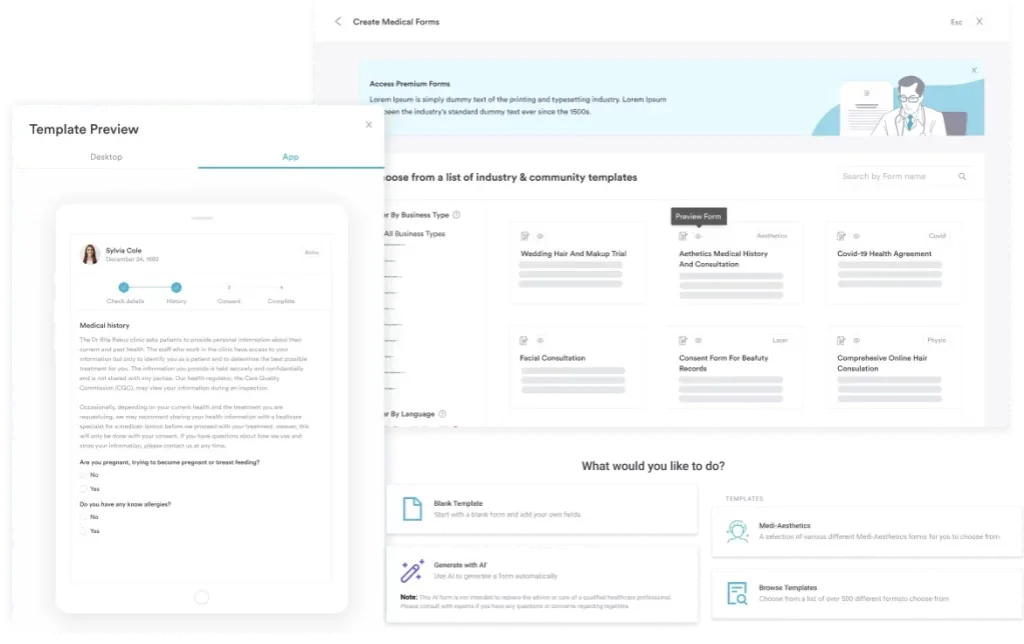
Insufficient documentation is the single most common reason L0113 claims fail post-payment audit. So, medical billing compliance for DME orthoses requires documentation that is current, specific, and easy to trace from the clinical record to the claim. In practice, digital clinical forms built around each required data element lower the risk that an otherwise clean claim is rejected for missing evidence.
Required documentation for a compliant L0113 claim typically includes:
Documentation requirements may vary by MAC. So, review the LCD that applies and its policy article for the complete list your jurisdiction’s DME MAC requires.
L0113 is the prefabricated code. Its descriptor ends with “prefabricated, includes fitting and adjustment”, so a device fabricated for one patient does not belong under it. In contrast, the custom fabricated counterpart is L0112, which the descriptor limits to congenital torticollis and which requires an adjustable range of motion joint. Getting that fork wrong is the most expensive error on this code pair, because the allowable amounts differ, and so does the evidence a reviewer expects. The table below sets the two side by side.
When the correct code for a specific product is unclear, submit a PDAC (Pricing, Data Analysis and Coding) coding verification request before billing. Then, a PDAC decision gives you written proof of the HCPCS code for that device, and it stands up as a defense in audit.
CMS applies a Reasonable Useful Lifetime (RUL) policy to covered orthoses and DME. For most cervical orthoses, the RUL is five years. So, Medicare generally does not cover a replacement inside that window unless specific conditions are met. Billing a replacement before the RUL expires without a strong enough reason is a common audit finding, and it can trigger an overpayment demand.
Replacement before the RUL may be covered in a few cases:
When billing a replacement L0113 before the five-year RUL, document the specific reason for early replacement in the clinical and billing record. Also, cite CMS RUL policy directly in your documentation. RUL timelines run from the date the original item was delivered, not from the order date or the payment date.
Track L0113 device delivery dates in your billing system as a separate data field. Then, when a patient returns for a replacement, check the time since the original delivery date against the five-year RUL before you submit. Without documented justification, a claim for a replacement inside the RUL is a near-automatic audit flag.
Choosing the wrong cervical orthosis code is a frequent source of claim edits. The codes below are the neighbors L0113 is confused with most often. They differ by how the device is built, not by the part of the body it supports. So, read each long descriptor against the device in front of you before you pick one. If you want to check them by code, the NLM HCPCS Level II lookup returns the complete descriptors.
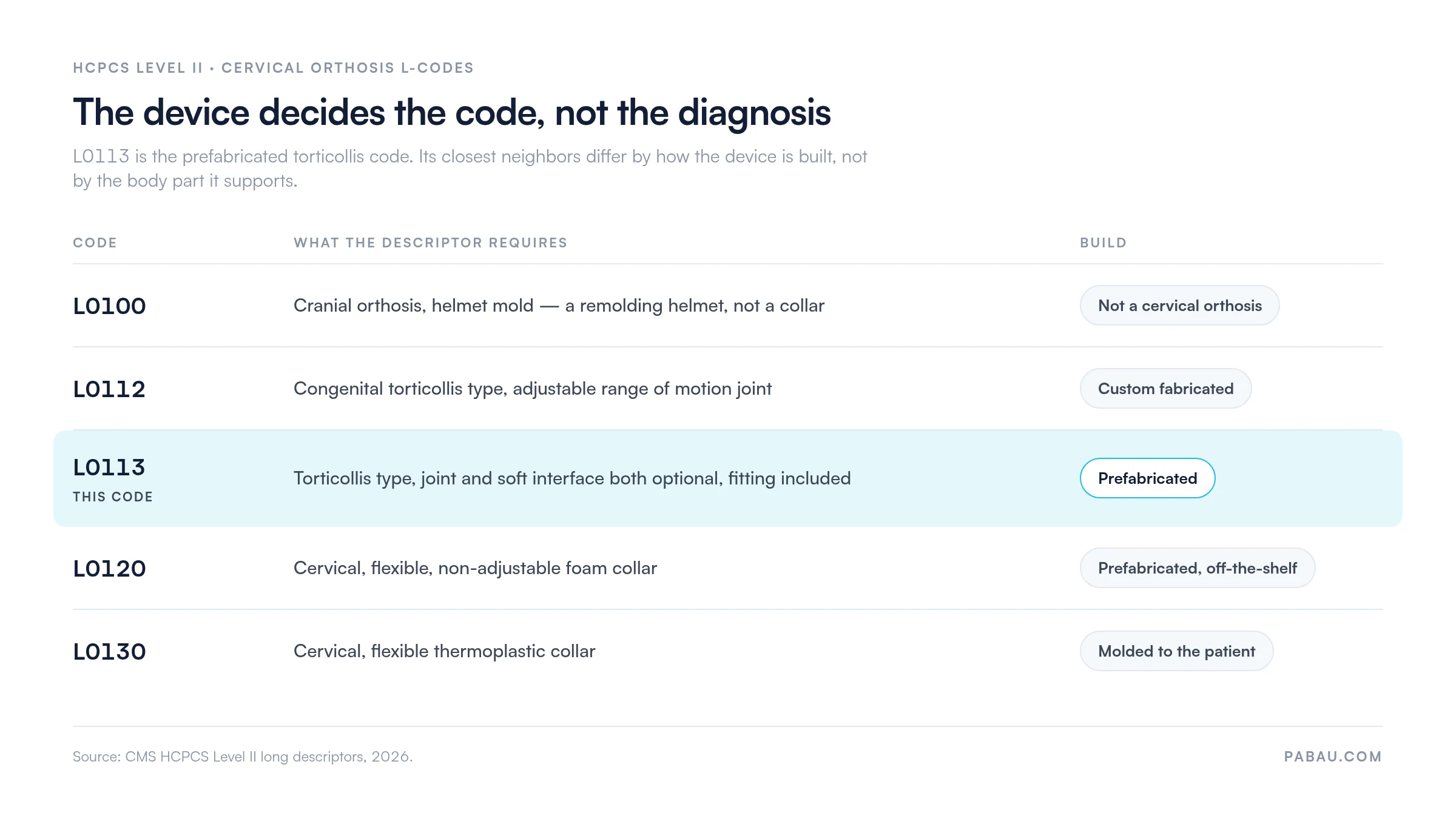
The table below also carries each long descriptor in full, with the one detail that separates it from L0113.
A basic foam collar is L0120. So, billing it under L0113 is upcoding, and it carries serious compliance risk. Instead, match the code to the device, not to the reimbursement rate.
Most DME suppliers hold an L0113 claim in three places at once. First, the order and the face-to-face note sit in the chart. Then the signed delivery receipt sits in a folder, and the claim sits in the billing system. So when a records request arrives two years later, someone has to piece the set back together.
Pabau keeps them on one patient record instead. The written order, the evaluation note, the covered ICD-10 code, and the proof of delivery all attach to the file the claim is built from. Our audit-ready claims management then submits the claim and tracks what the payer does with it.
The result is a claim you can answer for. So, every element a reviewer asks about is dated, attributable, and filed against the same patient. That way, answering a records request becomes retrieval, not rebuilding it from scratch.

Pabau connects clinical notes, diagnosis codes, and billing records in one place. Your L0113 claims carry their documentation trail before they reach the payer.

An L0113 claim succeeds when three conditions hold at once. First, the device matches the long descriptor. Second, the diagnosis is an LCD-covered indication. Third, the documentation runs unbroken from the order to the proof of delivery. So, most denials trace back to one of those three failing, not to an eligibility problem or a rate dispute.
The practical discipline is short. First, set the code from the device, not from the diagnosis. Then check that diagnosis against the current LCD, and keep the documentation with the claim from the day it is dispensed. Book a demo to see how Pabau keeps DME billing documentation together from order to delivery.

Need to understand how clean claims work for DME? Clean claim submission in medical billing walks through the elements a DME claim must contain to pass payer edits on first pass.
Dealing with denied L0113 claims? Denial codes in medical billing explains the most common CARC and RARC codes you will see on rejected DME claims and how to appeal them.
Want to reduce orthotic billing audit risk? Medical billing compliance guidance covers the documentation and process controls that keep DME claims defensible through payer review.
HCPCS Code L0113 bills a prefabricated cranial cervical orthosis of the torticollis type. The device may or may not carry a joint, and may or may not carry soft interface material. DME suppliers and orthotists use the code when they dispense that device to a patient with torticollis. The fee includes fitting and adjustment.
Yes, Medicare Part B covers L0113 under the Durable Medical Equipment benefit when the device is medically necessary. Coverage is not automatic. The ordering physician must document medical necessity, and the ICD-10 diagnosis must be an LCD-covered indication. The claim also needs the KX modifier confirming that LCD criteria are met.
Medicare applies a five-year Reasonable Useful Lifetime to cervical orthoses, counted from the original delivery date. A replacement claim inside those five years is generally not covered. The exceptions are a device that is lost, stolen, or irreparably damaged, and a material change in the patient’s condition. Early replacement needs justification documented by the ordering physician.
A custom fabricated device is built for one patient from measurements or a mold, while a prefabricated device is selected from a stock size range. For torticollis orthoses that distinction splits the codes: L0113 is the prefabricated code, and L0112 is the custom fabricated code for congenital torticollis. Custom fabrication carries a higher allowable but a heavier documentation load, including fabrication and fitting records. Billing a stock device under the custom code is upcoding, so confirm the code with your DME MAC or a PDAC verification request.



