

HCPCS code E0198: Water pressure pad billing guide
HCPCS code E0198 is a water pad for a standard mattress HCPCS code E0198 is the ...

Last Updated: Oct 13, 2026
L0462 is the HCPCS Level II code for a prefabricated thoracic-lumbar-sacral orthosis (TLSO) with triplanar control. The device is a modular segmented spinal system with three rigid plastic shells and a soft liner. Its posterior section runs from the sacrococcygeal junction to just below the scapular spine. The anterior section runs from the symphysis pubis to the sternal notch. Fitting and adjustment are included in the code.
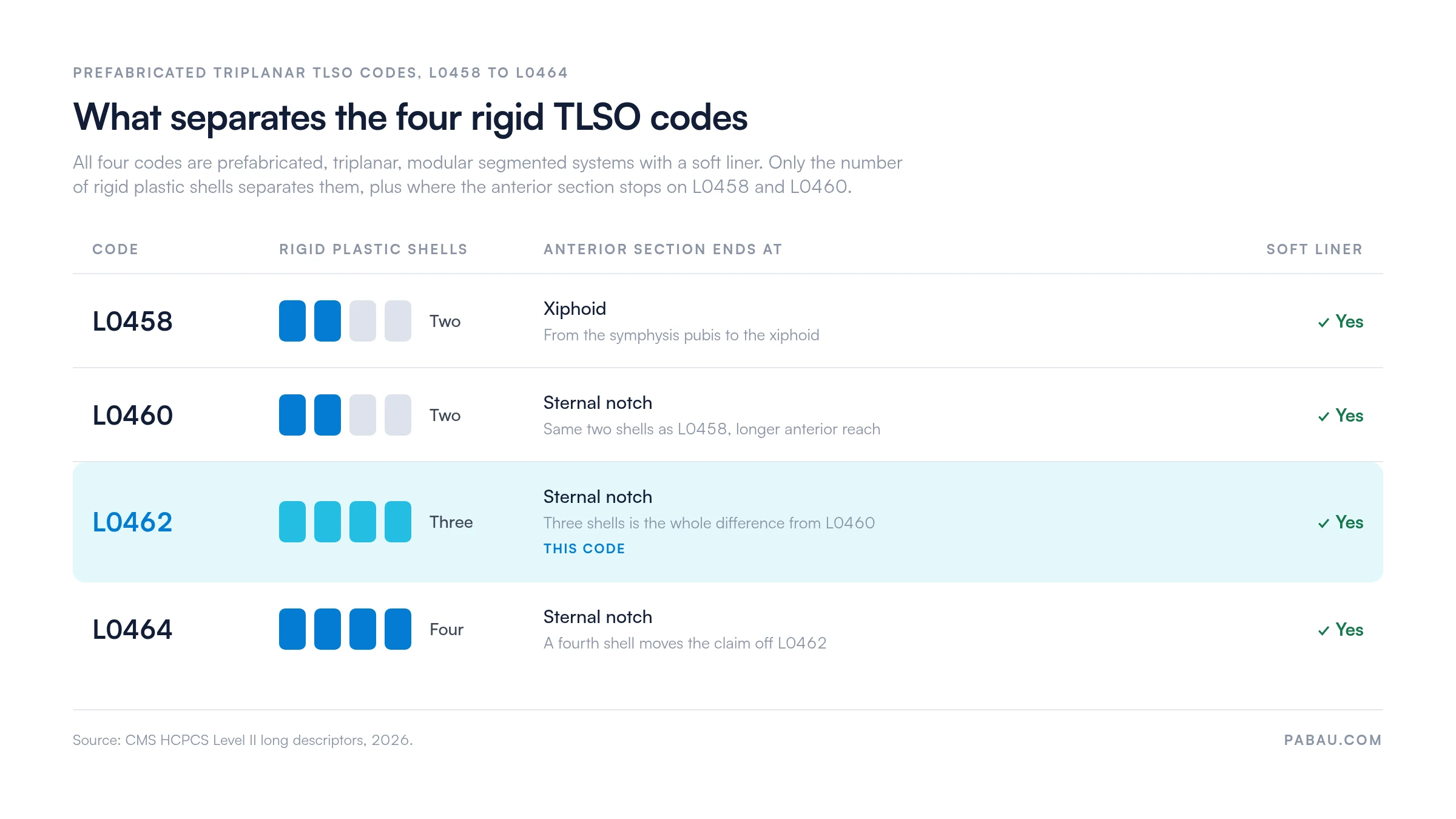
Shell count is what moves a claim between the neighboring codes. Two rigid shells bill as L0458 or L0460, and four rigid shells bill as L0464. All of those codes include a soft liner, so the liner never decides the code.
Let Pabau's smart automation suggest the right codes, reduce claim denials, and keep your practice compliant—effortlessly.
Automate repetitive tasks and focus on what matters most—your patients.
Reduce coding errors and ensure compliance with the latest regulations.
Clean claims, fewer denials, and faster reimbursements.
Powerful insights and reporting to help your practice thrive.
HIPAA compliant SOC 2 certified GDPR-compliant Trusted by 4,000+ clinics worldwide

HCPCS Code L0462 covers a prefabricated TLSO only. Custom-fabricated TLSOs use different codes in the L0450-L0492 range.
Billing requires both a Certificate of Medical Necessity (CMN) and a Detailed Written Order (DWO) before the device is dispensed.
Shell count separates the neighboring codes. Two rigid shells bill as L0458 or L0460, three as L0462, and four as L0464.
Medicare Part B covers L0462 as durable medical equipment under CMS Policy Article A52500. Medical necessity must be documented for a covered diagnosis, such as a spinal fracture.
Pabau’s claims management software supports DME billing workflows, documentation storage, and claim submission in a single platform.
HCPCS Code L0462 is the Medicare billing code for a prefabricated TLSO with triplanar control. The device is a modular segmented spinal system built from three rigid plastic shells and a soft liner. Fitting and adjustment are bundled into the code, so neither is billed separately.
The code sits in the L0450 to L0492 TLSO range maintained by CMS as part of the HCPCS Level II code set. It falls under the wider Orthotic Procedures and Devices section, which covers spinal orthoses for the thoracic, lumbar, and sacral regions.
Each element of the descriptor carries billing weight. “Triplanar control” means the orthosis restricts motion in the sagittal, coronal, and transverse planes. “Modular segmented” means the shell system is assembled from separate components rather than formed as one piece. Shell count is the element reviewers check first, because three rigid shells are what hold a device on L0462. Getting any descriptor element wrong in the order or the medical record is enough to trigger a code mismatch denial.
A single-piece rigid shell falls outside that modular definition. A brace built as one rigid plastic shell with an interface liner bills as L0488, which is also prefabricated and triplanar.
Medicare Part B reimburses L0462 under the DMEPOS fee schedule, which CMS updates on a published cycle. Reimbursement varies by locality and by provider participation status. The figures below reflect 2026 national benchmarks. Always confirm current amounts in the CMS DMEPOS fee schedule for the Medicare Administrative Contractor (MAC) jurisdiction you bill.
The national limiting charge is a ceiling rather than a required price. Non-participating providers cannot bill a patient above it, and they are not obliged to charge up to it. Participating DMEPOS suppliers accept assignment and bill Medicare directly, so the patient pays only the coinsurance and deductible portion. Check the current DMEPOS fee schedule file before you submit, because CMS revises the amounts between updates.
Medicare Part B covers L0462 as durable medical equipment under CMS Policy Article A52500, which governs spinal orthoses in the TLSO and LSO categories. Coverage requires documented medical necessity, and a prescription on its own does not establish it. Confirm both Part B enrollment and the DME benefit before the device is dispensed.
Conditions CMS recognizes as supporting medical necessity for a rigid TLSO include:
Coverage is not automatic even for a covered diagnosis. The clinical record must show that conservative measures were tried or are contraindicated, and that the device is expected to improve the patient’s condition. It must also show that the device meets the L0462 descriptor rather than a less restrictive code. Non-covered situations include routine low back pain without structural pathology, and preventive use with no documented spinal instability.
The ICD-10-CM codes below are commonly accepted by Medicare and most commercial payers as supporting medical necessity for a rigid TLSO. Coverage varies by MAC and by the applicable Local Coverage Determination (LCD). Verify the covered diagnosis list against your MAC’s LCD for spinal orthoses before you submit.
Always pair the primary spinal diagnosis with any relevant aftercare or encounter-type code. A claim carrying only a symptom code does not meet medical necessity for a rigid TLSO and will be denied. M54.5 is the classic example, and it was deleted from ICD-10-CM effective FY2022. The clinical documentation has to show the structural pathology that justifies L0462, not only the claim form.
Verify your MAC’s current LCD for spinal orthoses before submitting. Local Coverage Determinations can restrict covered ICD-10 codes beyond the national A52500 policy article. Some MACs also require specific functional assessment language in the clinical notes. A claim that passes national criteria can still deny under a stricter local policy.
Inadequate documentation is the primary reason L0462 claims fail on post-payment audit rather than on initial submission. CMS Policy Article A52500 requires all of the following before a compliant claim goes out.
A CMN is required for L0462 and must be completed by the treating physician rather than the supplier. The CMN documents the diagnosis, the length of need, and the clinical justification. It must be signed and dated before the device is dispensed. A CMN backdated after dispensing is grounds for denial and a possible fraud referral. The supplier retains the CMN and does not submit it with the claim, but must produce it on request.
A DWO must reach the supplier before billing. It carries the patient’s name and date of birth, the prescribing physician’s name and NPI, and the physician’s handwritten or electronic signature. It must also name the item ordered in enough detail to determine the HCPCS code, plus the quantity. A verbal order becomes a DWO only once the supplier receives the written document. Digital intake forms in practice management software like Pabau capture those fields at the point of order, which shortens the wait for a signed DWO.
The medical record must independently support the diagnosis and the medical necessity. Progress notes, imaging reports (X-ray, MRI, CT), and operative reports for post-surgical cases should all be on file. The record must show that the treating physician evaluated the patient, identified the structural pathology, and judged a rigid TLSO to be medically necessary. Supplier notes recording the fitting and adjustment belong in the dispensing record too.
Choosing the wrong code inside the TLSO range is a frequent billing error. Among the prefabricated triplanar codes, the number of rigid plastic shells does most of the work, and the anterior extent separates L0458 from L0460. Flexible TLSOs with no rigid shells sit elsewhere in the range, under codes such as L0450. The AAPC HCPCS code range lookup carries the full descriptors for the whole range.
The decision between L0462 and its neighbors comes down to how many rigid plastic shells the device has. Two shells bill as L0458 or L0460, three as L0462, and four as L0464. Between L0458 and L0460, the anterior extent is what differs. All four codes include a soft liner, so the liner never decides which code applies.
Not every triplanar TLSO has shells to count. L0470 describes a triplanar brace built from a rigid posterior frame and a flexible soft anterior apron, so no shell count applies.
The medical record and the supplier’s dispensing notes must describe the device components that justify whichever code is billed. Counting the shells at the fitting and writing that number down is what makes the claim defensible on audit.
Billing L0462 correctly means completing several pre-claim steps in the right sequence. Skipping one, or taking them out of order, causes most preventable denials.
Most L0462 denials fall into five categories, and each one is preventable with the right pre-claim workflow.
A denial codes reference helps a team decode the CARC and RARC values on a remittance. CO-4 means the procedure code is inconsistent with the modifier used, or that a required modifier is missing. CO-50 means the payer does not accept the service as medically necessary, and it is the code billers see most often on TLSO claims. A clean claim checklist written for L0462 is among the highest-value process improvements a DMEPOS billing team can make.
Run a quarterly audit of your L0462 claims by pulling the remittances and flagging every CO-4 and CO-50 denial. Map each one back to the documentation file. A run of CO-4 denials points at the modifiers on the claim line rather than at the code itself. A run of CO-50 denials points at the diagnosis code or a missed MAC LCD check.
Most DMEPOS suppliers keep the CMN in one place, the DWO in another, and the dispensing notes in a third. When a post-payment audit asks for the file, someone rebuilds it out of email and scans, and the claim ages while they look.
Pabau, practice management software for healthcare practices, keeps the order, the signed forms, the clinical notes, and the claim on one patient record. Its claims management software submits and tracks the claim from that record. The documents supporting L0462 stay with the claim instead of sitting in a separate folder.
The payoff is a faster audit response and fewer denials traced to a missing document. A biller can see which L0462 claims still lack a signed CMN before the device leaves the building. The fitting note lands on the same record the moment the supplier writes it.

Pabau brings together documentation workflows, claims management, and patient records so your team spends less time chasing paperwork and more time on care. See how it works for DME-billing practices.

Three rigid plastic shells and a soft liner are what L0462 describes. A device with a fourth shell belongs on L0464, and a two-shell device belongs on L0458 or L0460. Counting the shells at the fitting takes a minute, while correcting the claim afterwards takes an appeal.
The denials that follow L0462 are rarely clinical. They come from a signed document that arrived late, a diagnosis code the MAC does not cover, or a shell count nobody wrote down. Fix that sequence once and the same claim stops coming back.
Book a demo to see how Pabau keeps CMN, DWO, and claim records together for DMEPOS billing.

Need a framework for handling denied DME claims? Denial management in healthcare walks through a structured appeals process and root-cause analysis for DMEPOS denials.
Want to understand the broader billing compliance picture? Revenue cycle management covers the end-to-end process from eligibility verification through payment posting.
Looking for a reference on the clearinghouse side of claim submission? Medical claims clearinghouses explains how electronic claims reach payers and where L0462 claims can be validated before submission.
HCPCS Code L0462 is the Medicare billing code for a prefabricated thoracic-lumbar-sacral orthosis (TLSO) with triplanar control. The device is a modular segmented spinal system with three rigid plastic shells and a soft liner, and fitting and adjustment are included. Medicare Part B covers it as durable medical equipment under CMS Policy Article A52500.
L0462 is a prefabricated (off-the-shelf) TLSO code. Custom-fabricated TLSOs with comparable design elements are billed under different codes in the L0450 to L0492 range. Billing a custom-fabricated device under L0462 is a code selection error and a compliance risk.
The most frequent denial drivers are a missing or unsigned CMN, a non-covered ICD-10 diagnosis, or a DWO signed after dispensing. A shell count that does not match the code billed is the fourth. A pre-dispensing checklist for DMEPOS spinal orthoses prevents each one.
The national limiting charge is 109.25% of the non-participating provider fee schedule amount for L0462 in a given locality. It is the maximum a non-participating provider may charge a Medicare beneficiary out of pocket. Verify the specific dollar figure against the current CMS DMEPOS fee schedule for your MAC jurisdiction, as it changes with each fee schedule update.



