CPT Code 52352: Ureteroscopic stone removal billing guide
CPT Code 52352: Official descriptor and procedure overview CPT Code 52352 descri...

Last Updated: Oct 30, 2026
K0814 is the HCPCS Level II code for power wheelchair, group 1 standard, portable, captains chair, patient weight capacity up to and including 300 pounds. It describes a power chair that breaks down for transport and has an automotive-style captain's chair seat.
Most K0814 denials have one of three causes. The claim lacks prior authorization, the written order and face-to-face notes do not match, or KX was added before the documentation was complete.
Let Pabau's smart automation suggest the right codes, reduce claim denials, and keep your practice compliant—effortlessly.
Automate repetitive tasks and focus on what matters most—your patients.
Reduce coding errors and ensure compliance with the latest regulations.
Clean claims, fewer denials, and faster reimbursements.
Powerful insights and reporting to help your practice thrive.
HIPAA compliant SOC 2 certified GDPR-compliant Trusted by 4,000+ clinics worldwide

HCPCS code K0814 describes a group 1 standard portable power wheelchair with a captain’s chair seat, billed under Medicare Part B for home use.
Prior authorization is mandatory before delivery, and a chair delivered without a provisional affirmation is not paid, whatever the medical need.
Append the KX modifier only when the standard written order, the face-to-face notes and the prior authorization affirmation are complete and on file.
Portability and the captain’s chair seat set K0814 apart, so K0813 and K0816 are the codes it is most often confused with.
Practice software such as Pabau keeps the face-to-face notes, signed orders and billing steps for each patient in one record.
HCPCS code K0814 is the Level II code for a group 1 standard power wheelchair that is portable and has a captain’s chair seat.
It covers patients up to and including 300 pounds. The Centers for Medicare & Medicaid Services (CMS) maintain the code, which sits in the K0813–K0899 power wheelchair range. The table below summarizes the official descriptor and code family.
“Group 1 standard” is the lowest-complexity power wheelchair tier CMS defines. A group 1 chair must reach a minimum speed of about 3 mph and a range of at least 5 miles per charge. K0814 adds a weight capacity of up to 300 pounds.
“Portable” means the chair can be broken down for transport without tools. “Captain’s chair” refers to an automotive-style seat with fixed armrests and a defined seat back. That seat is what separates K0814 from K0813, the portable chair with a sling or solid seat and back.
The code comes from the CMS HCPCS Level II code set, which CMS updates every year. Confirm the code’s active status against the current Alpha-Numeric HCPCS file before you submit claims. Neighboring wheelchair and DME codes are listed in our index of HCPCS codes.
Medicare Part B pays 80% of the allowed amount for K0814 once the annual deductible is met. The beneficiary pays the remaining 20% coinsurance. Check the exact 2026 allowed amount on the CMS DMEPOS fee schedule, because rates change each January and vary by state.
Since January 1, 2011, Medicare has paid for standard power wheelchairs, including K0814, on a capped rental basis only. Bill the RR modifier; outright purchase is no longer an option.
Medicare covers K0814 for beneficiaries with a significant mobility limitation that a cane, walker or manual wheelchair cannot adequately address. The Power Mobility Devices Local Coverage Determination (LCD) sets the clinical criteria that suppliers and clinicians must document. The three core conditions are:
The LCD also excludes devices when the underlying condition is reversible and the length of need is under three months. Review the LCD published by your DME Medicare Administrative Contractor (MAC), CGS or Noridian, before you submit.
Every K0814 claim must include at least one ICD-10 diagnosis code that supports medical necessity under the LCD. The table below lists commonly accepted codes. Verify each one against the active LCD for your jurisdiction before you submit.
Incomplete documentation is the largest single driver of K0814 denials. Solid medical billing compliance starts before the device ships, so gather each item below before you submit the claim.
The face-to-face encounter can take place in person or through a Medicare-approved telehealth visit that meets the telehealth rules. The treating physician or NPP must document the following in the exam notes:
The supplier must receive those exam notes before delivery and keep them on file for a MAC audit.
Yes. K0814 is on the CMS required prior authorization list for power mobility devices. The supplier must receive a provisional affirmation from the DME MAC before delivering the chair. Delivery before affirmation results in non-payment, and this program offers no retroactive authorization.
A prior authorization request has two possible outcomes:
Medicare Advantage plans set their own prior authorization rules, which may differ from traditional Medicare. Check the plan’s prior authorization process before you start a request.
Billing K0814 through clean medical billing workflows means completing each step in order. Skipped or out-of-order steps cause most avoidable denials. Here is the standard sequence for DMEPOS suppliers:
Run a clean claim check before step 6. It catches a missing modifier or a wrong place of service before the claim reaches the DME MAC.
Attach the prior authorization affirmation number to your claim file before the device ships. In a post-payment MAC audit, auditors check that number early. A missing or incorrect number can trigger a full recoupment demand, even when the clinical documentation is solid.
The modifier on a K0814 claim signals rental status and documentation compliance. A wrong modifier or a missing KX is a frequent denial trigger for this code.
The KX modifier deserves special attention. Appending it without the documentation on file is a false assertion to Medicare, and it can trigger a program integrity review. Use KX only when the face-to-face notes, the standard written order and the prior authorization affirmation are complete and on file.
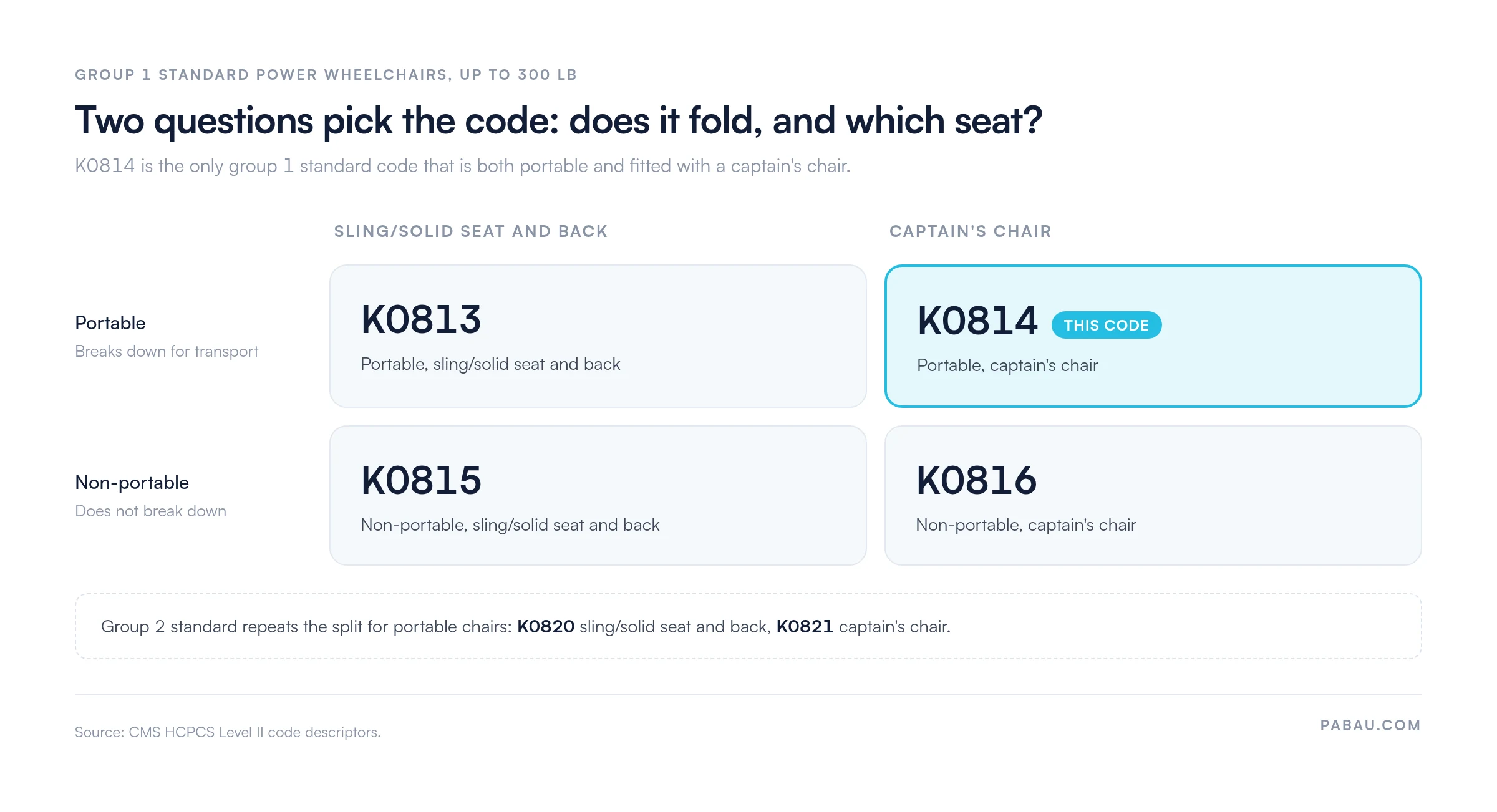
The standard power wheelchair codes differ by one or two features, which makes them easy to confuse. Two features separate K0814 from its neighbors: portability and seat type. The table below shows when each code applies.
The most common miscoding error is billing K0814 for a chair that differs in one feature. The non-portable captain’s chair is K0816, and the portable sling/solid-seat chair is K0813. Billing K0820 or K0821 for a chair that only meets group 1 specifications is the same mistake.
The code billed must match the chair delivered. Billing for a chair the patient did not receive is a False Claims Act issue, not merely a coding error. The grid below maps the four group 1 standard codes to the two questions that decide between them.
K0814 denials cluster around the same preventable errors. Effective denial management strategies start with the root cause behind each denial reason.
Not under current contracts. The current round of the DMEPOS Competitive Bidding Program does not cover standard power wheelchairs, and the earlier contracts have lapsed. Any Medicare-enrolled supplier can therefore bill K0814 at the fee schedule rate.
If a future round brings power wheelchairs into a competitive bidding area (CBA), two rules would apply there:
To check a beneficiary’s address against active CBAs, use the Competitive Bidding Implementation Contractor (CBIC) look-up tool. Tracking electronic remittance advice codes on K0814 claims also surfaces location-related denials early.
Much of the K0814 paperwork starts in the treating practitioner’s office. The face-to-face notes and the signed standard written order both have to reach the supplier before the chair ships.
Pabau, the practice management and EHR platform we build, keeps those documents in one patient record. Clinicians can record the exam on a custom form built around the LCD criteria. Signed orders and forms sit beside the notes, ready to share.
With Pabau’s claims management software, the documentation and billing steps for each patient stay in one place. A missing order is easier to spot before anything is submitted.

Pabau keeps face-to-face notes, signed orders and invoices together in one patient record. See how it fits your practice’s documentation workflow.

K0814 claims are won or lost before the chair ships. When the written order, face-to-face notes and prior authorization are in place at delivery, KX is honest and payment holds up on audit.
The trade-off is time up front. Waiting for a provisional affirmation delays delivery, but billing without one leaves no route to payment. Check the code against the chair at delivery too, because portability and seat type decide between K0813, K0814 and K0816.
Book a demo to see how Pabau keeps power wheelchair documentation together for your practice.

New to the billing cycle? Medical billing workflows covers the end-to-end billing process from code selection through payment posting.
Dealing with repeated claim rejections? Denial management in healthcare explains how to categorize, track, and resolve denied claims systematically.
Want a clean claim every time? Clean claim submission covers the elements payers check before adjudicating any DMEPOS or DME claim.
Need a form for payer approval? Medical prior authorization form gives you a ready template for collecting the details a prior authorization request needs.
HCPCS code K0814 covers a group 1 standard portable power wheelchair with a captain’s chair seat, for patients up to 300 pounds. Medicare pays for it under Part B as DME for beneficiaries with documented mobility limitations at home. It needs prior authorization, a standard written order and a face-to-face examination before delivery.
Yes. K0814 is on the CMS required prior authorization list for power mobility devices. The supplier must obtain a provisional affirmation from the DME MAC before delivering the device. Delivering without affirmation results in non-payment, and there is no retroactive authorization.
The most common modifiers are RR (capped rental, the Medicare billing method for this code) and UE (used equipment). NU (new equipment) applies only where a payer allows purchase. KX means documentation on file meets LCD criteria, GA means a liability waiver is on file, and GY marks an item Medicare does not cover. KX asserts that coverage criteria are met, so append it only when the required documentation is complete and on file.
K0814 is a group 1 standard portable power wheelchair with a captain’s chair. K0820 is a group 2 standard portable power wheelchair with a sling/solid seat and back, and K0821 is the group 2 portable captain’s chair. Group 2 chairs meet higher performance specifications for patients whose needs exceed a group 1 chair. Billing K0820 or K0821 for a chair that only meets group 1 specifications is a miscoding error.
K0814 is on the CMS list of DMEPOS items that need prior authorization as a condition of payment. Payment also depends on a documented medical need, primary use in the home, and a standard written order with face-to-face notes on file before delivery. The supplier must hold current Medicare enrollment and, where a competitive bidding contract applies, be a contract supplier.
The most common reasons are a missing prior authorization and a KX modifier appended without the documentation on file. Others include face-to-face notes that skip home-setting limitations, an incomplete written order, and the wrong code for the chair delivered.