

HCPCS code E0198: Water pressure pad billing guide
HCPCS code E0198 is a water pad for a standard mattress HCPCS code E0198 is the ...

Last Updated: Oct 13, 2026
K0105 is the HCPCS Level II code for iv hanger, each.
Let Pabau's smart automation suggest the right codes, reduce claim denials, and keep your practice compliant—effortlessly.
Automate repetitive tasks and focus on what matters most—your patients.
Reduce coding errors and ensure compliance with the latest regulations.
Clean claims, fewer denials, and faster reimbursements.
Powerful insights and reporting to help your practice thrive.
HIPAA compliant SOC 2 certified GDPR-compliant Trusted by 4,000+ clinics worldwide

HCPCS Code K0105 is the Level II code for an IV hanger, each, covering wheelchair-mounted IV bag hangers under Medicare Part B.
CMS uses the same wording, IV hanger each, as both the short and the long descriptor for this code.
Only enrolled DMEPOS suppliers may bill K0105, so a physician cannot submit it directly to Medicare.
A purchase or rental modifier belongs on every claim line, and omitting it is the leading cause of K0105 denials.
Practice management software like Pabau lets DME billing teams apply modifiers and submit K0105 claims in one workflow.
K0105 sits in the Healthcare Common Procedure Coding System (HCPCS) Level II set. It describes an IV hanger that attaches to a wheelchair frame, so a patient receiving IV therapy can move around during an infusion.
CMS classifies it as durable medical equipment (DME), and DMEPOS suppliers bill it to Medicare Part B and Medicaid when it is medically necessary.
The table below lists the code record as CMS maintains it.
Both descriptor fields carry identical wording, which is unusual. Several third-party code databases publish a longer phrasing, such as “intravenous hanger for use with wheelchair”. That expanded text is editorial, not the CMS descriptor. Quote the short form in any documentation a payer will read.
The “each” unit descriptor matters for billing. Every hanger supplied is billed as a separate unit. Confirm the unit count against the number dispensed before the claim goes out.
K0105 is covered under the Medicare Part B DME benefit, administered by the Centers for Medicare and Medicaid Services (CMS) HCPCS program. Coverage applies when the IV hanger is medically necessary and the beneficiary uses a wheelchair.
Five requirements decide whether the claim is payable.
Documentation is what survives the audit, not the clinical judgment behind it. Working to the same medical billing compliance standard on every K0105 order protects the supplier when a contractor reviews the claim years later.
Traditional Medicare Part B does not generally require prior authorization for K0105 as a wheelchair accessory. Check whether K0105 falls under the DMEPOS Competitive Bidding Program in the patient’s area, since bidding rules can affect which suppliers may furnish the item.
State Medicaid programs and Medicare Advantage plans ask for prior authorization far more often, so confirm with the payer before delivery.
A short pre-delivery checklist settles most of this in one pass. Confirm the payer, the authorization requirement, and the supplier’s eligibility in that area before the hanger leaves the warehouse.
K0105 is paid from the CMS DMEPOS fee schedule, and rates vary by geographic locality. The table below reflects general benchmark figures from publicly available DMEPOS fee schedule data. Verify current rates against the CMS DMEPOS fee schedule, which publishes the annual files DME payment is calculated from.
One shortcut to avoid: the Physician Fee Schedule lookup tool does not return DMEPOS codes, so K0105 will never appear in it. A blank result there means the wrong tool, not a deleted code.
Important: K0105 rates vary by locality and change every year. Download the current DMEPOS fee schedule files from CMS before quoting a rate to a patient or reconciling a payment. Third-party rate tables often lag the latest locality adjustments.
Download the DMEPOS fee schedule ZIP file from CMS.gov at the start of each calendar year. Import it into your billing system before you submit any January claims. Rates move between years, and billing against last year’s expectation delays reconciliation and complicates ERA matching.
Modifier application is the most common failure point in K0105 billing. The AAPC HCPCS Level II code reference lists the modifiers that attach to wheelchair accessory codes, and the ones below cover almost every K0105 line.
The table says what each modifier means. The sequence below is the order a biller actually reaches for them on a single K0105 line.
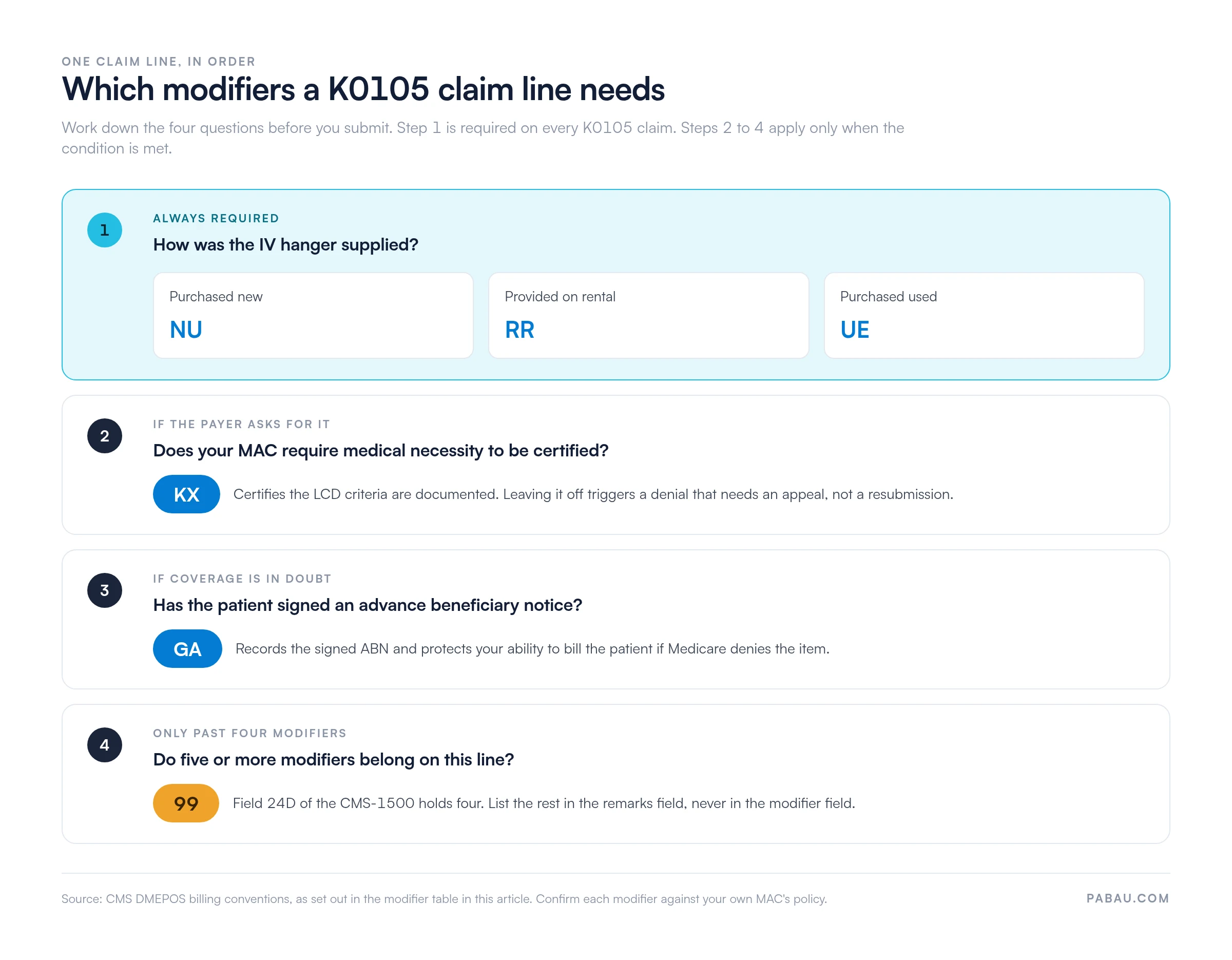
Modifier rules are payer-specific. The conventions above follow general Medicare DME billing practice, and individual Medicare Advantage plans or state Medicaid programs may ask for different ones. Confirm against the payer’s own billing guidelines before you submit.
Coders regularly have to separate K0105 from adjacent K-series and E-series codes covering wheelchair accessories and IV equipment. The table below lists the codes it is cross-referenced with most often.
Confirm that K0105 is the most specific code for the item before defaulting to E1399 or K0108. Payers scrutinize miscellaneous code submissions harder and usually ask for extra documentation to support them.
Most K0105 denials trace back to a short list of predictable errors. The same pattern runs through DMEPOS billing generally, so the common denial codes behind those rejections are worth knowing before you submit.
Documentation practice: keep the physician order, proof of delivery, and any signed advance beneficiary notice for at least seven years. Medicare Administrative Contractors run post-payment audits, and missing paperwork means full recoupment however sound the clinical case was.
Build a K0105 pre-submission checklist into your billing system. Check the purchase or rental modifier, then KX where the payer requires it. Then confirm the order predates delivery, the NPI is the enrolled DMEPOS one, and proof of delivery is on file. Those checks take under a minute and prevent most K0105 denials.
Reference-only HCPCS lookup tools, including AAPC’s code database and hcpcsdata.com, give coders the definition and stop there. Every lookup then has to be retyped into a separate billing system. That handoff is where transcription errors, missed modifiers, and unattached documentation pile up.
Practice management software like Pabau keeps the code and the claim in one place. Our claims software for billers puts HCPCS code entry, modifier selection, and claim submission in a single workflow.
A biller working a K0105 line stays in the platform to check the code and add the transaction modifier. Confirming the order predates delivery happens on the same screen.
A lookup tool ends at the code definition. A billing platform carries that code through submission, tracking, and appeal, which is the part of the job that decides whether the claim gets paid.

Pabau’s claims management tools help DME billing teams enter the right HCPCS codes, apply modifiers correctly, and track claim status without switching platforms.

K0105 is a narrow code with an unforgiving claim line. Denials come from the transaction modifier, the order date, and the enrollment record, not from disagreement about whether the patient needed the hanger. Fix those three before submission and the code behaves.
The suppliers who bill it cleanly treat the checklist as part of delivery rather than part of billing. That way the order, the proof of delivery, and the modifier are all decided before the hanger reaches the patient.
Pabau keeps the modifier, the order, and the proof of delivery on one claim record. An audit two years later has somewhere to look. Book a demo to see how Pabau handles K0105 and wider DMEPOS billing.

Filling in the claim form itself? CMS-1500 form walks through each field, including the modifier boxes a K0105 line depends on.
Working through a batch of rejected claims? Denial management in healthcare covers how to triage denials, appeal them, and stop the same reason code repeating.
Billing another piece of durable medical equipment? HCPCS Code E0147 applies the same DMEPOS rules to a heavy-duty walker with wheels.
New to HCPCS Level II billing? What is medical billing sets out how a claim travels from the encounter to the remittance advice.
HCPCS Code K0105 bills an IV hanger, each. It is the wheelchair-mounted accessory that holds an intravenous bag while a patient receives infusion therapy. Enrolled DMEPOS suppliers bill it to Medicare Part B and Medicaid when the item is medically necessary for a wheelchair user.
Yes. Medicare Part B covers K0105 as a DME accessory when it is medically necessary. The order must come from a licensed practitioner, and an enrolled DMEPOS supplier must furnish it. Payment follows the DMEPOS fee schedule, and the usual deductible and coinsurance apply.
Every line carries one transaction modifier: NU for a new purchase, RR for rental, or UE for used equipment. KX certifies that the medical necessity criteria in the applicable LCD are documented. GA records a signed advance beneficiary notice. Requirements vary by payer, so confirm with the MAC or health plan first.
The 2026 rate varies by locality and by competitive bidding status. K0105 is paid from the DMEPOS fee schedule, so it does not appear in the Physician Fee Schedule lookup tool. Download the current DMEPOS file from CMS.gov for the exact rate in your billing region.
Enrolled DMEPOS suppliers bill K0105, not physicians or hospital outpatient departments. The claim must carry the enrolled supplier’s National Provider Identifier and go out on the CMS-1500 or 837P claim form.
Start with a physician order dated before delivery, proof of delivery, and documented medical necessity. Append NU, RR, or UE to match the transaction, and add KX if your MAC requires it. Submit under your enrolled DMEPOS supplier NPI. Each hanger dispensed is billed as one unit.



