

HCPCS code E0198: Water pressure pad billing guide
HCPCS code E0198 is a water pad for a standard mattress HCPCS code E0198 is the ...

Last Updated: Oct 13, 2026
A4633 is the HCPCS Level II code for a replacement bulb/lamp for an ultraviolet light therapy system, billed per lamp. It covers a new lamp for a home UV phototherapy unit the patient owns, such as a 6-foot panel (E0693) or cabinet (E0694).
Medicare doesn't pay A4633 separately in the month the unit is dispensed, because the unit's payment already includes its lamps. After that, each replacement needs its own physician order, a frequency check, and proof the patient owns the device.
Let Pabau's smart automation suggest the right codes, reduce claim denials, and keep your practice compliant—effortlessly.
Automate repetitive tasks and focus on what matters most—your patients.
Reduce coding errors and ensure compliance with the latest regulations.
Clean claims, fewer denials, and faster reimbursements.
Powerful insights and reporting to help your practice thrive.
HIPAA compliant SOC 2 certified GDPR-compliant Trusted by 4,000+ clinics worldwide

A4633 covers one replacement bulb or lamp for a patient-owned home ultraviolet light therapy system, not the unit itself or lamps used in a clinic.
Medicare Part B covers A4633 when the beneficiary owns an eligible home UV system and a physician has ordered phototherapy for a covered diagnosis.
Medicare does not pay A4633 separately in the month the unit is dispensed, because the unit’s payment already includes its lamps.
Missing or invalid physician orders, frequency limit overruns, and lack of proof of device ownership are the top denial triggers for A4633 claims.
Pabau’s claims management software helps billing teams check eligibility, track documentation, and submit A4633 claims with the correct modifiers.
HCPCS code A4633 describes a replacement UV lamp for a home ultraviolet light therapy system. It belongs to the Centers for Medicare and Medicaid Services (CMS) HCPCS Level II code set. It is one of the A-series HCPCS supply codes, which cover accessories and supplies for durable medical equipment (DME) rather than the equipment itself. The code is active in the current annual HCPCS release.
Understanding A4633 as a supply code, not an equipment code, is the first step in avoiding wrong-code submissions. The lamp and the therapy unit are separate billable items with separate HCPCS codes. Billers unfamiliar with medical billing workflows for DME sometimes collapse the two, which triggers a code mismatch denial from the DME MAC.
A4633 covers one replacement ultraviolet bulb or lamp for a home phototherapy unit the beneficiary already owns. The patients who need one usually have plaque psoriasis, vitiligo, or atopic dermatitis (eczema), and their dermatologist has prescribed home UV therapy.
The code does not cover:
Diagnosis alone does not establish medical necessity for A4633. The treating physician must have ordered home phototherapy for the specific condition. The diagnosis must also map to a covered indication in the applicable Local Coverage Determination (LCD) for the beneficiary’s DME MAC jurisdiction. The most frequently supported ICD-10-CM codes include:
Confirm covered indications against the current active LCD for the beneficiary’s DME MAC jurisdiction before submitting. LCD coverage indications can change with annual updates. A diagnosis that was covered last year may need a different ICD-10 code or an extra coverage condition this year.
Medicare Part B covers A4633 as a DME supply benefit when it meets every criterion below, as set by the applicable DME MAC LCD. Dermatology practices that supply the lamp to their own patients should confirm each criterion is documented before dispensing it.
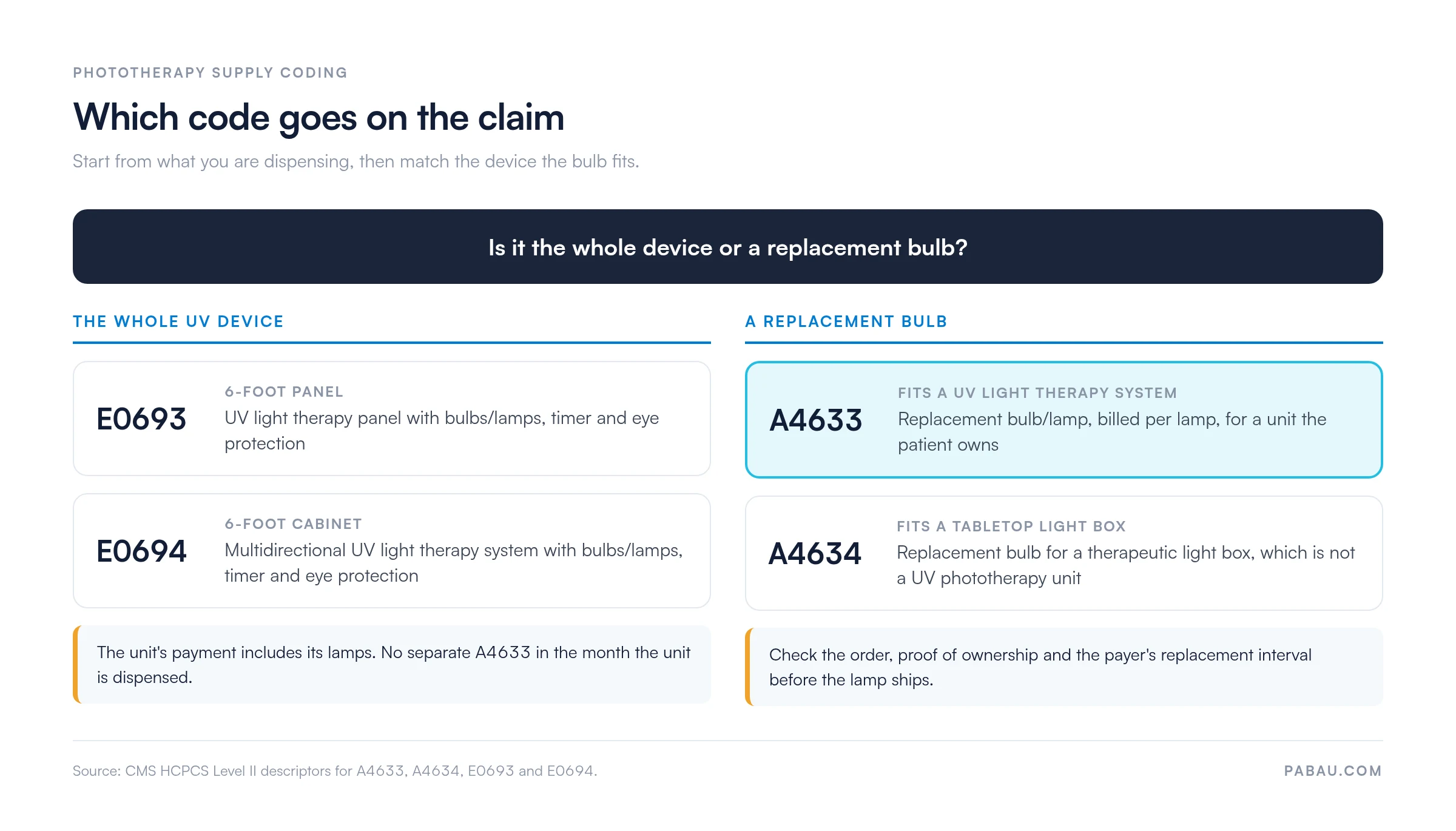
Timing matters as well. The E0691 through E0694 descriptors state that each unit includes its bulbs/lamps. Medicare therefore does not separately pay A4633 in the month the unit is dispensed. Bill the lamp only when it replaces one in a unit the patient already owns.
Commercial payers and Medicaid state plans each apply their own criteria. Never assume Medicare LCD requirements transfer to other payers. Check each payer’s coverage policy, prior authorization list, and frequency schedule separately before submitting. According to the CMS Physician Fee Schedule lookup, A-series supply codes like A4633 are paid under the DME fee schedule, not the physician fee schedule.
How often A4633 can be billed depends on the replacement frequency defined in the applicable LCD and payer policy. No universal Medicare-wide frequency applies to A4633. Each DME MAC sets allowed replacement intervals through its LCD or billing article. One timing rule is fixed, though. A4633 is not separately payable in the month the unit is dispensed, since the unit’s payment covers its lamps. Billing above that frequency without an Advance Beneficiary Notice of Noncoverage (ABN) on file is a direct path to a denial and potential overpayment liability.
When in doubt, call the payer before dispensing. A single phone call to confirm frequency allowance takes less time than working a denial through the appeals process.
Run a frequency check against the active LCD before every A4633 submission. If your billing system can flag claims that approach a frequency limit, set that threshold to two billing cycles before the cutoff. Catching the issue before submission costs a minute of checking. Catching it after a denial costs staff time and delays payment.
Solid documentation is what separates a paid A4633 claim from a denied one at post-payment audit. Ensure the following are on file before dispensing the replacement lamp, following medical billing compliance best practices for DME suppliers.
Documents obtained before dispensing differ from documents that can be collected post-dispensing. The physician order and prior authorization approval (where required) must exist before the lamp is supplied. Diagnosis documentation and CMNs may have specific look-back windows defined in the LCD.
A frequent wrong-code error on A4633 claims is submitting it when A4634 is correct, or vice versa. A4633 is the replacement bulb or lamp for any ultraviolet light therapy system. A4634 is the replacement bulb for a tabletop therapeutic light box, which is a different device from a UV phototherapy unit. A quick reference to the AAPC HCPCS Level II code lookup can confirm the correct code before submission.
A4633 depends on a base unit the patient already owns, such as E0693 or E0694. Submitting it without a record of that unit (or documentation that Medicare previously covered it) is a common trigger for medical necessity denials. Use the PGM Billing HCPCS lookup tool to confirm descriptors for adjacent codes. The decision path below shows which code belongs on the claim for each phototherapy item.
Getting modifiers wrong on A4633 is one of the fastest ways to create a repeating denial pattern on DME supply claims. The modifiers most relevant to A4633 billing are listed below. Confirm applicability against the current DME MAC LCD and billing article for your jurisdiction before appending any modifier.
The KX modifier carries legal weight. By appending it, the supplier attests that the LCD requirements are met and the supporting documentation exists. Appending KX without the documentation on file exposes the supplier to false claims liability. Verify the LCD modifier requirement for each DME MAC jurisdiction, as KX applicability is not identical across all four jurisdictions.
A clean A4633 claim moves through a predictable set of steps. Skipping any one of them is usually why claims come back denied. Running them through claim-tracking software keeps every biller on the same checklist.
Most A4633 denials trace back to a small set of recurring problems. Each one is preventable with the right pre-submission checks. Incorporating these into your billing workflow reduces rework and protects your denial management metrics.
Build a payer-specific prior authorization matrix for your top five payers that covers A4633, A4634, E0693, and E0694. Update it each quarter by calling the payer’s provider line or checking the plan’s online prior auth tool. One quarterly review prevents far more denials than a batch appeals process ever will.
Prior authorization requirements for A4633 vary by payer and cannot be generalized. Medicare itself does not routinely require prior authorization for HCPCS A-series supply codes, but DME MACs may impose prior auth under specific circumstances. Commercial plans and Medicaid state programs are where prior auth requirements are most common and most variable.
For commercial plans managed by EviCore or similar prior authorization contractors, A4633 may appear on the plan’s DME PA code list. Submit the authorization request through the plan’s designated PA portal with the physician order, diagnosis documentation, and proof of unit ownership before dispensing. Retroactive authorization is rarely granted for supply codes.
Most supply billers track A4633 across a spreadsheet of last-billed dates, a folder of scanned orders, and a payer portal. Each replacement means checking all three by hand before the lamp ships.
In Pabau, the practice management platform we build, the insurer details sit on the patient record beside the order and the ownership proof. US claims go out through the Claim.MD integration, with real-time eligibility checks. A validation step flags missing details, such as an authorization code, before the claim is submitted.
Each claim then moves through pending, submitted, processing, paid, or error. Your team spots a stalled lamp claim within days instead of at the next audit, and ERA remittances post back to the same dashboard.

Pabau’s claims tools check eligibility, flag missing authorization codes, and track every A4633 claim from submission to payment.

A4633 is a simple code with strict timing. Bill it only for a lamp that replaces one in a unit the patient owns. Never bill it in the month the unit ships, and stay inside the payer’s replacement interval.
The trade-off is front-loaded work. Checking the order, the ownership proof, and the last-billed date before the lamp leaves takes minutes. Unwinding a post-payment audit can drag on for months.
Book a demo to see how Pabau tracks replacement lamp claims from the eligibility check to payment.

Need to understand how denials are tracked and appealed? Denial management in healthcare covers the full workflow from denial identification through appeal resolution.
Looking to verify patient eligibility before dispensing DME supplies? Insurance eligibility verification outlines the steps to confirm coverage before the date of service.
Unsure when a payer needs approval before you dispense? The prior authorization process walks through each step from request to approval.
Want fewer supply claims bouncing back on the first pass? What makes a clean claim explains the fields payers check before they pay.
HCPCS code A4633 covers a replacement UV lamp (bulb) for a home ultraviolet light therapy system that the beneficiary owns. It does not cover the therapy unit itself, lamps for rented devices, or lamps used in a clinical setting.
Yes. Medicare Part B covers A4633 as a DME supply when the beneficiary owns an eligible home UV therapy unit. A physician must also have ordered phototherapy for a covered diagnosis. The claim must also meet the DME MAC’s criteria, including frequency limits, and it is not paid separately in the month the unit is dispensed.
A4633 covers a replacement bulb or lamp for any ultraviolet light therapy system, billed per lamp. A4634 covers a replacement bulb for a tabletop therapeutic light box, which is a separate device. Billing the wrong one for your patient’s equipment is a direct path to a code mismatch denial.
The most common reasons are a missing or invalid physician order, a rented rather than owned device, and an uncovered ICD-10 diagnosis code. Other triggers are an exceeded frequency limit with no ABN on file and missing prior authorization for commercial or Medicaid payers. A pre-submission documentation checklist prevents each one.
You need a signed physician order dated before dispensing, proof the patient owns the home UV unit, and diagnosis documentation supporting a covered ICD-10-CM code. Add a CMN where the applicable LCD requires one, and a prior authorization approval from payers that mandate it.
Medicaid coverage for A4633 varies by state. Some state Medicaid plans cover the replacement lamp as a DME supply. Others require prior authorization or do not cover home phototherapy supplies at all. Confirm coverage, prior auth requirements, and frequency limits with the specific state Medicaid DME policy before dispensing.



