

HCPCS code E0198: Water pressure pad billing guide
HCPCS code E0198 is a water pad for a standard mattress HCPCS code E0198 is the ...

Last Updated: Oct 13, 2026
K0011 is the HCPCS Level II code for standard - weight frame motorized/power wheelchair with programmable control parameters for speed adjustment, tremor dampening, acceleration control and braking.
Those parameters cover speed adjustment, tremor dampening, acceleration control and braking. Medicare pays it under the Part B durable medical equipment benefit, as either a capped rental or a purchase.
Much of the guidance circulating about K0011 describes rules that no longer apply. The Centers for Medicare and Medicaid Services (CMS) retired Certificates of Medical Necessity in 2023.
K0011 also does not sit on the mandatory prior authorization list. The compliance weight now falls on the face-to-face mobility exam and the Standard Written Order.
Let Pabau's smart automation suggest the right codes, reduce claim denials, and keep your practice compliant—effortlessly.
Automate repetitive tasks and focus on what matters most—your patients.
Reduce coding errors and ensure compliance with the latest regulations.
Clean claims, fewer denials, and faster reimbursements.
Powerful insights and reporting to help your practice thrive.
HIPAA compliant SOC 2 certified GDPR-compliant Trusted by 4,000+ clinics worldwide

HCPCS Code K0011 describes a standard-weight frame motorized power wheelchair with programmable control parameters for speed adjustment, tremor dampening, acceleration control and braking. The descriptor sets no cap on power options.
K0011 is billed under Medicare Part B as DMEPOS. It sits on the CMS DMEPOS Master List, but not on the Required Prior Authorization List. No mandatory PA request is needed before delivery.
Coverage is governed by Local Coverage Determination L33789. A face-to-face mobility exam and a Standard Written Order dated within 45 days of that exam are both required before the device is delivered.
CMS eliminated Certificates of Medical Necessity for dates of service on or after January 1, 2023. Form CMS-484 is the home oxygen CMN and never applied to power wheelchairs.
Claims management software like Pabau helps DMEPOS suppliers and practices document, bill, and track K0011 claims in one system.
HCPCS Code K0011 is a Level II DMEPOS code maintained by CMS under the HCPCS system. It sits in the K-code family, which holds temporary codes for durable medical equipment, prosthetics, orthotics, and supplies. The rest of the HCPCS Level II codes cover drugs, supplies, and transport rather than physician services.
Note what the descriptor does not say. K0011 carries no limit on power options. The three-option ceiling that circulates in coding forums belongs to the Group 2 and Group 3 power wheelchair codes (K0835-K0864), not to this code.
What separates K0011 from its neighbors is the programmable control package itself. Misclassifying a device against that descriptor is one of the most common audit flags on these claims.
The code also carries a history that shapes how MACs read it. K0011 was the standard power wheelchair code for dates of service before October 1, 2006. CMS then moved power mobility to the Group 1 through Group 3 series (K0813-K0864).
The code remains active, but most new power wheelchair claims now land on a K08xx code. Some reference material you will find for K0011 is archival rather than current.
Medicare pays K0011 as either a capped rental or a purchase, depending on the beneficiary’s circumstances and the MAC jurisdiction. DMEPOS competitive bidding is currently in a nationwide gap period.
No competitive bidding contracts have been in force in any product category since January 1, 2024, and the next round has not begun.
That changes what a fee schedule amount actually represents. Nationwide, the allowable is the former competitive bidding single payment amount adjusted by the CPI-U, not a contract supplier rate. Look up the current figure for the beneficiary’s state in the CMS DMEPOS fee schedule files before you quote a patient.
Patient responsibility is generally 20% of the Medicare-approved amount after the Part B deductible is met. Supplemental insurance may cover the cost-sharing portion. Verify Part B eligibility and any secondary payer coordination before the equipment is delivered.
Coverage for K0011 is governed by Local Coverage Determination L33789, the CMS policy for power mobility devices. K0011 appears on the CMS DMEPOS Master List, which is the pool of items CMS may make subject to conditions of payment.
Being on that list is not the same as being subject to prior authorization. CMS’s own Master List entry for K0011 answers no to prior authorization. It also answers no to a face-to-face exam and written order prior to delivery.
LCD L33789 sets the medical necessity criteria that determine whether a power wheelchair is covered at all. The beneficiary must meet all of the following to qualify for K0011 specifically:
LCD L33789 requirements apply at the MAC level. Noridian, CGS, Palmetto, and other MACs may publish specific guidance that supplements the national LCD. Check your MAC’s website for jurisdiction-specific policy articles before you file.
CMS maintains two separate lists, and they are easy to confuse. The DMEPOS Master List names every item CMS could select for prior authorization or for a face-to-face and written order requirement. The Required Prior Authorization List is the much shorter subset that actually carries a mandatory PA condition of payment.
For power wheelchairs, that required list currently covers the Group 1 through Group 3 codes in the K0813-K0864 range, including K0813 through K0816. K0011 itself is not on it, so there is no PA request to submit and no approval number to wait for before delivery.
Do not read that as blanket relief for Group 1 power wheelchairs, because several Group 1 codes are on the required list. Confirm the current list and your MAC’s guidance before each delivery, since CMS revises both periodically.
Missing or incomplete documentation is the primary driver of K0011 denials. Every element below must be in the file before a claim is submitted. Compliance requirements for DMEPOS are stricter than in most ambulatory settings, because CMS has historically identified power wheelchairs as a high-fraud category.
A face-to-face mobility examination by the treating practitioner must occur before the order is written. The examining clinician can be a physician, physician assistant, nurse practitioner, or clinical nurse specialist.
The exam has to document the specific mobility limitations that establish medical necessity, and that write-up must sit in the medical record.
A diagnosis code on its own does not carry it. The Standard Written Order must then be dated and received by the supplier within 45 days of the exam. It also has to be on file before delivery, because an order signed after delivery does not satisfy the requirement.
Form CMS-484 has no role in a K0011 claim. CMS-484 is the Certificate of Medical Necessity for home oxygen, and it was never the power wheelchair form. CMS then eliminated CMNs and DME Information Forms altogether for dates of service on or after January 1, 2023. A CMN attached to a K0011 claim today is a rejection waiting to happen.
What stands in its place is the Standard Written Order. Since January 1, 2020, under the final rule at CMS-1713-F, the SWO absorbed the old seven-element order for power mobility devices. One order now carries all six required elements.
The SWO does not stand alone. The supporting medical records have to substantiate what the order asserts. The supplier also keeps proof of delivery and its home assessment on file for audit. Keep the whole file together, because a MAC reviewer reads it as one package.
Modifier selection decides whether a K0011 claim pays. The wrong modifier triggers automatic edits that suspend payment, and some combinations produce an outright denial. The AAPC HCPCS code reference covers modifier applicability, and the table below summarizes the most common scenarios for K0011.
KX is a frequent point of confusion. Most MACs require KX on every K0011 claim to certify that the medical necessity documentation is in the supplier’s file and available for audit. Omitting KX when the MAC requires it triggers an automatic edit. Check your MAC’s billing guidance before you set up a claims template.
Two separate sequences run on every K0011 claim, and the diagram below puts both of them on one page.
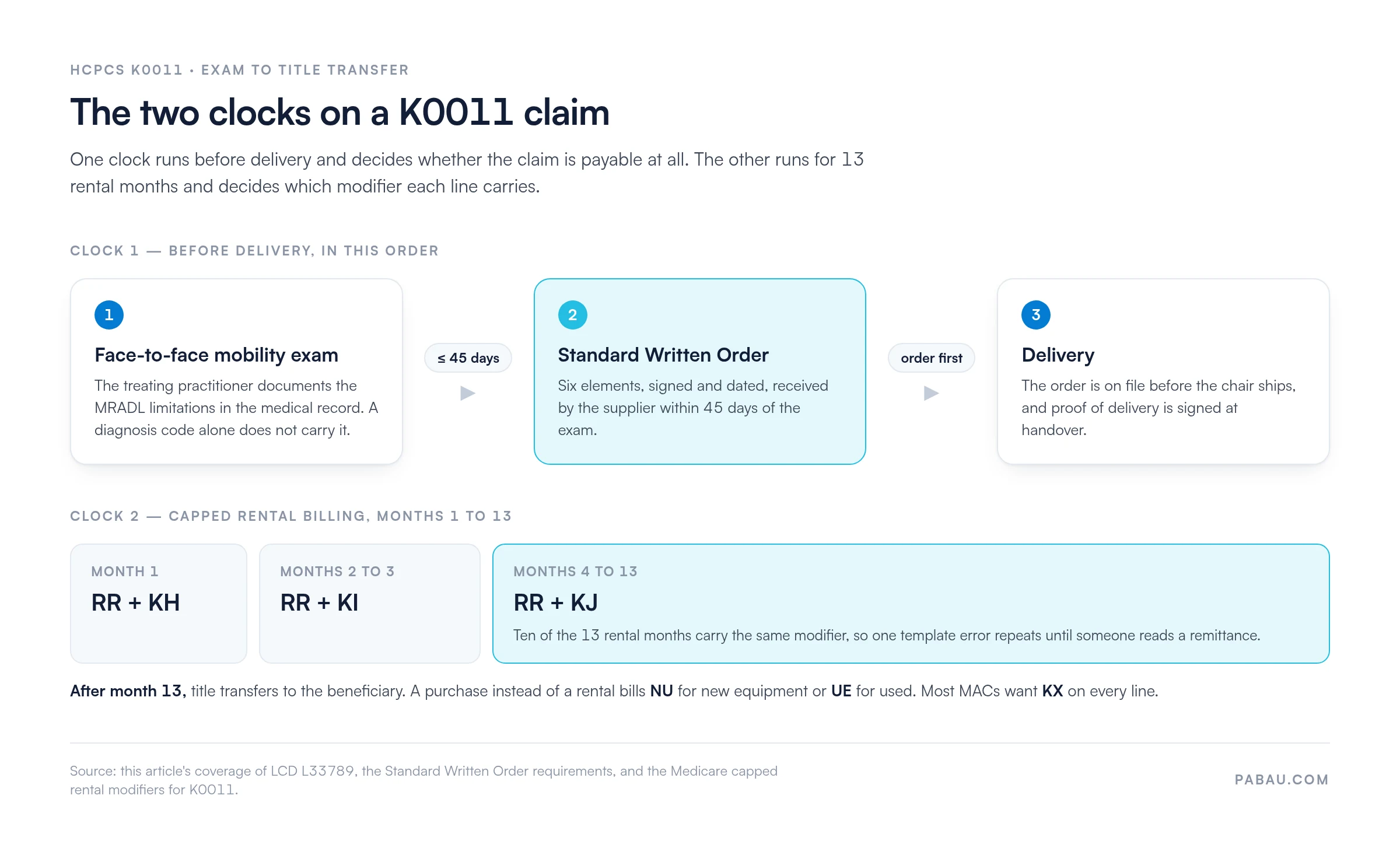
Run a quarterly audit of your K0011 claims for modifier consistency. Pull every claim where KX was absent and cross-reference with your MAC’s modifier policy. A single template error repeated across 20 claims adds up to significant write-off exposure well before you catch it in remittances.
Selecting the wrong power wheelchair code within the K001x series is a common upcoding or downcoding risk. The three codes look similar but describe meaningfully different devices.
Billing K0011 for a device that only qualifies as K0010 is an overpayment. Billing K0010 when the device has programmable controls is underbilling. Review the distinctions with the prescribing physician before you finalize the order.
The programmable control package is the practical differentiator here, not a power-option count. K0011 says nothing about how many powered seating components the chair carries. Do not let a three-option rule of thumb pick the code for you. Confirm the manufacturer spec sheet against the CMS long description before the order goes out.
Then check whether the current Group 1 through Group 3 series (K0813-K0864) describes the device better. That series replaced the K001x family in October 2006. Powered seating features such as tilt, recline, and seat elevation carry their own HCPCS codes rather than folding into the base wheelchair code.
K0011 claims are submitted on the CMS-1500 claim form or the 837P electronic transaction. DMEPOS suppliers must be enrolled in Medicare as a supplier with an active PTAN before they bill.
Check what sits behind the NPI as well, since a provider-type certification is attached to some HCPCS codes. Oral methadone dispensed in an opioid treatment program is billed with HCPCS code S0109, which only a SAMHSA-certified program may submit.
There is no prior authorization number to carry on a K0011 claim. The technical fields that decide the outcome are the modifiers, the diagnosis, and the date spans on rental lines. Validate those three before transmission and most avoidable rejections never happen.
K0011 has one of the highest pre-payment review rates among DMEPOS codes. CMS and its MACs have flagged power wheelchairs for targeted audit activity in multiple program integrity reports.
The denial reasons below are the patterns cited most often in denial management reviews for power wheelchair claims. Each one is preventable with the right pre-submission checklist.
Tracking which CARC codes appear on your K0011 remittances tells you where the process breaks down. Build a denial pattern review into the monthly billing cycle rather than working each denial in isolation. One template error caught early saves every rental line that would have repeated it.
Build a pre-delivery checklist that covers every documentation requirement before any K0011 equipment ships. Make the written order the hard stop: no signed SWO dated within 45 days of the face-to-face exam, no delivery date on the calendar. That single step removes the largest and most expensive denial category on power wheelchair claims.
Most DMEPOS suppliers hold this sequence in three places at once. The exam note sits in the referring practitioner’s record. The signed order sits in a shared drive, and the rental months sit in a billing spreadsheet. Nobody watches the 45-day window until a remittance says it already closed.
Pabau is practice management software that keeps the documentation and the claim on one record. The mobility exam note, the Standard Written Order, the home assessment, and the signed proof of delivery live in one place.
They attach to the client file the claim is built from. The biller can see which of them is still outstanding before submission rather than after it.
That makes audit-ready claims management a checklist your team clears in one screen. Modifier rules are set once per code instead of retyped per claim, and every rental line carries the same date logic. When a MAC asks for the file, it is already assembled.
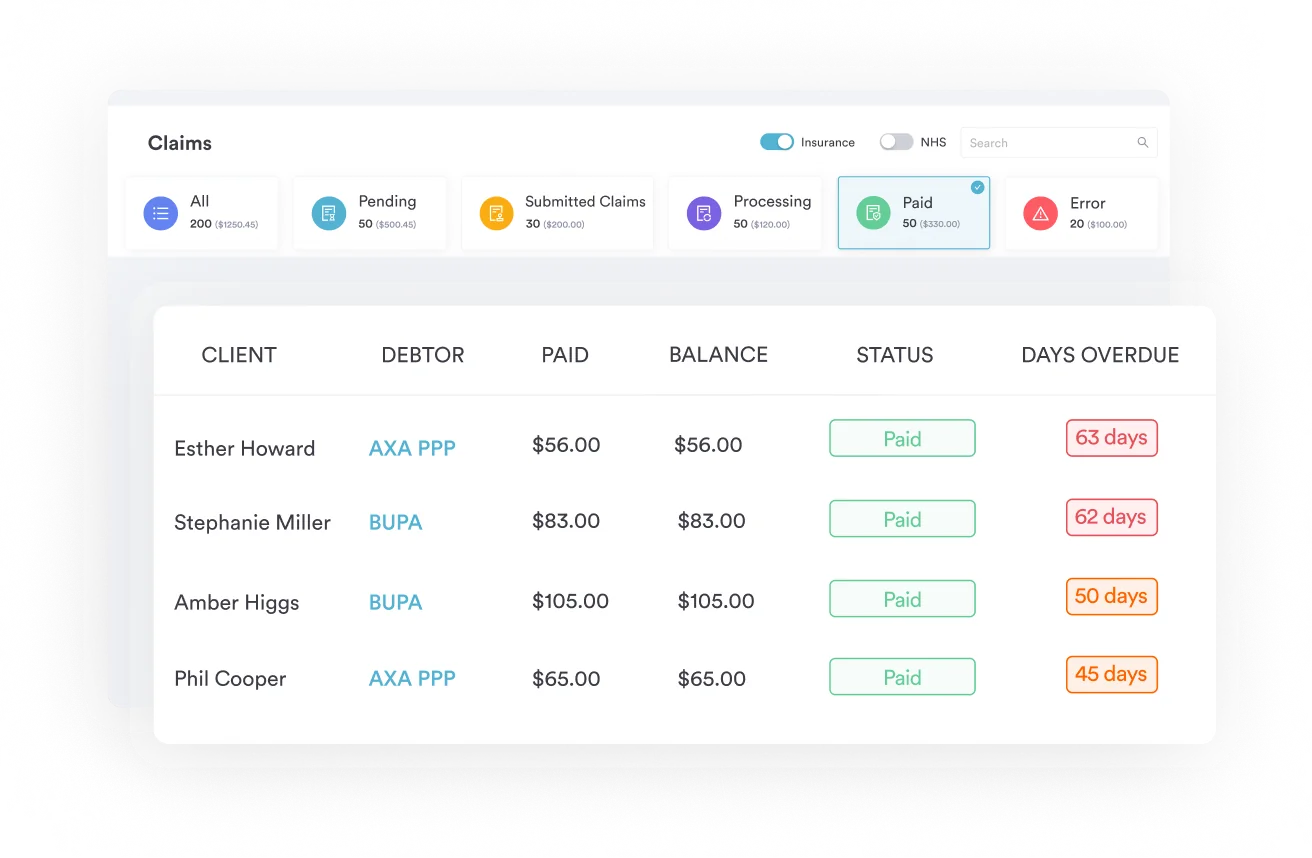

Pabau’s claims management tools help DMEPOS suppliers and practices document, submit, and track K0011 and other HCPCS claims in one place. That means fewer modifier errors and less denial exposure.

The two rules worth unlearning about K0011 are the ones you are most likely to hear repeated. There is no mandatory prior authorization, and there is no CMN to complete. Auditing a workflow against retired requirements costs more than the denials it was meant to prevent.
What survives is a sequence, and the sequence is where a busy supplier slips. The exam comes before the order, the order lands within 45 days, and delivery follows both. Get that chain right and the rest of a K0011 claim is data entry.
Fix the pre-delivery checklist first, because it removes the denial category that is hardest to appeal. Book a demo to see how Pabau keeps the exam, the order, and the rental months on one record.

Need to understand how denial codes work across DMEPOS claims? Denial codes in medical billing covers how to read and respond to CARC and RARC codes on remittance advice.
Want to strengthen your eligibility checks before delivery? Insurance eligibility verification explains how to confirm active Part B coverage and secondary payer status before equipment ships.
Looking to tighten your billing compliance posture? Medical billing compliance covers the documentation, audit, and payer policy frameworks that apply across DMEPOS claim types.
Want fewer rejections on the first pass? Clean claim sets out the fields a payer checks first, and how to validate them before a claim is transmitted.
Need the wider picture around DMEPOS cash flow? What is revenue cycle management walks through the stages between an order and a posted payment.
HCPCS Code K0011 is used to bill for a standard-weight frame motorized or power wheelchair with programmable control parameters. Those parameters cover speed adjustment, tremor dampening, acceleration control and braking. It is billed under Medicare Part B as a DMEPOS item. Suppliers use it when the prescribed device matches that descriptor.
No. K0011 appears on the CMS DMEPOS Master List, which is the pool of items CMS could make subject to conditions of payment. It is not on the Required Prior Authorization List. CMS’s Master List entry for K0011 answers no to prior authorization, and no to a face-to-face and written order prior to delivery. The required list does cover the current power wheelchair series in the K0813-K0864 range, so confirm which code you are billing.
K0010 covers a standard-weight frame power wheelchair without programmable controls. K0011 covers the same frame with programmable control parameters for speed adjustment, tremor dampening, acceleration control and braking. K0012 covers a lightweight portable power wheelchair. The programmable control package is what defines K0011, and there is no power-option cap anywhere in its descriptor.
No. Form CMS-484 is the CMN for home oxygen, and it was never the power wheelchair form. CMS also eliminated CMNs and DME Information Forms for dates of service on or after January 1, 2023. Submitting one with a K0011 claim now causes a rejection. The current requirement is a face-to-face mobility exam, a standard written order dated within 45 days, supporting medical records, and supplier proof of delivery.
K0011 rental claims require the RR modifier plus the rental-period modifier that matches the month. That is KH for month 1, KI for months 2 and 3, and KJ for months 4 through 13. Most MACs also require the KX modifier to certify that medical necessity documentation is on file. Purchase claims use NU for new equipment or UE for used equipment. Check your MAC’s billing guide for jurisdiction-specific requirements.
Coverage for K0011 and other power mobility devices is governed by Local Coverage Determination L33789. That LCD sets the medical necessity criteria: a mobility limitation in the home, inability to use a manual wheelchair, and an accessible home environment. It also requires the treating practitioner to determine that a standard power wheelchair is the appropriate device. Verify the current active version on the CMS LCD database, because policies are periodically revised.



