

CPT Code 52352: Ureteroscopic stone removal billing guide
CPT Code 52352: Official descriptor and procedure overview CPT Code 52352 descri...

Last Updated: Oct 30, 2026
J9303 is the HCPCS Level II code for injection, panitumumab, 10 mg. It covers Vectibix, the anti-EGFR antibody from Amgen, and each billing unit equals 10 mg of drug.
A 480 mg dose is billed as 48 units of J9303. Vectibix treats metastatic colorectal cancer that is RAS wild-type or, with sotorasib, KRAS G12C-mutated. Discarded drug from its single-dose vials goes on a separate line with modifier JW.
Let Pabau's smart automation suggest the right codes, reduce claim denials, and keep your practice compliant—effortlessly.
Automate repetitive tasks and focus on what matters most—your patients.
Reduce coding errors and ensure compliance with the latest regulations.
Clean claims, fewer denials, and faster reimbursements.
Powerful insights and reporting to help your practice thrive.
HIPAA compliant SOC 2 certified GDPR-compliant Trusted by 4,000+ clinics worldwide

HCPCS code J9303 covers panitumumab (Vectibix) and is billed per 10 mg, so a 480 mg dose is reported as 48 units.
Vectibix is FDA-approved for RAS wild-type metastatic colorectal cancer and, with sotorasib, for previously treated KRAS G12C-mutated disease.
Dosing is 6 mg/kg every 14 days, so the unit count changes with each patient’s weight.
Vectibix ships in 100 mg and 400 mg single-dose vials, so Medicare claims carry JW for discarded drug or JZ when none is discarded.
In Pabau’s practice software, the infusion note, vial details and claim lines sit in one patient record, so units are never rebuilt by hand.
HCPCS Code J9303 is the CMS Level II code for “injection, panitumumab, 10 mg.”
It sits in the J9000–J9999 chemotherapy drug range of the J-series, within the wider set of HCPCS Level II codes. The code identifies Vectibix, the panitumumab product made by Amgen. CMS made J9303 effective on January 1, 2008, replacing temporary code C9235.
One unit of J9303 equals 10 mg of panitumumab. Panitumumab is a human IgG2 monoclonal antibody that blocks the epidermal growth factor receptor (EGFR). It is given by intravenous infusion.
Vectibix is FDA-approved for two metastatic colorectal cancer (mCRC) settings, per its current prescribing information. Each one depends on a biomarker result from an FDA-approved test.
Wild-type means no mutation in exons 2, 3 or 4 of either KRAS or NRAS. The sotorasib combination needs a confirmed KRAS G12C mutation instead. Keep the report that applies in the chart before the first dose.
Traditional Medicare can also cover an off-label anticancer use when a recognized compendium, such as NCCN, supports it. That rule sits in the Medicare Benefit Policy Manual, Chapter 15, section 50.4.5. Commercial plans set their own drug policies, so check the plan first.
Divide the milligrams administered by 10 to get J9303 units. Vectibix is dosed at 6 mg/kg every 14 days, so the unit count follows each patient’s weight.
An 80 kg patient receives 480 mg, which is 48 units. Drawing that dose takes one 400 mg vial and one 100 mg vial, so 20 mg is left over. That 20 mg goes on a second line as 2 units with modifier JW.
The vial mix decides the waste as much as the dose does. Ask the pharmacy to record which vials it opened, so the JW line matches the drug purchased.
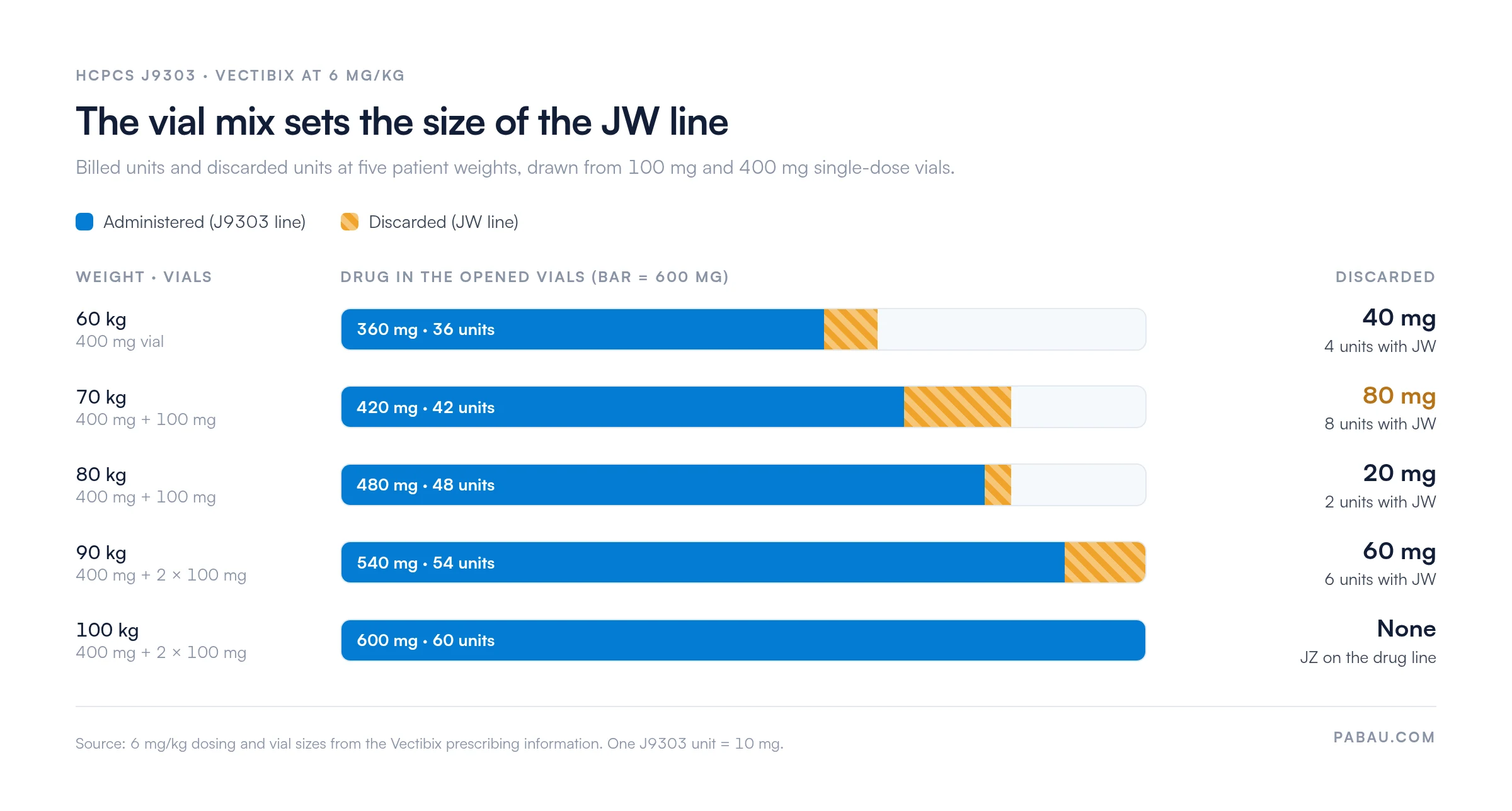
Both Vectibix vials are single-dose, and the label says to discard any unused portion. Since July 1, 2023, Medicare Part B has required modifier JW on discarded drug and JZ when none is discarded.
Report the administered units on one line and the discarded units on a second line with JW. Record the discarded amount in the patient’s chart. Medicaid and commercial plans set their own wastage rules, so confirm them before billing a JW line.
Vectibix is given by intravenous infusion, so the J9303 line is billed with an administration code. Monoclonal antibodies such as panitumumab use the chemotherapy administration codes.
Doses up to 1,000 mg run over 60 minutes, so most visits bill 96413 alone. The label allows 30 to 60 minutes for later infusions once the first is tolerated. Doses above 1,000 mg run over 90 minutes, which still does not reach the 96415 threshold.
Physician offices bill on the 837P or CMS-1500 with place of service 11. Hospital outpatient departments bill on the institutional claim, usually under revenue code 0636.
Mix-ups usually come from drugs in the same class, drugs used in the same colorectal regimens, or an outdated code list.
Two errors cost the most time. Billing J9999 when J9303 exists invites a denial and a slow appeal. A J2513 line for Vectibix bills a deleted fluid code, so the claim denies outright.
Before each J9303 claim, match the drug on the infusion record to panitumumab, not cetuximab. Then check the milligrams against the order, divide by 10 and confirm which vials were opened.
Medicare Part B covers J9303 under buy-and-bill. The practice buys Vectibix, administers it and bills Medicare for the drug and the infusion.
Medicare pays separately payable Part B drugs at average sales price (ASP) plus 6%, in physician offices and hospital outpatient departments alike. Sequestration then trims 2% from the Medicare payment.
CMS updates ASP payment limits every quarter. Offices take the rate from the CMS ASP pricing files, and hospitals from OPPS Addendum B. Check the current quarter before quoting expected payment.
Traditional Medicare does not require prior authorization for J9303. Medicare Advantage plans, Medicaid plans and most commercial payers often do, so check each plan before the first cycle.
Tracking authorization status next to the claim queue stops a J9303 claim from going out before approval lands. A claim sent without approval is among the costliest denials for this drug.
Medicaid programs require the NDC on physician-administered drug claims so states can collect manufacturer rebates. Many commercial payers ask for it as well, and a missing NDC can deny the line.
The label also lists package codes ending in -21 for each vial. Bill the NDC printed on the carton you used.
A frequent slip is copying the NDC from the last claim after the vial mix changed. Pull it from the dispensing record for that infusion date.
J9303 denials follow a predictable pattern. The table maps each one to its fix, and the wider denial management in healthcare process applies to drug claims too.
Sound medical billing compliance for panitumumab starts with the right documents in the chart before the claim goes out. A missing document found in a post-payment audit costs more to fix than one caught beforehand. Clean claim submission habits cut both first-pass denials and audit exposure.
Practices moving infusion records off paper should map these fields between the infusion system and billing. Our guide to medical billing workflows covers how a charge moves from the chart to the claim.
Vectibix claims tend to break at the hand-off. The weight is in the visit note, the vial NDC on the carton and the waste in a nurse’s log. A biller then rebuilds the claim from all three.
Pabau holds the treatment note, dose and stock records in one patient record. Its claims management software builds the claim from that record, so the logged milligrams and waste carry through to the claim lines.
Scheduling covers the 14-day cycle. Booking each infusion two weeks out, with an automated reminder, keeps the regimen inside the dates the authorization covers.

Pabau records the dose, vial NDC and discarded milligrams at the infusion. J9303 claims go out with the right units and modifiers, and the audit trail is already in place.

J9303 unit math is simple, with one unit for every 10 mg. Claims fail when the vial mix, the waste line or the biomarker report gets pieced together after the infusion.
Set the vial logic and the JW or JZ rule once in your charge capture. Tie each claim to a labeled indication, and every 14-day cycle bills the same way.
To see how Pabau keeps Vectibix doses, vial records and claim lines together, book a demo.

Need a framework for reducing oncology billing denials? Denial management in healthcare covers the end-to-end process for tracking, appealing, and preventing claim rejections across drug and procedure codes.
Want to understand how drug claims move through payers? What is revenue cycle management explains the full billing lifecycle from verification through payment posting, with a focus on reducing leakage.
Looking for guidance on superbill and claim export formats? Superbill billing guide covers how to structure drug and procedure line items for clean claim submission.
HCPCS Code J9303 is the Level II code for injection, panitumumab, 10 mg. It covers Vectibix, Amgen’s anti-EGFR antibody for metastatic colorectal cancer. Each unit is 10 mg, so a 480 mg infusion is 48 units.
Divide the milligrams given by 10. A 480 mg dose is 48 units, and a 420 mg dose is 42 units. Bill any discarded drug as extra units on a separate JW line.
Use the colorectal site code from pathology: C18.0–C18.9 for colon, C19 for the rectosigmoid junction or C20 for rectum. Add a secondary code such as C78.7 for liver metastases. Use C18.9 only when the site is not documented.
Yes. Medicare Part B covers Vectibix for its labeled RAS wild-type and KRAS G12C-mutated mCRC uses, and for compendium-supported off-label uses. Traditional Medicare needs no prior authorization. Payment is ASP plus 6%, less sequestration.
Yes, on Medicare claims. Vectibix comes in single-dose vials, so add JZ when no drug is discarded. Otherwise bill the discarded milligrams on a separate line with JW, and record the amount in the chart.
Report the NDC on the vial used: 55513-0954-01 for the 100 mg vial or 55513-0956-01 for the 400 mg vial. Use the 11-digit format with the N4 qualifier, taken from the dispensing record.
J9303 is panitumumab (Vectibix), an anti-EGFR antibody for colorectal cancer. J9055 is cetuximab (Erbitux), a different anti-EGFR antibody. J9301 is obinutuzumab (Gazyva), an anti-CD20 antibody for blood cancers. J2506 is pegfilgrastim (Neulasta), which treats chemotherapy-induced neutropenia.
No. J2513 described injection, pentastarch, 10% solution, 100 ml, a plasma volume expander, and was deleted effective December 31, 2025. Panitumumab is billed with J9303.



