HCPCS Code Q4185: Cellesta flowable amnion billing guide
HCPCS Code Q4185: definition and official descriptor HCPCS Code Q4185 is the Lev...

Last Updated: Nov 20, 2026
J8530 is the HCPCS Level II code for cyclophosphamide; oral, 25 mg. One billing unit equals 25 mg, so a 50 mg tablet bills as 2 units. Medicare uses J8530 for oral cyclophosphamide taken as immunosuppression after an organ transplant.
Medicare covers oral cyclophosphamide under Part B when it treats cancer, because an injectable form of the same drug exists. Those claims go to the DME MAC with the product's NDC, at one unit per tablet. Part D covers non-cancer use, such as lupus or rheumatoid arthritis.
Let Pabau's smart automation suggest the right codes, reduce claim denials, and keep your practice compliant—effortlessly.
Automate repetitive tasks and focus on what matters most—your patients.
Reduce coding errors and ensure compliance with the latest regulations.
Clean claims, fewer denials, and faster reimbursements.
Powerful insights and reporting to help your practice thrive.
HIPAA compliant SOC 2 certified GDPR-compliant Trusted by 4,000+ clinics worldwide

J8530 bills oral cyclophosphamide at one unit per 25 mg, so a 50 mg tablet is 2 units. Medicare uses J8530 for immunosuppression after an organ transplant.
Medicare Part B covers oral cyclophosphamide for cancer through the DME MAC, billed by the product’s NDC at one unit per tablet. Non-cancer use falls to Part D.
Missing or badly formatted NDC numbers are among the top reasons J8530 claims are denied. Drug claims need the 11-digit NDC in 5-4-2 format, without dashes.
IV and injectable cyclophosphamide now bill under J9071-J9075 at 5 mg per unit, because CMS deleted J9070 effective April 1, 2024.
In Pabau’s practice software, the prior authorization code, dates and sessions sit on the patient’s case, with a warning when one is missing.
HCPCS code J8530 is the Level II code for oral cyclophosphamide, with one billing unit equal to 25 mg of the drug. CMS lists it in chapter 17 of the Medicare Claims Processing Manual, which counts a 50 mg tablet as 2 units. The official descriptor in the CMS HCPCS code set reads “Cyclophosphamide; oral, 25 mg.”
Medicare covers oral cyclophosphamide under Part B when it treats cancer, and Part D covers non-cancer use. The drug is an alkylating agent used in oncology and autoimmune medicine, sold under brand names including Cytoxan. The table below holds the reference facts coders need.
Medicare prices J8530 on the average sales price (ASP) method, not the Physician Fee Schedule. The CMS ASP pricing files set its limit at $1.233 per 25 mg from October 1 to December 31, 2026. The patient owes 20% coinsurance. CMS resets the limit every quarter, so check the current file before quoting a dollar amount.
J8530 covers only the oral tablet or capsule form of cyclophosphamide self-administered at home. The route of administration sets the boundary. Oral administration qualifies, and parenteral or intravenous delivery does not.
Coders meet this boundary most often when a patient switches between IV and oral cyclophosphamide mid-treatment.
One unit of J8530 equals 25 mg of oral cyclophosphamide dispensed, so divide the milligrams dispensed by 25 rather than counting tablets. That rule applies whenever J8530 goes on the claim, as in transplant immunosuppression or with a payer that accepts the J-code. Medicare cancer-use claims to the DME MAC bill the product’s NDC instead, at one unit per tablet or capsule.
Take a common case. A patient picks up a 30-day supply of 50 mg tablets, one tablet daily, so the supply holds 30 × 50 mg = 1,500 mg. On a J8530 claim, that is 60 units. A Medicare cancer-use claim bills the NDC for 30 tablets instead.
Confirm the quantity on the prescription label before entering units, and record the days’ supply on the claim. Payers audit mismatches between units and NDC quantity.
Always verify units against the dispensed quantity on the medication label, not the prescribed dose on the treatment plan. Prescribed and dispensed quantities can differ, and billed units must match the dispensed quantity.
J8530 covers oral cyclophosphamide, while IV and injectable cyclophosphamide bill under J9071-J9075 at 5 mg per unit. CMS deleted the single 100 mg code, J9070, effective April 1, 2024. J9075 covers any product not otherwise specified, and the others name specific manufacturers. A code mismatch between the oral and IV forms generates a denial and may trigger a medical record review.
The unit difference is a trap. A 100 mg oral dose is 4 units of J8530, but 100 mg IV is 20 units of a 5 mg code such as J9075. Mixing the two produces a fivefold unit error on the claim, which payers flag. Check the route in the physician’s order before selecting the code.
Whether Medicare covers oral cyclophosphamide under Part B or Part D depends on what it treats, not on where it is dispensed. Part B covers oral anticancer drugs that share an active ingredient with a covered injectable, under SSA §1861(s)(2)(Q). Cyclophosphamide qualifies because an IV form exists, and the chart below maps each use to its pathway.
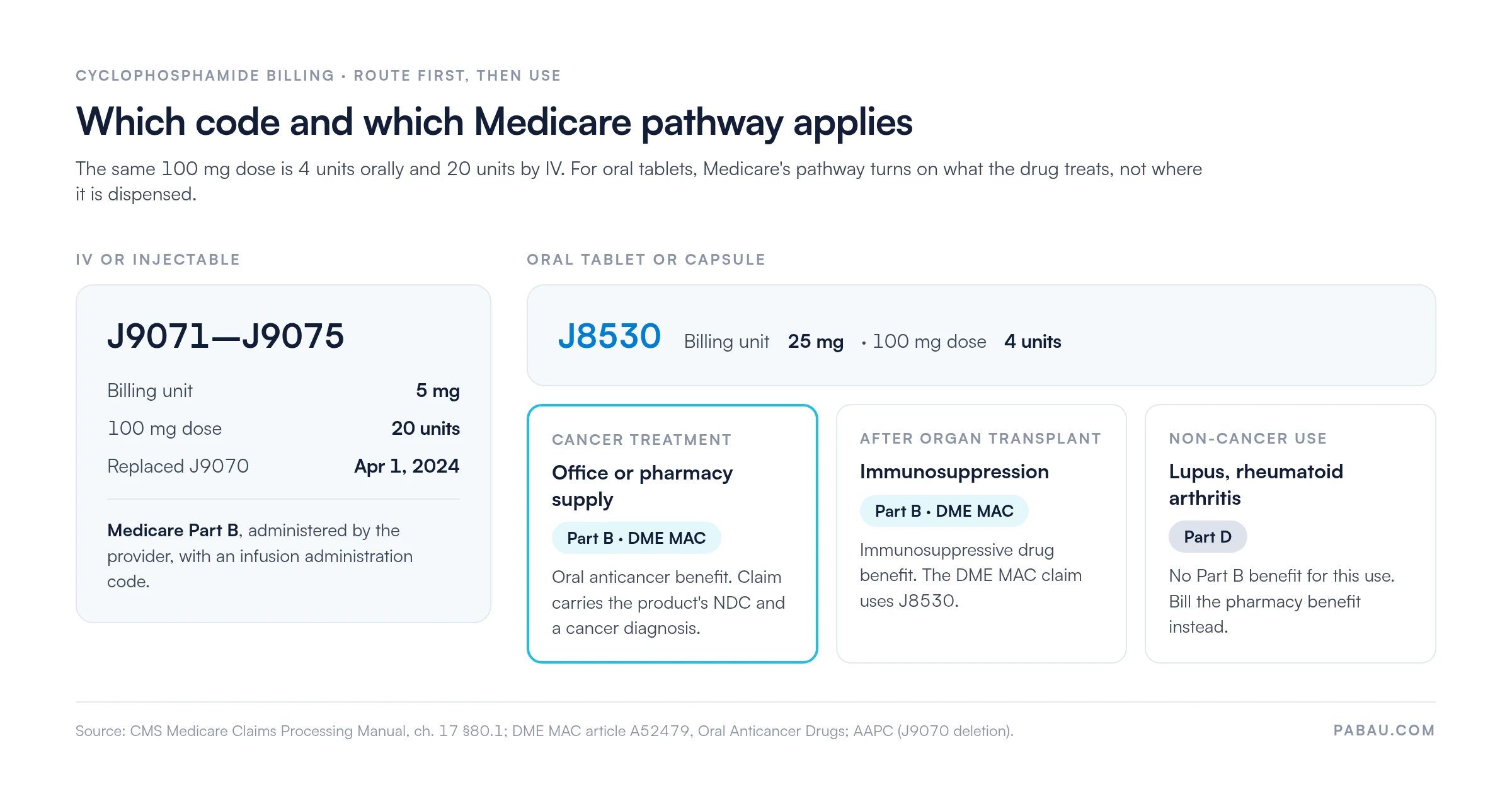
The CMS manual sends these claims to the DME MAC whether the physician’s office or a pharmacy supplies the drug, hospital pharmacies included. A cancer diagnosis must appear on the claim, or it is denied. The DME MACs’ oral anticancer drugs policy article asks suppliers to bill the NDC for cancer use, one unit per tablet. It reserves J8530 for cyclophosphamide prescribed after an organ transplant.
Commercial payers follow their own rules. State oral chemotherapy parity laws require many plans to cover oral cyclophosphamide at the same cost-sharing as IV chemotherapy, but those laws vary by state. Confirm the plan’s oral chemotherapy benefit before quoting the patient.
Many commercial payers and some Medicare Advantage plans require prior authorization for J8530, particularly for autoimmune and off-label indications. Insurance eligibility verification at the start of treatment should include a check for oral chemotherapy PA requirements, not just standard drug benefit PA.
Standard PA documentation for J8530 includes the following elements. Missing any one of them can cause a denial or a long delay.
Most payers turn urgent oncology PA requests around in 24 to 72 hours. Standard review takes 3 to 5 business days. Always initiate PA before the drug is dispensed; retroactive authorization requests are denied at a significantly higher rate and require additional appeal steps.
A clean J8530 claim requires several data elements that go beyond the HCPCS code and diagnosis codes. Each missing or malformatted element is a potential denial trigger. Using a structured superbill preparation workflow that captures all drug claim fields before submission significantly reduces rework. Good medical billing compliance practices require every element below to be verified at the time of dispensing, not reconstructed from memory later.
The NDC must appear on the claim as 11 digits in the 5-4-2 format, without dashes. Retail pharmacies billing the DME MAC use the NCPDP format, where the NDC takes the place of the HCPCS code. Other suppliers follow their DME MAC’s instructions for the 837P or CMS-1500 claim.
An NDC sent in 10-digit format or with dashes usually triggers an “invalid NDC” edit or denial. Because it doesn’t read as “missing NDC,” the root cause can take longer to find.
The NDC must match the product dispensed, down to the manufacturer. When the supplier switches to another generic manufacturer’s cyclophosphamide, the NDC on the claim must change with it. Keeping a current NDC crosswalk in the dispensing workflow prevents repeated mismatches.
Place of service doesn’t switch J8530 between payment systems. Whoever dispenses the drug bills the DME MAC, and Medicare pays an ASP-based drug amount plus a supply fee. On DME MAC claims, place of service reflects where the patient uses the drug, often the home, so confirm the code with your DME MAC.
The ICD-10-CM diagnosis code on a J8530 claim must establish medical necessity for cyclophosphamide. CMS and commercial payers with Local Coverage Determinations for oral chemotherapy typically specify which diagnosis codes satisfy medical necessity. Off-label diagnoses, particularly autoimmune conditions, frequently require additional documentation and may be subject to payer review.
Medicare has no Part B benefit for oral cyclophosphamide in lupus, rheumatoid arthritis or other non-cancer conditions outside transplant care. The DME MAC policy article says not to submit those claims unless the beneficiary asks, and then with a GY modifier. Commercial payers set their own rules for autoimmune use. Check the plan’s policy, and include a letter of medical necessity with the claim or the PA file.
J8530 denials cluster around four root causes: missing or invalid NDC, unit errors, absent prior authorization, and diagnoses that fail medical necessity. Denial management workflows for oral chemotherapy codes should track each cause separately, since each needs a different fix.
The table pairs each denial with its fix. When a remittance carries an unfamiliar CARC or RARC code, look it up in our guide to denial codes before you correct and resubmit.
Build a J8530 claim edit into your pre-submission workflow that checks three fields before the claim goes out. Units must match what you bill, mg ÷ 25 under J8530 or one per tablet under an NDC. The NDC must be 11 digits in 5-4-2 format. The PA number must be filled in whenever the payer requires PA. Catching these before submission takes seconds. Working a denial after the fact takes days.
Coders know the per-25 mg unit rule, so most J8530 denials start in the workflow. A dispensing tech enters the wrong NDC, a prior authorization lapses unnoticed, or units come from the prescribed dose instead of the dispensed one.
Pabau, the practice management platform we build, keeps the case, the prescription and the claim on one patient record. Here is how the practice records each piece in Pabau:
The NDC and the unit count still need a coder’s check against the dispensed package. With the authorization, prescription and claim on one record, the clean claim requirements above are easier to meet before submission.

Pabau tracks prior authorizations on the patient’s case and sends US claims through Claim.MD, so your J8530 paperwork lives in one record.

Settle the route and the use before you touch units. Oral cyclophosphamide for cancer goes to Medicare Part B through the DME MAC, billed by NDC, and Part D takes non-cancer use. J8530 itself, at one unit per 25 mg, carries transplant immunosuppression claims. IV doses now bill under J9071-J9075.
From there, count units from the dispensed quantity and match the NDC to the package in hand. Those two checks prevent the denials this code sees most.
Pabau keeps the prior authorization, the prescription and the claim on one patient record, so your team checks each in one place. Book a demo to see how Pabau’s claims and authorization tracking fits your J8530 workflow.

Need a full framework for handling claim rejections systematically? Denial management in healthcare covers the end-to-end workflow for tracking, appealing, and preventing claim denials across drug and procedure codes.
Unsure what a clean claim actually requires at submission? Clean claim requirements explains the data elements payers check before processing, including NDC format, units, and prior authorization fields.
Want to understand how electronic remittance works after a J8530 claim processes? Electronic remittance advice explains how to read ERA files and match CARC denial codes to corrective actions.
HCPCS code J8530 covers oral cyclophosphamide (brand name Cytoxan) self-administered at home, billed at one unit per 25 mg. It applies only to the oral tablet or capsule form. Injectable or IV cyclophosphamide bills under J9071-J9075, separate codes billed at 5 mg per unit.
A 50 mg tablet bills as 2 units of J8530. Divide the total milligrams dispensed by 25. A 100 mg dose is 4 units, and a 150 mg dose is 6 units. A Medicare cancer-use claim bills the NDC instead, at one unit per tablet. Always use the dispensed quantity, not the prescribed dose, when calculating units.
Yes, when oral cyclophosphamide treats cancer. Part B covers it as an oral anticancer drug under SSA §1861(s)(2)(Q), because an injectable form exists. That holds whether the physician’s office or a pharmacy supplies it, and the claim goes to the DME MAC by NDC. J8530 itself is used for transplant immunosuppression. Non-cancer use, such as lupus, falls to Part D instead.
Use the 11-digit NDC of the cyclophosphamide product dispensed, in 5-4-2 format without dashes. Retail pharmacies billing the DME MAC send it in NCPDP format, and other suppliers follow their DME MAC’s 837P or CMS-1500 instructions. Another manufacturer’s NDC is a claim error, even for the same drug. Check the NDC on the package each time the supplier changes.
The leading J8530 denials are a missing or badly formatted NDC, a wrong unit count, and absent or expired prior authorization. A diagnosis that fails medical necessity is the fourth. A route mismatch, such as billing J8530 when IV cyclophosphamide was given, also causes denials. Those need a code correction and resubmission rather than a simple appeal.
Medicare doesn’t pay oral cyclophosphamide differently by place of service. The dispensing supplier bills the DME MAC, and payment follows the ASP-based limit plus a supply fee. On DME MAC claims, place of service reflects where the patient uses the drug, often the home. Confirm the code with your DME MAC.