HCPCS Code G0163: Skilled nursing observation and assessment
What is HCPCS Code G0163? HCPCS Code G0163 is a deleted Level II code for skille...

Last Updated: Oct 15, 2026
J8520 is the HCPCS Level II code for capecitabine, oral, 150 mg. CMS terminated it with effect from 30 September 2024, so it is no longer valid for claims after that date.
HCPCS code J8520 does not exist anymore. CMS terminated it on September 30, 2024, together with its 500 mg sibling J8521, and capecitabine has been billed a different way ever since.
The code described capecitabine (Xeloda), oral, 150 mg, an oral chemotherapy drug Medicare still covers. Leave J8520 in the charge master, though, and the claim comes back rejected for an invalid procedure code.
For a billing team, that is a fully payable drug denied on a formatting problem. Here is what the code covered, the three billing windows that followed its deletion, and how a capecitabine claim gets put together today.
Let Pabau's smart automation suggest the right codes, reduce claim denials, and keep your practice compliant—effortlessly.
Automate repetitive tasks and focus on what matters most—your patients.
Reduce coding errors and ensure compliance with the latest regulations.
Clean claims, fewer denials, and faster reimbursements.
Powerful insights and reporting to help your practice thrive.
HIPAA compliant SOC 2 certified GDPR-compliant Trusted by 4,000+ clinics worldwide

HCPCS code J8520 described capecitabine (Xeloda), oral, 150 mg. CMS terminated it on September 30, 2024, along with J8521, capecitabine, oral, 500 mg.
Suppliers billed J8999 for dates of service from October 1 to December 31, 2024. The drug name, dosage and NDC went in the claim narrative.
From January 1, 2025, capecitabine bills by NDC with no J code on the line. SV101-2 carries S5000 or S5001 only when that NDC has no assigned HCPCS.
J8522, capecitabine, oral, 50 mg, is the reference crosswalk descriptor CMS published. It is not the code a DME MAC supplier submits.
Capecitabine qualifies for Medicare Part B on its own, with no concurrent injectable drug needed. Part D applies when the dispenser cannot bill the DME MAC.
J8520 was the HCPCS Level II code for capecitabine, oral, 150 mg. HCPCS Level II is the code set the Centers for Medicare and Medicaid Services (CMS) maintains for drugs, supplies and equipment.
J8520 sat in the J8xxx series, the alphanumeric block CMS reserves for oral anti-cancer drugs dispensed in an office or outpatient setting. CMS added the code on January 1, 2000. It terminated the code on September 30, 2024, which makes that the last valid date of service.
Capecitabine itself is a prodrug. The body converts it into 5-fluorouracil, mainly at the tumor site. That mechanism puts it squarely in the oral antineoplastic category. It also explains why its coverage rules differ from intravenous chemotherapy billed under the J0xxx or J9xxx series.
The table below pulls together the reference fields CMS published for J8520. Read every row as history. The code is terminated, so none of it governs a current date of service.
J8520 is deleted. CMS terminated it on September 30, 2024 and assigned action code N, which means the code gets no further maintenance.
J8521, capecitabine, oral, 500 mg, went on exactly the same date. Neither code is a valid choice for a date of service after September 30, 2024. Neither one is a crosswalk for the other.
Reference databases are where most of the confusion starts. Several still list both codes under a current-year heading, and that heading is only the dataset year. It is not a sign of reactivation.
Open either record and the September 30, 2024 termination date is still sitting there. The CMS HCPCS quarterly update files are the authoritative record of what is live.
Billing a terminated code earns a clearinghouse rejection or an invalid-procedure-code denial from the payer. Because a stored code triggers it rather than a keying slip, a charge master sweep fixes it and a claim-by-claim correction does not. A legacy J8520 entry keeps firing until someone retires it.
Capecitabine (brand name Xeloda, made by Roche) is an oral fluoropyrimidine carbamate. The FDA has approved it for two main indications, colorectal cancer and breast cancer.
Those approved indications drive the claim. The diagnosis you report has to line up with them, or the medical necessity test fails.
You do not need oncology training to code this drug. Knowing the approved uses is enough to judge whether a physician’s note supports the claim.
In practice, capecitabine claims pair with ICD-10-CM diagnosis coding from the C18 to C20 range for colorectal malignancy, or C50.x for breast malignancy.
Part B is usually the right route for capecitabine, and that catches oncology billers off guard. The general rule for a drug the patient swallows at home is Part D.
Capecitabine is one of the carve-outs. It sits inside the Part B oral anti-cancer drug benefit, so a supplier claim is often the right route.
That benefit is set out in CMS Publication 100-04, Chapter 17, Section 80.1, and in Policy Article A52479. The test has nothing to do with what else the patient receives that day. Four statutory criteria have to be met:
Capecitabine clears all four on its own. It is an FDA-approved oral prodrug that the body turns into 5-fluorouracil, the active ingredient in an injectable chemotherapy drug Part B already covers. It treats the same colorectal and breast cancer indications as that injectable form. No second drug has to be given alongside it.
In day-to-day work, two of those four criteria are the ones that actually decide the route. The diagram below runs them in order, then shows what identifies the drug once Part B applies.
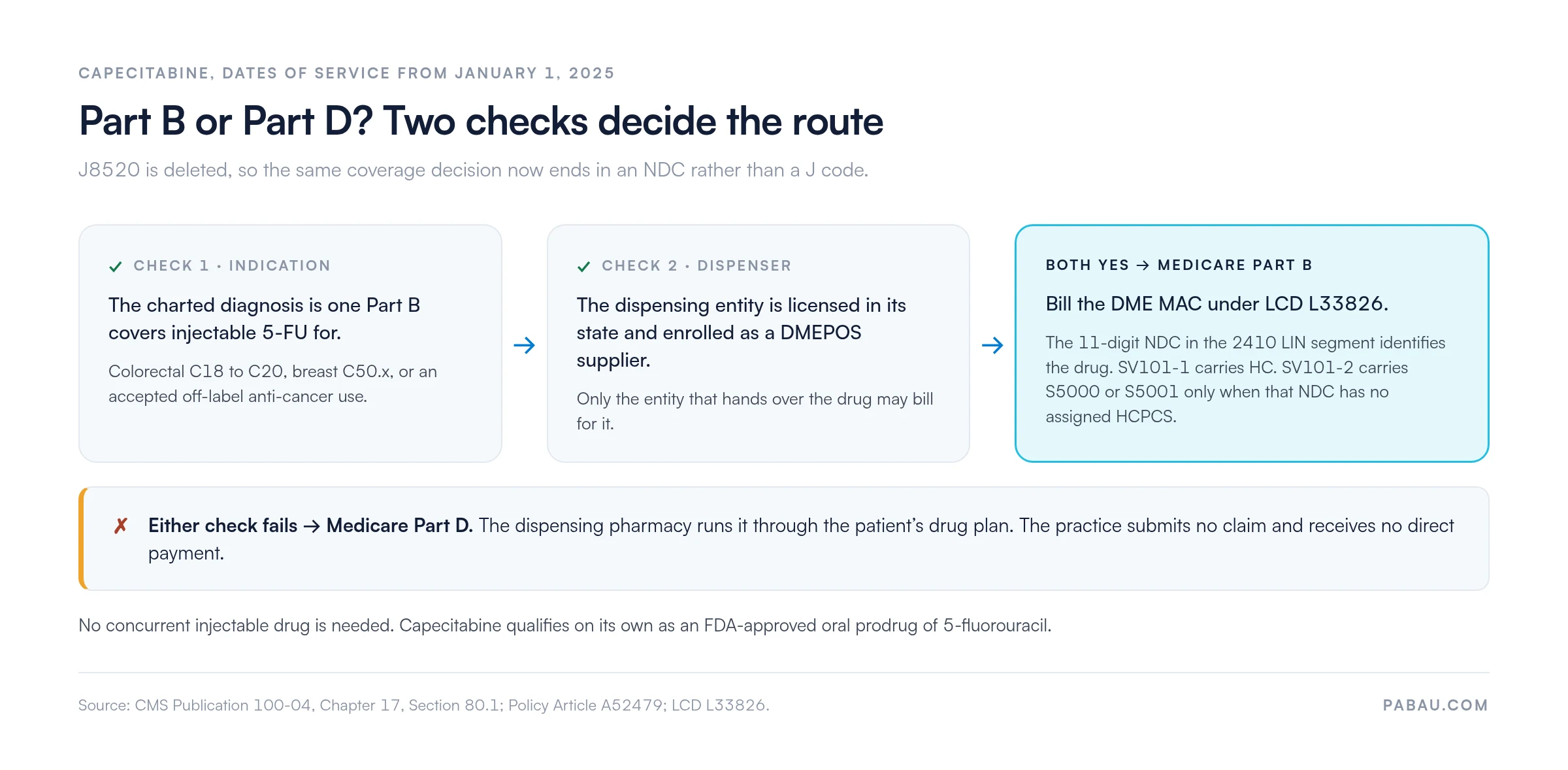
Those claims go to the DME MAC under the Oral Anti-Cancer Drugs local coverage determination, LCD L33826. CGS Medicare and Noridian publish matching billing instructions for it.
Only the entity that dispenses the drug may bill for it. That entity has to be licensed in its state and enrolled as a DMEPOS supplier.
Part D picks up the prescription when those conditions are not met. A retail or mail-order pharmacy that does not bill the DME MAC runs it through the patient’s drug plan instead. A non-cancer use fails the third criterion and moves the drug to Part D as well.
Sending a capecitabine claim to Part B when Part D applies is the expensive mistake here. The denial itself arrives fast. Unwinding it means coordinating with the patient’s drug plan, which can add weeks.
So confirm two things before you pick a route: who is dispensing the drug, and how the patient’s coverage is set up.
The billing method depends on the date of service. Three windows apply, and only the third is open for new claims. All three come from the DME MAC instructions for oral anti-cancer drugs, published by CGS Medicare and Noridian under LCD L33826.
For a current date of service, the walkthrough below produces a submittable Part B claim.
Since January 1, 2025 the NDC does the job the J code used to do. It names the manufacturer’s product exactly, down to the strength of each tablet and the count in the package. It has to match what was handed to the patient.
Format the NDC as a continuous 11-digit string. That is 5 digits for the labeler, 4 for the product and 2 for the package.
Some NDCs are printed on the box in a 10-digit format with hyphens. Convert those first, padding the short segment with a leading zero. Send the hyphenated pharmacy format and the clearinghouse will kick the line straight back.
On the 837P, the NDC goes in Loop 2410, segment LIN, with qualifier N4. On a paper CMS-1500 it goes in the shaded part of Box 24A, again after the N4 qualifier.
Claims in the October to December 2024 window worked differently. There the NDC belonged in the narrative, in NTE 2300 or NTE 2400 electronically, or Item 19 on paper.
No modifier makes a terminated code payable, and a capecitabine line no longer carries a J code at all. The KD requirement that once accompanied J8520 claims is obsolete for this drug. Liability modifiers still behave normally.
Narrative and modifier rules vary by DME MAC, so confirm them with the contractor for your region. CGS Medicare handles Jurisdictions B and C. Noridian handles Jurisdictions A and D.
There is no DME MAC Jurisdiction E, so a policy reference to one signals an unreliable source.
Under Part B, the chart has to support the claim. A claim can be technically complete and still fail an audit if the documentation behind it is thin.
So treat these five items as part of the billing job, not just the clinical one.
Where a practice dispenses capecitabine to several patients at once, that pairing gets hard to track by hand. This is the job of software for billing teams, which ties each dispensing record to the right claim line before submission.
Five codes come up around capecitabine, and none of them belongs on a current supplier claim line. The table maps each one to what it is actually for.
J8522 is the entry people misread most often. CMS created it as the crosswalk descriptor at the same time the DME MACs told suppliers to stop using J codes for capecitabine altogether.
The old unit arithmetic went out with the codes. A 1,500 mg dose once meant 10 units of J8520, and ten 500 mg tablets meant 10 units of J8521.
There is no equivalent conversion now, because the claim line carries an NDC rather than a milligram-based HCPCS unit. Report the quantity dispensed for that NDC instead.
Most capecitabine denials trace back to stored data rather than a keying error. Run this list once per claim, and once across the system whenever a coding update lands.
A clean claim for capecitabine is one where all seven hold. Miss one and the line usually comes back within days.
Capecitabine claims have their own denial pattern, and the deletion of J8520 reshaped it. The six errors below account for most of what oncology practices still see on remittance.
Sorting denials by reason code tells a billing lead which of these problems they have. CARC CO-181, procedure code invalid on the date of service, usually points at a stale J code in the charge master.
CARC CO-16, claim lacks information, usually points at the NDC or the narrative instead.
Search your charge master, saved claim templates and dispensing interface feed for J8520, J8521 and J8999, then retire all three for capecitabine. Check any payer-specific fee schedule loaded into the practice management system as well. Those often carry the old codes long after the clearinghouse has stopped accepting them. One stale entry keeps firing invalid-code denials long after the billing team has learned the new rule.
There is no current Medicare rate for J8520. A terminated code carries no payment amount, and a capecitabine line no longer carries a J code to price against. Payment on a Part B capecitabine claim follows the DME MAC’s pricing for the NDC submitted.
Suppliers who need a specific allowance should ask their DME MAC. For coding questions, ask the Pricing, Data Analysis and Coding contractor, known as PDAC.
Average Sales Price methodology still governs Part B drugs that do carry a HCPCS code, and CMS republishes those rates every quarter. The CMS ASP pricing files are the source for those figures. Free third-party HCPCS lookup tools are not.
Several run on CMS extracts a decade old, and they return no ASP pricing at all. So no fixed per-unit figure should sit in a charge master without a quarterly refresh against the CMS file.
For Part D claims, capecitabine pricing runs through the patient’s prescription drug plan formulary. The practice submits no claim and receives no direct payment, because the dispensing pharmacy handles that transaction.
If your practice dispenses capecitabine directly and is enrolled as a DMEPOS supplier, you bill the DME MAC as a supplier instead.
Two failures break capecitabine claims, and both are stored data rather than missing knowledge. One is a terminated code still sitting in the charge master. The other is an NDC that does not match what the patient was handed.
Practice management software like Pabau puts insurance claim submission and tracking in one place. Each claim gets checked for the fields payers require before it leaves, so fewer come back asking for information you already had.
The tracking side matters just as much on a drug like this one. Every submitted claim sits in one list with its status. A run of capecitabine lines stuck on an error then shows up in a morning review, not at month end.
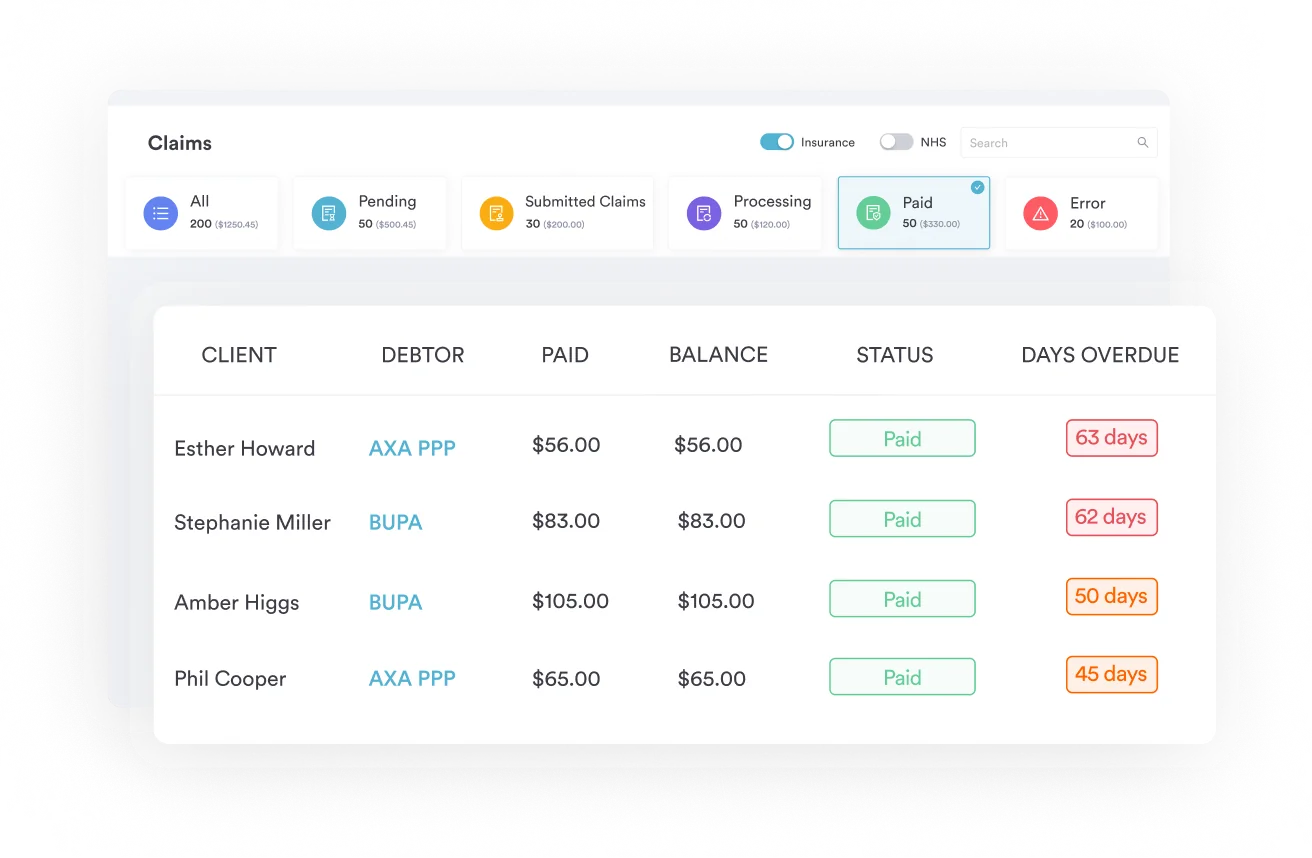

Pabau is practice management software that submits and tracks insurance claims in one place. Each claim gets checked for the fields payers require before it leaves, so your team spends less time reworking denials.

J8520 is history. It ended on September 30, 2024 alongside J8521, and J8999 carried the three months that followed. Capecitabine has been billed by NDC since January 1, 2025. J8522 exists as the 50 mg crosswalk descriptor, and no supplier submits it.
Two risks are left, and neither one is about knowing the rule. The first is a stale J code sitting in a system nobody has swept. The second is a Part B claim filed where Part D applies, which costs weeks to unwind.
Both are worth an afternoon of housekeeping, and both stay fixed once the stored data is right. If claim rework is eating your billing team’s week, book a demo and see how Pabau follows every submitted claim through to payment.

Want to cut drug claim denials across the practice? Denial management in healthcare covers how to track, appeal and prevent the rejections that repeat most often.
Need a primer on what medical billing involves end to end? What is medical billing walks through the revenue cycle from patient registration to payment posting.
Submitting 837P files and unsure what a clean claim needs? Clean claim requirements breaks down every required field, including NDC placement for drug lines.
Reading remittance and want the denial pattern faster? Electronic remittance advice explains how to read an ERA and sort denials by reason code.
Worried an audit would find your documentation thin? Medical billing compliance sets out what to keep, who signs it, and how long to hold it.
Yes, for a date of service on or before September 30, 2024. That is what the code covers, so a rework of an old claim keeps it. Medicare’s timely filing limit is one calendar year from the date of service, though. Most 2024 capecitabine claims are past that window now.
A J code groups a drug by name and by a unit of measure, such as 150 mg. An NDC identifies one manufacturer’s exact package, down to strength and count. That is why the quantity math changed. Units used to be a milligram calculation, and now the quantity is what was dispensed.
The standard Part B rules apply. Once the annual Part B deductible is met, Medicare pays 80 percent of the approved amount and the patient owes the remaining 20 percent. A supplemental policy may cover that share. Under Part D, the patient pays whatever cost sharing their drug plan sets.
They have to cover what Original Medicare covers, so the Part B benefit still stands. Each plan sets its own prior authorization, network and supplier rules on top of that. Check the member’s plan before the drug is dispensed, because a retroactive approval is rarely granted.