Inpatient billing cheat sheet
An inpatient billing cheat sheet is a quick reference for the codes and claim ru...

Last Updated: Oct 19, 2026
J7683 is the HCPCS Level II code for triamcinolone, inhalation solution, compounded product, administered through dme, concentrated form, per milligram.
The code is active, and Medicare will not pay it. CMS Policy Article A52466 denies every compounded inhalation solution as not reasonable and necessary, and J7683 is named in that list.
So the claim has a different job than usual. It documents a non-covered dispense and moves the balance to the patient, rather than chasing an allowable.
Let Pabau's smart automation suggest the right codes, reduce claim denials, and keep your practice compliant—effortlessly.
Automate repetitive tasks and focus on what matters most—your patients.
Reduce coding errors and ensure compliance with the latest regulations.
Clean claims, fewer denials, and faster reimbursements.
Powerful insights and reporting to help your practice thrive.
HIPAA compliant SOC 2 certified GDPR-compliant Trusted by 4,000+ clinics worldwide

HCPCS Code J7683 is triamcinolone, inhalation solution, compounded product, administered through DME, concentrated form, per milligram.
Medicare denies J7683 as not reasonable and necessary, because Policy Article A52466 excludes every compounded inhalation solution.
Bill one unit per milligram of triamcinolone dispensed, and match the unit count to the physician order.
The KO, KP and KQ modifiers belong on unit dose codes such as J7684, never on a concentrated form code.
A signed Advance Beneficiary Notice, taken before dispensing, is what lets the supplier bill the patient after the denial.
J7683 describes triamcinolone, inhalation solution, compounded product, administered through DME, concentrated form, per milligram.
It is a Level II HCPCS J-code maintained by the Centers for Medicare and Medicaid Services (CMS). Suppliers report it when a pharmacy compounds concentrated triamcinolone for delivery through a physician-ordered nebulizer.
Two phrases in that descriptor do most of the work. “Compounded product” means a pharmacy mixed the solution, rather than supplying an FDA-approved final product. “Concentrated form” means it is diluted before nebulization, unlike the ready-to-use unit dose form that J7684 describes.
Medicare denies J7683. Policy Article A52466, the companion document to nebulizer LCD L33370, lists the compounded inhalation solutions that will be denied as not reasonable and necessary.
J7683 sits in that list alongside J7680, J7681, J7684 and J7685. A52466 is a policy article rather than the LCD itself, and it is where the payment rules for these codes actually live.
The block sits with the product itself. Medicare pays for FDA-approved final products delivered through a nebulizer, and a pharmacy-compounded solution does not meet that standard. No physician order and no diagnosis code makes the line payable.
This is a medical-necessity denial rather than a statutory exclusion, and that distinction decides who pays. Liability moves to the patient only when a signed Advance Beneficiary Notice (ABN) is on file before the drug is dispensed. Without one, the supplier absorbs the cost.
Claims and appeals run through the DME MAC for the beneficiary’s jurisdiction. Four contractors split the country between them, and two of them cover two jurisdictions each.
A52466 applies nationally, so all four contractors handle J7683 the same way. Fee schedule amounts still update quarterly for the codes that do pay. Pull those figures from the contractor’s own site rather than a rate aggregator.
Take a signed ABN before compounded triamcinolone leaves the pharmacy, and file it with the physician order. The denial itself is predictable and costs nothing to plan around. A missing waiver is what turns a routine non-covered line into an unbillable balance.
The line still has to be built correctly, even though it will deny. A clean denial supports patient billing and any appeal. A rejection for an invalid code supports neither, and it has to be reworked before either can happen.
J7683 is billed per 1 mg of triamcinolone dispensed. The unit count must equal the total milligrams on the physician order, so a 40 mg dispense is 40 units. Round-number entries that do not match the dispensed quantity are a standard audit flag.
The KO, KP and KQ modifiers do not belong on J7683. A52466 restricts them to unit dose form codes, and J7683 is a concentrated form code. Appending one invalidates the line before the coverage decision is reached.
Two other modifiers matter here. KX attests that the coverage criteria in LCD L33370 have been met, which is relevant on the nebulizer and on drugs that can be paid. GA tells the contractor that a signed ABN is on file for an expected denial, which is the one J7683 usually needs.
Keep the same file you would keep for a covered drug, plus the waiver. Four documents carry the line:
On a non-covered line, the ABN is the document an auditor asks for first.
A listed diagnosis does not make J7683 payable. The codes below support nebulizer therapy under LCD L33370, and they belong on the claim. The compounded-product denial still applies, whatever sits in the diagnosis field.
Our ICD-10-CM code reference covers how each of these families is structured if you need to confirm a fourth or fifth character.
Covered diagnosis lists are grouped by HCPCS code inside A52466 and they change, so check the current groups for your jurisdiction before you submit.
Medicaid managed care plans and many commercial payers want an NDC on the drug line alongside the HCPCS code. A compounded preparation has no finished-product NDC of its own, so payers ask for the NDC of the triamcinolone the pharmacy started from.
Report it in the 11-digit 5-4-2 format, with the quantity and the unit qualifier the payer specifies. Compound billing rules differ on whether a plan wants every ingredient listed or only the active drug, so check the policy before the first submission.
Both codes describe a compounded triamcinolone product and both are denied, so the choice between them does not change the payment.
What it changes is whether the line is valid at all. J7684 requires a KO, KP or KQ modifier, and J7683 must not carry one. A swapped code therefore produces a rejection instead of a clean denial.
This range is not a triamcinolone family. It covers terbutaline sulfate, tobramycin and triamcinolone, and it mixes compounded products with one FDA-approved final product. The thing that decides payment across all six codes is the product type, not the drug and not the form.
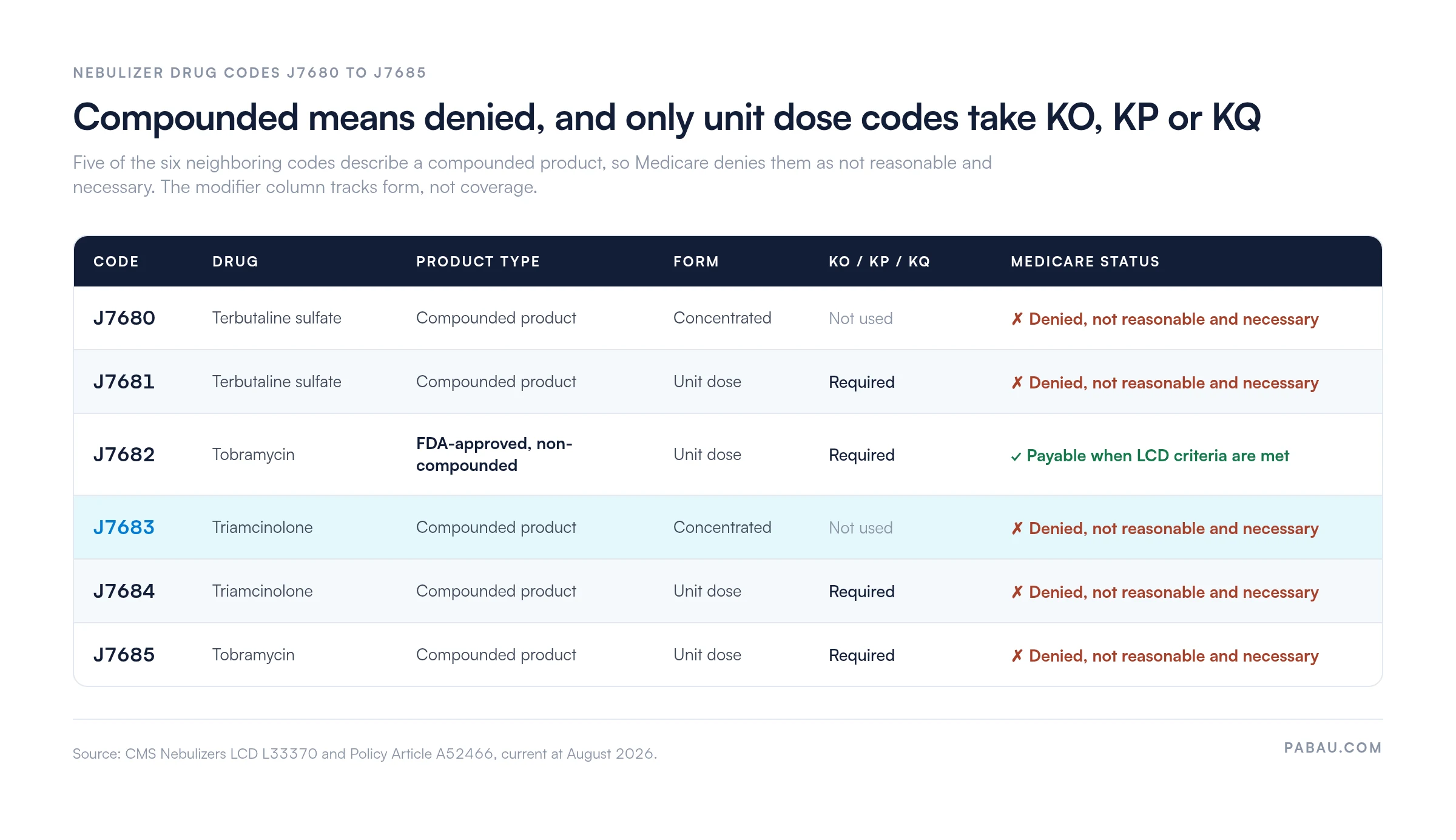
The full official descriptors are worth reading once, because the drug name alone will not tell you which code to pick.
When you audit claims in this range, sort by product type before you sort by code. Every compounded line should carry a GA modifier and a matching ABN in the file. Any that does not is a balance you cannot bill and cannot appeal.
Errors on J7683 cluster around a handful of repeatable mistakes. Good denial management catches them before the claim leaves the practice, rather than after the remittance arrives.
In most practices the order, the signed ABN and the invoice live in three places. The order sits in the clinical record, the waiver is a scan in a shared folder, and the balance sits in the billing system. When a J7683 line denies, someone has to reassemble all three before the patient can be billed.
Pabau, an all-in-one practice management system, keeps them on one patient record. The order and the signed waiver attach to the file. The dispensed quantity is recorded against the treatment note, and the invoice is raised from the same record.
Our claims management software is where those pieces meet, so the billing team does not have to reassemble them after the remittance arrives.
The outcome is that a predictable denial gets billed on the day it lands, rather than aging in a worklist until someone writes it off.
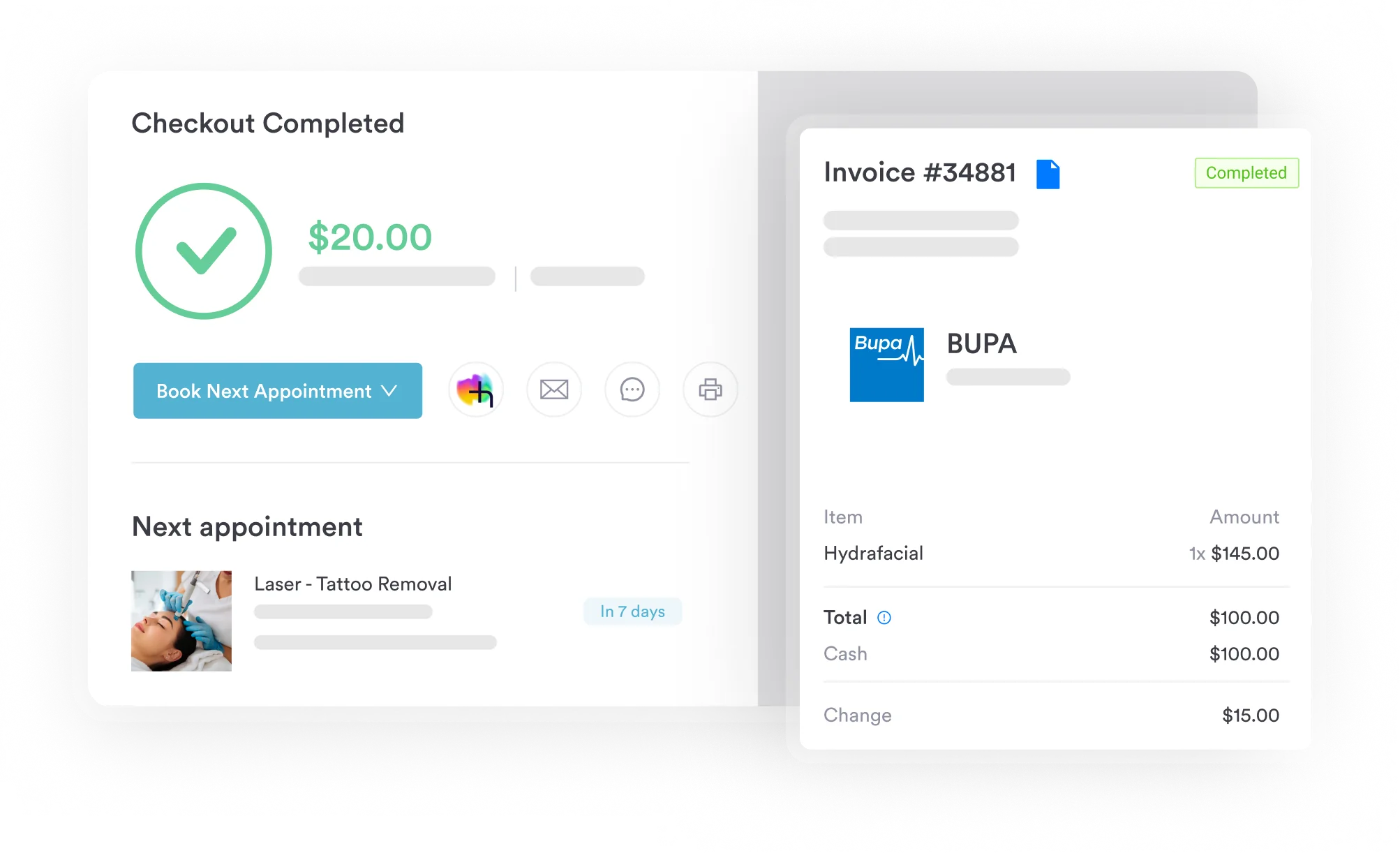

Pabau keeps the physician order, the signed waiver and the invoice on one patient record. A non-covered drug line then gets billed the day the remittance arrives.

The point worth remembering about J7683 is that the claim itself is rarely the question. Medicare has denied compounded inhalation solutions for years, and it will deny this one, so the payment outcome is settled before you submit.
What you control is the file around it. A signed ABN before dispensing, a unit count that matches the order, and no KO, KP or KQ on the line will never win coverage. They decide whether the balance is billable to the patient or a write-off for the supplier.
Recheck A52466 each year rather than assuming, because CMS revises the compounded-drug list. Book a demo to see how Pabau keeps the order, the waiver and the invoice on one record. A denied drug line then still gets paid.

Need to see where a denial sits in the wider billing cycle? Revenue cycle management fundamentals covers the claim lifecycle from charge capture through to payment posting.
Want fewer avoidable rejections on the codes that do pay? Clean claim submission sets out the fields payers reject on first pass and how to catch them earlier.
Tightening documentation before claims go out? Medical billing compliance outlines the records that support a non-covered drug line under Medicare.
J7683 reports triamcinolone, inhalation solution, compounded product, administered through DME, concentrated form, per milligram. Suppliers use it when a pharmacy compounds concentrated triamcinolone for a physician-ordered home nebulizer. It records the dispense, but it does not produce a Medicare payment.
No. CMS Policy Article A52466 denies compounded inhalation solutions as not reasonable and necessary, and J7683 is named in that list. Because it is a medical-necessity denial rather than a statutory exclusion, a signed Advance Beneficiary Notice is what allows the supplier to bill the patient.
One unit per 1 mg of triamcinolone dispensed. The unit count must equal the total milligrams on the physician order, so a 40 mg dispense is billed as 40 units. Unit counts that do not match the order are a common audit flag.
No. A52466 restricts KO, KP and KQ to unit dose form codes such as J7684. J7683 is a concentrated form code, so appending one of them invalidates the line. The modifier J7683 usually needs is GA, which signals that a signed waiver is on file.
J7683 covers the concentrated form of compounded triamcinolone, which is diluted before nebulization. J7684 covers the unit dose form, administered as supplied. Both are billed per 1 mg and both are denied, but only J7684 takes a KO, KP or KQ modifier.
COPD codes such as J44.0 and J44.1, and asthma codes such as J45.20 through J45.50, support nebulizer therapy under LCD L33370. They belong on the claim, but they do not make a compounded drug payable. Check the current diagnosis groups in A52466 before submitting.