Inpatient billing cheat sheet
An inpatient billing cheat sheet is a quick reference for the codes and claim ru...

Last Updated: Oct 19, 2026
J7684 is the HCPCS Level II code for triamcinolone, inhalation solution, compounded product, administered through dme, unit dose form, per milligram.
The DME MAC nebulizer policy, LCD L33370, names J7684 among the compounded inhalation solutions that will be denied as not reasonable and necessary. The code is valid to submit, but a denial is the expected result rather than a claim error to rework.
That changes what billers should do with the code. Guidance that presents J7684 as an average sales price (ASP) drug with quarterly updates is describing a different set of codes. Those are the covered, FDA-approved nebulizer drugs, such as budesonide under J7626.
Let Pabau's smart automation suggest the right codes, reduce claim denials, and keep your practice compliant—effortlessly.
Automate repetitive tasks and focus on what matters most—your patients.
Reduce coding errors and ensure compliance with the latest regulations.
Clean claims, fewer denials, and faster reimbursements.
Powerful insights and reporting to help your practice thrive.
HIPAA compliant SOC 2 certified GDPR-compliant Trusted by 4,000+ clinics worldwide

HCPCS code J7684 describes triamcinolone inhalation solution as a compounded product, administered through DME, unit dose form, per milligram.
Medicare denies J7684 as not reasonable and necessary, because DME MAC policy L33370 lists every compounded inhalation solution as non-covered.
No ICD-10 code supports medical necessity for J7684, so a different diagnosis on the claim will not change the outcome.
A compounded preparation has no manufacturer-reported average sales price, so no quarterly ASP payment limit exists for this code.
Unit dose lines still need a KO, KP, or KQ modifier, plus GA when an ABN is on file or GZ when one is not.
Budesonide billed as J7626 is the FDA-approved, non-compounded route Medicare covers for nebulized corticosteroid therapy.
Practice management software like Pabau keeps orders, delivery records, and claim detail in one patient file, so expected denials are handled cleanly.
J7684 sits in the J-code series of HCPCS Level II, which CMS maintains for drugs and biologicals that CPT does not report. The official long descriptor is: Triamcinolone, inhalation solution, compounded product, administered through DME, unit dose form, per milligram.
Two words in that descriptor decide the money: compounded product. HCPCS splits most nebulizer drugs into a pair of codes, one for the FDA-approved final product and one for the pharmacy-compounded version. Triamcinolone has no FDA-approved final product code at all. Both triamcinolone inhalation codes, J7683 and J7684, describe compounded preparations, which is why neither one gets paid.
Medicare denies J7684 because the DME MACs treat every compounded inhalation solution as not reasonable and necessary. The nebulizer LCD lists the affected codes by number, J7684 among them, and states that they will be denied.
CGS Administrators and Noridian Healthcare Solutions apply that policy across all four DME MAC jurisdictions. The answer does not change with the patient address.
The nebulizers policy article (A52466) defines what counts as compounded. A compounded inhalation solution is one where the product delivered to the beneficiary is not an FDA-approved preparation. A pharmacy has mixed, combined, or altered ingredients for an individual patient.
The starting ingredient can be an FDA-approved injectable. Once the pharmacy mixes it into a nebulizer solution, the dispensed product is compounded. J7684 is then the correct code for a non-covered item.
The denial does not stop at the drug line. If none of the drugs used with a nebulizer are covered, the equipment falls with them. The compressor, the nebulizer, and related accessories are denied as not reasonable and necessary. A patient whose only nebulized drug is compounded triamcinolone therefore loses the equipment claim alongside the drug claim.
One distinction matters for the appeal and for patient liability. This is a medical necessity denial under an LCD, not a statutory exclusion. Inhalation drugs furnished through covered DME sit inside a Medicare benefit category, so the item is covered in principle and denied on policy.
That is what makes an Advance Beneficiary Notice (ABN) the right instrument for shifting liability to the patient.
Ask the dispensing pharmacy one question before the claim goes out: is this an FDA-approved final product or a compounded preparation? That single answer decides whether the line is J7626 and payable or J7684 and denied. Record the answer in the patient file, because it is the fact an auditor will ask you to evidence.
There is no Medicare allowed amount to look up for J7684. Payment limits under the ASP methodology are built from sales data that manufacturers report to CMS each quarter. A solution mixed by a pharmacy for one patient has no manufacturer behind it.
With no reported average sales price, CMS publishes no quarterly payment limit for the code. The DME MACs deny the line rather than price it.
Covered nebulizer drugs work differently. The four DME MACs jointly establish payment limits for drugs billed to them, under the ASP-based statutory formula, and those limits are refreshed quarterly. Check them on the DME MAC drug fee schedule. The Physician Fee Schedule lookup tool prices physician services and does not carry DME drug allowances.
The dispensing fee rule catches suppliers who expect at least a handling payment. G0333, Q0513, and Q0514 are payable for covered inhalation drugs only. Each must be billed on the same claim as the drug, and one fee is paid per period.
A shipment of compounded triamcinolone generates none of them, and the policy is explicit that compounding itself is not separately payable.
Bill J7684 only when the patient asks for a claim, or a secondary payer needs a Medicare denial on file. Units follow the descriptor: one unit per milligram, so a 4 mg unit dose vial is four units.
Modifiers decide whether the line is processed at all. The policy article is prescriptive about which ones belong on a unit dose line:
Two smaller rules save rework. Do not bill the diluent separately for a compounded unit dose preparation. A pharmacist diluting a concentrate into ready-to-use single dose vials still produces a compounded unit dose product, billed on the unit dose code — the step that lands many claims on J7684 unintentionally.
Because the denial is predictable, get the ABN right. Issue it before delivery, explain the expected Medicare decision in plain terms, and keep the signed copy with the delivery record. The denial codes reference helps separate this from fixable coding errors.
No diagnosis makes J7684 payable. The nebulizers policy article puts J7684 in the group where all ICD-10 codes are listed as not supporting medical necessity. Severe persistent asthma supports this line no better than an unspecified code does. The denial follows the product rather than the patient.
The asthma and COPD codes below still matter, but they belong on the covered drug line and the equipment claim. They sit in the policy group that supports medical necessity for codes such as J7626 budesonide and J7644 ipratropium.
The diagnosis on a covered line still has to match the treating physician record. Pairing a COPD code with a note that documents asthma alone creates a mismatch. DME MAC reviewers find those mismatches quickly, so the check belongs at order entry.
A compounded solution has no National Drug Code of its own. NDCs identify manufactured final products, and a pharmacy preparation mixed for one patient is not one. What the pharmacy holds instead is the NDC of each source ingredient, such as the injectable triamcinolone acetonide it started from, plus the compounding record.
The nebulizer drug codes run in pairs, and coverage tracks the pair rather than the drug. One code in each pair describes the FDA-approved final product and gets paid when the criteria are met. The other describes the compounded version and is denied. The map below shows how that split falls across the three drugs nebulized most often.
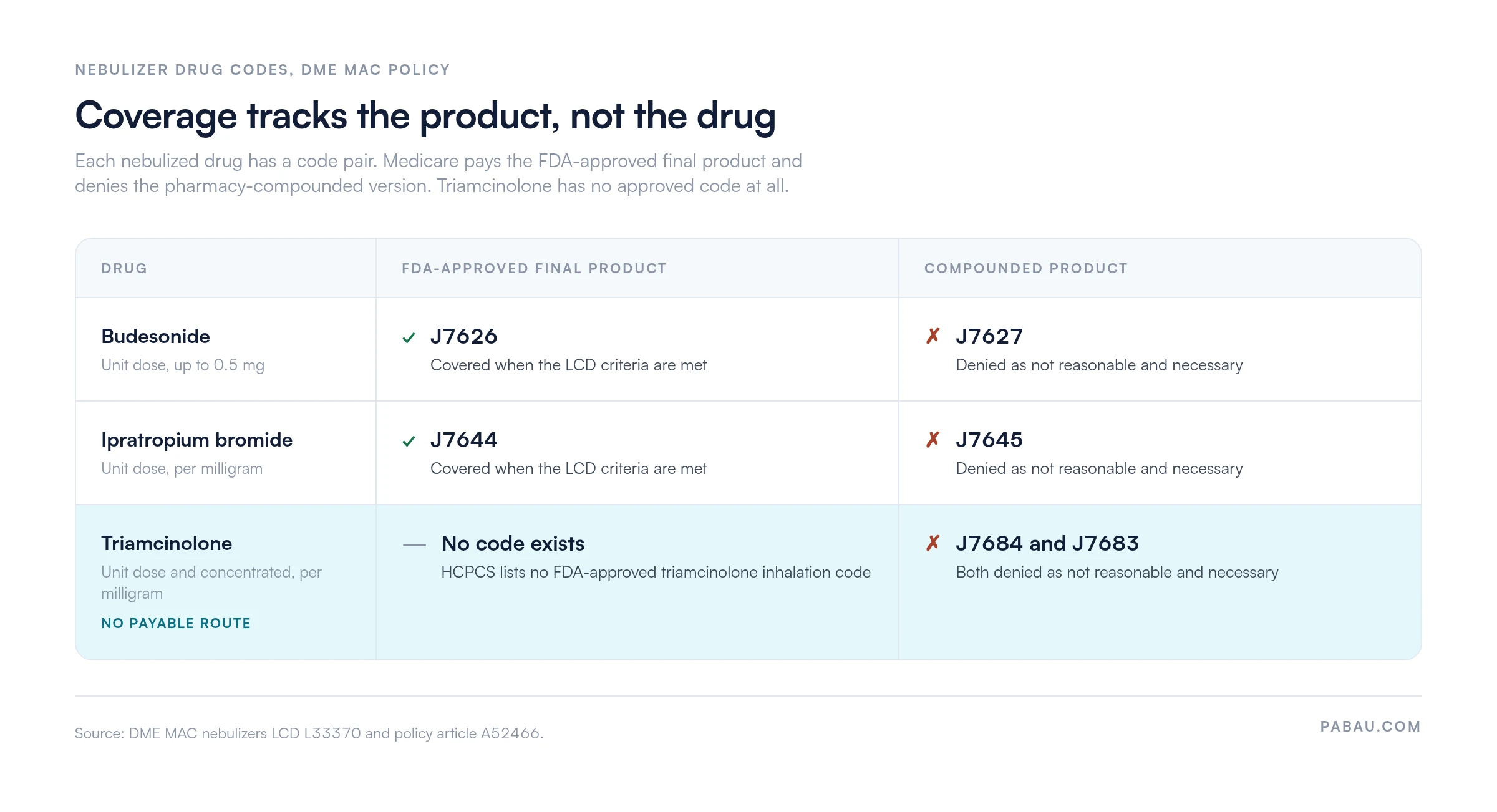
J7683 and J7684 are the pair billers confuse most often, and the choice between them changes nothing about payment. Both are compounded triamcinolone, so both are denied. The distinction that does carry money is the one across the pair, from a compounded code to the FDA-approved code for a different corticosteroid.
Budesonide inhalation solution is the usual covered route for nebulized corticosteroid therapy in Medicare patients. Its FDA-approved unit dose code is J7626, described as an FDA-approved final product, non-compounded, administered through DME, unit dose form, up to 0.5 mg.
The prescribing decision belongs to the physician. The supplier role is to flag the coverage position before a patient is dispensed a product that cannot be paid.
The file for a nebulizer drug claim has to stand up on its own, and the compounded question belongs in it. Keep the following together in the patient record:
Keep a short internal note against J7684 in your billing system that reads: non-covered, LCD L33370, ABN required, expect denial. A code-level note stops the next biller from rediscovering the policy. It also gives new staff the answer before the claim goes out.
Nebulizer drug billing goes wrong in the handoffs. The order arrives from the prescriber. The pharmacy decides which product it dispenses. The biller picks a code days later from whatever made it into the file. When those three records live in separate systems, nobody can see that a compounded product left the shelf until the remittance says so.
Practice management software like Pabau keeps the whole chain in one patient record. The order, the signed ABN, the delivery note, and the invoice sit against the same file.
The person coding the line can see what was dispensed and what the patient was told. Digital forms capture the ABN signature at the point of delivery instead of leaving it on paper in a van.
From there, claims software for suppliers submits what your team entered and tracks what comes back, and reporting groups the results by code.
A supplier can see how many J7684 lines went out in a quarter, and how many carried an ABN. The same screen shows how much of that revenue was always going to fall to the patient. That is what turns a predictable denial into a planned conversation.

Pabau holds the order, the signed ABN, the delivery record, and the invoice in one patient file. Billing teams code J-code lines from the record itself.

HCPCS code J7684 is a valid code for a non-covered product. The compounded wording in its descriptor puts it on the DME MAC denial list. No diagnosis lifts it off, and no ASP-based rate exists to bill against.
Handling it well takes four steps. Verify coverage before dispensing, get the ABN signed, and code the line with KO, KP, or KQ plus GA or GZ. Then point the prescriber toward J7626 when nebulized corticosteroid therapy is the goal.
Teams that handle this cleanly are the ones whose records make the answer visible before the claim goes out. To see how Pabau keeps orders, consents, delivery records, and billing in one place, book a demo with the team.

Need the wider process behind a clean J-code claim? What is medical billing covers the route from charge capture through payment posting.
Tracking denial patterns across DME drug lines? Denial management in healthcare sets out how to sort policy denials from fixable ones.
Want fewer rejections before the payer sees the claim? Clean claim submission explains the checks that catch the most common HCPCS errors.
Billing the covered corticosteroid instead? HCPCS code J7626 walks through budesonide unit counting, modifiers, and coverage criteria.
HCPCS code J7684 reports triamcinolone inhalation solution that is a compounded product, administered through DME, in unit dose form, per milligram. Suppliers use it when a pharmacy has mixed the nebulizer solution for an individual patient rather than dispensing an FDA-approved final product.
No. The DME MAC nebulizer policy, LCD L33370, lists J7684 among the compounded inhalation solutions that will be denied as not reasonable and necessary. The code remains valid to submit, which matters when a patient or a secondary payer needs the Medicare denial on record.
The denial follows the product rather than the patient. A compounded preparation is not an FDA-approved final product, and the nebulizer policy treats every compounded inhalation solution as not reasonable and necessary. Clinical severity does not change that position.
Every unit dose line needs KO, KP, or KQ, or it is denied as an invalid code. Add GA when a properly executed ABN is on file and GZ when one is not. Lines without KX, GA, or GZ are rejected as missing information, and KX does not apply to this code.
There is none. Payment limits under the ASP methodology come from sales data that manufacturers report to CMS. A pharmacy-compounded solution has no reported average sales price. The DME MACs deny the line instead of pricing it.