CCSD Code W1640: Simple pelvic osteotomy and fixation
CCSD Code W1640: Definition and procedure scope CCSD Code W1640 covers a simple ...

Last Updated: Nov 26, 2026
J7645 is the HCPCS Level II code for ipratropium bromide, inhalation solution, compounded product, administered through DME, unit dose form, per milligram. It applies only to compounded preparations, not to FDA-approved ipratropium.
Medicare does not pay for J7645. DME MAC LCD L33370 denies every compounded inhalation solution as not reasonable and necessary, in all jurisdictions. The covered code for FDA-approved ipratropium is J7644, so confirm the product source before you code and collect an ABN before dispensing a compounded product.
Let Pabau's smart automation suggest the right codes, reduce claim denials, and keep your practice compliant—effortlessly.
Automate repetitive tasks and focus on what matters most—your patients.
Reduce coding errors and ensure compliance with the latest regulations.
Clean claims, fewer denials, and faster reimbursements.
Powerful insights and reporting to help your practice thrive.
HIPAA compliant SOC 2 certified GDPR-compliant Trusted by 4,000+ clinics worldwide

HCPCS Code J7645 reports compounded ipratropium bromide inhalation solution, unit dose form, per milligram, delivered through a DME nebulizer
Medicare does not pay for J7645: DME MAC LCD L33370 denies every compounded inhalation solution as not reasonable and necessary, in all jurisdictions
J7644, the code for FDA-approved ipratropium, is the Medicare-covered code, capped at 93 mg per month under the same LCD
Bill J7645 to Medicare with GA when a valid ABN is on file, or GZ without one, and never append KX
Medicaid and commercial payers set their own policies for compounded drugs, so verify coverage in writing before dispensing
HCPCS Code J7645 is the Level II drug code for ipratropium bromide, inhalation solution, compounded product, administered through DME, unit dose form, per milligram. Medicare denies it under DME MAC LCD L33370, which names J7645 among the compounded inhalation solutions it will not cover.
The code is valid to report, and CMS maintains it in the HCPCS Level II code set. Valid does not mean payable, and the payable ipratropium code under Medicare is J7644.
Two words in the descriptor, “compounded product,” separate J7645 from J7644. Under Medicare, they also separate a denied claim from a payable one.
Medicare covers nebulizer drugs under the DME benefit, and the two DME MACs apply one shared policy. LCD L33370 (Nebulizers), revision effective February 1, 2026, settles compounded products in a single sentence.
“Compounded inhalation solutions (J7604, J7607, J7609, J7610, J7615, J7622, J7624, J7627, J7628, J7629, J7632, J7634, J7635, J7636, J7637, J7638, J7640, J7641, J7642, J7643, J7645, J7647, J7650, J7657, J7660, J7667, J7670, J7676, J7680, J7681, J7683, J7684, J7685, and compounded solutions billed with J7699) will be denied as not reasonable and necessary.”
LCD L33370, Nebulizers
The companion Policy Article A52466 defines a compounded inhalation solution as one that is not an FDA-approved preparation. It keeps separate codes for the FDA-approved and compounded forms of each drug. It also lists J7645 among the codes for which no ICD-10 diagnosis supports medical necessity.
That denial does not depend on the jurisdiction, the diagnosis, or a prior authorization. It changes five things at the claim level.
Before you dispense compounded ipratropium to a Medicare patient, ask the prescriber whether the FDA-approved product would serve. A switch to J7644 turns a guaranteed denial into a covered claim, and the patient avoids the full cash price.
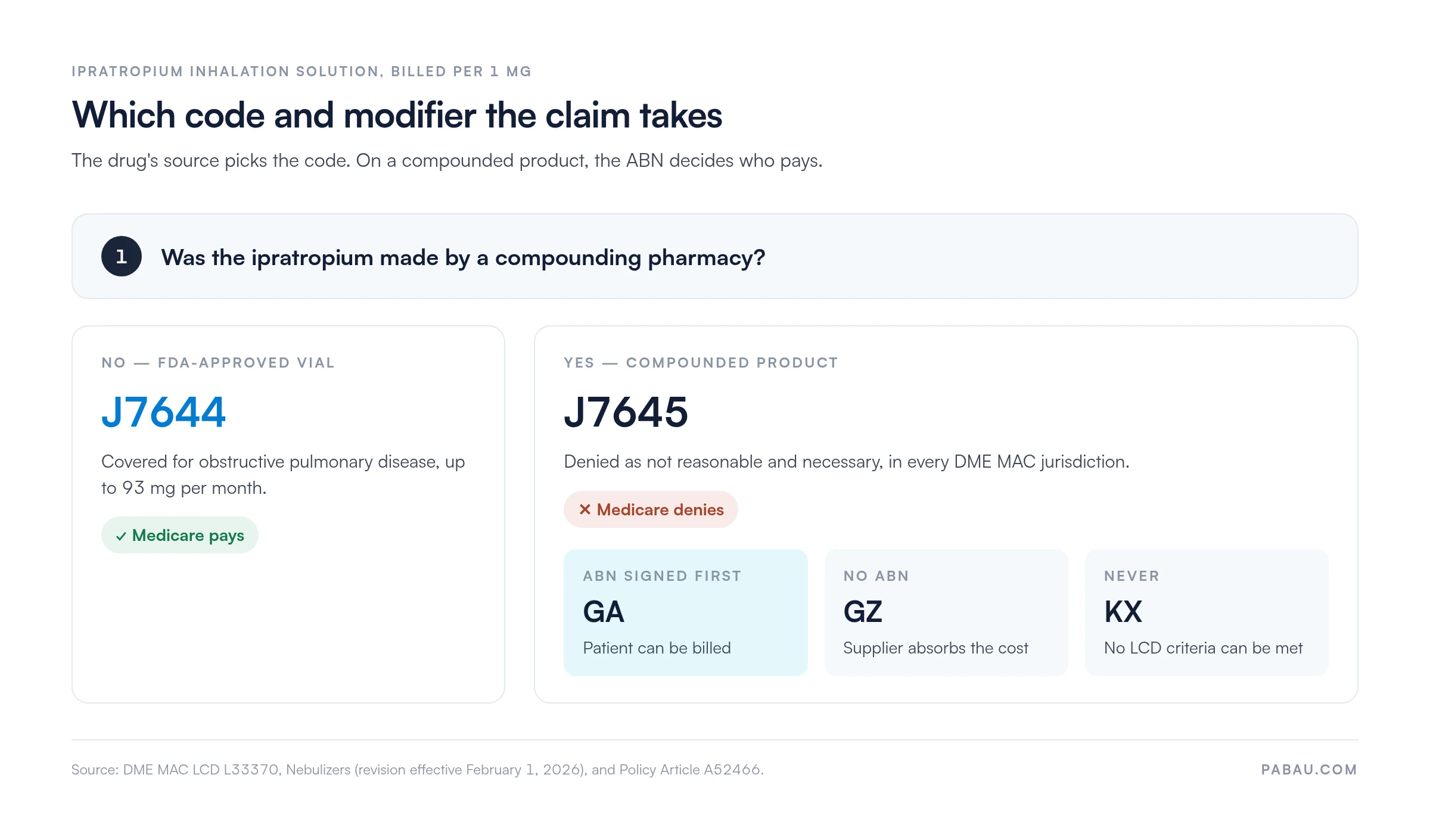
J7644 reports FDA-approved ipratropium bromide inhalation solution, and J7645 reports the compounded version. The product decides the code, never the payer you hope will pay.
The practical test is where the drug came from. A commercially manufactured, FDA-approved unit dose vial is J7644. A preparation made by a compounding pharmacy is J7645, even when the dose and the nebulizer are identical.
The FDA-approved and compounded split runs through the whole J76xx range. The codes coders mix up most often sit next to J7645.
Every compounded code in that table is on the LCD L33370 denial list. When ipratropium and albuterol are dispensed together, code each drug separately by its own unit. The FDA-approved pair, J7644 with J7613, is the combination Medicare covers.
Denied by Medicare does not always mean unpaid. A few routes stay open, and each one runs on its own policy.
Run the same checks for every non-Medicare payer before the first fill:
Medicare pays nothing for J7645. The claim line denies under LCD L33370, so no allowed amount, deductible or coinsurance applies to it.
Any payment comes from a payer outside original Medicare, at whatever rate that payer sets. Treat a commercial or Medicaid figure as a contract term to confirm, not a benchmark you can look up on the CMS fee schedule.
One unit of J7645 equals 1 mg of ipratropium bromide. Report the total milligrams dispensed on the claim line, not a rounded count per treatment.
Policy Article A52466 shows the method with albuterol: 120 ampules of 2.5 mg bill as 300 units. The same arithmetic applies to ipratropium, and it applies to J7644 as well.
Under J7644, Medicare denies claims above 93 mg of ipratropium per month. Use the same total-mg count when a non-Medicare payer pays J7645, unless its policy states another unit rule.
On a code Medicare denies as not reasonable and necessary, the modifiers report whether the patient was warned. That one fact decides who carries the cost.
The ABN has to name the item, give the reason Medicare is expected to deny it, and quote the cost. Get the signature before the first delivery, then keep it with the order and proof of delivery.
Put together, the claim turns on two questions: where the drug came from, and whether an ABN was signed first.
Documentation cannot win Medicare coverage for J7645. It still decides whether the patient or a non-Medicare payer can be billed, and whether the record survives an audit.
A Certificate of Medical Necessity is not part of this process. CMS retired CMNs for DMEPOS claims, and the SWO now carries the order.
Policy Article A52466 lists J7645 with the codes for which no ICD-10 diagnosis supports medical necessity. Under Medicare, no diagnosis code on the claim will change the outcome.
The obstructive pulmonary disease codes below matter for J7644 under Medicare, and for any other payer that covers the compounded product. Check each one against the ipratropium diagnosis group in A52466, or the other payer’s own list. Code to the detail the record supports, so a documented COPD exacerbation goes to J44.1 rather than J44.9.
Most J7645 denials trace back to one assumption, that Medicare pays compounded ipratropium. Each of the six triggers below comes with its fix. The reference on medical billing denial codes decodes the remittance, and the guide to denial management strategies covers the wider workflow.
Build a hard stop into order intake. If the payer is original Medicare and the product is compounded, send the order back to the prescriber before dispensing. It costs one phone call, and it saves a denied claim and a disputed patient bill.
A code Medicare denies creates work before the claim is ever built. Someone has to confirm the payer, collect a signed notice, and quote the patient a price. Pabau, a practice management and billing platform, keeps all three on one patient record.
Pabau’s claims management software works with Claim.MD in the US. It checks a patient’s eligibility before the visit, submits the claim, and imports the ERA remittance so your team sees each denial reason.
Pabau’s digital forms hold the ABN and the delivery sign-off against the same patient. At checkout, the self-pay balance is invoiced and collected rather than left in accounts receivable.
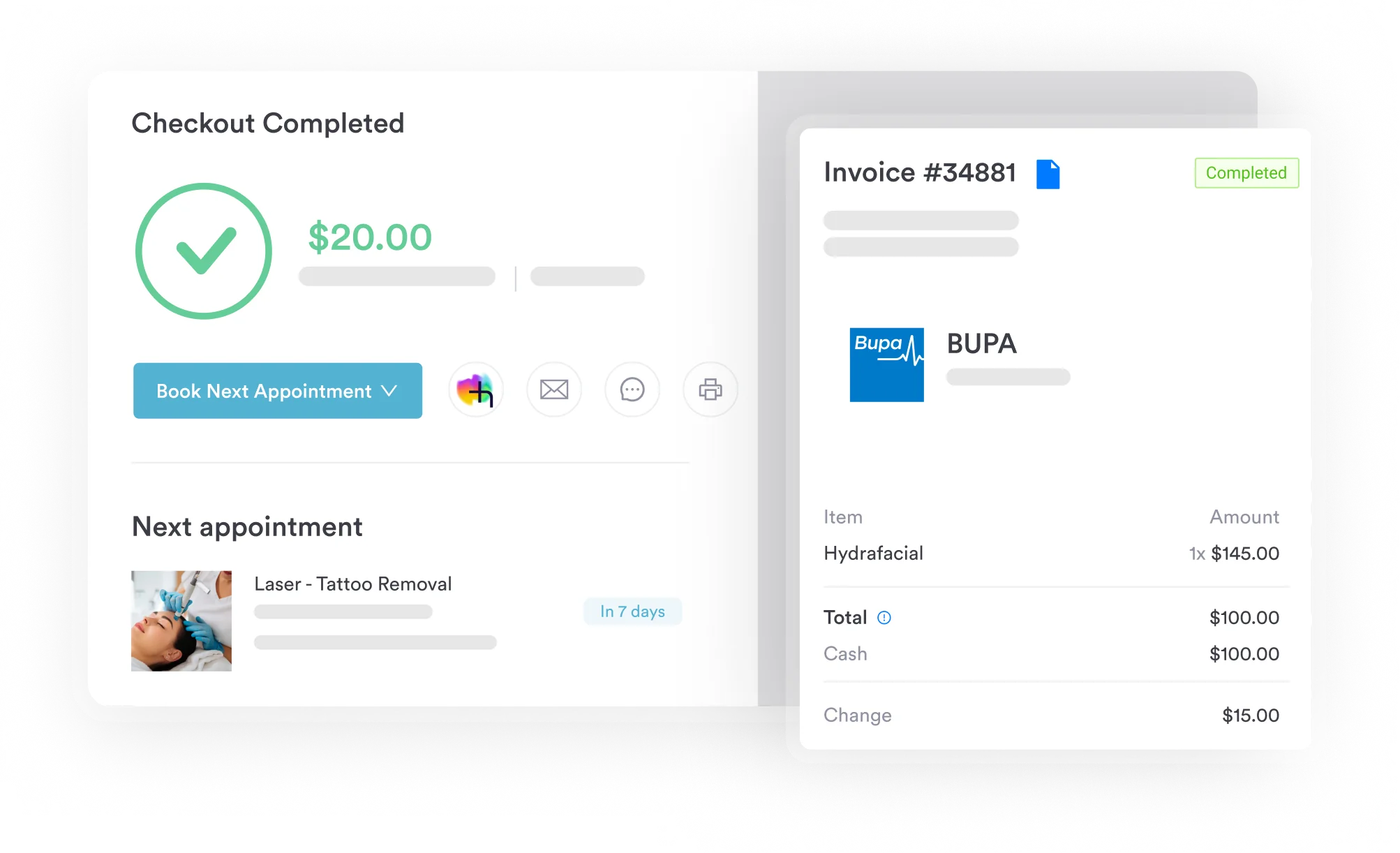

Pabau checks eligibility, submits claims through Claim.MD, and imports ERA remittances. Digital forms keep the ABN on the patient record, so a denied claim never becomes an unbillable one.

LCD L33370 denies compounded ipratropium in every DME MAC jurisdiction, so a J7645 claim to Medicare only ever records a denial. The decision that protects revenue is made before dispensing.
Steer Medicare patients to FDA-approved ipratropium under J7644 wherever the prescriber agrees. When the compounded product is the right choice, get an ABN or written payer approval first, and bill units as total milligrams.
Book a demo to see how Pabau keeps the eligibility check, the ABN and the patient payment on one record.

Need a broader view of HCPCS billing structure? Medical billing fundamentals explains how HCPCS Level II codes fit into the overall claims lifecycle.
Seeing recurring claim rejections across payer types? Denial management in healthcare covers systematic approaches to tracking, categorizing, and appealing denied claims.
Keeping your drug billing documentation audit-ready? Medical billing compliance outlines the documentation standards that protect practices during payer audits.
Dispensing FDA-approved ipratropium instead? HCPCS code J7644 covers the Medicare-covered code, its 93 mg monthly limit and the diagnosis group behind it.
Billing albuterol in the same nebulizer order? HCPCS code J7613 explains the unit-dose albuterol code that pairs with J7644.
HCPCS Code J7645 is the Level II code for compounded ipratropium bromide inhalation solution, unit dose form, per milligram, given through a DME nebulizer. It applies only to compounded preparations. FDA-approved ipratropium is reported under J7644.
No. DME MAC LCD L33370 denies all compounded inhalation solutions, J7645 included, as not reasonable and necessary. The denial applies in every DME MAC jurisdiction. Prior authorization and diagnosis codes do not change it.
J7644 reports FDA-approved ipratropium bromide inhalation solution, and J7645 reports the compounded version. Both bill per 1 mg. Medicare covers J7644 for obstructive pulmonary disease, up to 93 mg per month, and denies J7645.
One unit equals 1 mg of ipratropium bromide, and the claim reports the total milligrams dispensed. For example, 60 unit dose vials of 0.5 mg equal 30 mg, so the claim shows 30 units.
Report GA when the patient signed a valid ABN before delivery, so the patient can be billed for the denied item. Report GZ when no ABN was obtained, and the supplier carries the cost. Never append KX.
Some Medicaid programs and commercial plans may cover compounded ipratropium, usually with prior authorization and a clinical reason. Many exclude it when an FDA-approved product exists. Confirm coverage in writing before dispensing.
Yes. Code each drug separately by its own unit. Compounded albuterol is J7609 and is also denied under LCD L33370. The FDA-approved pair, J7644 with J7613, is the combination Medicare covers.