HCPCS Code Q4175: Billing, coverage, and documentation guide
HCPCS code Q4175: Code description and product identity HCPCS Code Q4175 is the ...

Last Updated: Nov 20, 2026
J7332 is the HCPCS Level II code for hyaluronan or derivative, Triluron, for intra-articular injection, 1 mg. It covers one product, Triluron, and one unit equals 1 mg.
A full Triluron syringe holds 20 mg in 2 mL, so you bill 20 units at each of three weekly visits. Other hyaluronan products bill their own codes, such as SynoJoynt (J7331) or Euflexxa (J7323).
Let Pabau's smart automation suggest the right codes, reduce claim denials, and keep your practice compliant—effortlessly.
Automate repetitive tasks and focus on what matters most—your patients.
Reduce coding errors and ensure compliance with the latest regulations.
Clean claims, fewer denials, and faster reimbursements.
Powerful insights and reporting to help your practice thrive.
HIPAA compliant SOC 2 certified GDPR-compliant Trusted by 4,000+ clinics worldwide

HCPCS Code J7332 bills one product, Triluron, a sodium hyaluronate knee injection, at 1 mg per unit
A full Triluron syringe holds 20 mg in 2 mL, so each injection bills 20 units of J7332
A Triluron course is three weekly injections, billed one date of service at a time, never 60 units on one line
Every other hyaluronan product has its own J-code, and a product with no code of its own bills an unlisted code such as J3490
Medicare pays J7332 at ASP plus 6%, and that payment limit is the figure CMS updates each quarter
HCPCS Code J7332 is the Level II code for Triluron, an intra-articular sodium hyaluronate injection for knee osteoarthritis. The official long descriptor reads “Hyaluronan or derivative, Triluron, for intra-articular injection, 1 mg.” NGS’s Medicare billing article names J7332 as Triluron’s code for dates of service from October 1, 2019.
The code reports the drug only. The injection bills separately, usually with CPT 20610 or 20611. CMS created the code in the October 2019 quarterly update to the HCPCS Level II code set, after the FDA approved Triluron in March 2019.
J7332 names one product in its descriptor, and that product is Triluron. Every other hyaluronan product bills under the code CMS assigned to that product, not J7332.
A hyaluronan product with no code of its own bills an unlisted drug code such as J3490. Put the product name and NDC on the claim, and check the payer’s instructions for unlisted codes first.
The descriptor and the product behind J7332 do not change from quarter to quarter. The figure CMS revises every quarter is the ASP payment limit, covered in the pricing section below.
One unit of J7332 equals 1 mg of Triluron. A full syringe holds 20 mg, so a standard injection bills 20 units.
Bill each injection on its own date of service. Three weekly injections produce three claim lines of 20 units each, never one line of 60 units.
Treating both knees on the same day doubles the drug, so report 40 units. Follow your Medicare contractor’s billing article for the bilateral convention, such as RT and LT lines.
Triluron comes in a single-dose syringe, so Medicare’s drug wastage rules apply. Since July 1, 2023, Medicare claims need JZ when nothing is discarded from a single-dose container.
If part of the syringe is discarded, bill the administered amount on one line. Bill the discarded amount on a second line with JW, and record that amount in the chart.
CPT 20610 reports aspiration or injection of a major joint without ultrasound guidance. CPT 20611 adds ultrasound guidance with a permanent recorded image, so save the image to the record.
Bill the drug and the administration on separate claim lines. The diagnosis should name knee osteoarthritis with laterality, because unspecified codes invite questions on review.
Medicare contractor billing articles list covered codes from the M17 category. The codes below are common examples, so check the full covered list for your jurisdiction before you submit.
Each hyaluronan code names its own product or products in the descriptor. Some bill per milligram and some per dose, so the units on one injection run from 1 to 168. That split is where most unit errors start.
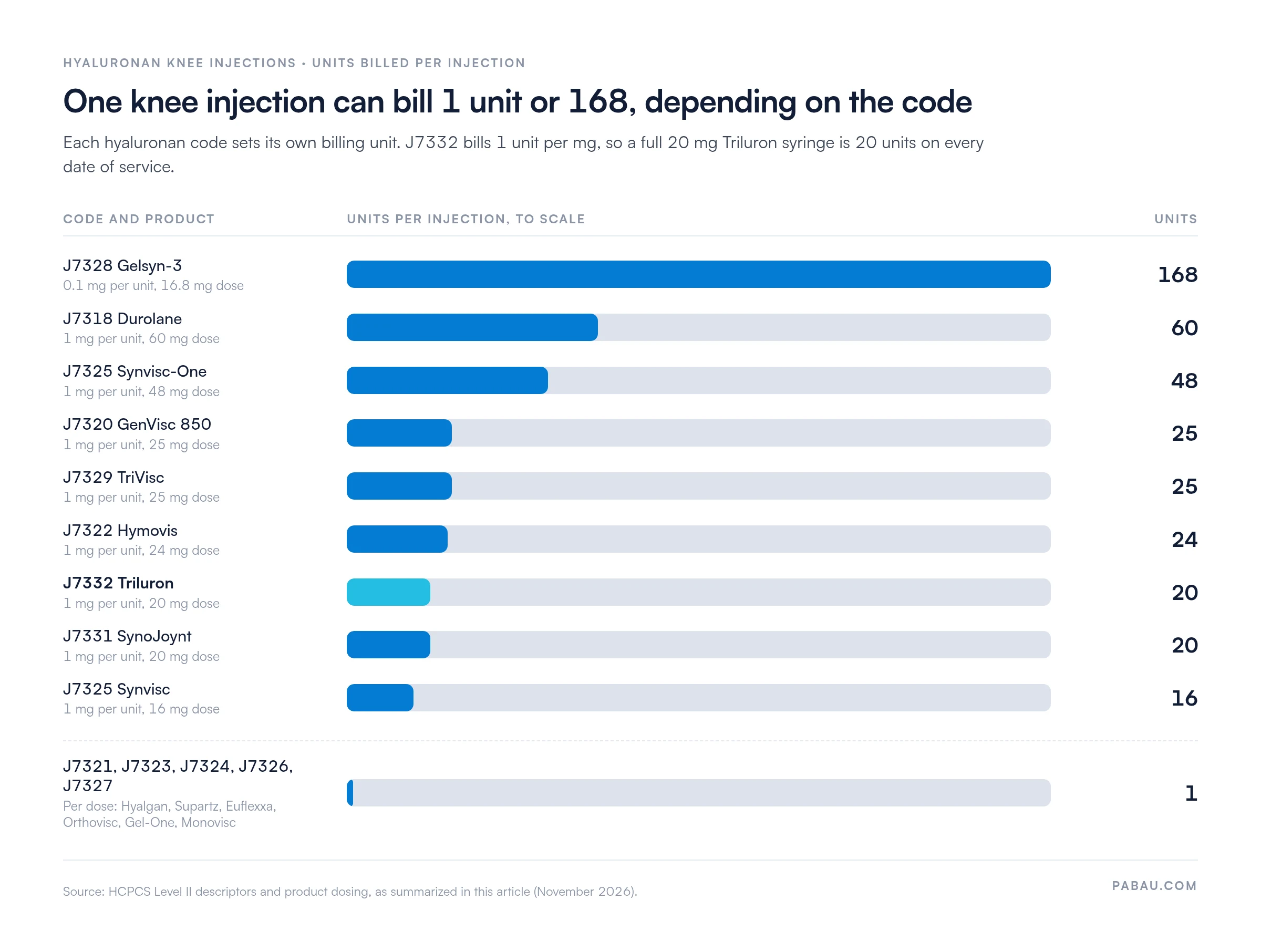
J7332 and J7331 bill the same 20 units for the same 20 mg dose. A swapped code is easy to miss on review, so match the product’s NDC to its code before submission.
Older charge masters may still carry J7333 for Visco-3. Current payer policies list Visco-3 under J7321, billed per dose, so audit any leftover entry.
Medicare Part B pays J7332 at the average sales price plus 6%, per unit. CMS publishes the per-unit payment limit in the quarterly ASP pricing files.
Multiply the current per-unit limit by 20 to price one syringe. Medicare pays 80% after the Part B deductible, and the patient owes 20% coinsurance.
The physician fee schedule search does not price J7332. It prices the administration code, 20610 or 20611, which pays differently in an office and in a facility.
In an office, the practice buys the drug and bills J7332 itself. In a hospital outpatient department, the hospital bills the drug under the outpatient payment system. The physician then bills only the administration, at the facility rate.
Price J7332 from the ASP file, not from memory. Pull the current quarter’s per-unit limit, multiply by 20 for one syringe, and compare it with your acquisition cost before you schedule the series.
Traditional Medicare covers hyaluronan knee injections under the Part B drug benefit. No national coverage determination applies, so each Medicare Administrative Contractor publishes its own billing and coding article.
Examples include Palmetto GBA article A59030, NGS article A52420, and WPS article A56157. These articles set the covered diagnoses and the rules for a repeat series.
A repeat series commonly needs six months since the last one and documented improvement from it. Read the article for your jurisdiction before you schedule a second course.
Traditional Medicare does not require prior authorization for J7332. Medicare Advantage plans and most commercial payers do, and confirming it before the first injection is part of a clean claim.
Step therapy sits at the core of most authorization criteria. Payers want dated evidence that conservative care failed first. That usually means oral analgesics or NSAIDs, physical therapy, and at least one corticosteroid injection.
Auditors expect each injection note to stand alone. A note reading “patient returned for second injection” fails if it does not link back to the diagnosis, imaging, and failed conservative care.
Build a template that captures every element at each visit. Good medical billing compliance also means reviewing that template against your contractor’s current billing article each year.
J7332 denials fall into a handful of patterns that repeat across claims. Good denial management workflows trace each one to its root cause rather than appealing claims one at a time.
When a J7332 claim is denied under medical billing denial codes for medical necessity, the appeal needs the full clinical record. Send imaging, conservative care history, and the treating provider’s attestation. Build that record at the point of care, because rebuilding it after a denial rarely works.
Run a quarterly J7332 denial report grouped by reason code. If authorization denials dominate, the fix sits in scheduling. If unit or code errors dominate, the fix sits in charge entry and the charge master.
A Triluron series spans three visits, an authorization, and a stack of records. In Pabau, a practice management platform with built-in claims tools, the whole series sits on one patient record.
Pabau’s claims management software submits the J7332 and 20610 lines and tracks each claim’s status. Denial codes come back to the same record, so your team sees which visit needs work.
Visit notes hold the NDC, lot number, dose, and knee for each injection. Checkout then collects the patient’s coinsurance before they leave.
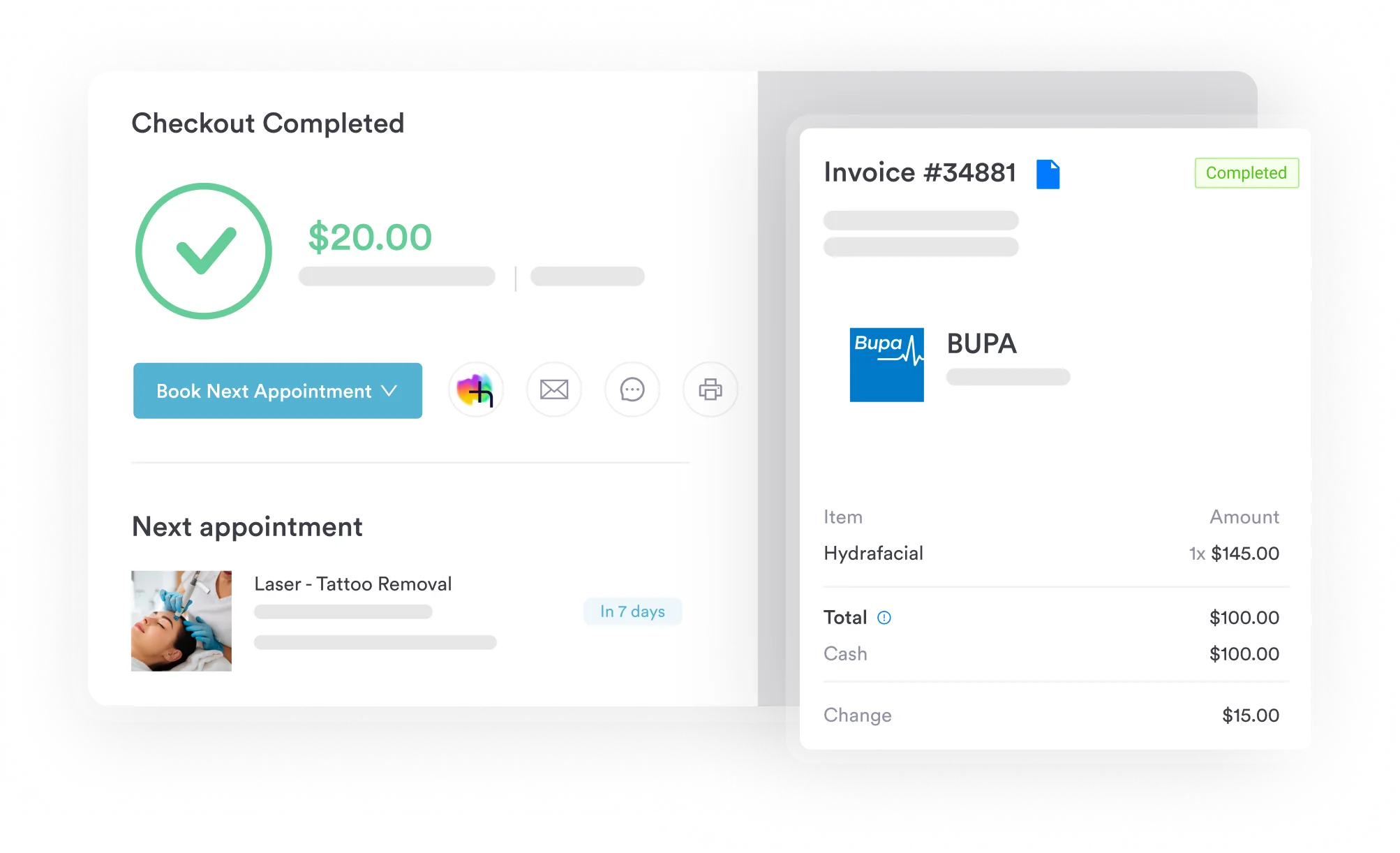

Pabau’s claims management submits your J7332 and 20610 lines and tracks each claim’s status and denial codes. Visit notes, NDCs, and payments sit on the same patient record.

J7332 is a single-product code. It bills Triluron at 1 mg per unit, and one full syringe is 20 units. Most J7332 denials trace back to losing sight of one of those facts.
Match the NDC to the code before each claim, and price the drug from the current ASP file. Confirm authorization before the first injection, not after the third.
Book a demo to see how Pabau keeps a full Triluron series, from authorization to payment, on one record.

Need a foundation in HCPCS drug code billing? Medical billing fundamentals guide covers how Part B drug claims move from charge entry to payment posting.
Want to reduce denials across your practice? Denial management in healthcare explains how to build a denial-tracking and appeal workflow that reduces rework.
Billing Synvisc or Synvisc-One instead? HCPCS code J7325 covers the per-mg units for both the 16 mg and 48 mg products.
Working with a per-dose hyaluronan? HCPCS code J7323 shows how Euflexxa bills one unit per injection.
J7332 covers Triluron, a sodium hyaluronate injection for knee osteoarthritis, billed per 1 mg. The descriptor names Triluron only, so other hyaluronan products bill their own codes. The injection itself bills separately, usually with CPT 20610 or 20611.
One unit equals 1 mg. A full Triluron syringe holds 20 mg, so each injection bills 20 units. Bill each of the three weekly injections on its own date of service, never 60 units on one line.
Yes. Medicare Part B covers Triluron under J7332 for knee osteoarthritis, following your contractor’s billing and coding article. Those articles set the covered diagnoses and repeat-series rules. Medicare pays 80% of the ASP plus 6% limit, and the patient owes 20% coinsurance.
Traditional Medicare does not require prior authorization for J7332, but Medicare Advantage plans and most commercial insurers do. Requests usually need imaging that supports knee osteoarthritis, records of failed conservative care, and a physician attestation. A missing authorization is a common denial and hard to overturn.
Medicare pays J7332 at the average sales price plus 6%. CMS updates that per-unit limit every quarter in the ASP pricing files. Multiply it by 20 to price one syringe. The physician fee schedule search prices the 20610 administration, not the drug.