

CCSD code G5100: Bypass of duodenum billing guide
CCSD code G5100 bills a bypass that leaves the duodenum in place CCSD code G5100...

Last Updated: Oct 16, 2026
J7331 is the HCPCS Level II code for hyaluronan or derivative, synojoynt, for intra-articular injection, 1 mg.
Medicare Part B pays the drug under buy-and-bill at ASP plus 6 percent. In practice, that rate is the same in an office and a hospital outpatient department. It also covers the supporting ICD-10 codes, payer coverage rules, and the buy-and-bill workflow.
Let Pabau's smart automation suggest the right codes, reduce claim denials, and keep your practice compliant—effortlessly.
Automate repetitive tasks and focus on what matters most—your patients.
Reduce coding errors and ensure compliance with the latest regulations.
Clean claims, fewer denials, and faster reimbursements.
Powerful insights and reporting to help your practice thrive.
HIPAA compliant SOC 2 certified GDPR-compliant Trusted by 4,000+ clinics worldwide

HCPCS code J7331 describes hyaluronan or derivative, SynoJoynt, for intra-articular injection, 1 mg, and bills to Medicare Part B and commercial payers.
Each billable unit equals 1 mg administered, so the units on the claim must match the milligrams in the encounter note.
Medicare pays J7331 under buy-and-bill at ASP plus 6 percent, and the drug rate does not change with the site of service.
Single-dose containers carry a discard modifier on every claim: JW for the amount wasted, or JZ when nothing is wasted.
Practice management software like Pabau tracks J7331 units, attaches the right modifiers, and submits clean claims without manual recoding.
HCPCS code J7331 is an active HCPCS Level II J-code maintained by the Centers for Medicare and Medicaid Services (CMS). Specifically, it is classified under the Drug/Biological category and covers a single physician-administered viscosupplementation product.
SynoJoynt is a hyaluronic acid viscosupplementation product indicated for osteoarthritis of the knee when conservative treatment has not given adequate relief. HCPCS code J7331 applies only when a qualified provider administers SynoJoynt in an office or other clinical setting.
The code descriptor sets the unit at 1 mg, so every milligram administered equals one billed unit. The sequence below runs from the product label to the finished claim line, and each step in turn feeds the next.
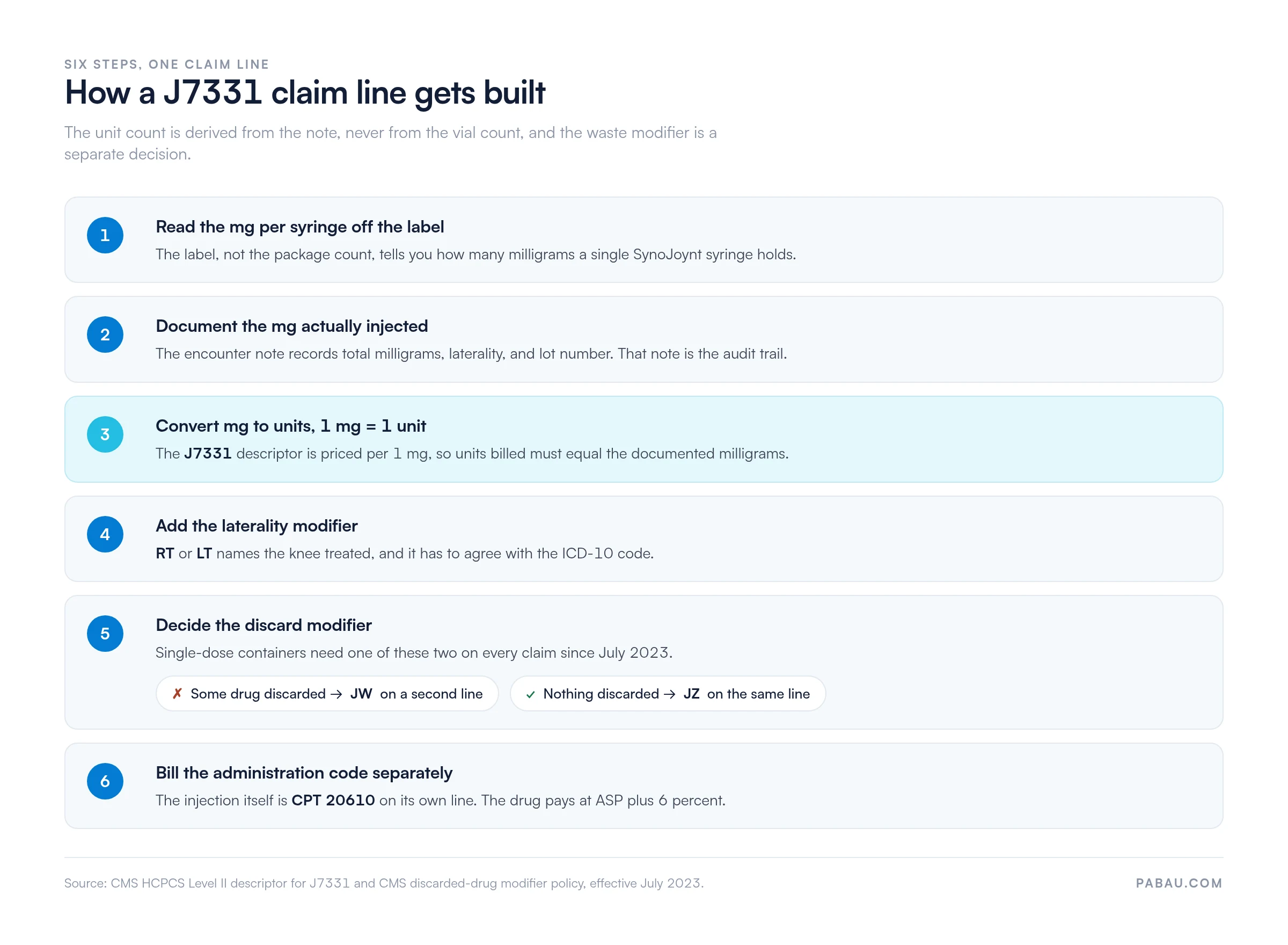
Verify the mg per syringe on the SynoJoynt label before each injection session. The encounter note has to state the total milligrams administered so an auditor can trace the unit count back to the record. As a result, billing more units than the documentation supports creates an overpayment exposure.
Medicare Part B covers HCPCS code J7331 as a physician-administered drug under the buy-and-bill model. Specifically, payment follows the average sales price (ASP) methodology established in Section 1847A of the Social Security Act.
Never use a prior quarter’s ASP figure. Because rates shift with each quarterly update, stale data leads to underpayments or payer adjustments. Still, the electronic remittance advice from Medicare shows the allowed amount per unit, which you can check against the current quarter’s file.
In contrast, commercial allowable rates are negotiated independently and vary widely from the Medicare figure. Verify the current rate with each payer before administering SynoJoynt.
Modifier selection for J7331 turns on the route of administration, the knee treated, and whether any drug was discarded. Two of the route modifiers below are listed because coders reach for them by habit, not because they belong on this code.
JA and JB are both route modifiers, and neither one describes an intra-articular injection. JB in particular is often assumed to mean any non-intravenous route, but its official descriptor is “administered subcutaneously”. As a result, appending it to a J7331 line asserts a route the record does not support.
The discard modifiers are the ones that matter here. Since July 2023 CMS has required either JW or JZ on claims for drugs supplied in single-dose containers, which is how SynoJoynt is packaged. Use JZ on the J7331 line when nothing was discarded. Where part of the syringe was wasted, bill the administered milligrams on one line. Put the discarded milligrams on a second line with JW, and record the amount and the reason in the note.
Always document the laterality (right or left knee) in the procedure note. Many MAC jurisdictions and commercial payers require RT or LT modifiers on J7331 claims. Missing laterality is among the top reasons for remittance adjustments on viscosupplementation claims.
Every J7331 claim needs a covered ICD-10 diagnosis code to establish medical necessity. Specifically, the codes payers accept for viscosupplementation sit in the M17 osteoarthritis-of-knee range, and our ICD-10-CM code set reference carries the full descriptors.
Payers expect the diagnosis laterality to agree with the RT or LT modifier on the J7331 line. For example, a right-knee injection coded M17.11 without RT, or the reverse, is the kind of mismatch that trips a claim edit. In turn, coverage sits with your MAC’s Local Coverage Determination for viscosupplementation, and the list of qualifying diagnoses differs by jurisdiction.
Coverage for J7331 varies by payer type and by plan. Checking benefits before the injection is booked keeps the practice out of the two worst outcomes: a denied claim and an unexpected patient balance.
Medicare coverage for viscosupplementation is governed by MAC-level LCDs rather than a national coverage determination. Specifically, CMS Coverage Database Articles A52420 and A56157 set out the underlying hyaluronan framework. In turn, the specific criteria, including which diagnoses qualify and what evidence of conservative treatment failure is needed, are set at the MAC level. Review the LCD for your jurisdiction before each new patient’s injection series.
Commercial payers frequently require step therapy before they authorize viscosupplementation. Specifically, that usually means documented failure of physical therapy, NSAIDs, and corticosteroid injections. Capture those prior attempts in the chart as they happen. The prior authorization request can then be assembled in minutes instead of reconstructed from old notes.
SynoJoynt is billed under the buy-and-bill model. The practice purchases the product, administers it, and then bills the payer for the drug plus the administration code. Each step below has a documentation requirement that decides whether the claim pays.
Tracking buy-and-bill across several injection products is a standing load in injection-heavy practices. A practice management platform with integrated claims management software can carry the unit count from the encounter note through to claim submission, removing the re-entry step where most J7331 errors start.
SynoJoynt is one of more than ten hyaluronan products with its own HCPCS Level II J-code. In practice, knowing where J7331 sits in the family stops the two errors coders make most: substituting a neighboring product’s code, and copying its unit basis. Confirm current status against the AAPC HCPCS code database before you bill an unfamiliar one.
Read the billing-unit column before you reuse any of this unit math. J7331, J7325, and J7329 are priced per milligram, J7328 is priced per 0.1 mg, and Euflexxa, Orthovisc, Monovisc, and Gel-One are priced per dose. For example, a per-dose product billed at 25 units looks like a 25-fold overbill. Likewise, a per-milligram product billed as one unit gives away most of the payment.
The product name has to drive the code, not the other way round. Billing J7325 for Synvisc when SynoJoynt was injected is a coding error rather than a permitted substitution, and it reads as an overpayment on audit. As a result, bill the code for the product named in the clinical record.
Audit your last 20 J7331 claims before year-end. Compare the units billed to the mg documented in each encounter note, and check that every line carries JZ or a matching JW line. Correcting a handful now costs far less than answering a payer recovery demand later.
Practices that run a viscosupplementation service carry a layered documentation job. Inventory has to be tracked, the mg per encounter captured, modifiers attached, the diagnosis code linked, and the claim routed. In practice, done by hand across a busy injection schedule, each of those steps is a place for a number to drift.
Pabau, our practice management platform, connects clinical documentation straight to the billing workflow. In practice, a provider records the injection using Pabau’s digital forms and clinical note templates. The mg administered, the laterality, and the lot number are captured as structured fields. In turn, that data feeds the claim without re-entry, which is where the unit-count errors behind J7331 denials usually start.

From there the claims module sends the completed claim to the clearinghouse with the code, units, modifiers, and diagnosis attached. In addition, inventory tracking keeps each product’s billing data separate. A practice stocking several J-codes can then be sure a SynoJoynt encounter never picks up a Synvisc code.
Practices that want to tighten their viscosupplementation billing cycle can book a demo. In that session, we walk through the J7331 workflow end to end, from the note to the remittance.

Pabau captures the mg injected, the knee treated, and the lot number as structured fields. It then sends them to the clearinghouse with the right modifiers attached. Your team stops recoding by hand and stops chasing unit-count rejections.

J7331 is an unforgiving code for a simple reason: the payment is derived from a number someone typed into a note. Get the milligrams right, and the rest of the line follows as a result. Conversely, get them wrong and no modifier or diagnosis code saves the claim.
So put the effort at the point of care rather than in the billing queue. In turn, a note that records the mg injected, the mg discarded, and the knee treated gives the coder every field the claim needs. The alternative is reconstructing the dose from a syringe count weeks later, which is the version auditors read least charitably.
The trade-off worth remembering is that quarterly ASP pricing rewards practices that check the file and punishes the ones that assume. Book a demo to see how Pabau carries the documented milligrams onto a clean J7331 claim.

Need a step-by-step billing compliance framework? Medical billing compliance walks through the documentation and audit-readiness standards that protect your practice.
Want to stop claim rejections before the remittance? Clean claim best practices covers the pre-submission checks that catch J-code errors before the payer sees them.
Managing denial patterns across your billing team? Denial management in healthcare explains how to classify, appeal, and track denials by root cause.
HCPCS code J7331 bills Medicare Part B and commercial payers for SynoJoynt, a hyaluronan viscosupplementation product. Specifically, it is given by intra-articular injection and priced at 1 mg per unit. It applies when a qualified provider administers SynoJoynt directly into the knee joint of a patient with osteoarthritis or a covered related diagnosis.
Bill one unit for every 1 mg of SynoJoynt administered. In turn, the total units billed must exactly match the total milligrams documented in the encounter note. Verify the mg-per-vial on the product label before administration and record it in the chart so the unit count is directly traceable to the documentation.
Medicare does not require prior authorization for J7331, but Local Coverage Determinations set medical necessity criteria that must be met. In contrast, most commercial payers do require prior authorization, typically preceded by step therapy (documented failure of physical therapy, NSAIDs, and corticosteroid injections). Verify PA requirements with each payer before the injection appointment.
Yes. Since July 2023 CMS has required a discard modifier on drugs supplied in single-dose containers, and SynoJoynt is packaged that way. Use JZ on the J7331 line when the whole syringe was injected. Where part of it was wasted, bill the administered milligrams on one line and the discarded milligrams on a second line with JW.



