CCSD code H4430: Examination of rectum under anaesthetic
CCSD code H4430 pays for the examination alone CCSD code H4430 is the UK private...

Last Updated: Oct 20, 2026

HCPCS code J3488 (injection, zoledronic acid [Reclast], 1 mg) is deleted and cannot be used for claim submission.
J3489 replaced it and covers zoledronic acid 1 mg from any brand, including Reclast and Zometa.
J3487 and the interim code Q2051 also died on January 1, 2014, so older charge masters often hold more than one dead entry.
Reclast is billed as 5 units of J3489 for a 5 mg dose, and Zometa as 4 units for 4 mg.
Pabau’s claims management software pre-fills the claim from the record and provides ICD-10, CPT and HCPCS lookup libraries.
HCPCS code J3488 is a deleted Level II code that once described injection, zoledronic acid (Reclast), 1 mg. It has not been payable since January 1, 2014.
Legacy charge masters and older superbill templates keep J3488 alive long after it stopped being payable. The rejection then arrives before anyone notices the code.
The rest of this page handles the crosswalk, the unit math, and the documentation Medicare wants before it pays.
HCPCS code J3488 described “Injection, zoledronic acid (Reclast), 1 mg.” The Centers for Medicare and Medicaid Services (CMS) assigned it as a Level II J-code. It identified intravenous zoledronic acid supplied under the Reclast brand.
The code was billed per 1 mg administered, so a standard 5 mg infusion carried 5 units.
While J3488 was active, the descriptor named Reclast explicitly. That mattered because the same molecule is also sold as Zometa for oncology indications, and Zometa carried its own code.
J3489 dropped the brand restriction entirely. Any claim submitted with J3488 today will be rejected. Before your next billing cycle, check every J-code in the charge master against the current HCPCS code list.
J3488 was not retired on its own. CMS collapsed the brand-specific family into a single generic code, and the transition ran through a short-lived interim code in between.
That is why an old drug file can carry more than one dead zoledronic acid entry.
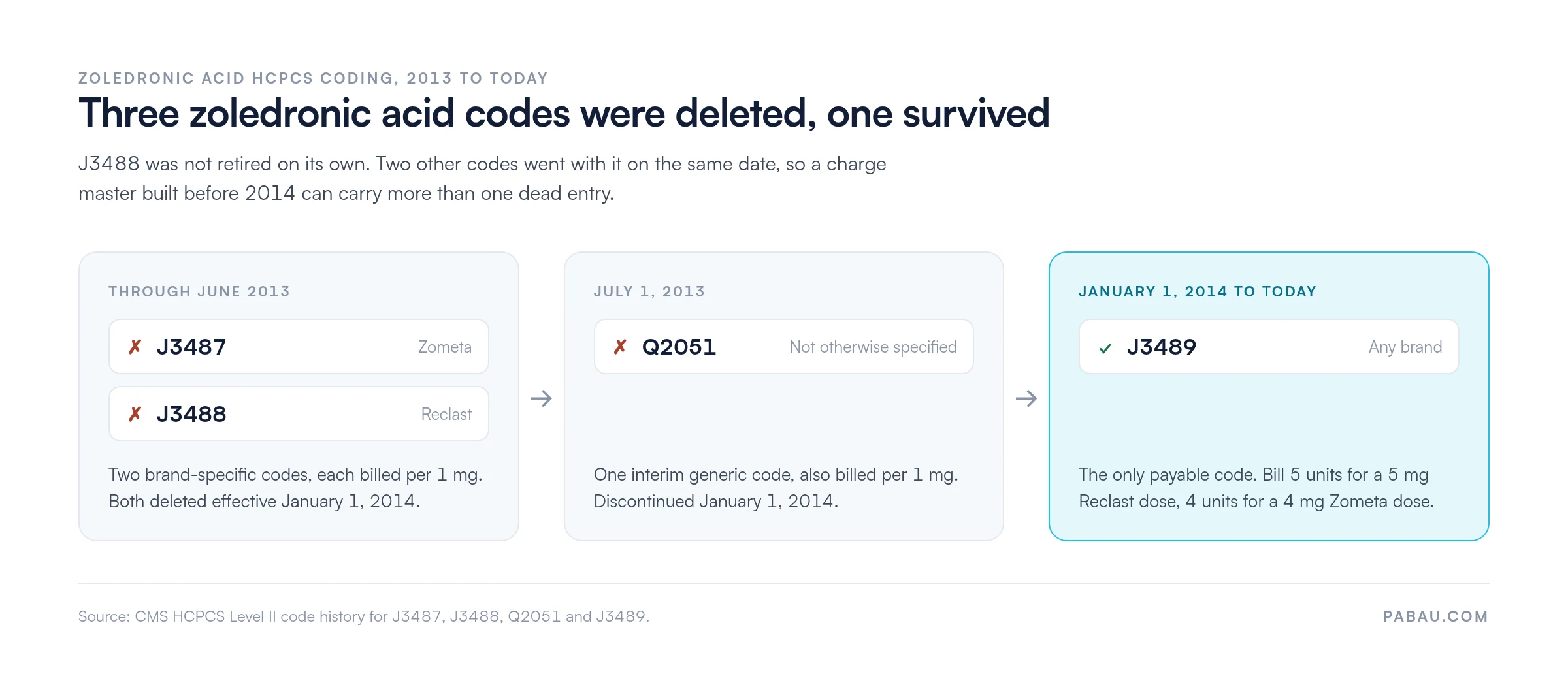
Turn that into a charge-master audit. If your drug file predates 2014, search it for J3487 and Q2051 as well as J3488. The deleted-code record for J3488 confirms the January 1, 2014 date.
All three are dead. Only J3489 pays, and it covers Reclast, Zometa and generic zoledronic acid alike.
J3489 is the current, active code for zoledronic acid infusions. Its descriptor reads “Injection, zoledronic acid, 1 mg,” with no brand named. That single descriptor covers Reclast at 5 mg/100 mL and Zometa at 4 mg/5 mL.
The dose difference between the two brands is the largest single source of error on crosswalk claims. Reclast is dispensed as a 5 mg/100 mL infusion, so you bill 5 units of J3489.
Zometa is dispensed as 4 mg/5 mL, so you bill 4 units. Read the milligrams off the administration record every time, rather than copying the unit count from the last claim.
Zoledronic acid is a third-generation intravenous bisphosphonate. It inhibits osteoclast-mediated bone resorption, which makes it useful wherever excessive bone turnover drives the disease.
The FDA has approved two branded formulations with different indications, and both bill under the same drug code.
The National Drug Code, or NDC, has to appear on the claim alongside J3489. Medicare uses it to cross-reference the drug dispensed against the units billed.
Capture the NDC and the lot number at the point of care. Rebuilding them from a pharmacy invoice later rarely matches what went into the patient.
Medical necessity for a zoledronic acid infusion rests on the diagnosis, not on which bottle you opened. The indication has to be FDA-approved and covered under CMS Local Coverage Determination (LCD) L33270, which governs intravenous bisphosphonates and monoclonal antibodies.
A correct J3489 with an uncovered diagnosis is still a medical necessity denial.
Medicare does not cover off-label use of zoledronic acid under this LCD. Document the approved indication in the record before the infusion is ordered.
Where a patient carries several conditions, link the claim to the diagnosis that drove this particular encounter.
Every zoledronic acid claim needs at least one ICD-10-CM code that maps to a covered indication under LCD L33270. Covered code lists change with each fiscal year.
Check them against the CMS ICD-10 codes page every year, not against a list saved in a shared drive.
Use the most specific code the record supports. Code osteoporosis to the site when a pathological fracture is present, using the M80 series.
For Paget disease, code to the affected bone where the note documents it. Unspecified codes still pay, but they draw audits more often, so avoid reaching for them out of habit.
Billing J3489 on its own leaves the infusion service unpaid. The drug code and the administration code are separate line items, and both belong on the claim.
Administration is reported with the time-based CPT codes in the 96360 to 96379 range.
Infusion start and stop times have to appear in the clinical note. A note that says only “infusion given” will not support the administration code when a reviewer asks.
Practices billing from an office setting should also confirm the place of service code matches where the infusion took place.
Document infusion start and stop times at the point of care, not after the fact. For a Reclast infusion running 15 to 30 minutes, CPT 96365 is the whole administration charge. Add CPT 96366 only when documented infusion time passes 60 minutes. Backdated time entries are a common audit trigger for infusion practices.
Medicare Part B covers zoledronic acid infusions given in a physician office or an outpatient setting. Coverage runs under LCD L33270, as maintained by your Medicare Administrative Contractor (MAC).
The CMS LCD L33270 code guide lists the covered HCPCS codes, the covered diagnosis codes, and the documentation each indication requires.
Four requirements decide most of these claims:
Checking eligibility and benefits before the appointment is what stops most of these denials. The drug is expensive, and a coverage problem found after the infusion leaves the practice holding the cost.
A payable claim needs the code, the units, the diagnosis and the administration code all correct, and a single miss sends it back.
The six steps below are the order a billing team works in:
A 68-year-old patient with age-related osteoporosis arrives for her annual Reclast infusion. The pharmacy supplies one 5 mg/100 mL bottle. The nurse records a start time of 10:14 and a stop time of 10:37.
That encounter produces five claim entries:
The infusion ran 23 minutes, so CPT 96366 has no place on this claim. Swap the bottle for a 4 mg Zometa vial and only two entries change. The unit count drops to 4, and the diagnosis moves to the oncology indication on file.
Those five checks head off the errors in the table below.
Zoledronic acid claims fail in a small number of predictable ways. The table pairs each error with what the payer does about it, then the fix that stops it recurring.
One denial reason repeating across several zoledronic acid claims points at a workflow problem rather than a coding slip.
Track the reasons monthly, and check code status against the CMS HCPCS overview whenever an annual update lands.
Run a quarterly audit of your charge master for HCPCS J-codes deleted in the most recent annual update. CMS publishes the annual HCPCS Level II update file in November, effective January 1, so the deleted-code list is available weeks before it bites. A single dead code left in a charge master can generate months of rejected claims before anyone reads the denial pattern.
In most infusion practices the drug, the dose, the diagnosis and the times sit in the clinical note. Someone retypes them into a claim form later that week. That retyping is where the unit count drifts and the NDC goes missing.
Practice management software like Pabau builds the claim from the record instead. The codes already attached to the service land on the charge line, and the ICD-10 slots are seeded from the client’s recorded problem list.
Search icons open full ICD-10-CM and CPT/HCPCS lookup libraries, refreshed with each official release, so a coder can confirm J3489 without leaving the form.
The last check is completeness. Pabau is built for claims that leave complete, so the Send button stays locked until required fields like membership and authorization numbers are filled.
Submission then runs through the clearinghouse for your region, which in the US is Claim.MD. That pipeline also returns real-time eligibility checks, claim-status tracking, and electronic remittance posting.
None of that picks the code for you. It removes the retyping step where units and NDCs get lost. The coder then spends their time on judgment calls instead of data entry.

Pabau pre-fills the claim from the clinical record and opens full ICD-10 and HCPCS lookup libraries at the charge line. Submission waits until the required fields are complete, then goes out through your region’s clearinghouse.

J3488 has not paid since January 1, 2014, and neither has J3487 or Q2051. Delete all three from your drug file and the rejections stop arriving.
Once J3489 is the only zoledronic acid code in the system, the remaining risk moves to the unit count. Reclast and Zometa look identical on a charge line and differ by one unit. The check that matters is the milligram figure on the administration record, and it belongs in the workflow rather than in someone’s memory.
The workflow worth building is simple. The record produces the claim, required fields are checked before it goes out, and the clearinghouse takes it from there.
Book a demo to see how Pabau moves an infusion claim from the treatment note to your payer without a retyping step.

Need the code that pays today? J3489 covers the descriptor, the unit counts and the coverage rules for the active zoledronic acid code.
Billing the infusion service as well as the drug? CPT 96365 covers the time thresholds, the add-on rules and the documentation an administration code needs.
Coding an osteoporosis infusion? M81.0 covers when age-related osteoporosis without current pathological fracture is the diagnosis to submit.
Want a checklist for a first-pass claim? Clean claim requirements sets out the elements payers validate before they process a drug or infusion claim.
Seeing the same denial reason repeat? Denial management in healthcare covers how to identify, appeal and prevent recurring claim denials.
It comes back as a rejection rather than a denial, because a deleted code fails the payer’s front-end edits before adjudication. Correct the code to J3489, check the unit count against the administration record, and resubmit as a new claim. An appeal will not help, because the original was never adjudicated.
Part B. Zoledronic acid is a physician-administered infusion, so it is paid as a Part B drug when given in an office or outpatient setting. Part D covers drugs the patient collects and self-administers, which does not describe an intravenous bisphosphonate.
One of the two, whenever the drug comes from a single-dose container. JW reports the amount discarded, and JZ reports that none was discarded. A 5 mg Reclast bottle given in full takes JZ, since the whole dose reaches the patient. Never report both on the same line.
Through the average sales price, or ASP, published quarterly for Part B drugs. The statutory rate is ASP plus 6 percent. The allowed amount therefore moves every quarter, rather than sitting in an annual fee schedule.