HCPCS Code Q4185: Cellesta flowable amnion billing guide
HCPCS Code Q4185: definition and official descriptor HCPCS Code Q4185 is the Lev...

Last Updated: Nov 20, 2026
J3095 is the HCPCS Level II code for injection, telavancin, 10 mg. It reports intravenous telavancin (Vibativ), a lipoglycopeptide antibiotic for hospital-acquired and ventilator-associated pneumonia and complicated skin and skin-structure infections.
Each billing unit equals 10 mg, so a 750 mg dose is billed as 75 units. Medicare Part B lines need the JW or JZ modifier to show whether any drug was discarded. Most Medicare Advantage and commercial plans also require prior authorization.
Let Pabau's smart automation suggest the right codes, reduce claim denials, and keep your practice compliant—effortlessly.
Automate repetitive tasks and focus on what matters most—your patients.
Reduce coding errors and ensure compliance with the latest regulations.
Clean claims, fewer denials, and faster reimbursements.
Powerful insights and reporting to help your practice thrive.
HIPAA compliant SOC 2 certified GDPR-compliant Trusted by 4,000+ clinics worldwide

HCPCS Code J3095 reports injection, telavancin (Vibativ), 10 mg, an IV lipoglycopeptide for HAP, VAP, and complicated skin and skin-structure infections.
Each billing unit equals 10 mg, so divide the milligrams dispensed by 10 and round to the nearest whole number.
Medicare Part B has required the JW or JZ modifier on J3095 lines since July 1, 2023, and claims-editing denials began on October 2, 2023.
Most Medicare Advantage and commercial plans require prior authorization for telavancin, and a claim without one comes back as CARC CO-197.
Pabau’s claims management software sends J3095 claims through the Claim.MD clearinghouse and warns staff when a case has no authorization on file.
HCPCS Code J3095 is the HCPCS Level II code for injection, telavancin, 10 mg, the intravenous lipoglycopeptide antibiotic sold as Vibativ. CMS maintains the descriptor in its HCPCS Level II code set, and each billing unit equals 10 mg of drug.
Vibativ is marketed by Cumberland Pharmaceuticals, which acquired it from Theravance Biopharma in 2018. Telavancin is given only by intravenous infusion, and there is no oral form.
The table below summarizes the core code facts billers need before submitting a claim.
CMS publishes the authoritative descriptor and any annual updates in the CMS HCPCS Level II code set. Check the current descriptor before each calendar year starts, because J-code descriptors occasionally receive minor wording revisions.
Telavancin is FDA-approved for three indications, and each requires a matching ICD-10-CM diagnosis code on the claim to establish medical necessity. Billing outside these indications is an off-label use and carries significant compliance risk.
Payers reviewing J3095 claims routinely cross-check the submitted diagnosis code against telavancin’s FDA label. A claim reporting J3095 with a non-pneumonia, non-cSSSI primary diagnosis will likely receive a CO-50 medical necessity denial.
Code to the organism once cultures confirm it, so MRSA pneumonia goes to J15.212 rather than the unspecified J18.9. Document the culture and sensitivity results confirming Staphylococcus aureus in the chart, even when the ICD-10 code alone looks sufficient.
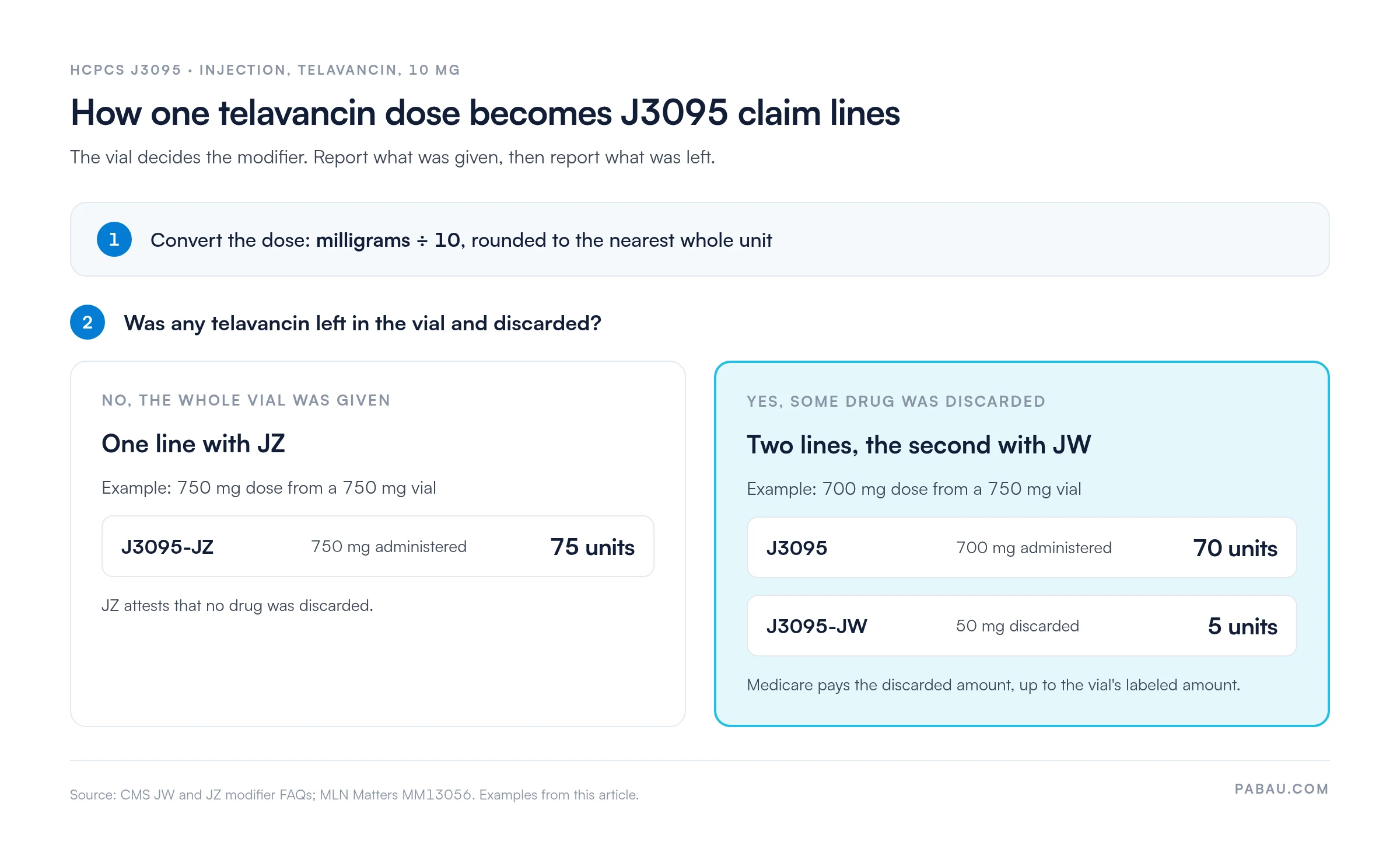
Each unit of HCPCS Code J3095 equals 10 mg of telavancin. Divide the total milligrams dispensed by 10, then round to the nearest whole number. Do not round down when the remainder is 5 mg or more.
Telavancin is dosed by weight, at 10 mg/kg once daily for all three indications. A 75 kg patient receives a 750 mg infusion, and a 150 kg patient receives 1,500 mg.
Vibativ vials come in 250 mg and 750 mg sizes. When a 750 mg vial is used to deliver a 700 mg dose, 50 mg remain in the vial. That discarded amount is reported separately using the JW modifier (covered in the next section). Never inflate the administered-dose units to absorb wastage.
Always pull the milligrams-dispensed figure from the pharmacy dispensing record, not from the physician order. Orders sometimes use ideal body weight; dispensed amounts reflect actual preparation. Submitting units based on the order rather than the dispensed record is a common audit trigger for high-cost J codes like J3095.
Medicare Part B reimburses HCPCS Code J3095 at the Average Sales Price plus 6% (ASP+6%). That is the standard Part B drug payment method set by Social Security Act Section 1847A. CMS updates the ASP rate quarterly, so the per-unit reimbursement for J3095 changes four times a year.
Because telavancin is a specialty pharmaceutical, the per-unit ASP rate tends to be high relative to most J-series antibiotics. Verify the current quarter’s figure in the CMS ASP pricing files before billing. The table below illustrates the quarterly update cadence.
Outpatient hospital settings use the Outpatient Prospective Payment System (OPPS) rate, which may differ from the Part B physician fee schedule rate. A hospital outpatient department should verify the applicable ambulatory payment classification (APC) payment rather than apply the Part B rate directly.
An 11-digit National Drug Code (NDC) must accompany every J3095 claim line submitted to Medicaid and most commercial payers. Medicare Part B fee-for-service does not mandate NDC reporting on the CMS-1500, but Medicare Advantage plans frequently mirror Medicaid rules. When in doubt, include the NDC on every claim.
Medicare Part B lines for single-dose container drugs such as J3095 carry the JW modifier (drug discarded) or the JZ modifier (none discarded). Practices could report JZ from January 1, 2023, and its use became required on July 1, 2023, per MLN Matters MM13056.
Claims-editing denials started on October 2, 2023. A J3095 line without either modifier is denied with CARC CO-4. That code means the procedure code is inconsistent with the modifier used, or a required modifier is missing.
Worked example: A 750 mg vial is used to deliver a 700 mg dose. Report J3095 x 70 units for the administered portion. Add a second J3095 line x 5 units with the JW modifier for the 50 mg discarded.
The JW line carries its own charge, because Medicare pays for the discarded amount up to the amount on the vial label.
When the whole vial is used, report J3095 with the JZ modifier on a single line. Never append both JW and JZ to the same claim line. CMS treats the pair as mutually exclusive and denies the line. The chart below shows how both cases split into claim lines.
Prior authorization for HCPCS Code J3095 varies by payer type and plan. Medicare fee-for-service Part B does not require PA for telavancin under the standard outpatient drug benefit. Most Medicare Advantage plans and nearly all commercial plans do, given telavancin’s cost and the cheaper alternatives available.
Start the prior authorization process before the first infusion, because a retrospective request is often refused.
When PA is required, record the authorization number and enter it in box 23 of the CMS-1500. A prior authorization request form keeps the indication, culture results, and failed therapies together for the reviewer.
A CO-197 denial (precertification or authorization absent) cannot be appealed without the approval letter and reference number on hand.
HCPCS Code J3095 is administered by IV infusion, so the place of service code must reflect where the infusion took place. The POS code affects the applicable rate and the administration code billed with the drug line. For a 60-minute telavancin infusion that is usually 96365, the initial hour of IV infusion.
Revenue code 0636 covers drugs that require detailed coding, which is why J3095 reports under it on the UB-04. Confirm the mapping in your facility’s chargemaster before submission.
Telavancin treats a narrow set of gram-positive infections. Coders occasionally confuse J3095 with neighboring antibiotic J-codes, particularly J3090. The table below confirms which code applies when several antibiotics appear in the chart for the same encounter.
J3090 and J3095 are the most common mix-up. Both cover gram-positive antibiotics, but their drug classes, indications, and unit sizes differ.
Use the drug name and NDC on the dispensing label to confirm the correct code before submitting. The AAPC HCPCS code lookup provides current descriptors for every J-series code and is a quick cross-check tool.
HCPCS Code J3095 generates a predictable set of denials. The table below maps the most common CARC codes to their root cause and the fix before resubmission or appeal. For a code not listed here, the guide to fixing claim denial codes covers each group.
Medical necessity appeals for telavancin should include the treating physician’s attestation that standard first-line agents (vancomycin, daptomycin) were either tried and failed, or were contraindicated.
The PGM Billing HCPCS lookup tool lets billing staff verify the current descriptor and cross-reference coverage notes before drafting an appeal.
Set a claim edit rule that flags any J3095 line missing both JW and JZ before the batch goes out. An automated edit takes minutes to build and prevents the most common J3095 denial. Review your edits quarterly as CMS modifier policies update.
Complete documentation is the first line of defense against J3095 audits and denials. Every element below must be present in the medical record before the claim is submitted.
Drug administration records that hold PHI also fall under the HIPAA Security Rule. It requires access controls and audit trails for how those records are stored and sent.
Most J3095 denials trace back to three records kept in different places: the dispensing log, the payer’s authorization letter, and the claim. When billing staff re-key units, modifiers, and authorization numbers from one to the next, a single slip sends a high-cost infusion claim into appeal.
Pabau, a practice management platform with built-in claims management, keeps the authorization and the claim on the same patient case. The auth code, its dates, and the approved sessions sit on the case. Staff get a warning when a case has no authorization on file.
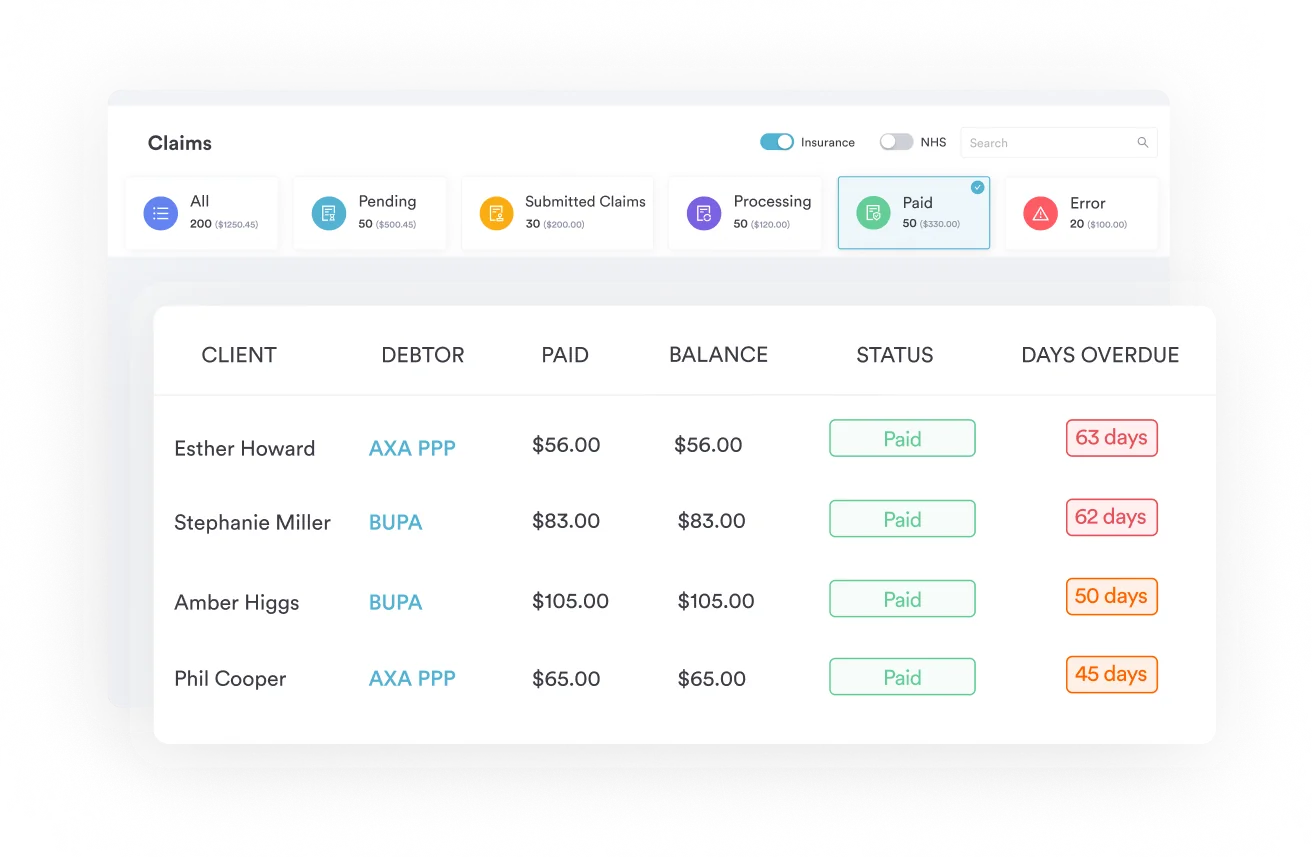
US claims go out through the Claim.MD clearinghouse as 837P transactions, with eligibility checks before the visit. Remittances come back as ERAs, so a CO-4 or CO-197 denial shows up against the claim it belongs to rather than in a month-end spreadsheet.

Pabau sends claims through the Claim.MD clearinghouse, checks eligibility, and warns staff when a case has no prior authorization on file. Your J3095 claims go out with the authorization they need.

J3095 claims fail on paperwork far more often than on medicine. Take the units from the dispensing record, choose JW or JZ from what was left in the vial, and confirm authorization before the first dose. Each check takes minutes, while each denial it prevents can take weeks to reverse on a drug this expensive.
The trade-off is extra work for the billing team at the start of every telavancin course. That work is small next to an appeal, and it happens while the infusion records are fresh. Book a demo to see how Pabau keeps authorizations, claims, and remittances for infusion drugs on one patient case.

Billing tedizolid on the same encounter? HCPCS code J3090 explains the 1 mg unit and the documentation tedizolid claims need.
Choosing a tool to track drug authorizations? Prior authorization software compares the options for tracking requests, approvals, and expiry dates.
Reviewing your whole billing setup? Medical practice billing software sets out what to look for in a billing system for a growing practice.
HCPCS Code J3095 reports injection, telavancin (Vibativ), 10 mg, given by IV infusion. Telavancin is a lipoglycopeptide antibiotic for hospital-acquired pneumonia, ventilator-associated pneumonia, and complicated skin and skin-structure infections.
Divide the total milligrams of telavancin dispensed by 10, rounding to the nearest whole number. A 750 mg infusion is 75 units, and a 1,000 mg infusion is 100 units.
Medicare Part B reimburses J3095 at ASP+6% per unit, updated quarterly. Check the current quarter’s CMS ASP Drug Pricing File for the exact per-unit figure, as it changes four times a year.
Medicare Part B fee-for-service generally does not require PA, but most Medicare Advantage and commercial plans do. Confirm PA requirements with the specific plan before administering telavancin.
J3090 is the code for tedizolid phosphate (Sivextro), 1 mg per unit, an oxazolidinone antibiotic. J3095 is for telavancin (Vibativ), 10 mg per unit, a lipoglycopeptide. They treat some overlapping indications but are entirely different drugs with different unit sizes.
Use JW on a separate J3095 line to report the milligrams left in a single-dose vial and discarded rather than administered. Medicare pays for that discarded amount, up to the amount on the vial label. Use JZ when the whole vial was used with no drug discarded.
Yes. Practices could report JZ from January 1, 2023, and Medicare Part B has required JW or JZ on J3095 claim lines since July 1, 2023. Claims-editing denials started on October 2, 2023, and a line with neither modifier is denied with CARC CO-4.
Report the 11-digit NDC from the Vibativ vial dispensed, with qualifier N4, on Medicaid and most commercial payer claims. Take it from the vial label rather than a formulary database, because the NDC identifies the exact product and package.