

HCPCS code E0198: Water pressure pad billing guide
HCPCS code E0198 is a water pad for a standard mattress HCPCS code E0198 is the ...

Last Updated: Oct 13, 2026
J2357 is the HCPCS Level II code for injection, omalizumab, 5 mg. It covers the drug cost of Xolair, the anti-IgE biologic given by subcutaneous injection, and bills in 5 mg units.
To get the unit count, divide the dose in milligrams by 5, so a 150 mg dose bills as 30 units. Pair it with CPT 96372 in the physician office and report drug waste with modifier JW or JZ. Modifier JZ, required on Medicare Part B claims for single-dose containers since July 1, 2023, applies when no drug is wasted.
Let Pabau's smart automation suggest the right codes, reduce claim denials, and keep your practice compliant—effortlessly.
Automate repetitive tasks and focus on what matters most—your patients.
Reduce coding errors and ensure compliance with the latest regulations.
Clean claims, fewer denials, and faster reimbursements.
Powerful insights and reporting to help your practice thrive.
HIPAA compliant SOC 2 certified GDPR-compliant Trusted by 4,000+ clinics worldwide

HCPCS code J2357 covers omalizumab subcutaneous injection, billed per 5 mg, not per vial or per dose.
Pair J2357 with CPT 96372 in the physician office. In outpatient hospital and ASC settings, the facility bills the drug and the administration.
Most Medicare Advantage, Medicaid and commercial plans require prior authorization for J2357, usually with IgE testing and failed first-line therapy for asthma. Original Medicare generally does not, so check the MAC LCD.
Medicare Part B requires JW or JZ on single-dose-container drug claims, with JZ required since July 1, 2023. Some commercial payers differ.
Pabau’s claims management software lets allergy and pulmonology practices submit claims through Claim.MD, track claim status, and check authorization codes are present before sending.
HCPCS code J2357 is the Healthcare Common Procedure Coding System (HCPCS) Level II code for omalizumab. Omalizumab is a humanized monoclonal antibody that binds free IgE and dampens the allergic response. The official CMS descriptor is Injection, omalizumab, 5 mg, so you bill one unit for every 5 mg given.
The table below lists the code’s key attributes.
Omalizumab is sold under the brand name Xolair and is co-marketed by Genentech and Novartis. The same J2357 code applies to both the standard vial and the prefilled syringe. In CMS’s HCPCS Level II code set, J-codes cover injectable drugs that no CPT code describes. They are typically given in a physician’s office or an outpatient setting.
Neighboring J-codes for other injectable drugs, from oncology agents to antibiotics, are listed in our HCPCS code library.
Omalizumab’s FDA-approved indications determine which ICD-10 diagnoses will support medical necessity when billing HCPCS code J2357. Claims submitted with a non-covered diagnosis are typically denied and need a corrected claim or appeal.
The food allergy indication, approved by the FDA in February 2024, is the newest addition. Not every payer has updated its local coverage determination (LCD) or medical policy to include it. Check the payer’s current policy before submitting a J2357 claim for food allergy.
HCPCS code J2357 is billed per 5 mg of omalizumab administered. The number of units to report equals the total dose in milligrams divided by 5. Billing the dose amount directly, without dividing, is the most frequent unit error on J2357 claims.
Omalizumab doses are weight-based and IgE-based, calculated from the prescribing information dosing table. Bill the administered units on one line. If labeled vial content is discarded, report those units on a second line with modifier JW. If none is discarded, add modifier JZ to the administered line.
HCPCS code J2357 covers the drug cost only. The administration service requires a separate CPT code billed on the same claim.
CPT 96372 covers a therapeutic subcutaneous or intramuscular injection, which makes it the correct pairing for omalizumab. Bill one unit of 96372 per injection visit, alongside the J2357 units.
In a facility setting, the facility supplies the drug and bills it with the administration. A physician claim that repeats J2357 or 96372 there is denied as a duplicate.
Several modifiers apply to HCPCS code J2357 depending on drug waste, billing circumstances, and payer requirements. Omitting required modifiers is one of the top denial reasons for biologic injectables.
CMS required modifier JZ from July 1, 2023, on Medicare Part B claims for drugs from single-dose containers. Some commercial payers have not adopted it, so check each payer’s policy before applying JZ.
Track drug waste on every omalizumab visit note. A 150 mg dose from a 150 mg vial or syringe is zero billable waste, so JZ applies. Bill JW only for labeled vial content left over, never for overfill. A 225 mg dose drawn from two 150 mg vials leaves 75 mg, which bills as 15 units on a JW line.
Where the injection is administered directly affects Medicare reimbursement for J2357. Medicare Part B reimburses physician-administered biologics at ASP+6% in non-facility settings, meaning the practice is paid the Average Sales Price plus a 6% add-on. In outpatient hospital and ASC settings, the facility supplies and bills the drug instead.
ASP rates change quarterly. Always reference the current CMS ASP Drug Pricing File for J2357 rates rather than using a historical figure. Check the CMS Physician Fee Schedule lookup to confirm the current allowable for the code and place of service combination.
Medicare Part B covers HCPCS code J2357 when omalizumab is physician-administered in an eligible setting and medical necessity is documented. Coverage is governed by national coverage determinations and contractor-specific LCDs, which vary by Medicare Administrative Contractor (MAC) region.
Medicaid coverage also exists in most states, but prior authorization criteria and reimbursement rates differ significantly. Managed Medicaid plans add a second layer of requirements on top of state Medicaid rules. Check the specific plan’s PA policy, not just the state’s fee-for-service Medicaid rules.
Prior authorization for HCPCS code J2357 is required by most Medicare Advantage, Medicaid and commercial plans. Original Medicare generally does not require it, so check the MAC’s LCD for its coverage criteria. Plan criteria vary, but most ask for the following before approving omalizumab for asthma.
A PA checklist keeps the IgE results, weight and step-therapy records together, so the request goes in complete the first time. Our guide to the prior authorization process maps each touchpoint from referral to approval. Following it means no J2357 dose is given without an active authorization on file.
Most Medicaid programs require the 11-digit National Drug Code (NDC) on J2357 claim lines in addition to the HCPCS code. Some commercial payers also enforce this requirement. A missing or invalid NDC on a Medicaid claim results in automatic rejection.
The correct NDC format is 5-4-2 (labeler code, product code, package code), zero-padded to 11 digits. The NDC is package-specific. The lot number and expiry change per batch and belong in the clinical note. Read the NDC from the vial or prefilled syringe packaging each time the drug is administered.
A clean claim for J2357 has the NDC, units, diagnosis code and modifier present and consistent before it leaves the practice.
Knowing which codes adjoin J2357 prevents misuse of unclassified codes and helps coders recognize when a biosimilar needs its own code.
Omlyclo (omalizumab-igec), the first omalizumab biosimilar, was FDA approved on March 7, 2025. It has its own code, Q5154, effective October 1, 2025. J2357 applies to reference Xolair only, so an Omlyclo dose bills under Q5154 with the same 5 mg unit math.
Check the CMS quarterly HCPCS update before billing any later biosimilar. The AAPC HCPCS code lookup is a reliable commercial reference for confirming a code assignment.
J2357 denials cluster around a predictable set of errors. Effective denial management in healthcare starts with a pre-claim check that catches them. The five checks below run that review on one worked claim.
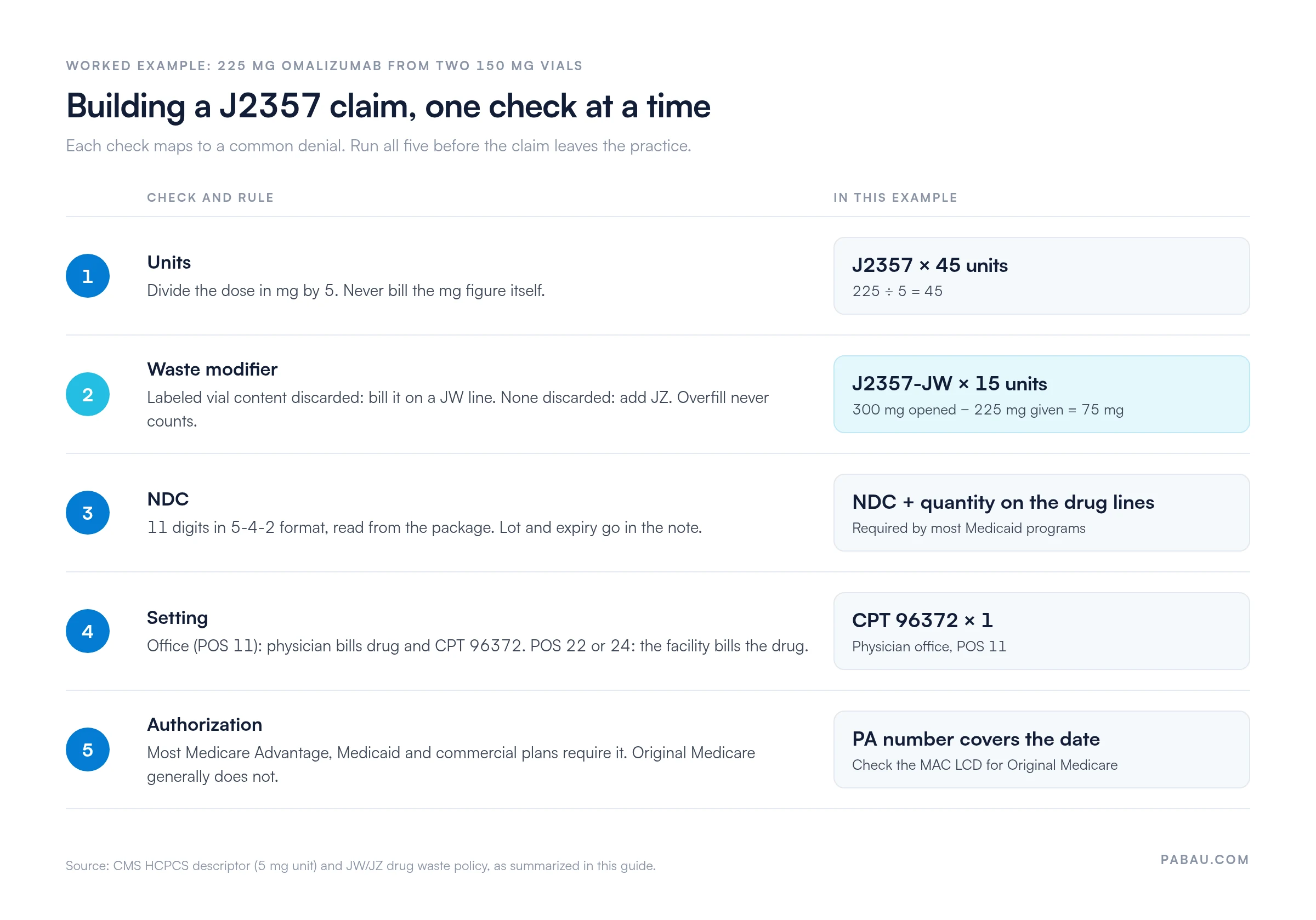
The table maps each common denial to its root cause and the correction that prevents it.
Each J2357 claim must be supported by a clinical note that can substantiate medical necessity and the billed units if audited. Strong medical billing compliance for biologics means every element below is captured at the time of service, not reconstructed later.
Missing the IgE level documentation for an asthma PA is one of the most common reasons initial authorization requests are denied. Including it upfront, rather than submitting appeals, significantly speeds the PA cycle for omalizumab-naive patients.
Audit your J2357 claims quarterly. Pull the last 90 days of omalizumab claims and check: (1) Do units match the administered dose divided by 5? (2) Is JW or JZ present on every claim line? (3) Does the NDC on the claim match the package documented for that date of service? These three checks catch the most common J2357 denial patterns early.
In many allergy and pulmonology practices, a biller checks each J2357 claim by hand before it goes out. Units, the JW or JZ line, the NDC and the authorization number all get rechecked against the visit note.
Pabau, the practice management platform we build, keeps the visit note, the patient record and the claim in one system. Its practice claims software lets your team submit claims through Claim.MD, track claim status, and check authorization codes are present before sending.
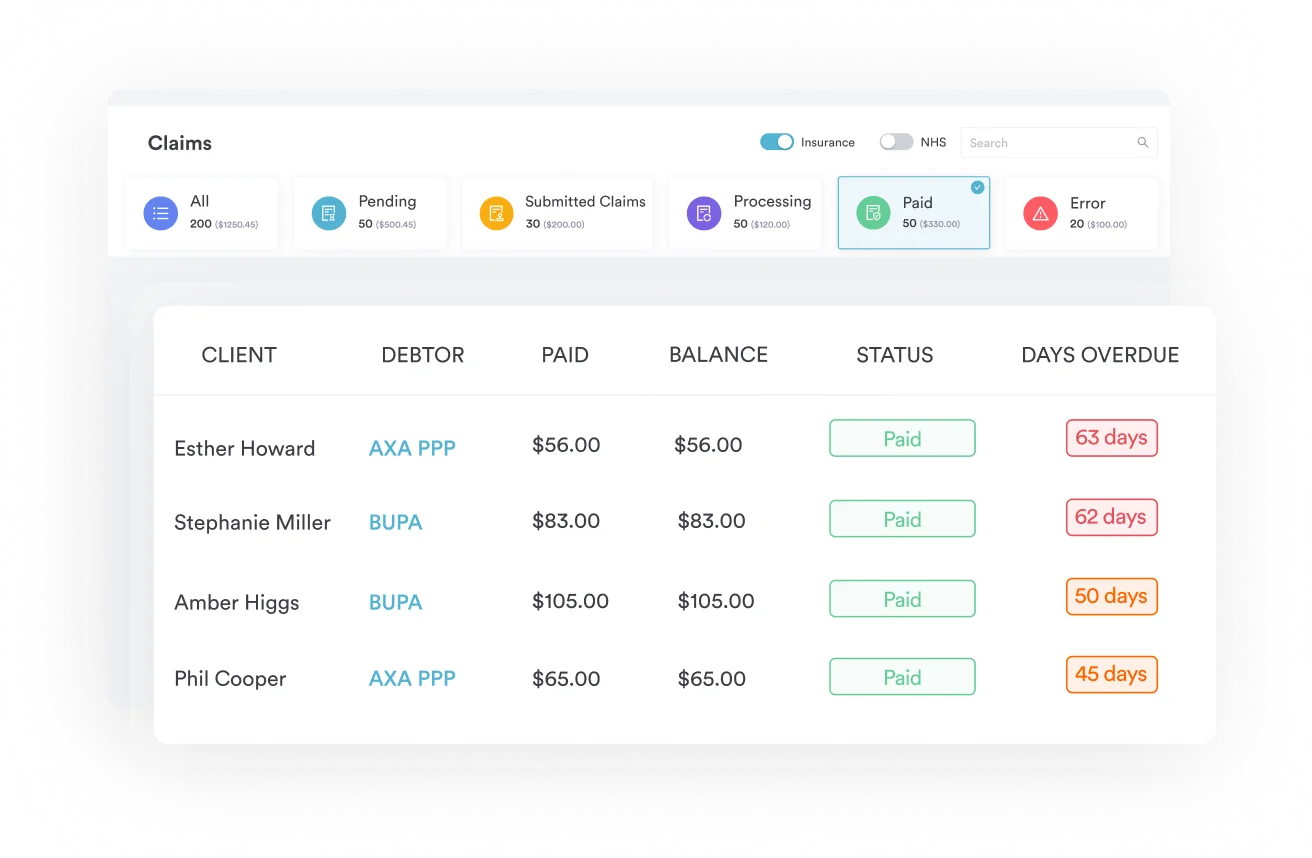
The outcome is a claim that leaves with its authorization code attached. Your team can also see each claim’s status without phoning the payer.

Pabau helps allergy, pulmonology, and immunology practices submit biologic injection claims through Claim.MD, track claim status, and check authorization codes before sending.

J2357 claims are won or lost at the injection visit, not at the appeal stage. The unit count, waste line, NDC and authorization number are all known when the dose is given. Record them in the visit note and the claim line follows from it.
The trade-off is a few extra minutes per visit, which costs far less than reworking a denied biologic claim. If Omlyclo joins your formulary, set Q5154 up as its own charge item now. For the wider picture, revenue cycle management shows where these checks sit.
Pabau’s practice management platform keeps visit notes, authorization codes and claim status together for allergy and pulmonology practices. Book a demo to see how it fits your omalizumab billing workflow.

Need to understand how denials are tracked and resolved? Denial management in healthcare covers the full workflow from CARC code identification through appeal submission.
Want a framework for clean claim submission on complex codes? Clean claim submission best practices walks through the pre-billing checks that prevent J-code rejections.
Looking to strengthen your overall billing compliance posture? Medical billing compliance outlines the documentation and audit trail requirements for physician-administered biologics.
Billing another J-code with JW and JZ? HCPCS code J9228 walks through units, drug waste modifiers and NDCs for Yervoy.
Pairing the administration code correctly? CPT code 96372 covers subcutaneous and intramuscular injection billing, modifiers and reimbursement.
HCPCS code J2357 is the Level II billing code for omalizumab (Xolair), a subcutaneous biologic injection. It treats moderate-to-severe allergic asthma, chronic idiopathic urticaria, chronic rhinosinusitis with nasal polyps, and IgE-mediated food allergy. It is billed per 5 mg administered and covers only the drug cost, not administration.
Bill 30 units of HCPCS code J2357 for a 150 mg dose. The calculation is 150 divided by 5, which equals 30. Apply this formula to any omalizumab dose: total milligrams divided by 5 equals the number of units to report.
Yes. HCPCS code J2357 applies to both the standard vial formulation and the prefilled syringe formulation of omalizumab. The same code and the same per-5-mg unit calculation apply regardless of which presentation is used.
CPT 96372 (therapeutic, prophylactic, or diagnostic subcutaneous or intramuscular injection) is the correct administration code to bill alongside J2357 in office settings. In facility settings such as hospital outpatient departments or ASCs, the facility bills the drug and the administration, so the physician bills neither.
Usually, yes. Most Medicare Advantage, Medicaid and commercial plans require prior authorization for J2357. Original Medicare generally does not, so check the MAC LCD. Plan requirements typically include a confirmed diagnosis, IgE level testing for the asthma indication, documented failure of first-line therapies, and prescriber specialty attestation. Verify the specific PA criteria with each payer before initiating treatment.
Yes. Omlyclo (omalizumab-igec), FDA approved on March 7, 2025, bills under its own code, Q5154, effective October 1, 2025. J2357 applies to reference Xolair only. Check the CMS quarterly HCPCS update and confirm with the payer before billing any later biosimilar.



