

CCSD code G5100: Bypass of duodenum billing guide
CCSD code G5100 bills a bypass that leaves the duodenum in place CCSD code G5100...

Last Updated: Oct 16, 2026
J2315 is the HCPCS Level II code for injection, naltrexone, depot form, 1 mg.
One 380 mg vial is reported as 380 units on a single claim line. Medicare Part B pays the drug under the buy-and-bill model at ASP plus 6%, a national rate that CMS republishes each quarter. The injection itself is billed separately with CPT 96372.
Let Pabau's smart automation suggest the right codes, reduce claim denials, and keep your practice compliant—effortlessly.
Automate repetitive tasks and focus on what matters most—your patients.
Reduce coding errors and ensure compliance with the latest regulations.
Clean claims, fewer denials, and faster reimbursements.
Powerful insights and reporting to help your practice thrive.
HIPAA compliant SOC 2 certified GDPR-compliant Trusted by 4,000+ clinics worldwide

HCPCS Code J2315 covers injection of naltrexone in depot (extended-release) form, billed at 1 mg per unit.
One Vivitrol vial holds 380 mg, so a complete dose is billed as 380 units of J2315.
Most commercial payers require prior authorization before the injection, and a missing approval is a leading cause of denial.
Most claims carry the JZ modifier because the whole vial is given, and JW applies only when part of it is discarded.
Practice management software like Pabau tracks J-code units, prior authorization status, and claim status in one workflow.
HCPCS Code J2315 sits in the HCPCS Level II J-code series. That series covers injectable drugs that the CPT code set does not describe. The Centers for Medicare and Medicaid Services (CMS) maintains the Level II code set annually. Medicare, Medicaid, and most commercial payers require these codes for covered injectable drugs.
Vivitrol carries two FDA-approved indications. The first is opioid use disorder (OUD) in patients who have already stopped opioids. The second is alcohol use disorder (AUD), where it reduces heavy drinking days. Both indications qualify for billing under HCPCS Code J2315 when supported by appropriate documentation.
Naltrexone works as an opioid antagonist. In the extended-release injectable form, one intramuscular injection holds therapeutic drug levels for about 30 days, which removes the compliance risk of daily oral dosing. Substance use programs give the injection monthly, so each patient generates one J2315 claim every 30 days.
Naltrexone and naloxone are different drugs with separate billing codes. A program that also stocks injectable naloxone should note that HCPCS Code J2310 was deleted effective July 1, 2025.
Vivitrol comes in a single-dose 380 mg vial. Because HCPCS Code J2315 is billed at 1 mg per unit, one complete vial equals 380 billing units. This is the most common source of claim errors on the code. A biller who submits 1 unit instead of 380 underbills by a factor no one may notice until an audit.
Each drug code sets its own unit size in the descriptor. HCPCS Code J2357 bills omalizumab in 5 mg units, so a 300 mg dose equals 60 units.
Vivitrol comes as a single-dose vial and the full 380 mg is normally administered, so most claims report 380 units with no wastage. Where part of the vial is discarded, report that amount on its own line with the JW modifier. Record the quantity in the administration note.
Audit your billing system’s unit defaults before submitting J2315 claims. Many EHR and practice management platforms default drug quantities to “1 unit” without prompting for the mg-per-unit calculation. Set a workflow checkpoint that confirms 380 units for every Vivitrol administration before the claim leaves the practice.
HCPCS Code J2315 is paid under Medicare Part B using the Average Sales Price (ASP) plus 6% methodology. The Physician Fee Schedule does not price the drug at all. Pull the current figure from the CMS ASP drug pricing file for the applicable quarter before you submit claims or quote a patient estimate.
Under the buy-and-bill model, the practice buys Vivitrol from a wholesaler or specialty pharmacy. It administers the drug, then bills Medicare Part B for the drug and the injection. The spread between ASP plus 6% and the price you actually paid is the margin on every vial. Track acquisition cost against payment per vial, because a drug this expensive turns a small pricing error into a large monthly loss.
ASP plus 6% is a single national rate, so the drug payment does not vary by locality. Urban and rural practices are paid the same amount per unit. Only the separately billed administration code is adjusted geographically, and the ASP file itself changes every quarter.
Every J2315 claim must carry at least one ICD-10-CM diagnosis code that establishes medical necessity. Payers use these codes to confirm the indication matches their coverage policy for Vivitrol. Submitting with an unsupported diagnosis code is a primary driver of denial.
Not all payers accept every code in this list. Medicare Local Coverage Determinations (LCDs) define which ICD-10 codes support J2315 coverage for a given payer. Always verify the specific LCD applicable to your Medicare Administrative Contractor (MAC) before submitting. The F11.10 and F10.10 “abuse” codes, in particular, may not satisfy coverage criteria with all payers.
Most commercial payers require prior authorization (PA) before administering Vivitrol and billing HCPCS Code J2315. Administering without confirmed PA status is one of the most expensive denials there is. The practice has already bought a vial costing several hundred dollars, and a denial can write off both the drug and the administration. Confirm coverage and PA status before the appointment is booked, not on the day of the injection.
Medicare does not universally require PA for J2315, but individual Medicare Advantage plans may apply their own PA requirements. Medicaid PA requirements vary significantly by state. Verify with each payer individually rather than applying a blanket rule. Record the PA approval number in the patient chart before the date of service.
Complete documentation is the foundation of a defensible J2315 claim. Payers auditing J2315 claims look for evidence that the drug was medically necessary, properly administered, and accurately reported. The goal is submitting a clean claim on the first pass. That depends on gathering the documentation at the point of care rather than reconstructing it later.
Capturing these fields on a structured administration form at the point of care removes most claim rework. Substance use records also carry federal confidentiality protections under 42 CFR Part 2, which sit on top of HIPAA. Release of that information to a payer follows the consent rules in Part 2, so build the consent step into the same form.
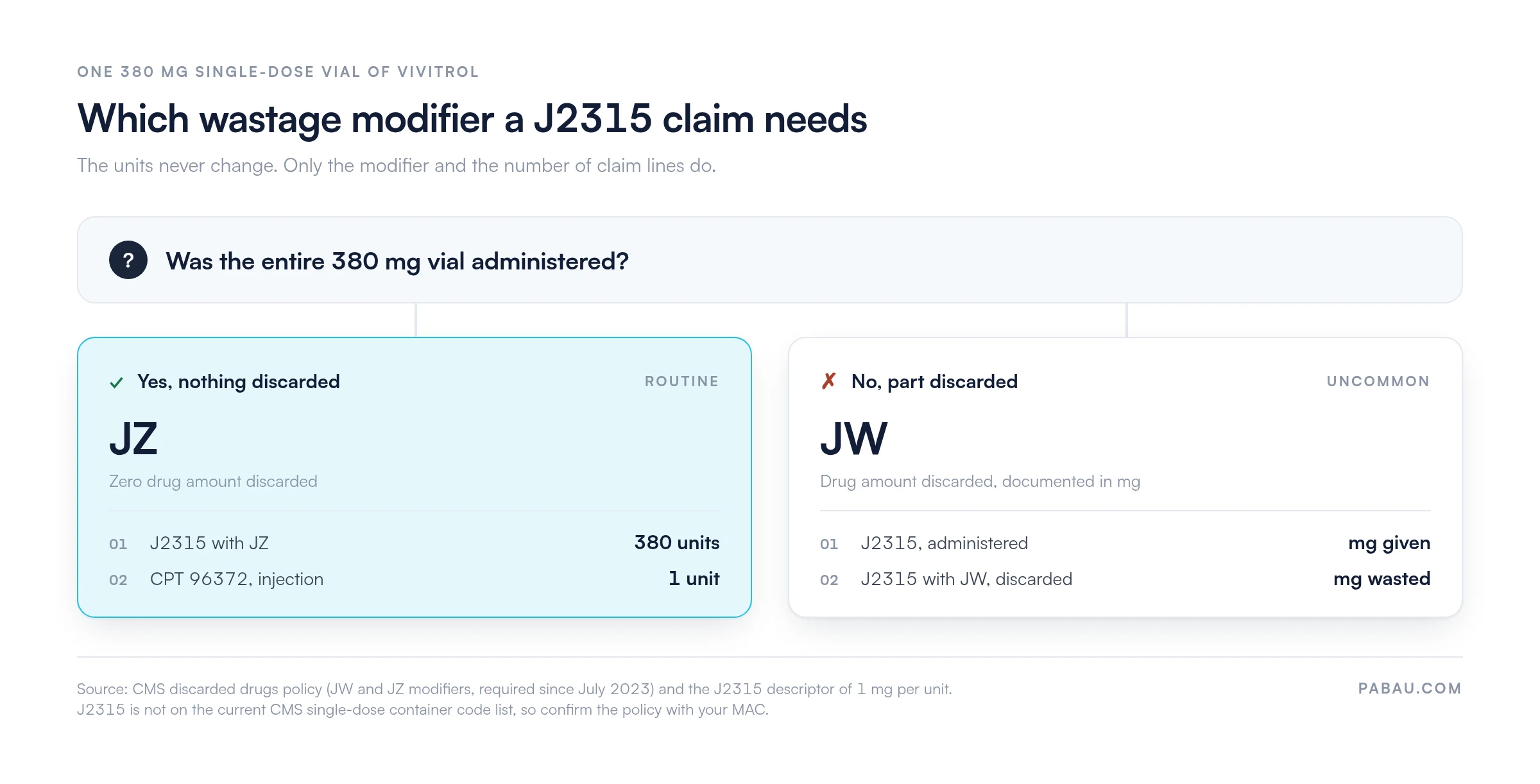
Two modifiers describe drug wastage on a J2315 claim, and only one of them belongs on a routine claim. The full 380 mg vial is normally administered, so JZ is the code most claims carry. JW is the exception, reserved for the claim where part of the vial is discarded.
JZ attests that nothing was discarded, which is what a complete 380 mg dose means on a claim. Reach for JW only when part of the vial genuinely goes in the sharps bin. Document the discarded amount in the medical record on the date of service. A JW line without that note is an audit invitation.
One caveat worth checking before you set a default in your billing system. J2315 does not currently appear on the CMS list of single-dose container codes named by the JW and JZ policy. That list is updated roughly twice a year. Confirm the current position with your MAC, then apply the same rule to every J2315 claim you send.
The decision itself comes down to one question at the point of care.
J2315 denial rates run higher than most drug codes because one claim is reviewed against several criteria at once. Units, covered diagnosis, PA status, and modifier accuracy each have to hold up on their own. A pre-submission checklist catches more of these than a reactive rework queue does. Reading the denial codes that come back on J-series drug claims also shows billing teams which step of the workflow is failing.
Run a 90-day J2315 denial audit before assuming your billing workflow is accurate. Pull every J2315 claim and filter for denials. The three most common patterns, wrong units, missing PA, and unsupported diagnosis, account for the majority of preventable write-offs. Fix the workflow before the pattern repeats across another quarter.
Coverage stances for HCPCS Code J2315 vary considerably across payer types. The table below summarizes the typical approaches. Verify the specific policy with each payer before administration, since Medicaid rules differ by state and by plan year.
The AAPC HCPCS code reference and the Local Coverage Determinations published on the CMS website are the primary sources for verifying coverage criteria. Check both again at the start of each plan year, since Medicaid criteria and commercial step-therapy rules move more often than the code itself.
Most practices keep three records apart for one Vivitrol injection: the appointment, the administration note with the dose and lot number, and the claim. Re-keying between them is where the 380-unit line, the modifier, and the PA number get lost.
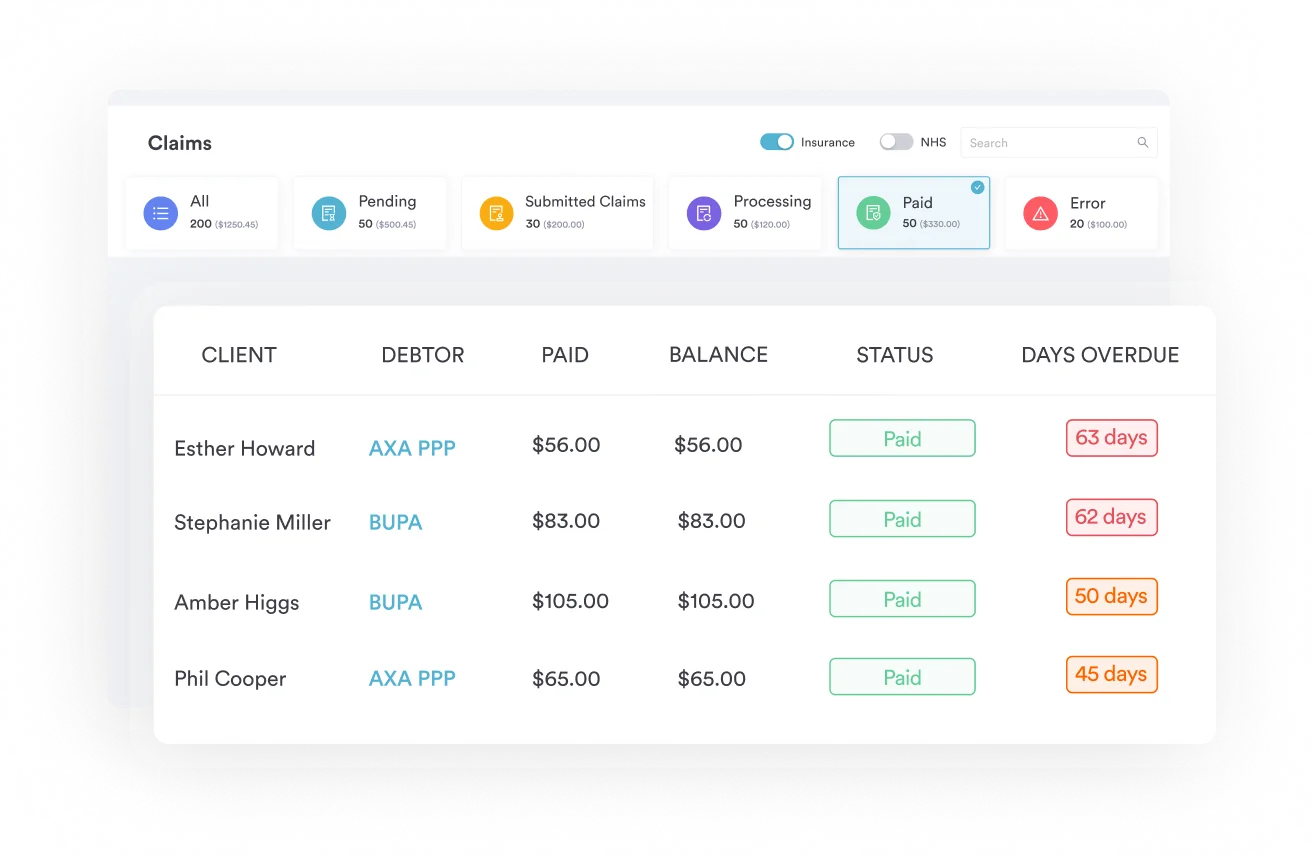
Pabau holds the appointment, the clinical note, and the invoice in one patient record. What the clinician documented at the chairside is already attached when the claim goes out. Nobody rebuilds the drug line from memory a week later. Our streamlined claims management then submits and tracks each claim, showing which J2315 lines are pending, paid, or denied.
For a program giving monthly injections, the authorization number, the administration record, and the claim status all sit in one chart. A pattern of denials shows up within days instead of at month-end reconciliation.

Pabau tracks HCPCS J-code units, prior authorization status, and claim submissions within the same platform your team already uses for scheduling and clinical documentation. See how it works for substance use and addiction medicine practices.

J2315 is not a difficult code, but it is an expensive one to get wrong. A vial costs several hundred dollars, so a single denied claim wipes out the margin on several correct ones. That economics is what makes the pre-service checks worth the time they take.
Fix three defaults once and the rest follows. Set 380 units on the drug line, JZ on a complete dose, and a PA number in the chart before the appointment is booked. Then set a quarterly reminder to re-pull the ASP file, because the payment moves even when your workflow does not.
To see how Pabau keeps the injection record and the outgoing claim in step for J-code billing, book a demo.

Need a framework for clean claim submission? Clean claim best practices covers the documentation and coding steps that reduce first-pass denial rates for injectable drug claims.
Handling claim denials after submission? Denial management in healthcare explains how to build a systematic appeals process for J-code drug claims.
Want to understand the broader billing lifecycle? Revenue cycle management workflow maps the end-to-end financial process from patient intake through payment posting.
HCPCS Code J2315 is the billing code for injection of naltrexone in depot (extended-release) form at 1 mg per unit. It bills Vivitrol (naltrexone extended-release injectable suspension) when a physician or qualified provider administers it for opioid or alcohol use disorder. Medicare Part B, Medicaid, and commercial payers all recognize the code.
One Vivitrol vial contains 380 mg of naltrexone, and the code is defined at 1 mg per unit. That vial is therefore billed as 380 units of J2315. Billing 1 unit instead of 380 is the most common unit error on J2315 claims and results in significant underpayment.
Yes, Medicare Part B covers J2315 under the physician buy-and-bill model using ASP+6% reimbursement methodology. Traditional Medicare generally does not require prior authorization, but Medicare Advantage plans may impose their own PA requirements. Verify with the specific plan before administering.
Most J2315 claims carry JZ, the zero-discarded modifier, because the whole 380 mg vial is administered. JW applies only when part of the vial is discarded, and the discarded amount goes on its own claim line with a supporting note. Medicare has required JZ on single-dose container claims with no wastage since July 2023.
A J2315 claim needs the ICD-10-CM diagnosis supporting OUD or AUD, plus a short medical necessity narrative. It also needs the administration record: date, the 380 mg dose, IM route, site, lot number, and expiration date. Add the prior authorization number and the signed patient consent. OUD claims also carry the record of the 7 to 10 day opioid-free interval.



