CPT Code 99465: Newborn resuscitation in the delivery room
CPT Code 99465: Definition and clinical description CPT Code 99465 is the AMA pr...

Last Updated: Nov 2, 2026
J1725 is the HCPCS Level II code for injection, hydroxyprogesterone caproate, 1 mg. CMS deleted it with effect from December 31, 2017, so it is not valid for dates of service from January 1, 2018.
Bill J1726 for Makena or J1729 for other hydroxyprogesterone caproate products instead, both at 10 mg per unit. The FDA withdrew approval of Makena and its generics in April 2023, so confirm payer coverage before any claim.
Let Pabau's smart automation suggest the right codes, reduce claim denials, and keep your practice compliant—effortlessly.
Automate repetitive tasks and focus on what matters most—your patients.
Reduce coding errors and ensure compliance with the latest regulations.
Clean claims, fewer denials, and faster reimbursements.
Powerful insights and reporting to help your practice thrive.
HIPAA compliant SOC 2 certified GDPR-compliant Trusted by 4,000+ clinics worldwide

HCPCS Code J1725 describes injection, hydroxyprogesterone caproate, 1 mg, and CMS deleted it with effect from December 31, 2017.
For dates of service from January 1, 2018, bill J1726 for Makena or J1729 for other hydroxyprogesterone caproate products.
J1725 counted 1 unit per mg, while J1726 and J1729 count 1 unit per 10 mg, so a 250 mg dose is 25 units.
The FDA withdrew approval of Makena and its generics in April 2023, so confirm coverage with the payer before any claim.
Pair the drug code with a trimester-specific ICD-10-CM code, such as O09.212, that documents a prior preterm birth.
HCPCS Code J1725 is a deleted Level II drug code whose official descriptor reads: Injection, hydroxyprogesterone caproate, 1 mg. CMS added it on January 1, 2012 and terminated it on December 31, 2017. The dates come from the Centers for Medicare and Medicaid Services (CMS) HCPCS code file.
J1725 is therefore not valid for any date of service from January 1, 2018. The drug moved to two 10 mg codes on that date. J1726 covers the Makena brand, and J1729 covers hydroxyprogesterone caproate not otherwise specified.
J1725 still turns up in three places:
Hydroxyprogesterone caproate (also called 17-OHPC or 17P) is a synthetic progestin. It was given to reduce the risk of preterm birth in patients with a singleton pregnancy and a history of singleton spontaneous preterm birth.
The labeled regimen was 250 mg by weekly intramuscular injection. Treatment started between 16 weeks 0 days and 20 weeks 6 days of gestation and continued until week 37 or delivery. A 275 mg subcutaneous auto-injector of Makena was added later.
OB/GYN and maternal-fetal medicine practices were the main billers of this drug. An audit of these claims turns on their records of obstetric history and gestational age.
No, J1725 is not valid for current claims. CMS terminated it on December 31, 2017, and a claim line carrying it for a later date of service is rejected as an invalid code.
CMS first split the drug with two temporary codes from July 1, 2017. Q9986 covered Makena, and Q9985 covered hydroxyprogesterone caproate not otherwise specified. On January 1, 2018 those Q-codes and J1725 were all retired, and J1726 and J1729 took over. Medicare Part B stopped accepting J1725 earlier, on July 1, 2017, when the Q-codes began, per CMS transmittal R3776CP. The timeline below shows when each code applied and what a 250 mg dose bills as.
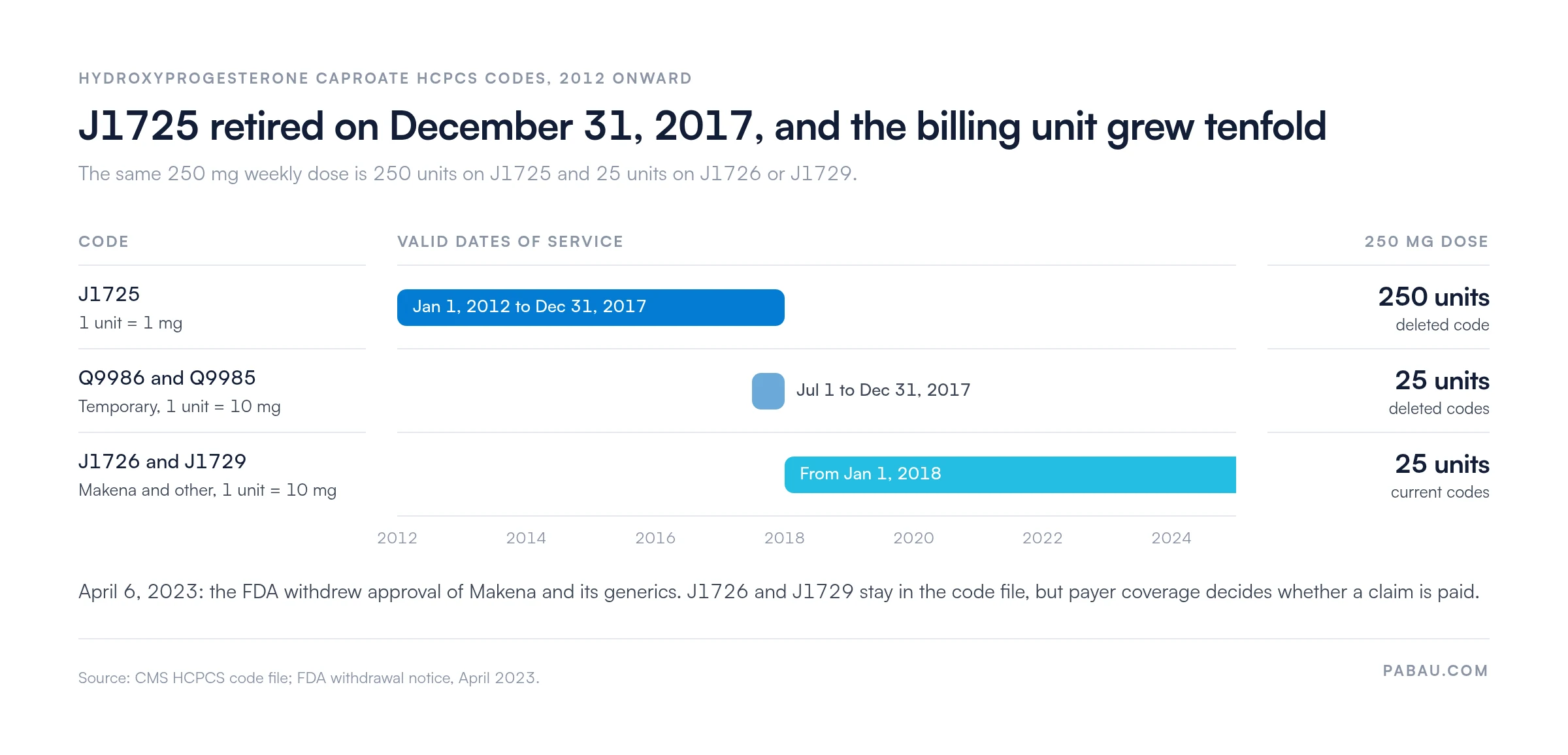
Decision rule: Start from the date of service, then the product. Makena, in either the vial or the auto-injector, maps to J1726. Any other hydroxyprogesterone caproate product maps to J1729.
Search your charge master for J1725 and the two Q-codes. A retired code left in a fee schedule keeps producing rejections. Its 1 mg unit also distorts any utilization report that mixes it with the 10 mg codes.
The unit size is where J1725 and its replacements differ most. J1725 counted 1 unit per mg, so a 250 mg dose was billed as 250 units. J1726 and J1729 count 1 unit per 10 mg, so the same dose is 25 units.
Carrying the old 1 mg habit over to the new codes is the costly mistake. Billing 250 units of J1726 claims ten times the dose given, which can trigger a medically unlikely edit or an overpayment recovery.
The same dose-to-unit error shows up on other obstetric drug codes. J2210, methylergonovine maleate, bills one unit per 0.2 mg vial, so a note reading 200 mcg is one unit, not 200.
The FDA withdrew approval of Makena and its generic versions on April 6, 2023. A confirmatory trial had not shown a clinical benefit, and the products can no longer be lawfully distributed in interstate commerce.
J1726 and J1729 remain in the HCPCS file, but no FDA-approved product now sits behind them. Many payers ended coverage after the withdrawal. Confirm the payer’s current policy in writing before any administration, not after.
Compounded hydroxyprogesterone caproate has no dedicated HCPCS code of its own. Payers that cover a compounded drug set their own rules for which code and documentation they accept.
Medicare Part B covers compounded drugs only in limited circumstances. Check your Medicare Administrative Contractor’s (MAC) policy and the payer’s written guidance before billing compounded 17P under any code.
The National Drug Code (NDC) is the 11-digit identifier of the drug product and package. Medicaid programs require it on claims for physician-administered drugs, and many commercial payers ask for it too. A missing or mismatched NDC is a common reason drug claims are denied.
The NDC also tells the payer which product was given. A Makena NDC belongs on a J1726 line, and a generic NDC belongs on a J1729 line. A mismatch between the two is an easy edit for a payer to catch.
Payers look for a diagnosis that matches the labeled indication: a current singleton pregnancy in a patient with a prior spontaneous preterm birth. The ICD-10-CM codes below are the ones most often used to document it.
O09.21 on its own is not a valid billing code. Submit the full trimester code, such as O09.212 for the second trimester, or the claim is rejected before payer review.
Medicare Part B pays most physician-administered drugs at the Average Sales Price (ASP) plus 6%. CMS publishes the rates in its quarterly ASP pricing files. J1725 has no current payment rate because the code is deleted.
Payers that cover hydroxyprogesterone caproate usually require prior authorization. The medical record has to support both the indication and each dose billed.
Keep these records for the full retention period your payer contracts and state rules set. A post-payment audit of 2017 claims will test the J1725 units against the dose recorded.
Most denials on this drug trace back to the 2018 code change or the 2023 withdrawal. The table pairs each common error with its fix.
Tracking these denials by reason code shows whether they cluster around one cause. Denial management workflows make that pattern visible before it spreads.
Injectable drug claims stand or fall on the record behind them. When the obstetric history, the dose and the product details sit in separate files, an authorization request or an audit means hours of searching.
Pabau, the all-in-one practice management system we build, keeps patient records, treatment notes, consent forms and invoices together. Staff can record the dose and product details in the treatment note for each visit, next to the patient’s history.
For practices that bill insurers, Pabau also offers claims management software built on the same patient record.

Pabau keeps the treatment note, the patient’s history and the invoice in one record. Billing staff can confirm the dose and product behind every injectable drug claim.

J1725 belongs to claims from 2012 through 2017 and nowhere else. Remove it from your charge master, and map any remaining hydroxyprogesterone caproate charges to J1726 or J1729 at 10 mg per unit.
The bigger risk now is coverage rather than coding. With no approved product on the market since April 2023, a payer’s written policy decides whether a claim is paid. Book a demo to see how Pabau keeps the record behind every drug claim in one place.

Need a complete picture of how denials flow through your revenue cycle? Denial management in healthcare covers how to categorize, track, and appeal claim denials systematically.
Looking for a structured billing workflow for injectable drugs? What is medical billing explains how the end-to-end billing process works for physician-administered drugs.
Want to understand how electronic claim submission works for J-codes? Superbill creation and claim submission covers how charge capture connects to the clearinghouse claim file.
HCPCS Code J1725 describes injection, hydroxyprogesterone caproate, 1 mg. CMS deleted it with effect from December 31, 2017, so it only applies to dates of service from 2012 through 2017.
From January 1, 2018, J1726 covers Makena and J1729 covers hydroxyprogesterone caproate not otherwise specified. Both codes count 1 unit per 10 mg.
Under J1725 a 250 mg dose was 250 units, because each unit was 1 mg. Under J1726 or J1729 the same dose is 25 units, because each unit is 10 mg.
J1726 is for the Makena brand, in either its vial or its auto-injector form. J1729 is for any other hydroxyprogesterone caproate product. The NDC on the claim shows which product was given.
Coverage is limited. The FDA withdrew approval of Makena and its generics on April 6, 2023, and many payers ended coverage. Confirm the payer’s written policy and authorization before administration.
O09.211, O09.212, O09.213 or O09.219 document a history of pre-term labor by trimester. O26.2- covers recurrent pregnancy loss, and a Z3A code can record weeks of gestation.