HCPCS Code G0163: Skilled nursing observation and assessment
What is HCPCS Code G0163? HCPCS Code G0163 is a deleted Level II code for skille...

Last Updated: Oct 15, 2026
J1190 is the HCPCS Level II code for injection, dexrazoxane hydrochloride, per 250 mg.
Both bill under the same J-code, so the drug line looks identical either way. The diagnosis codes underneath it do not. Pick a code that fits the other indication and the claim comes back.
Let Pabau's smart automation suggest the right codes, reduce claim denials, and keep your practice compliant—effortlessly.
Automate repetitive tasks and focus on what matters most—your patients.
Reduce coding errors and ensure compliance with the latest regulations.
Clean claims, fewer denials, and faster reimbursements.
Powerful insights and reporting to help your practice thrive.
HIPAA compliant SOC 2 certified GDPR-compliant Trusted by 4,000+ clinics worldwide

HCPCS code J1190 covers injection of dexrazoxane hydrochloride, and one billed unit equals 250 mg given to the patient.
Two FDA-approved indications share the code, so the diagnosis codes on the claim change with the indication you treated.
Pfizer discontinued Zinecard, so generic dexrazoxane now carries the cardioprotection indication on almost every J1190 claim.
Every J1190 line needs a waste modifier, either JW for a discarded amount or JZ when none was discarded.
Practice management software like Pabau pre-fills the claim from the treatment record and checks required fields before submission.
J1190 is the HCPCS Level II code for injection of dexrazoxane hydrochloride, per 250 mg. It belongs to the J-code series that CMS maintains for drugs given in physician offices, hospital outpatient departments, and infusion suites. You can check the current descriptor in the HCPCS Level II files published by CMS.
The long descriptor reads Injection, dexrazoxane hydrochloride, per 250 mg. The short descriptor is Dexrazoxane HCl injection. Both describe the same billable event, so whichever wording your clearinghouse displays, the line behaves the same way.
Dexrazoxane is a cardioprotective agent given alongside anthracycline chemotherapy. It chelates free iron and blocks the reactive oxygen species behind anthracycline-induced cardiomyopathy. T
he FDA has approved it for two separate jobs, and each one arrives on the claim with its own supporting documentation.
The brand landscape has also changed, which trips up practices working from an older fee schedule.
Pfizer stopped marketing Zinecard in April 2021, and the FDA withdrew the approval in September 2025. Generic dexrazoxane now carries the cardioprotection indication.
Dexrazoxane is also used off label, mostly in pediatric oncology and with anthracycline regimens outside the labeled one.
Payer coverage there is inconsistent. Most plans want compendia support, such as an NCCN citation, documented before the claim goes out.
Medical necessity for J1190 rests on the diagnosis codes, not on the J-code itself. Cardioprotection and extravasation pull from opposite ends of ICD-10.
Send an extravasation code with a planned cardioprotective dose and the payer reads it as a mismatch. That is a medical necessity denial now, and a recoupment target later.
The split below is worth pinning above the desk of whoever codes infusion charges.
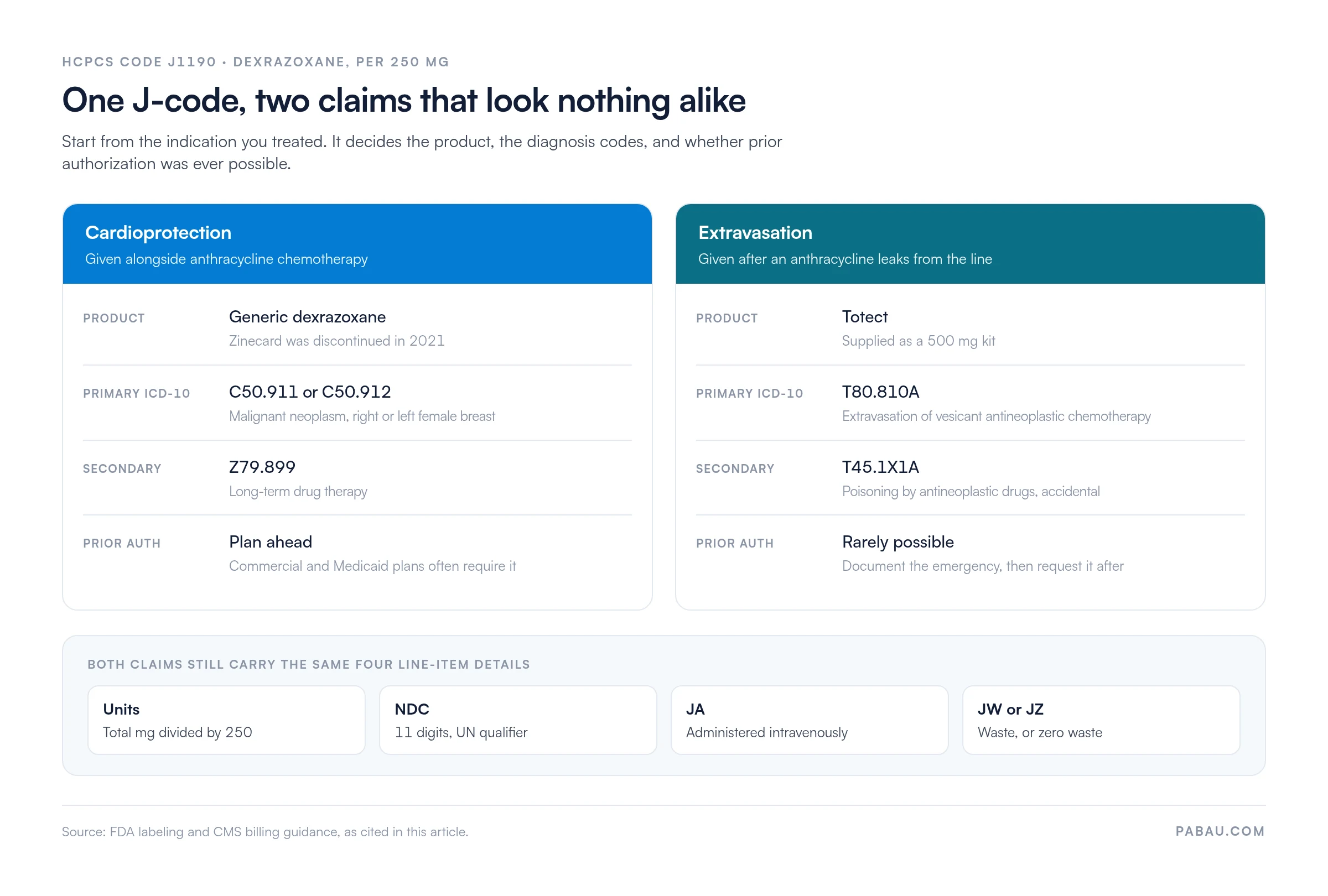
One code deserves a warning. T80.818A carries the descriptor Extravasation of other vesicant agent, and it exists for vesicants that are not chemotherapy.
An anthracycline is antineoplastic, so it belongs in the T80.810 series instead. Reaching for the catch-all is an easy habit and a slow one to unlearn.
Laterality, encounter type, and the patient’s primary oncology diagnosis all shift the final code set. Check each one against the CMS ICD-10-CM code files before you submit, because the annual update revises and retires codes every October.
Start with the dose in the infusion record, never the vial size. Units equal total milligrams divided by 250. So a 500 mg dose bills as 2 units, and 750 mg bills as 3.
Billing 1 unit for a 500 mg administration is the underbilling error nobody downstream catches. The claim pays, the remittance looks normal, and the practice absorbs half the drug cost quietly.
The NDC maps a specific manufacturer and package size to the J-code. A missing or stale one is a leading cause of technical denials on dexrazoxane.
Labelers change their NDCs when packaging or labeling changes, so a number that worked last year may not clear this year.
On a CMS-1500 or an 837 file, report the NDC in 11-digit format without hyphens. The unit qualifier for injectable drugs is UN, and the NDC quantity reflects the milligrams administered rather than the size of the vial. Those two numbers get transposed more often than you would expect.
Two modifiers do the real work on a J1190 line. JA states the route, and either JW or JZ accounts for the drug that did not reach the patient. Everything else is situational.
Dexrazoxane comes in single-dose containers, which puts it squarely inside the CMS discarded-drug policy. Since July 1, 2023, a separately payable Part B drug from a single-dose container must carry JW or JZ on every claim. Leaving both off is not a neutral omission, it returns the line unpaid.
The split is straightforward in practice. Wasted any of the vial? Bill the administered units on one line and the discarded units on a second line with JW, and record the amount in the patient’s chart.
Used all of it? One line with JZ. CMS sets out both scenarios in its discarded drugs policy.
Medicare Part B pays J1190 under the Average Sales Price plus 6% methodology. CMS builds ASP from manufacturer sales data and republishes it four times a year in the quarterly ASP pricing files.
Because the number moves every quarter, a fee schedule loaded in January is already stale by April. Rates quoted in third-party resources, this guide included, may reflect a past quarter. Pull the current file instead of trusting a figure you copied last cycle.
J1190 also runs on the buy-and-bill model. The practice purchases dexrazoxane from a wholesaler or specialty distributor, administers it, then bills the payer and waits.
Acquisition cost, wastage, and payment timing all land on practice cash flow before a single dollar comes back. Medicare pays the lesser of ASP plus 6% or the submitted charge. Set your charge below the fee schedule and you simply leave the difference behind.
Re-check your J1190 rate on the first working day of every quarter. Download the current CMS ASP drug pricing file, then compare it line by line against the fee schedule table in your practice management system. A rate that was right in Q1 can be underpaying you by Q3. The variance only shows up once the quarter’s claims have posted.
Coverage for dexrazoxane varies more by payer than the drug’s narrow label suggests. The pattern below holds across most plans, but the local coverage determination from your MAC is what governs a Medicare claim.
Planned cardioprotection gives you time, so verify benefits before each administration cycle and get the authorization number on file. Extravasation gives you none. Nobody pauses an emergency to call a plan, so the record has to do that work afterward.
Document the timeline clearly: when the extravasation was identified, when dexrazoxane was started, and who made the call. That note is what supports a retrospective authorization request, and it is the first thing an appeals reviewer looks for.
J1190 rarely travels alone. These are the neighbors worth recognizing on an oncology remittance, along with the two catch-all codes that should never stand in for it.
Six things decide whether a J1190 claim pays on the first pass. Work down them in order, and most denials never happen.
Four errors account for most of the rework on this code, and three of them start in the drug file rather than the claim.
When one does slip through, read the remittance rather than resubmitting on instinct. Our guide to common claim denial codes maps the adjustment reasons you will see back to what the payer actually wants fixed.
In most infusion practices the dose lives in one system and the claim gets built in another. Someone reads the infusion log, works out the units, types them into the billing screen, and hopes the NDC on file is current. Every one of those handoffs is a chance to drop a digit.
Practice management software like Pabau closes that distance. Its claims software for billers pre-fills the claim form straight from the record. The procedure code attached to the service lands on the charge line, and the diagnosis slots seed from the client’s recorded problem list.
Built-in ICD-10-CM and CPT/HCPCS lookup libraries sit behind a search icon, so a coder confirms a descriptor without leaving the claim.
Before the claim goes anywhere, Pabau checks that the fields the payer requires are filled in. The send button stays locked until they are.
From there it submits through the clearinghouse for your region, which in the US is Claim.MD. Eligibility checks, claim status, and remittance posting all come back into the same place.
It will not choose your modifiers or tell you which T80 code the chart supports. That judgment stays with your coder. What it does remove is the retyping between the treatment note and the claim, which is where J-code units go wrong.

Pabau pre-fills the claim from what your team charted, and puts ICD-10 and HCPCS lookup libraries beside the form. Submission stays blocked until the required fields are complete. Fewer retyped units, fewer technical denials.

J1190 is a simple code attached to a complicated decision. The drug line barely changes between the two indications. Accuracy has to come from the diagnosis codes, the unit math, and the waste modifier. Get those three right and the claim is unremarkable, which is exactly what you want from a high-cost drug.
The two items worth acting on this week are your drug file and your quarterly rate. If Zinecard is still sitting in it, that NDC will fail. If your fee schedule has not been refreshed since the last ASP file, you are billing against a number that has already moved.
If your infusion team is still retyping doses into the billing screen, book a demo. You will see how Pabau builds the claim from the treatment record instead.

Want fewer claims coming back at all? What makes a clean claim sets out the fields payers check first, and what a first-pass acceptance rate should look like.
Dealing with J1190 denials already? Denial management in healthcare walks through appeal workflows and the documentation that overturns oncology drug denials.
Need to stop authorization surprises? Insurance eligibility verification covers what to check before a high-cost administration, and when to check it.
Want the full picture around the claim? What is revenue cycle management follows the money from registration through to payment posting.
No. J1190 pays for the dexrazoxane itself. The infusion or injection service bills separately on its own line, using the appropriate 96XXX CPT code. Leaving that line off means the practice is paid for the drug but not for the chair time and nursing that delivered it.
In a physician office or infusion center, J1190 goes on the CMS-1500, submitted electronically as an 837P. Hospital outpatient departments bill it on a UB-04 as an 837I, with a revenue code for drugs requiring detailed coding. The HCPCS code stays the same on both.
Put the administered units on one line and the discarded units on a second line with modifier JW. Record the wasted amount in the patient’s chart. If none of the vial was wasted, the single line carries JZ instead.
JA for intravenous administration, plus JW or JZ to account for waste. JB means administered subcutaneously and does not apply to dexrazoxane. GY is used only to force a denial on a non-covered indication for a secondary payer.
Yes. Dexrazoxane and doxorubicin are separate drugs, so each takes its own line with its own units and NDC. J9000 covers doxorubicin per 10 mg. Both lines link to the diagnosis codes supporting the regimen.