CPT code 48152: Whipple procedure without pancreatojejunostomy
CPT code 48152: Official description and procedure overview CPT code 48152 descr...

Last Updated: Nov 13, 2026
J0715 is the HCPCS Level II code for injection, ceftizoxime sodium, per 500 mg. CMS deleted it effective 31 December 2025 and named no replacement code, so it is not valid for dates of service after that date.
For ceftizoxime given from 1 January 2026, bill the code your payer directs. That is usually the unlisted-drug code J3490, with the drug name and NDC. Claims for services on or before 31 December 2025 still bill J0715 at one unit per 500 mg.
Let Pabau's smart automation suggest the right codes, reduce claim denials, and keep your practice compliant—effortlessly.
Automate repetitive tasks and focus on what matters most—your patients.
Reduce coding errors and ensure compliance with the latest regulations.
Clean claims, fewer denials, and faster reimbursements.
Powerful insights and reporting to help your practice thrive.
HIPAA compliant SOC 2 certified GDPR-compliant Trusted by 4,000+ clinics worldwide

CMS deleted HCPCS Code J0715 (injection, ceftizoxime sodium, per 500 mg) effective 31 December 2025, with no replacement code named
A claim line with J0715 and a date of service on or after 1 January 2026 denies as an invalid code
For 2026 dates of service, bill the unlisted-drug code J3490 with the drug name and NDC, unless the payer directs otherwise
Claims for dates on or before 31 December 2025 still bill J0715 at one unit per 500 mg given
Pabau’s claim validation checks claims for missing or invalid details before they go to the clearinghouse, and shows the reason when a claim is rejected.
HCPCS Code J0715 was the HCPCS Level II code for injection, ceftizoxime sodium, per 500 mg.
CMS deleted it effective 31 December 2025, and the January 2026 discontinued-code list names no replacement code. It is not valid for any date of service on or after 1 January 2026.
The code sat in the J-series that the Centers for Medicare and Medicaid Services (CMS) keeps for drugs given other than by mouth. Practices reported it for the drug supply when ceftizoxime was given by IV infusion or IM injection. Claims for those services in 2025 or earlier still use it.
Ceftizoxime is a third-generation cephalosporin once sold as Cefizox. Its deletion took effect in the January 2026 annual update.
No. CMS discontinued J0715 in the January 2026 HCPCS update, with a termination date of 31 December 2025. The CGS Medicare January 2026 HCPCS update lists it among the discontinued codes, with the crosswalk column left blank. Noridian’s January 2026 update carries the same deletion.
The NLM HCPCS lookup, which carries the CMS code file, now flags J0715 as obsolete with a termination date of 31 December 2025. No grace period applies. A claim line with J0715 and a 2026 date of service is rejected as an invalid code.
Claims for services on or before 31 December 2025 still bill J0715, as long as they reach the payer within its timely filing limit. Medicare allows 12 months from the date of service, so late 2025 claims stay open until late 2026.
No HCPCS code currently describes ceftizoxime sodium. The CMS file holds no other ceftizoxime entry, so a 2026 dose falls to the unlisted-drug code J3490. Work through these five steps before the first 2026 claim goes out.
Some Medicaid programs and commercial plans publish their own unlisted-drug rules. Check the plan policy before the first claim, because a rejected J3490 line usually comes down to missing drug details. The diagram below maps each ceftizoxime dose to its code by date of service.
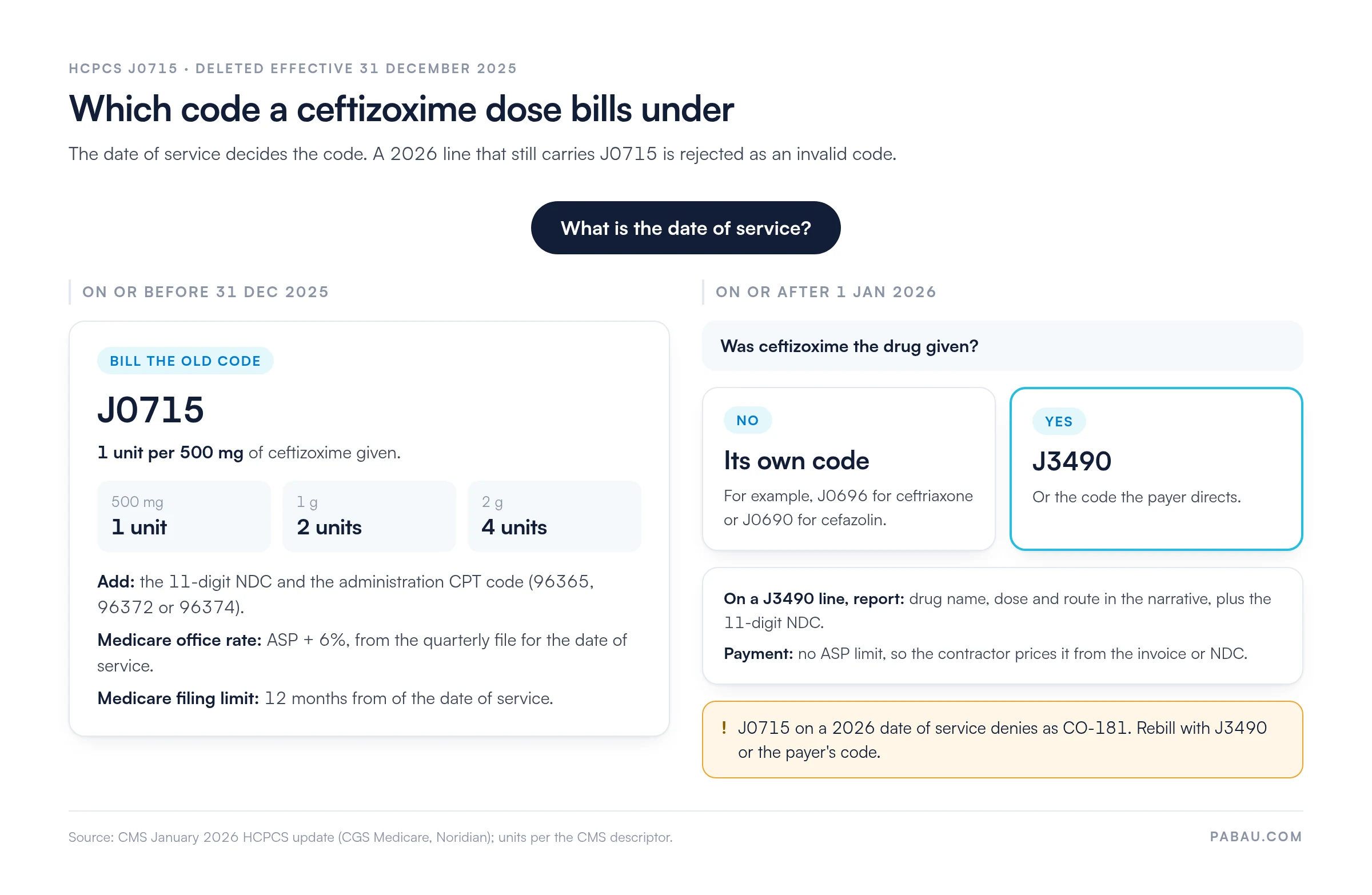
This section applies only to claims for services on or before 31 December 2025. Each unit of J0715 represents 500 mg of ceftizoxime sodium given. Divide the total dose in milligrams by 500 to get the unit count.
CMS Medically Unlikely Edits (MUEs) cap the units allowed per claim line per day. Check the MUE value that was in force on the date of service, not today’s table. A line above the MUE denies, and an appeal needs the administration record.
Bill the dose given, and document it. If a 1 g dose came from a 2 g vial, bill 2 units for the dose. Medicare pays the discarded 1 g only on a separate JW line, and only for separately payable drugs the FDA label describes as single-dose. Check the vial label and the payer’s rule before adding JW or JZ.
Most payers require a National Drug Code (NDC) on every drug claim line. That covers J0715 lines dated in 2025 or earlier, and J3490 lines for 2026 doses. When submitting a clean claim, the NDC ties the code to the exact product, labeler and package that was used.
Claims take the NDC in an 11-digit format. Convert the FDA’s 10-digit format by adding a leading zero to the labeler, product or package segment as needed. Report it in these places:
Take the NDC from the label of the vial that was used, not from a database. A mismatched NDC is a compliance risk as well as a denial trigger. The FDA National Drug Code Directory confirms the format and labeler.
For dates of service through 31 December 2025, Medicare Part B paid J0715 in the physician office at Average Sales Price (ASP) plus 6 percent. The payment limit came from the quarterly file on the CMS ASP drug pricing files page. Use the file for the quarter that holds the date of service.
Where manufacturers reported no ASP data, CMS could price a code from Wholesale Acquisition Cost (WAC) or leave it to the contractor. From 2026, ceftizoxime billed under J3490 has no ASP payment limit, so the MAC prices each line individually.
J0715 covered the drug supply only. The infusion or injection is a separate CPT administration code on the same claim. That pairing still applies when the drug bills under J3490 in 2026.
Physician offices report the administration code on the professional claim. Hospital outpatient departments also report codes such as 96365 and 96372 on the facility claim. OPPS then decides whether each line is paid separately or packaged.
Leaving out the administration code, or using the wrong one, is a common source of NCCI edit denials. The superbill documentation for a J0715 encounter should capture both the drug code and the administration CPT.
Ceftizoxime is one of several injectable cephalosporins with HCPCS J-codes. The others below are still active in the CMS file. If one of them was given, bill its own code, never J0715 or J3490.
The AAPC Codify HCPCS lookup lets you compare descriptors for neighboring J-codes side by side. J0694 and J0698 bill per gram, not per 500 mg. Applying J0715’s per-500 mg logic to them would double the units, turning 1 g into 2 units instead of 1, and overbill the claim.
Medicare Part B generally does not require prior authorization for physician-administered antibiotics. Each Medicare Administrative Contractor (MAC) may still publish a Local Coverage Determination (LCD) listing covered diagnoses. For J3490 lines, contractors also use the drug name and NDC to judge coverage.
Commercial plans often require prior authorization for outpatient antibiotic infusion. Medicaid rules vary by state, and some programs need a formulary exception for an unlisted drug. Check the rules at the time of each service rather than relying on past claims.
Most J0715 denials now fall into two groups: 2026 claims that still carry the deleted code, and late 2025 claims with unit or NDC errors. The table maps each cause to its usual CARC (Claim Adjustment Reason Code) and fix. Denial management workflows and medical billing fundamentals help billing teams triage them faster.
Reference the full list of common denial adjustment codes to map every CARC your practice receives to the right appeal strategy.
Run a report of every claim line with J0715 and a date of service after 31 December 2025. Each of those lines will deny as CO-181. Correct them in one batch rather than one by one as the denials arrive.
The line may bill J0715 for a 2025 date or J3490 for a 2026 date. Either way, the record must tie the drug to one patient, diagnosis and order. When the record skips one of those three, medical necessity and NDC denials tend to follow. The chart note or administration record needs each of these elements:
When ceftizoxime was chosen because a preferred antibiotic was unsuitable, the chart note should say why. That detail supports medical necessity appeals and any formulary exception request.
A deleted drug code rarely fails loudly. The charge master keeps offering it, staff keep picking it, and the first sign is a run of CO-181 denials weeks later. Ranitidine injection’s HCPCS J2780, deleted on July 1, 2024 with no replacement, is another code that can linger in a charge master.
Pabau, the practice management platform we build, adds a check before the claim leaves. In Pabau’s claims software for practices, claim validation checks each claim for missing or invalid details before it goes to the clearinghouse. A claim flagged Needs action has a Fix button that links straight to the field that needs correcting.
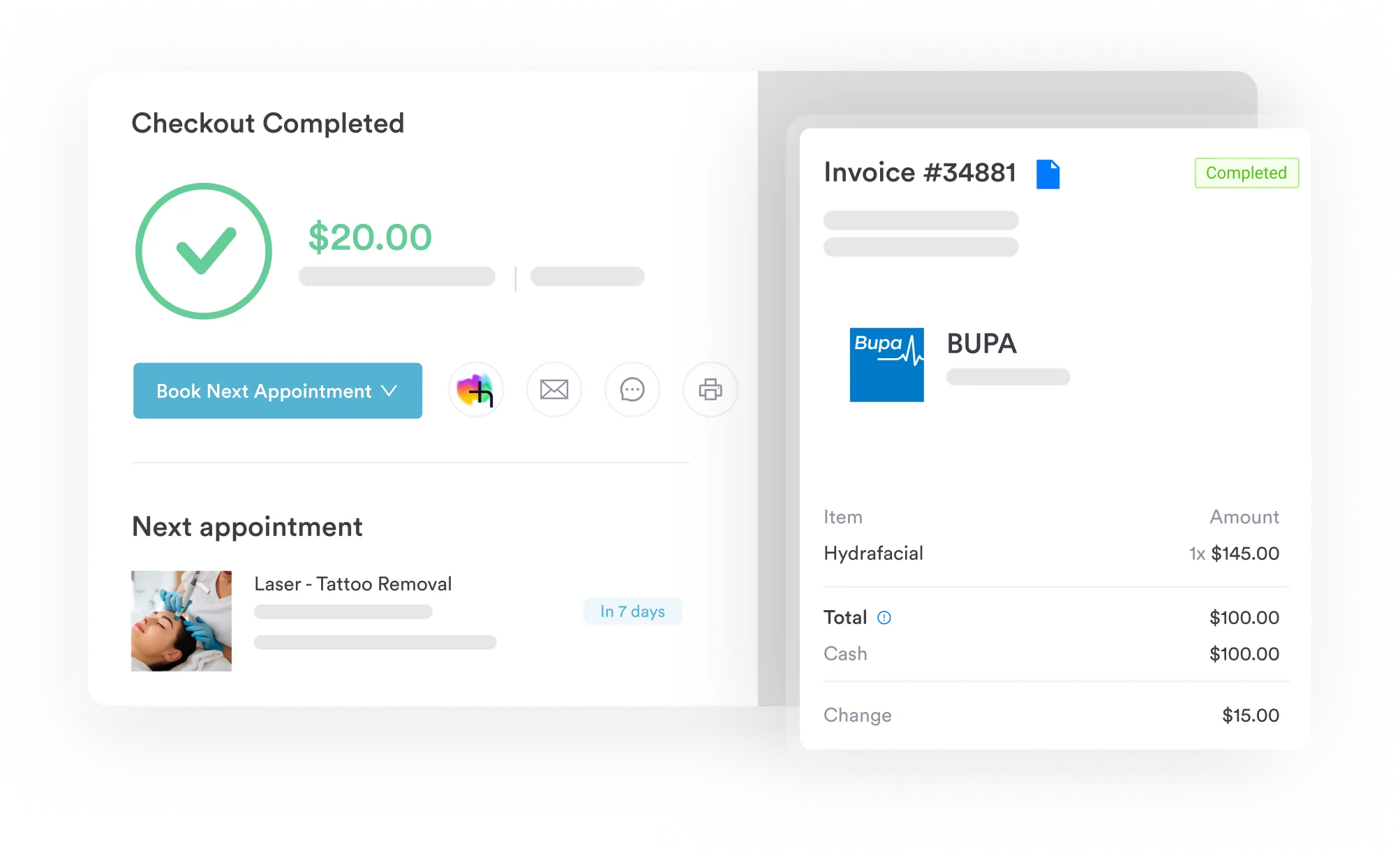
When a claim is rejected, Pabau shows the reason so staff can fix it and resubmit. For a 2026 ceftizoxime line, that fix is usually swapping J0715 for J3490 or the code the payer names.

Pabau checks each claim for missing or invalid details before it reaches the clearinghouse, and shows the reason when one is rejected. See how it fits your drug billing.

J0715 is a closed code, but the claims around it are not. Late 2025 ceftizoxime claims still bill under it until the 12-month filing window closes. Every 2026 dose needs J3490 or the code the payer names.
Retire J0715 in the charge master once, and no 2026 encounter can pick it up by default. That one change saves a stack of CO-181 rework later. Book a demo to see how Pabau checks claims before they go out.

Need to understand how clearinghouse edits catch J-code errors before they reach the payer? Medical claims clearinghouse workflows explains how 837P edits are applied upstream of payer adjudication.
Want a framework for reducing claim denials across all billing codes? Clean claim submission standards covers the data elements payers validate on every professional claim.
Looking to understand the broader revenue cycle around drug injection billing? Revenue cycle management fundamentals maps the complete claim lifecycle from encounter to payment posting.
No. CMS deleted J0715 effective 31 December 2025, and named no crosswalk code. It is not valid for dates of service on or after 1 January 2026, and no grace period applies. Claims for services on or before 31 December 2025 still use J0715.
J0715 covered the drug supply for an injection of ceftizoxime sodium, billed per 500 mg given. Ceftizoxime is a third-generation cephalosporin given by IV infusion or IM injection. The administration service always needed a separate CPT code.
No current HCPCS code describes ceftizoxime. Bill the unlisted-drug code J3490 unless the payer directs otherwise, with the drug name, dose, route and NDC in the claim narrative. If a different cephalosporin was given, bill that drug’s own code.
Bill one unit for every 500 mg of ceftizoxime sodium given. A 1 g dose is 2 units, and a 2 g dose is 4 units. Base the count on the documented dose given, and check the MUE that applied on the date of service.
Yes. Most payers require the 11-digit NDC with the N4 qualifier, in box 24A of the CMS-1500 or loop 2410 of the 837P. That applies to J0715 lines for 2025 dates and to J3490 lines for 2026 dates.
For dates of service through 31 December 2025, Medicare Part B paid J0715 at ASP plus 6 percent in the physician office. The limit came from the CMS quarterly ASP pricing file for the quarter of service. A 2026 J3490 line has no ASP limit, so the contractor prices it.
J0696 covers ceftriaxone sodium, billed per 250 mg, and is still active. J0715 covered ceftizoxime sodium, billed per 500 mg, and was deleted effective 31 December 2025. Always bill the code that matches the drug given.