CPT code 49321: Laparoscopy with biopsy billing guide
What is CPT code 49321? CPT code 49321 is the surgical laparoscopy code for a bi...

Last Updated: Oct 7, 2026
J0461 is the HCPCS Level II code for injection, atropine sulfate, 0.01 mg. It covers injectable atropine given intravenously, intramuscularly or subcutaneously. Each billing unit equals 0.01 mg, so a 0.4 mg dose is billed as 40 units.
In a physician office, the claim pairs J0461 with an administration code such as 96372 or 96374. Medicare pays the drug at ASP plus 6%, and Medicaid and many commercial payers also require the 11-digit NDC.
Let Pabau's smart automation suggest the right codes, reduce claim denials, and keep your practice compliant—effortlessly.
Automate repetitive tasks and focus on what matters most—your patients.
Reduce coding errors and ensure compliance with the latest regulations.
Clean claims, fewer denials, and faster reimbursements.
Powerful insights and reporting to help your practice thrive.
HIPAA compliant SOC 2 certified GDPR-compliant Trusted by 4,000+ clinics worldwide

J0461 covers injectable atropine sulfate only, while eye drops and oral forms are billed differently.
One billing unit equals 0.01 mg, so a 0.4 mg dose goes on the claim as 40 units.
Medicaid and many commercial payers require the 11-digit NDC with the N4 qualifier, so check each payer’s policy.
Atropine that isn’t therapeutically equivalent to J0461 takes J0462, and J3490 is only for products with no assigned code.
Pabau, the practice platform we build, helps you submit and track J0461 claims and spot denial patterns.
HCPCS Code J0461 is the Centers for Medicare and Medicaid Services (CMS) Level II drug injection code for atropine sulfate. Its official descriptor is “Injection, atropine sulfate, 0.01 mg.” The code belongs to the HCPCS Level II J-series, which covers drugs administered other than by mouth that a CPT procedure code alone can’t describe.
Atropine sulfate is an anticholinergic drug. Clinicians inject it to treat symptomatic bradycardia and organophosphate poisoning, and give it with neostigmine when neuromuscular blockade is reversed after surgery. J0461 covers only the injectable formulation administered in a clinical setting.
The table below summarizes the code’s key reference data.
J0461 covers atropine sulfate administered by injection in a clinical setting. It does not cover all clinical uses of atropine or all atropine formulations. Billing the wrong formulation under J0461 is a direct path to a denial.
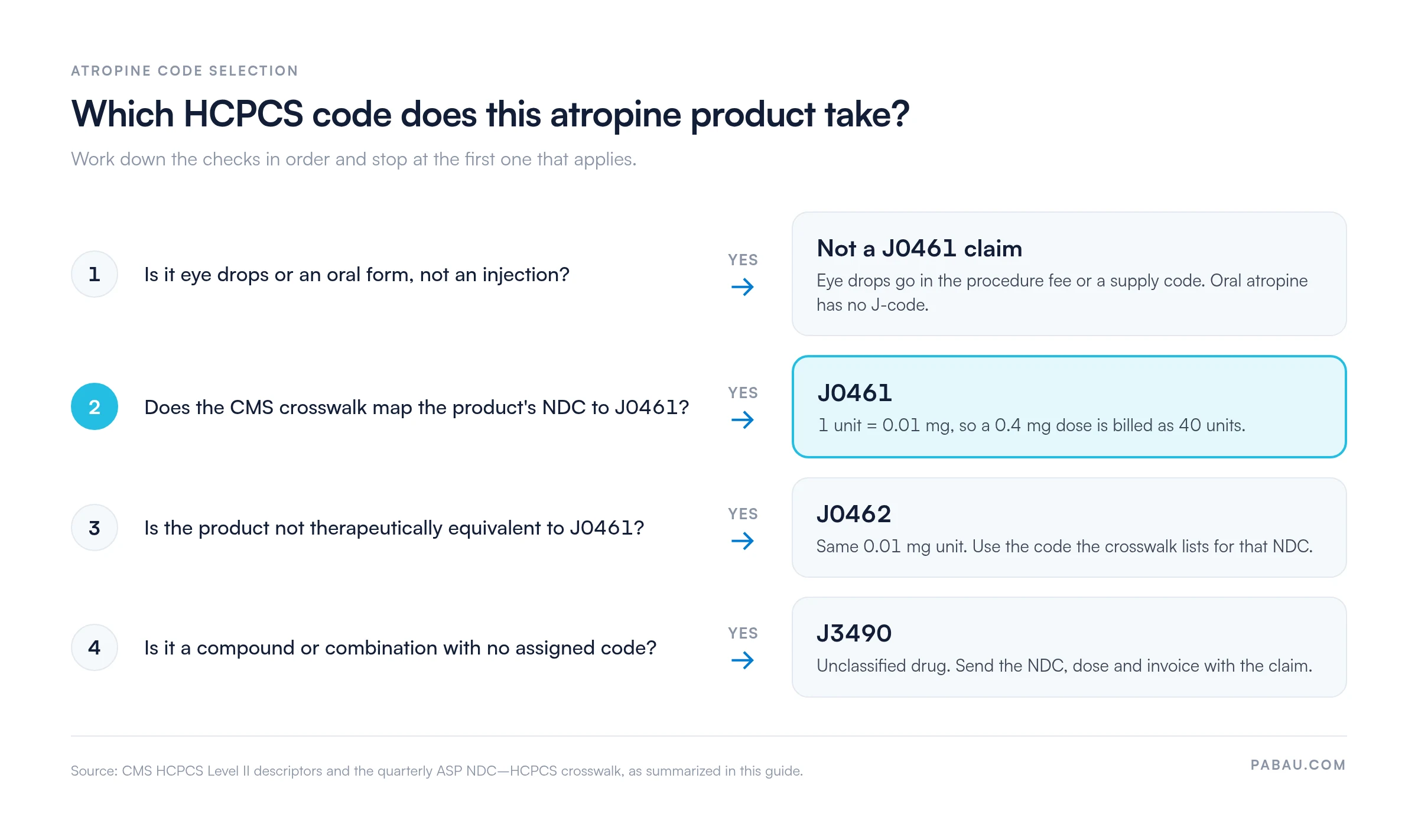
When a practice compounds atropine or uses a nonstandard concentration, ask the payer whether J0461, J0462, or J3490 with an invoice applies before submitting. CMS also maintains product-specific atropine codes, such as J0463 for Fresenius products, so the NDC crosswalk is the deciding check. The diagram below works through those checks in order.
The unit definition for J0461 is 0.01 mg of atropine sulfate per unit. Convert the administered dose in milligrams to units by dividing by 0.01, which is the same as multiplying by 100.
Rounding rule: bill only for the dose actually administered. If a single-dose vial holds 0.4 mg and 0.3 mg is given, bill 30 units on one line. Report the discarded 0.1 mg as 10 units on a second line with modifier JW. If none of the single-dose vial is wasted, add modifier JZ instead.
Medicare has required JW on discarded drug since 2017. JZ has been required on Medicare single-dose container claims since July 1, 2023, after an educational period from January to June. JW and JZ are Medicare policy, so check other payers’ rules before applying them.
The most common unit error is entering the milligram dose directly into the units field. A biller who enters “0.4” instead of “40” reports a fraction of the dose, so the line rejects or underpays. Over-counting units trips the payer’s medically unlikely edit (MUE) or a CO-151 adjustment instead.
Complete documentation on the CMS-1500 form is the front line against denials. For J0461, seven data elements must be correct before submission.
Following a clean claim checklist before submission catches missing elements that automated payer edits flag within seconds of receipt.
Medicaid requires the NDC on drug claims under the Deficit Reduction Act of 2005 rebate rules, and many commercial payers require it too. Medicare Part B does not require it on J0461, which has an assigned J-code and an ASP payment limit. Check payer policy before you submit.
Where an NDC is required, report the 11-digit form of the product actually given. A 10-digit package NDC needs a leading zero in the right segment to reach the 5-4-2 format.
Keep an NDC reference sheet for every atropine sulfate product the office stocks. When a supplier or package size changes, update the sheet the same day. Payers that require NDCs reject a claim whose NDC doesn’t match the product given, even when the drug itself is correct.
Medicare Part B pays for J0461 under the Average Sales Price (ASP) methodology set by the Medicare Modernization Act of 2003. In a physician office, the payment limit is ASP plus 6 percent. CMS updates the limits quarterly, so check the current CMS Part B ASP pricing files before estimating patient cost-sharing.
Atropine sulfate is a low-cost generic, so the ASP+6% dollar figure is small. The place of service matters more, because it decides who bills the drug at all.
Medicaid coverage is not uniform. Each state Medicaid program maintains its own drug fee schedule. Some payers, including Medicaid managed care plans, may apply PA or coverage limits, so verify with the payer. Check the state-specific Medicaid fee schedule rather than assuming federal Medicare rates apply.
Medicare Part B does not require prior authorization for atropine sulfate injection under standard Part B coverage. Atropine is common in emergency, cardiac, and perioperative care, where waiting for prior approval would be clinically impractical.
Other payers set their own rules, and some may apply PA or coverage limits. Verify with the payer before assuming no PA is needed:
Running an insurance eligibility verification before the appointment surfaces PA requirements and benefit limits before the drug is administered.
J0462 is the code for injectable atropine sulfate that is not therapeutically equivalent to J0461, billed in the same 0.01 mg units. Check the product’s NDC against the J0461/J0462 crosswalk to see which code it maps to.
J3490 is the unclassified drug code, used only when no specific HCPCS code exists for the drug administered. Because atropine has assigned codes, J3490 is almost never right for a standard injectable product. Most payers down-code or deny J3490 when a specific code exists, and the extra documentation raises audit risk.
J3490 is legitimately used for compounded atropine (e.g. atropine in a multi-drug compound without an assigned code) or for combination products. Confirm the formulation and NDC before choosing between the three codes.
J0461 rarely stands alone on an office claim. It is normally paired with an administration code: 96372 for a subcutaneous or intramuscular injection, or 96374 for an IV push.
The diagnosis code and any JW or JZ modifier complete the line. Building these companion codes into your superbill template keeps the administration code from being left off.
Most J0461 denials fall into five categories. Each one has a specific root cause and a targeted corrective action. Compare your denial management workflow against this list to see which errors your practice encounters most often.
The full denial code reference covers CARC and RARC combinations for drug claims, helping billers tell payer error from practice error on remittance advice. Tracking these denial patterns monthly shows whether a denial is a one-off entry mistake or a recurring workflow problem.
Run a monthly denial report filtered to J0461 only. If CO-16 with M119 (NDC errors) appears more than twice, check for a recent product switch where the NDC reference sheet was not updated. If unit errors dominate, lock the unit calculation into the charge entry template instead of relying on manual entry.
The denials above usually start at charge entry, where someone converts the dose by hand and copies the NDC off the vial. A charge entry template that spells out the unit math and NDC steps cuts those errors before the claim leaves the practice.
Pabau, the practice platform we build, includes claims software for practices. It helps you submit and track J0461 claims and spot denial patterns. Your team still owns these steps:
Once a claim goes out, Pabau tracks its status and remittance. A repeat CO-16 or CO-151 on J0461 then shows up as a pattern, so you can fix the template before the next batch.

Pabau helps practices submit and track J0461 claims and spot denial patterns, so unit and NDC errors get fixed at the source.

J0461 is a straightforward code once the unit formula, the payer’s NDC rule, and the administration code are built into charge entry. The denials that cost practices money on atropine claims are almost always preventable.
The trade-off is upkeep. Your charge template and NDC reference sheet need updating whenever the crosswalk changes or the practice switches supplier. Skip that, and yesterday’s clean claim becomes today’s CO-16.
Pabau helps you submit and track J0461 claims and spot denial patterns, so your team fixes causes instead of reworking claims. Book a demo to see how it fits your drug billing workflow.

Need a complete medical billing reference? What is medical billing walks through the full revenue cycle from charge capture to payment posting.
Tracking denials across your drug claims? Denial management in healthcare covers how to categorize, appeal, and reduce claim rejection rates systematically.
Want a clean claim framework for every submission? Clean claim best practices outlines the pre-submission checks that keep drug claims out of the denial queue.
HCPCS Code J0461 is the Level II drug injection code for atropine sulfate, with each billing unit equal to 0.01 mg of the drug. CMS maintains it, and practices use it to bill injectable atropine under Medicare Part B and most insurance plans. It applies in physician offices, outpatient hospitals, ASCs, and emergency settings.
Divide the administered dose in milligrams by 0.01 to get the unit count. A 0.4 mg dose is 40 units, and a 1.0 mg dose is 100 units. Bill only the dose given, and report any discarded portion of a single-dose vial on a separate line with modifier JW.
It depends on the payer. Medicaid requires the 11-digit NDC with the N4 qualifier under the Deficit Reduction Act of 2005 rebate rules, and many commercial payers do too. Medicare Part B does not require it on J0461, so check payer policy. When you report it, use the NDC of the product given.
Coverage varies by state. Most state Medicaid fee-for-service programs cover injectable atropine sulfate, but some payers, including Medicaid managed care plans, may apply PA or coverage limits. Check the state Medicaid fee schedule and verify with the patient’s plan before assuming coverage.