

CCSD code G5100: Bypass of duodenum billing guide
CCSD code G5100 bills a bypass that leaves the duodenum in place CCSD code G5100...

Last Updated: Oct 16, 2026
Billable Code
J0131 is the HCPCS Level II code for injection, acetaminophen, not otherwise specified, 10 mg. It reports IV acetaminophen from any manufacturer except Fresenius Kabi, whose product bills under J0134.
Each unit equals 10 mg, so a standard 1,000 mg infusion bills as 100 units. Single-dose vial claims to Medicare also need the JW modifier for discarded drug, or JZ when none was wasted. Medicaid and many commercial payers want the 11-digit NDC on the claim line as well.
Let Pabau's smart automation suggest the right codes, reduce claim denials, and keep your practice compliant—effortlessly.
Automate repetitive tasks and focus on what matters most—your patients.
Reduce coding errors and ensure compliance with the latest regulations.
Clean claims, fewer denials, and faster reimbursements.
Powerful insights and reporting to help your practice thrive.
HIPAA compliant SOC 2 certified GDPR-compliant Trusted by 4,000+ clinics worldwide

HCPCS code J0131 is billed at one unit per 10 mg of acetaminophen administered, so a 1,000 mg infusion is 100 units.
J0131 is the not-otherwise-specified code for IV acetaminophen, while Fresenius Kabi’s product bills under J0134. Reporting the wrong code for the vial used is a common denial trigger.
Medicaid and many commercial payers require the 11-digit NDC on the claim line, so check each payer’s policy. Inpatient administration is bundled under the DRG and not separately billable.
Pabau, the practice software we build, runs claim validation checks before submission and tracks each claim through to payment.
HCPCS code J0131 is the Level II code for acetaminophen injection, not otherwise specified, billed in units of 10 mg. It reports any IV acetaminophen product except Fresenius Kabi’s, which has its own code, J0134. J0131 sits in the J-code section that the Centers for Medicare and Medicaid Services (CMS) maintains for drugs given other than by mouth. Practices report it for doses given in physician offices, outpatient hospital departments, and infusion centers.
The quick-reference table below captures the fields coders and billers check most often.
The official CMS descriptor reads: Injection, acetaminophen, not otherwise specified, 10 mg. That unit definition drives the entire billing calculation. The drug is a sterile, preservative-free solution typically supplied in 100 mL vials at 10 mg/mL. A standard 1,000 mg (1 g) infusion therefore equals a full 100 mL vial.
The brand historically associated with J0131 is Ofirmev, launched by Cadence Pharmaceuticals. Mallinckrodt acquired Cadence in 2014 and went on to market Ofirmev. Ofirmev has since been discontinued, and generic IV acetaminophen now serves most of the market. Because J0131 is the not-otherwise-specified code, it covers every acetaminophen injection that J0134 does not describe.
Medicare Part B does not generally require an NDC for J0131, but Medicaid and many commercial payers do. Where a payer requires it, the NDC goes on the claim line in 11-digit format, so check the payer’s policy first. The AAPC HCPCS code reference helps coders confirm which code applies to a specific product before submitting.
Knowing the boundaries prevents many coverage denials before they happen.
Unit calculation for HCPCS code J0131 follows a single rule: Bill one unit for every 10 mg of acetaminophen administered. Divide the total milligrams given by 10 to get the units to report on the claim.
JW and JZ modifiers: CMS has required the JW modifier for drug discarded from single-dose vials since January 1, 2017. The JZ modifier, which attests that no drug was discarded, was optional from January to June 2023 and became mandatory on July 1, 2023. Use JW when drug remains in the vial after administration and is discarded.
Report the administered units under J0131 on one line, and the discarded units under J0131 with JW on a separate line. Use JZ when the entire vial was administered. Omitting both modifiers is itself a denial trigger.
Code choice, unit count, and modifier are three separate decisions on every J0131 line, and the flow below runs them in order.
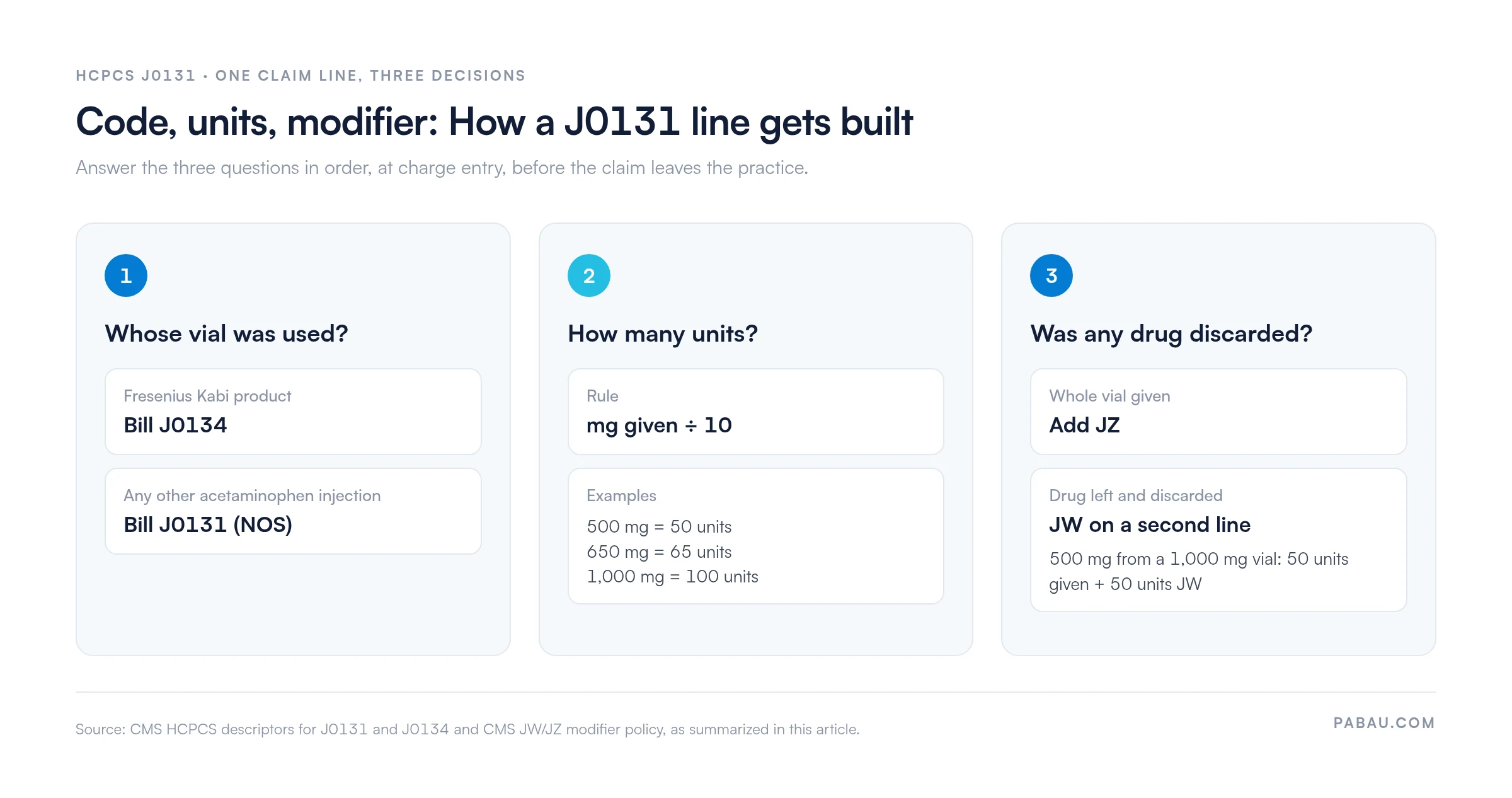
J0131 and J0134 both describe injectable acetaminophen, but they are not interchangeable. J0134 applies only to Fresenius Kabi’s product, while J0131 is the not-otherwise-specified code for every other acetaminophen injection. Payers that require the NDC check it against the code, so J0131 billed with a Fresenius Kabi NDC can trigger a mismatch denial.
The practical rule: Pull the NDC from the vial label and look it up in the CMS NDC-to-HCPCS crosswalk before selecting the J-code. Never default to J0131 simply because it’s the more familiar code.
Medicare Part B covers J0131 in outpatient settings when the drug is medically necessary and administered by or under the direct supervision of a physician. Coverage requires that the IV route is clinically indicated rather than simply a patient preference over oral forms.
Place-of-service codes typically paired with J0131 claims include: 11 (physician office), 19 (off-campus outpatient hospital), 22 (on-campus outpatient hospital), and 49 (independent clinic). Inpatient settings (POS 21) are excluded because the drug is bundled into the Part A DRG.
Medicare reimburses J0131 under the Part B drug payment methodology, based on the drug’s Average Sales Price (ASP). The standard formula is ASP plus 6% for drugs administered in most outpatient physician and infusion settings. In hospital outpatient departments, reimbursement follows the Outpatient Prospective Payment System (OPPS) and may differ.
ASP rates update quarterly. The current quarter’s rate per unit (per 10 mg) is published in the CMS ASP pricing files on cms.gov. Because rates change four times a year, any rate cited in a static reference may be outdated within 90 days. Always pull the current quarter’s file before calculating expected reimbursement.
To calculate expected payment for a claim: Multiply the current ASP rate per unit by the number of units billed. For a standard 1,000 mg infusion (100 units), the total reimbursement equals the per-unit rate multiplied by 100. Billing 10 units instead of 100 for a 1,000 mg dose undercuts reimbursement sharply and may trigger a compliance review.
Both the medical record and the claim itself must support every element of the J0131 billing. Missing documentation is a common denial reason, alongside NDC mismatch.
Achieving a clean claim for J0131 starts with these required elements.
Audit your drug administration records quarterly: Confirm that the mg documented in the nursing note matches the units billed on the claim. Discrepancies between the clinical record and the claim are audit targets and often signal systemic unit-calculation errors rather than one-off mistakes.
Denial management for J0131 follows predictable patterns. The table below maps common denial types to their root causes and corrective actions.
Run a quarterly J0131 denial audit: Pull every J0131 line denied with CARC 4 (modifier inconsistent or missing) or CARC 16 (claim lacks information). Group them by denial reason and trace each pattern back to its data entry point. Check whether a pattern traces to an NDC, unit, or modifier issue before treating it as a coverage problem.
The diagnosis code on a J0131 claim establishes the medical necessity for IV acetaminophen. Payers match the diagnosis to their coverage criteria for parenteral analgesics. The table below lists ICD-10-CM codes often submitted alongside J0131 claims.
Select the most specific code available in the ICD-10-CM code set. A claim with only R50.9 (unspecified fever) as the sole diagnosis for a post-operative patient misses the specificity payers use to validate medical necessity.
The NDC identifies the manufacturer’s product, and the product decides between J0131 and J0134. Wherever a payer requires the NDC, identifying the correct one is a prerequisite to accurate billing. CMS publishes its NDC-to-HCPCS crosswalk with the quarterly ASP drug pricing files, and the NLM Clinical Tables HCPCS API offers a searchable HCPCS lookup. NDC mappings change as new generics enter the market, so verify the crosswalk each quarter rather than memorize it.
The 11-digit NDC follows a 5-4-2 format: Labeler code (5 digits), product code (4 digits), and package code (2 digits). Payers reject claims where the NDC is submitted in a 10-digit or hyphenated format that does not convert correctly to the 11-digit standard.
J0131 billing errors concentrate in three steps: Selecting the wrong J-code for the vial, miscounting units, and omitting the JW or JZ modifier. Each error tends to repeat across claims, so a check built into the billing workflow does more than retraining alone.
Pabau, the practice management platform we build, includes claims software for practices that runs validation checks in the background before a claim is submitted. Claims go electronically to thousands of payers through the Claim.MD clearinghouse. Each one then shows as pending, submitted, processing, paid, or error on a single dashboard.
Real-time eligibility checks confirm a patient’s coverage before the infusion, and ERA remittances post back against the claim. For practices running IV therapy services, fluids, vitamins, and analgesics often share one claim. An error on any line can hold the whole encounter in pending status, so a dashboard that flags it early shortens the wait for payment.
Pabau’s medical billing workflows keep invoices, claims, and remittances on the patient’s record. When a J0131 line is denied, your team can trace it back to the visit and the treatment note behind it.

Pabau’s claims management tools validate claims before submission, check eligibility in real time, and track every claim to payment. Your team catches errors before they reach the payer.

Every J0131 line comes down to three checks at charge entry. Confirm the manufacturer on the vial, convert milligrams to 10 mg units, and pick JW or JZ. Settling all three before submission removes the causes behind the denials in the table above.
The NDC is the one variable that changes from payer to payer. Keep a short list of which payers want it and where it goes, and the remaining rules stay fixed from claim to claim. Book a demo to see how Pabau validates, submits, and tracks drug claims for your infusion services.

Need help managing medical billing compliance across your practice? Medical billing compliance walks through the documentation and audit standards that keep claims clean.
Want to understand how clearinghouse submission works end to end? Our Claim.MD clearinghouse overview explains how electronic claim submission and remittance work for outpatient drug claims.
Looking for a reference on denial codes? Denial codes in medical billing covers CARC and RARC codes so you can read and act on your EOBs faster.
HCPCS code J0131 is the Level II code for acetaminophen injection, not otherwise specified, billed per 10 mg given intravenously in an outpatient setting. It covers every acetaminophen injection not described by J0134, including the former Ofirmev. Fresenius Kabi’s product is billed under J0134.
One unit equals 10 mg of acetaminophen administered. For a standard adult dose of 1,000 mg, bill 100 units. For a 650 mg dose, bill 65 units. Divide the total milligrams given by 10 to get the units to report.
J0134 applies only to Fresenius Kabi’s acetaminophen injection, while J0131 is the not-otherwise-specified code for every other acetaminophen injection, including the former Ofirmev. Both are billed per 10 mg. Choose the code from the manufacturer and NDC on the vial administered. Submitting the wrong J-code for the NDC is a common J0131 denial reason.
It depends on the payer. Medicare Part B does not generally require an NDC for J0131, but Medicaid and many commercial payers do, so check the payer’s policy. On an 837P, the 11-digit NDC goes in the LIN segment of loop 2410. Inpatient administration is not separately billed under J0131, so the question only arises in outpatient settings.
The most common denial reason is an NDC mismatch, where the NDC submitted maps to J0134 rather than J0131. Another is an incorrect unit count, such as billing mg instead of 10 mg units. Others are a missing NDC for a payer that requires one, and an absent JW or JZ modifier on a single-dose vial claim. Review the CARC code on the remittance to identify which issue applies.
Traditional Medicare does not generally require prior authorization for J0131 in standard outpatient infusion settings. Medicare Advantage plans and many Medicaid programs impose their own PA requirements, though. Verify the specific plan’s policy before administering IV acetaminophen when prior authorization is uncertain.



