

CCSD code G5100: Bypass of duodenum billing guide
CCSD code G5100 bills a bypass that leaves the duodenum in place CCSD code G5100...

Last Updated: Oct 16, 2026
H2028 is the HCPCS Level II code for sexual offender treatment service, per 15 minutes. It reports offense-specific therapy for people who have committed a sexual offense or show sexually harmful behavior, billed in 15-minute units.
Medicare does not pay for H2028, so claims go to state Medicaid programs, state agencies, or commercial plans that cover it. Its per diem counterpart is H2029. Most H2028 denials trace back to unit math, a missing authorization, or session notes without offense-specific detail.
Let Pabau's smart automation suggest the right codes, reduce claim denials, and keep your practice compliant—effortlessly.
Automate repetitive tasks and focus on what matters most—your patients.
Reduce coding errors and ensure compliance with the latest regulations.
Clean claims, fewer denials, and faster reimbursements.
Powerful insights and reporting to help your practice thrive.
HIPAA compliant SOC 2 certified GDPR-compliant Trusted by 4,000+ clinics worldwide

HCPCS code H2028 reports sexual offender treatment service in 15-minute units. Its per diem counterpart is H2029.
Medicare does not pay for H2028, so claims go to state Medicaid programs, state agencies, or commercial plans that recognize the code.
Each payer sets its own rounding rule, rate, and prior authorization terms, so check the state manual before the first session.
Every unit needs start and stop times, the offense-specific work delivered, and progress against the treatment plan.
Pabau’s claims management software helps behavioral health practices match units to session notes and submit clean H2028 claims.
HCPCS code H2028 is the CMS Level II Healthcare Common Procedure Coding System code for sexual offender treatment service, per 15 minutes. It reports offense-specific therapy for people who have committed a sexual offense or show sexually harmful behavior. Each unit equals 15 minutes of treatment time.
CMS added H2028 on April 1, 2003, together with H2029 for the per diem version. The CMS HCPCS file gives it coverage code I, which means Medicare does not pay for it. State Medicaid programs and other payers decide whether and how they cover it.
This treatment is often ordered by a court, a probation office, or a juvenile justice agency. Who funds the program decides whether the care reaches an insurance claim at all. Some states pay through Medicaid, while others pay through corrections budgets or leave it to self-pay.
H2028 covers time spent delivering treatment aimed at sexual offending or sexually harmful behavior. Payers read the code narrowly, so the session note has to show offense-specific work.
State Medicaid manuals may widen or narrow these lists. Check your state’s benefit definition before you bill the first unit.
The national descriptor does not name a provider type, so each state decides who may bill the code. Most programs require a licensed behavioral health clinician enrolled with the payer.
Many states add a specialist credential on top of licensure. Some run a sex offender management board that approves treatment providers. Others require supervised hours in offense-specific treatment before a clinician can bill.
Check these three points before you schedule the first session.
One unit of H2028 equals 15 minutes of treatment time. The leftover minutes cause most unit errors, because payers do not all round the same way. Sound medical billing workflows start with knowing your payer’s rounding rule.
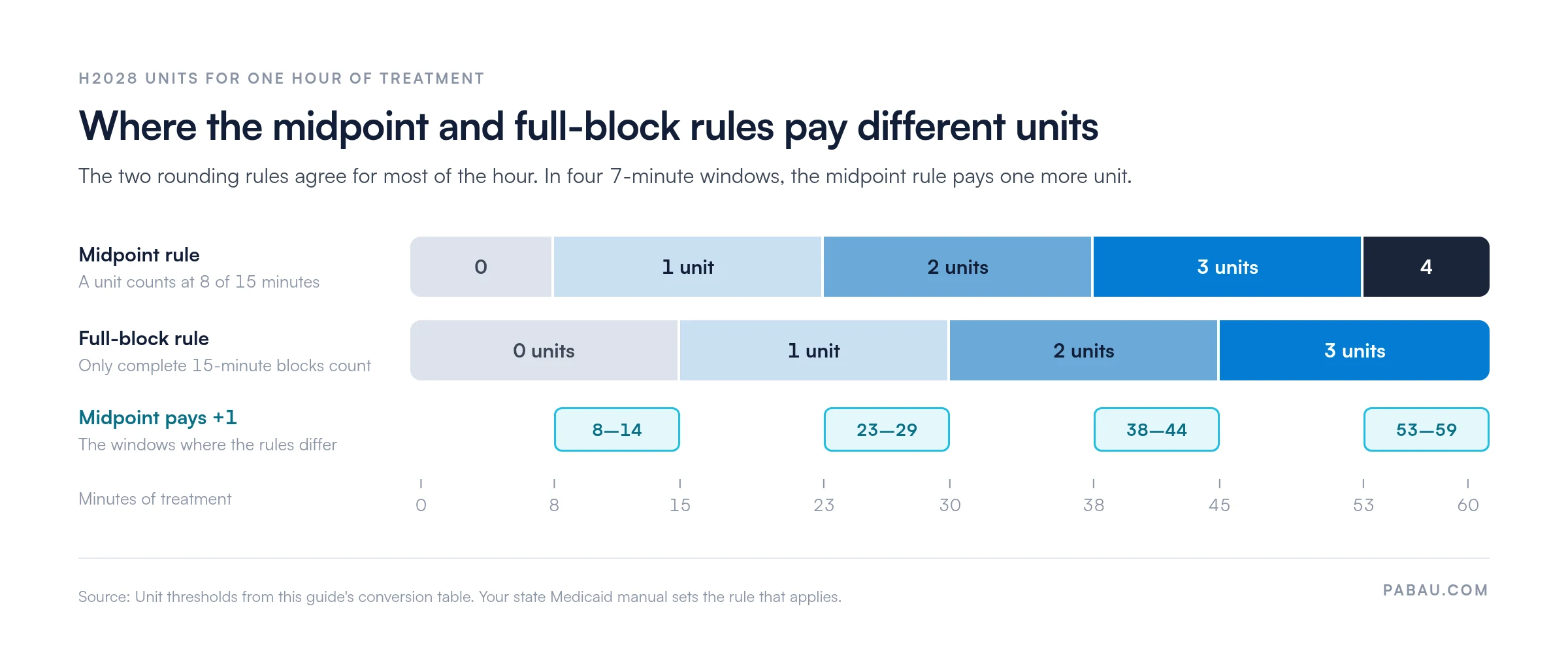
Many state Medicaid manuals use a midpoint rule, where a unit counts once at least 8 of its 15 minutes are delivered. Other states pay only for complete 15-minute blocks. The table shows how the same session converts under each rule.
Plotted across one hour, the two rules only part ways in four short windows.
Group sessions are billed per participant. Each patient’s claim carries the units for the minutes that patient attended. Many states also require the HQ modifier, which identifies a group setting.
H2028 and H2029 describe the same service in different units. Most payers will not pay both for the same patient on the same date. Bill the one your contract and authorization name.
Medicare does not cover H2028, so there is no Medicare claim to coordinate. For a dual-eligible patient, the claim goes to Medicaid if the state covers the service. Meeting billing compliance requirements means verifying Medicaid eligibility separately before each authorization period.
Commercial plans that accept H2028 usually treat it as an outpatient behavioral health benefit. Some exclude treatment ordered by a court, so get the plan’s position in writing first.
Medicaid managed care plans may add their own steps on top of the state baseline. Some ask for quarterly progress reports before they renew an authorization. Check each plan separately.
Each session note has to support the code, the units, and the offense-specific focus. Auditors reject notes that could describe any therapy session.
These records often travel to courts or probation officers. Share them only under a signed release that names the recipient and the information covered. Keep billing progress notes separate from psychotherapy notes, which HIPAA protects more tightly.
Before each claim run, recalculate units from the start and stop times in every H2028 note. Then confirm the authorization still has units left for that date. A mismatch caught before submission takes minutes to fix, while a recoupment after an audit can take months.
Several H-series codes sit close to H2028, and one older mix-up still circulates. Supported employment is reported with H2023 and H2024, not H2028. Use the table to match the service to the code.
Some payers want CPT psychotherapy codes for this work, such as 90832 through 90838 or group code 90853. In those states, H2028 may not be on the fee schedule at all. Confirm which code family your payer expects before you build the charge.
H2028 denials cluster around a few causes. Most can be caught before submission with structured denial management strategies and Pabau’s claims management software.
Use this list as a pre-submission check for every H2028 encounter.
Digital documentation tools with required fields stop incomplete notes before they reach billing. A clinician cannot sign off a session until every mandatory field is filled.
Verify H2028 against the current CMS HCPCS release before billing. CMS updates the Level II file every quarter, and descriptors or status codes can change between releases. Neighboring H-series services sit in our HCPCS codes reference.
Most H2028 billing work happens between the session and the claim. Staff copy times out of notes, count units by hand, and check authorizations in a separate spreadsheet.
Pabau, the practice management and billing platform we build, keeps notes, appointments, and claims on the same patient record. Billing staff can check each H2028 claim against the session it came from before it goes out.
The result is fewer unit mismatches and fewer denials for missing information. Your clinicians spend their time on treatment instead of on resubmissions.

Pabau links session notes, appointments, and claims on one patient record. Behavioral health practices can check H2028 units and authorizations before every submission.

H2028 is a narrow code with a clear job. It pays for offense-specific treatment in 15-minute units, and only where a payer has chosen to cover it.
Settle the payer question before the first session. Confirm the fee schedule, the rounding rule, the provider credential, and the authorization. After that, clean claims come down to notes that show the work behind every unit.
Book a demo to see how Pabau helps behavioral health practices bill H2028 accurately and keep authorizations on track.

Need a structured framework for behavioral health billing compliance? Billing compliance requirements for healthcare practices walks through the documentation and submission controls that reduce audit risk across Medicaid-billed services.
Managing claims across multiple payers? Pabau claims management consolidates prior authorization tracking, unit verification, and claim submission into one workflow.
Billing the per diem version of this service? HCPCS code H2029 covers sexual offender treatment billed per diem, the counterpart to the 15-minute units of H2028.
Treating patients outside an offense-specific program? HCPCS code H0004 covers behavioral health counseling and therapy in 15-minute units.
HCPCS code H2028 means sexual offender treatment service, per 15 minutes. It reports offense-specific therapy for people who have committed a sexual offense or show sexually harmful behavior. Each unit equals 15 minutes of treatment time.
H2028 bills sexual offender treatment in 15-minute units, while H2029 bills the same service per diem. Use H2029 when the payer pays a daily rate for program-based treatment. Most payers will not pay both for one patient on the same date.
No, Medicare does not pay for H2028. The CMS HCPCS file assigns it coverage code I, which means not payable by Medicare. Claims go to state Medicaid programs, state agencies, or commercial plans that recognize the code.
A 50-minute session is 3 units under both common rounding rules. Under the midpoint rule, a fourth unit needs at least 53 minutes. Under the full-block rule, it needs 60 minutes.
Many state Medicaid programs and managed care plans require prior authorization for H2028. The request usually needs an assessment, a treatment plan, and the number of units requested. Submit it before treatment begins.
No, H2028 is not a supported employment code. Supported employment is billed with H2023 per 15 minutes or H2024 per diem. H2025 and H2026 cover ongoing support to maintain employment.



