

CPT Code 52352: Ureteroscopic stone removal billing guide
CPT Code 52352: Official descriptor and procedure overview CPT Code 52352 descri...

Last Updated: Oct 30, 2026
G0295 is the HCPCS Level II code for electromagnetic therapy outside the G0329 ulcer criteria. Its descriptor reads: electromagnetic therapy, to one or more areas, for wound care other than described in G0329 or for other uses.
It is the residual code for electromagnetic therapy. G0329 covers chronic stage III and IV pressure, arterial, diabetic and venous stasis ulcers after 30 days of failed conventional care. G0295 captures other wounds and non-wound uses, and Medicare lists it as non-covered (coverage code M).
Let Pabau's smart automation suggest the right codes, reduce claim denials, and keep your practice compliant—effortlessly.
Automate repetitive tasks and focus on what matters most—your patients.
Reduce coding errors and ensure compliance with the latest regulations.
Clean claims, fewer denials, and faster reimbursements.
Powerful insights and reporting to help your practice thrive.
HIPAA compliant SOC 2 certified GDPR-compliant Trusted by 4,000+ clinics worldwide

HCPCS code G0295 is the residual code for electromagnetic therapy, used for wound care outside G0329 or for other uses.
Medicare lists G0295 with coverage code M, so it is non-covered and has no payable national rate.
G0329 covers chronic stage III and IV pressure, arterial, diabetic and venous stasis ulcers after 30 days of failed conventional care.
Don’t bill G0295 and G0329 together for the same wound on the same date of service.
Lead with GA or GZ to show who carries the liability, because the KX modifier does not make G0295 payable.
Pabau, the practice management platform we build, helps track claim status and denials by HCPCS code, so G0295 denial patterns surface early.
HCPCS code G0295 is the Level II code for electromagnetic therapy used outside the ulcer criteria of G0329. Its official descriptor reads “Electromagnetic therapy, to one or more areas, for wound care other than described in G0329 or for other uses.”
That makes it a residual code. G0329 holds the chronic ulcers Medicare covers, and G0295 captures electromagnetic therapy for any other wound and for non-wound uses. G codes are temporary national codes that CMS maintains for services no CPT code adequately describes.
G0295 took effect on July 1, 2004, and it remains a current Level II code. Medicare carries it with coverage code M, which means non-covered by Medicare. Confirm the code against each annual CMS HCPCS update, as you would for any G code. Our HCPCS guides for coders cover neighboring Level II codes with the same descriptor, coverage and billing detail.
G0295 reports electromagnetic therapy to one or more areas when the indication falls outside G0329. That includes wounds that miss the G0329 ulcer list or its 30-day failure criterion. It also includes electromagnetic therapy given for conditions other than wounds.
Electromagnetic therapy, often called pulsed electromagnetic field (PEMF) therapy, applies an electromagnetic field to the treatment area through a coil or applicator. The descriptor sets no device type, no contact method and no body site. Because it reads “one or more areas”, one session is one unit however many areas are treated.
Typical G0295 scenarios include:
What G0295 does not cover:
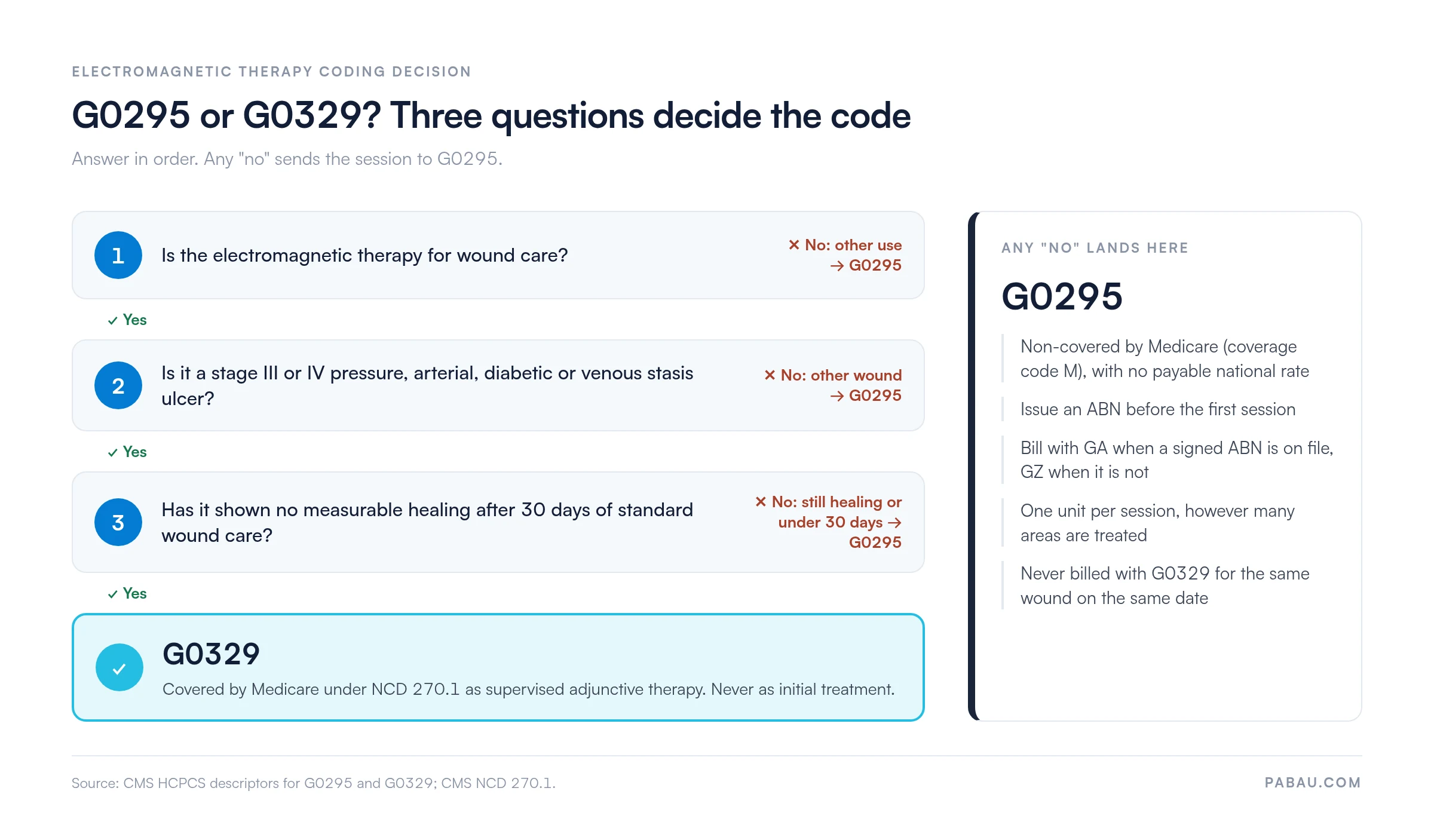
G0295 and G0329 describe the same modality, so the indication decides the code. G0329 covers chronic stage III and IV pressure ulcers, arterial ulcers, diabetic ulcers and venous stasis ulcers. Those ulcers must show no measurable signs of healing after 30 days of conventional care, as part of a therapy plan of care. G0295 covers other wound care and non-wound uses.
Never bill G0295 and G0329 together for the same wound on the same date of service. Choose one code from the wound type and the healing history in the record. If the ulcer meets the G0329 criteria, G0295 is the wrong code. The three questions below settle the choice in order.
Medicare sets coverage for electromagnetic wound therapy nationally, through NCD 270.1, Electrical Stimulation (ES) and Electromagnetic Therapy for the Treatment of Wounds. It is a national coverage determination, so it binds every Medicare Administrative Contractor (MAC). CMS decision memo CAG-00068N sets out the reasoning behind it.
Under NCD 270.1, Medicare covers electromagnetic therapy only as adjunctive therapy for these chronic ulcers:
Four further conditions apply:
Those covered services are reported with G0329. G0295 sits outside them, which is why Medicare lists it as non-covered. Expect Medicare to deny a G0295 claim, and issue an Advance Beneficiary Notice (ABN) before treatment starts.
Commercial payers write their own policies, such as Aetna’s Clinical Policy Bulletin 0175. Verify coverage and any prior authorization rule with each payer before treatment. Sound medical billing compliance includes recording the authorization number in Box 23 of the CMS-1500 and the 2300 loop of the 837P.
Before the first session, check the wound against NCD 270.1 and record the result. If the ulcer qualifies, bill G0329. If it does not, issue an ABN and bill G0295 with GA, so the patient’s liability is documented before the denial arrives.
A G0295 claim still needs an ICD-10-CM code for the wound or condition treated. Because G0295 is non-covered, the diagnosis does not unlock payment. It documents the indication and shows whether G0329 should have been billed instead.
Acute wounds, superficial injuries and skin conditions unrelated to chronic ulceration fall outside G0329. Pair the wound diagnosis with comorbidities, such as diabetes or peripheral vascular disease, that explain why healing has stalled.
Documentation decides which code is right before it decides whether a claim survives review. Building a clean claim for electromagnetic therapy means the record tells the payer three facts. It shows what the wound is, how it has responded to standard care, and why G0295 applies rather than G0329.
A standardized checklist for each G0295 session reduces audit exposure and gives you the evidence an appeal needs.
Billing G0295 well starts with confirming that G0329 does not apply. Then match the place of service to the setting, add the liability modifier, and report one unit per session.
Don’t add modifier 59 to push G0295 and G0329 through for the same wound on the same date. Those two codes should never appear together for one wound.
Report G0295 as one unit per session, because the descriptor already covers one or more areas. Check commercial policies for session or frequency limits. Your superbill documentation should capture the code, the units, the modifier and the ABN status. Use the AAPC HCPCS code lookup to confirm the current descriptor before submission.
G0295 claims produce a predictable set of denial codes. The remittance advice code tells you what went wrong and what any correction must address. Effective denial management in healthcare starts with tracking denials by procedure code, so patterns show early. Pabau’s claims management software helps track claim status and denials by HCPCS code.
Appealing a G0295 non-coverage denial: Medicare does not cover G0295, so an appeal that argues for coverage has no policy to stand on. First check whether the wound met the G0329 criteria. If it did, correct the code to G0329 and resubmit with the measurement log and the 30-day standard care record.
Flag every G0295 denial the same day the remittance advice arrives. Track CO-97 and PR-96 separately. A CO-97 pattern points to a coding fix, such as G0295 billed alongside G0329. A CO-96 with no signed ABN points to a step missed at the front desk before treatment.
G0295 has no payable national Medicare rate, because Medicare lists it as non-covered. To confirm its current status, enter G0295 in the CMS Physician Fee Schedule Look-Up Tool for the current year. Read the status it returns rather than looking for a payment amount.
With a valid ABN and the GA modifier, the practice can collect its self-pay fee from the Medicare patient after the denial. Without an ABN, the practice generally cannot bill the patient for the service.
Commercial payers set coverage and rates under each provider agreement, and those rates are not public. Verify coverage in writing before treatment starts.
Without a shared system, coverage checks, signed ABNs and denials sit in separate spreadsheets and payer portals. A G0295 problem then surfaces weeks later, often after the patient has finished treatment.
Pabau keeps the patient record, signed forms and billing in one place. Its claims management software helps track claim status and denials by HCPCS code, so a run of G0295 denials stands out quickly. Your coders still choose the code and modifier, and Pabau keeps the evidence beside the outcome.
The result is fewer surprises at remittance and a complete record for every appeal.

Pabau’s claims management software helps you track claim status and denials by HCPCS code, so wound-care billing problems surface before they repeat.

The coding decision on G0295 happens before the first session, when you check the wound against NCD 270.1. If a qualifying ulcer has failed 30 days of standard care, G0329 is the code. If it has not, G0295 applies, and Medicare will not pay for it.
The remaining choice is who carries the cost. A signed ABN and the GA modifier keep that choice with the practice and the patient. KX belongs on the claim only when a specific payer policy asks for it.
Book a demo to see how Pabau helps your wound-care practice track G0295 claim status and denials.

Want to understand how claim denials are classified and overturned? Denial management in healthcare explains the full denial lifecycle and how practices build effective appeal workflows.
Need a reference on how 837P transactions carry wound-care claims to payers? Medical claims clearinghouse guide covers how claims move from the practice to the payer through a clearinghouse.
Looking for guidance on denial code categories used across HCPCS claims? Denial codes in medical billing maps the most common CARC codes to their root causes and correction steps.
HCPCS code G0295 describes electromagnetic therapy, to one or more areas, for wound care other than described in G0329 or for other uses. It is the residual electromagnetic therapy code. It captures wounds outside the G0329 ulcer criteria and non-wound uses.
Yes. G0295 is a current HCPCS Level II code, effective since July 1, 2004. Medicare carries it with coverage code M, so it is valid to report but non-covered. Confirm its status in each annual CMS HCPCS update.
The difference is the indication. G0329 covers chronic stage III and IV pressure, arterial, diabetic and venous stasis ulcers that show no measurable healing after 30 days of conventional care. G0295 covers other wound care and non-wound uses. Don’t bill both for the same wound on the same date of service.
No. Medicare lists G0295 as non-covered. NCD 270.1 covers electromagnetic therapy only for qualifying chronic ulcers after 30 days of failed standard care, and that service is billed as G0329. Issue an ABN before treating a Medicare patient under G0295.
Lead with GA when a valid ABN is on file, or GZ when it is not. Some payers ask for GY on non-covered services. Use KX only where a specific MAC or payer policy requires it, because KX does not make G0295 payable.
Medicare has no payable national rate for G0295, because the code is non-covered. Check its current status in the CMS Physician Fee Schedule Look-Up Tool. With a signed ABN and the GA modifier, the practice can bill the patient its self-pay fee.



