HCPCS Code J1110: Dihydroergotamine mesylate injection billing guide
HCPCS Code J1110: Official descriptor and drug overview HCPCS Code J1110 is the ...

Last Updated: Oct 29, 2026
E0255 is the HCPCS Level II code for hospital bed, variable height, hi-lo, with any type side rails, with mattress. It covers a home-use hospital bed whose height, head and foot all adjust manually, billed to Medicare as a 13-month capped rental.
Medicare covers it under LCD L33820 when the patient meets one fixed-height bed criterion. The patient must also need a different bed height to transfer to a chair, wheelchair or standing position. A bed with electric head and foot adjustment is billed as E0260 or E0265 instead.
Let Pabau's smart automation suggest the right codes, reduce claim denials, and keep your practice compliant—effortlessly.
Automate repetitive tasks and focus on what matters most—your patients.
Reduce coding errors and ensure compliance with the latest regulations.
Clean claims, fewer denials, and faster reimbursements.
Powerful insights and reporting to help your practice thrive.
HIPAA compliant SOC 2 certified GDPR-compliant Trusted by 4,000+ clinics worldwide

HCPCS Code E0255 covers a variable-height (hi-lo) hospital bed with manual height adjustment, any type of side rails and a mattress.
A bed with electric head and foot adjustment is billed as E0260 (semi-electric) or E0265 (total electric), not as E0255.
Medicare covers E0255 under LCD L33820 when the patient meets a fixed-height bed criterion and needs a different bed height for transfers.
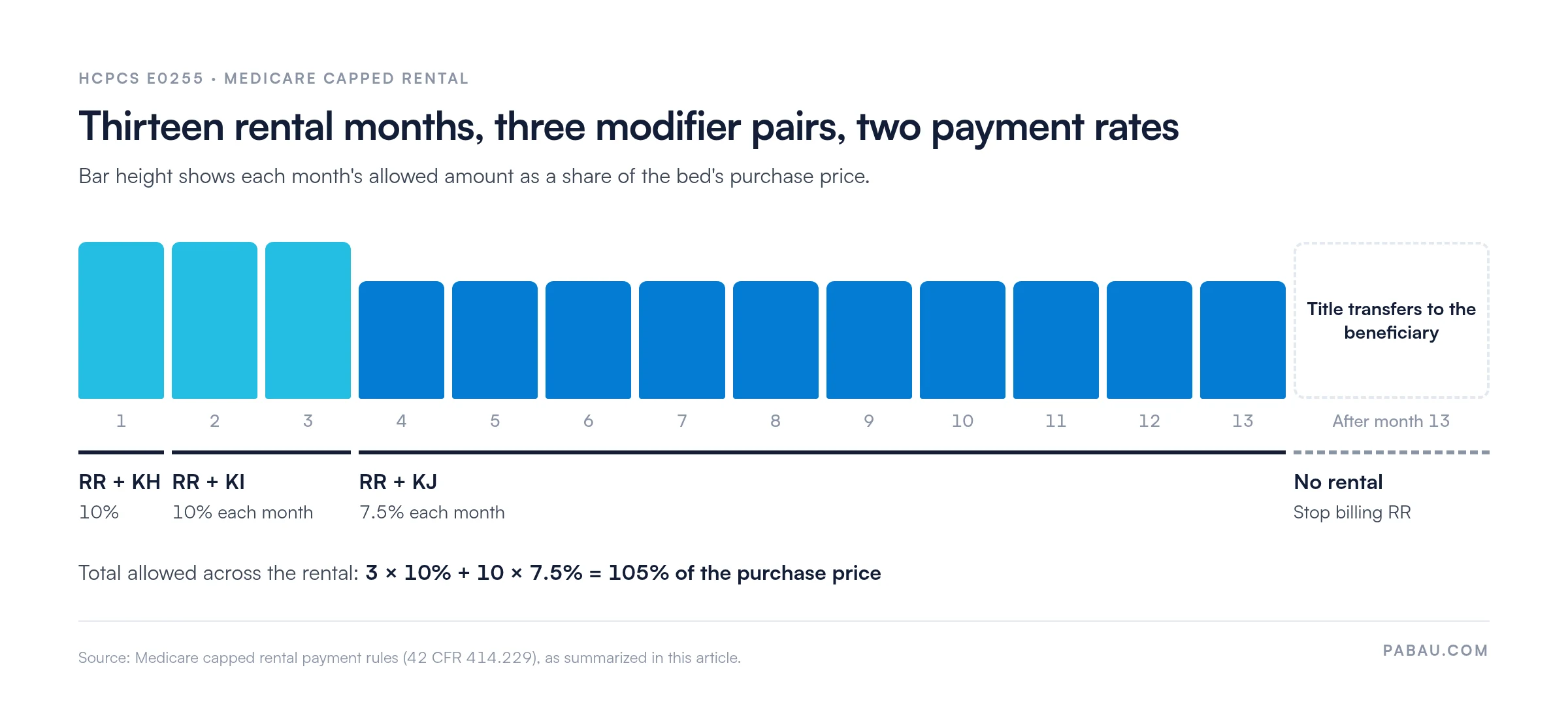
E0255 is a 13-month capped rental, billed with RR plus KH, KI or KJ at 10% and then 7.5% of the purchase price.
Modifier KX goes on the claim only when every L33820 criterion is met and documented in the medical record.
HCPCS Code E0255 is the durable medical equipment (DME) code for a hospital bed, variable height (hi-lo), with any type of side rails, with mattress. The Centers for Medicare and Medicaid Services (CMS) publishes it in the HCPCS Level II code set. Suppliers use it to bill Medicare Part B and commercial payers for a home-use variable-height bed.
The “hi-lo” designation means the bed frame is raised and lowered manually. A caregiver can then work at a comfortable height, and the patient can transfer safely. The head and foot sections also adjust manually. Electric adjustment moves the bed to E0260 or E0265.
The code bundles the bed frame, any type of side rails (half or full-length) and a standard mattress into one line item.
The table below shows which components E0255 bundles and which ones a supplier bills under a separate code.
Once the bed is delivered, the supplier bills Medicare monthly and collects the patient’s 20% coinsurance separately.
The most common miscoding errors on E0255 involve confusing it with E0250 or E0260. All three codes cover hospital beds for home use, but their physical features differ enough to make each code distinct under Medicare’s criteria. Selecting the wrong code is one of the top audit triggers for DME suppliers.
Key differentiator: On an E0255 bed, every adjustment is manual: overall height, head and foot. E0260 makes the head and foot adjustment electric, while its height still adjusts manually. If the delivered bed adjusts the head and foot sections electrically, E0260 applies, not E0255. Billing E0255 for a semi-electric bed is a coding error that can trigger a claim audit.
Medicare Part B covers HCPCS E0255 as DME for home use when the patient meets the criteria in a Local Coverage Determination (LCD). The governing LCD is L33820 (Hospital Beds and Accessories), issued by the DME MACs (Noridian and CGS). Check the current version of L33820 before each order, because LCD criteria are revised periodically.
A variable-height bed is covered when the patient meets at least one fixed-height hospital bed criterion. The patient must also need a bed height different from a fixed-height bed, to permit transfers to a chair, wheelchair or standing position. The fixed-height criteria are:
The ordering physician must document both parts explicitly, because a diagnosis alone is not sufficient. The record has to name the fixed-height criterion the patient meets and explain why transfers need a different bed height. Good medical billing compliance includes a documentation checklist in the order workflow, completed before the bed is delivered.
Documentation for HCPCS Code E0255 must be assembled before billing, not after. The DME MAC can request records at any point, and a record missing at delivery cannot always be corrected later. Required documentation typically includes the following:
Medicare requires DME suppliers to retain documentation for seven years from the date of service. A superbill that captures the diagnosis and procedure codes at the point of service starts the documentation trail before a claim is filed.
Request the medical records and the signed order before scheduling delivery. If the notes do not link the diagnosis to the need for a hi-lo bed, send a documentation checklist back to the ordering physician. Do this before billing. Retroactive documentation is not accepted by most DME MACs.
HCPCS Code E0255 is billed under Medicare’s capped rental model, the standard payment method for most hospital beds classified as DME. Knowing how medical billing works for capped rental items prevents a common error: billing rent past the ownership transfer point.
The capped rental billing sequence for E0255 works as follows:
In each month, Medicare pays 80% of the allowed amount and the beneficiary owes 20% coinsurance. Across all 13 months, the allowed amounts add up to 105% of the purchase price, as the timeline below shows.
Purchase billing (modifier NU for new equipment, UE for used equipment) applies only in limited circumstances. One example is a commercial payer whose policy covers purchase rather than rental. Verify the payer’s policy before switching from rental to purchase billing.
Correct modifier selection is where most E0255 billing errors occur. The modifiers below cover different billing scenarios, and an invalid combination leads to automatic claim rejection. Always verify modifier stacking rules against AAPC’s HCPCS code guidance and your specific DME MAC’s billing guidelines before submitting.
Common stacking error: Billing RR and NU on the same claim line is invalid, because a claim cannot be both a rental and a purchase. KX and GY cannot appear together either. KX asserts the criteria are met, while GY asserts the item is not covered.
Medicare reimbursement for HCPCS Code E0255 is set by the DMEPOS fee schedule, which CMS updates annually. Rates vary by jurisdiction and by whether the supplier operates in a Competitive Bidding Area (CBA). Suppliers in CBAs are paid the competitive bidding rate, which is typically lower than the national fee schedule rate. Suppliers outside CBAs are paid the national rate.
Rates change each January 1 and CBA status changes periodically, so dollar amounts in third-party sources go stale quickly. Use the CMS DMEPOS fee schedule files to find the current allowed amount for E0255 in your state. Tracking reimbursement inside a broader revenue cycle management workflow helps suppliers catch rate changes before they affect cash flow.
Medicare pays 80% of the allowed amount after the beneficiary deductible is met. The remaining 20% is the beneficiary’s coinsurance responsibility, which may be covered by a supplemental (Medigap) policy. Verify secondary coverage before delivery to set accurate billing expectations.
Medicare does not currently require prior authorization (PA) for E0255. The code is not on CMS’s Required Prior Authorization List for DMEPOS items. CMS adds codes to that list through Federal Register notices, so check the current list before each order.
If CMS ever adds E0255 to the list, the Medicare PA process works as follows:
Commercial payers set their own prior authorization rules, separate from Medicare’s. Check each payer’s policy for E0255 before delivery, because a missing commercial PA is a non-correctable denial in most cases. Strong denial management flags PA requirements at order entry, before the delivery window opens.
E0255 claims are denied for predictable reasons. Most denials trace back to documentation assembled after delivery, or to modifier errors that claim scrubbing could have caught. Knowing the common denial codes helps billers find the root cause faster and prioritize appeals.
The ICD-10-CM codes on an E0255 claim must support the LCD criteria, not simply reflect the patient’s primary diagnosis. A diagnosis code alone is not sufficient, so the record must also show the functional impairment that requires a variable-height bed. Verify that each code in the table below is current before use, because ICD-10 updates take effect each October 1.
Use the PGM Billing HCPCS lookup tool or the AAPC Codify HCPCS lookup to cross-reference codes and verify active status.
Pairing a high-specificity ICD-10 code with a narrative note on the functional limitation strengthens the medical necessity case. Avoid “unspecified” codes where a more specific code exists, because specificity signals thorough documentation to the DME MAC reviewer. A clean claim with matched diagnosis codes and complete records reduces the chance of a prepayment review.
Cross-reference each ICD-10 code with the LCD’s covered diagnosis list before submitting. If the patient’s primary diagnosis does not appear on the LCD’s covered list, check whether a secondary diagnosis code does. Submitting the most relevant covered code in the primary position can prevent an automatic non-covered denial.
An E0255 claim stands or falls on the ordering practice’s notes. The supplier bills the bed, but the record has to show the L33820 criterion the patient meets and why a fixed-height bed blocks safe transfers.
In Pabau, that reasoning sits in the treatment note next to the diagnosis and the signed order. When a supplier or MAC requests records, the practice pulls them from one patient record instead of chasing paper files.
Pabau’s claims tracking software then submits claims and tracks their status. A rejected claim shows up quickly, while the visit and its documentation are still fresh.

Pabau keeps the notes behind each hospital bed order in one patient record, then submits and tracks your claims. Records are ready when a supplier or MAC asks.

The decision that protects an E0255 claim happens before the bed leaves the warehouse. Confirm that the patient meets a fixed-height criterion and needs a different bed height for transfers, and get both into the record. Then confirm the delivered bed is fully manual, because electric head and foot adjustment makes it E0260 or E0265.
That intake check slows the order by a day or two. Skipping it puts up to 13 months of rental claims at risk. Book a demo to see how Pabau keeps the ordering practice’s notes and claim status in one place.

Need to understand how denials are categorized? Denial codes in medical billing explains the most common CARC and RARC codes DME suppliers encounter on rejected claims.
Want to tighten your pre-claim submission process? What makes a clean claim covers the documentation and coding criteria that help DME and practice claims pass first-pass adjudication.
Looking to improve your broader billing operation? Revenue cycle management explained walks through the end-to-end process from order intake to payment posting for healthcare suppliers.
HCPCS Code E0255 is the Level II DME code for a hospital bed, variable height (hi-lo), with any type of side rails and mattress. Its height, head and foot all adjust manually. Medicare Part B bills it as durable medical equipment for home use, covering the frame, side rails and a standard mattress as one line item.
E0255 covers a variable-height (hi-lo) bed whose height, head and foot all adjust manually. E0260 covers a semi-electric bed, with electric head and foot adjustment and manual height adjustment. If the delivered bed adjusts the head and foot sections electrically, E0260 is the correct code. Billing E0255 for a semi-electric bed is a coding error.
No. Medicare does not currently require prior authorization for E0255, because the code is not on CMS’s Required Prior Authorization List for DMEPOS items. CMS updates that list periodically, so check it before delivery. Commercial payers set their own PA rules, and a missing commercial PA is usually a non-correctable denial.
The most common E0255 denials come from medical necessity records that name a diagnosis but not the transfer-height need. Other frequent causes are a missing KX modifier and E0255 billed for a delivered E0260 bed. Incomplete Detailed Written Orders and rental billing past month 13 also recur. A pre-delivery documentation checklist prevents most of them.