HCPCS Code G0163: Skilled nursing observation and assessment
What is HCPCS Code G0163? HCPCS Code G0163 is a deleted Level II code for skille...

Last Updated: Oct 15, 2026
E0199 is the HCPCS Level II code for dry pressure pad for mattress, standard mattress length and width.
Let Pabau's smart automation suggest the right codes, reduce claim denials, and keep your practice compliant—effortlessly.
Automate repetitive tasks and focus on what matters most—your patients.
Reduce coding errors and ensure compliance with the latest regulations.
Clean claims, fewer denials, and faster reimbursements.
Powerful insights and reporting to help your practice thrive.
HIPAA compliant SOC 2 certified GDPR-compliant Trusted by 4,000+ clinics worldwide

HCPCS Code E0199 is the active Level II code for a dry pressure pad for mattress, at standard mattress length and width.
Medicare covers E0199 under Group 1 pressure reducing support surfaces. The record has to document mobility limitation, pressure injury risk, and a physician determination of medical necessity.
Billing errors cluster around missing KX modifiers, unsigned physician orders, and diagnosis codes that do not support Group 1 coverage.
A dry foam or fiber pad is E0199, while a dry full mattress replacement is E0184.
Pabau claims management software builds each claim from the patient record and tracks its status after submission. Code and modifier selection stays with your billing team.
HCPCS Code E0199 is the Level II alphanumeric code for a dry pressure pad for mattress, standard mattress length and width. It is an active code for 2026, maintained by the Centers for Medicare & Medicaid Services (CMS) under the E-series of the DMEPOS code set.
The CMS HCPCS coding system publishes annual updates to code status and descriptors. Verify the code remains active against the current year release before submitting claims.
A dry pressure pad is a non-powered overlay placed on top of a standard mattress. It redistributes body weight and reduces interface pressure on bony prominences. Alternating pressure pads use a pump to cycle pressure, but the E0199 device is passive. There is no electricity, no pump, and no inflation cycle.
Clinical use centers on patients at elevated risk for pressure injuries. That risk usually comes from limited mobility, poor tissue perfusion, or existing skin breakdown. The pad conforms to body contours using foam, gel, or fiber fill to spread load across a larger surface area.
CMS organizes pressure-reducing support surfaces into three groups, ranked by clinical complexity. HCPCS Code E0199 falls under Group 1, the least complex tier. Group 1 holds the non-powered overlays and mattresses in the E0181 to E0199 range, apart from E0193 and E0194.
The CMS Medicare Coverage Database (Article 52489) sets out which patients qualify for a Group 1 surface. It also sets the documentation a claim for E0199 has to carry. Choosing a Group 2 or Group 3 code for a Group 1 patient triggers a medical-necessity denial.
Medicare Part B covers HCPCS Code E0199 when the patient meets the Group 1 criteria in the applicable Local Coverage Determination (LCD). Coverage is not automatic. The ordering physician has to document that specific clinical conditions are present.
Medicare core eligibility requirements for Group 1 surfaces, per CMS Article 52489, include:
LCD policies vary by DME MAC jurisdiction. Noridian Healthcare Solutions covers Jurisdictions A and D. CGS Administrators covers Jurisdictions B and C, so your jurisdiction decides which policy applies. Review the LCD in force for your service area before you finalize a coverage determination, because thresholds and documentation language differ.
Before ordering E0199, document in the physician notes whether the patient is bed- or chair-confined, and list the pressure injury risk factors that apply. A short checklist note at the point of care heads off the most common denial reason, which is thin documentation of medical necessity.
Incomplete documentation is the leading cause of E0199 claim denials. Every element below has to be present in the medical record before the claim goes out, per CMS Article 52489.
Some DME MACs also require a Certificate of Medical Necessity (CMN) for Group 1 surfaces. Verify the CMN requirement with the DME MAC for your service area before submitting. Under 42 CFR 424.516, documentation supporting a DMEPOS order or certification has to be retained for seven years from the date of service.
The ICD-10-CM diagnosis code on the claim establishes medical necessity. Choose the code that reflects the patient clinical condition, not the one that is most often accepted. The codes below are frequently paired with HCPCS Code E0199 in compliant billing.
Use the most specific code the record supports. An unspecified-site code is acceptable only where the medical record itself lacks that detail. For the current official tabular list, consult the CDC ICD-10-CM web tool.
HCPCS Code E0199 is reimbursed under the Medicare DMEPOS fee schedule. Amounts vary by calendar year and by locality, because Medicare applies locality-based adjustments to DMEPOS rates. Verify current figures against the CMS DMEPOS fee schedule before citing rates in authorization requests or patient estimates.
Four reimbursement considerations shape what you actually collect on E0199:
Getting the code right is only part of clean-claim submission. Modifier selection and claim construction decide whether the payer processes or denies the claim. The modifiers below apply to Group 1 pressure-reducing surfaces billed to Medicare, per AAPC HCPCS coding guidance.
The denial patterns below account for most E0199 rework:
Sorting remittance advice by reason code shows whether your E0199 denials cluster on documentation or on code choice. Our reference on denial codes explains what each one is telling you, which is where a rework pattern usually shows itself first.
Audit your E0199 denials once a month and sort them by reason code. Where missing documentation or modifier errors dominate the list, the problem sits in the intake workflow rather than in individual claims. Fix the step that produced them, not the claims themselves.
Selecting the wrong code from the E0181 to E0199 range is a recurring source of claim errors. The table below sets out the differentiators, so coders can match the product supplied to the correct code.
Three attributes define E0199, and the product has to satisfy all of them:
Fill material and form decide the code together, and the grid below shows how those two axes map onto the rest of the family.
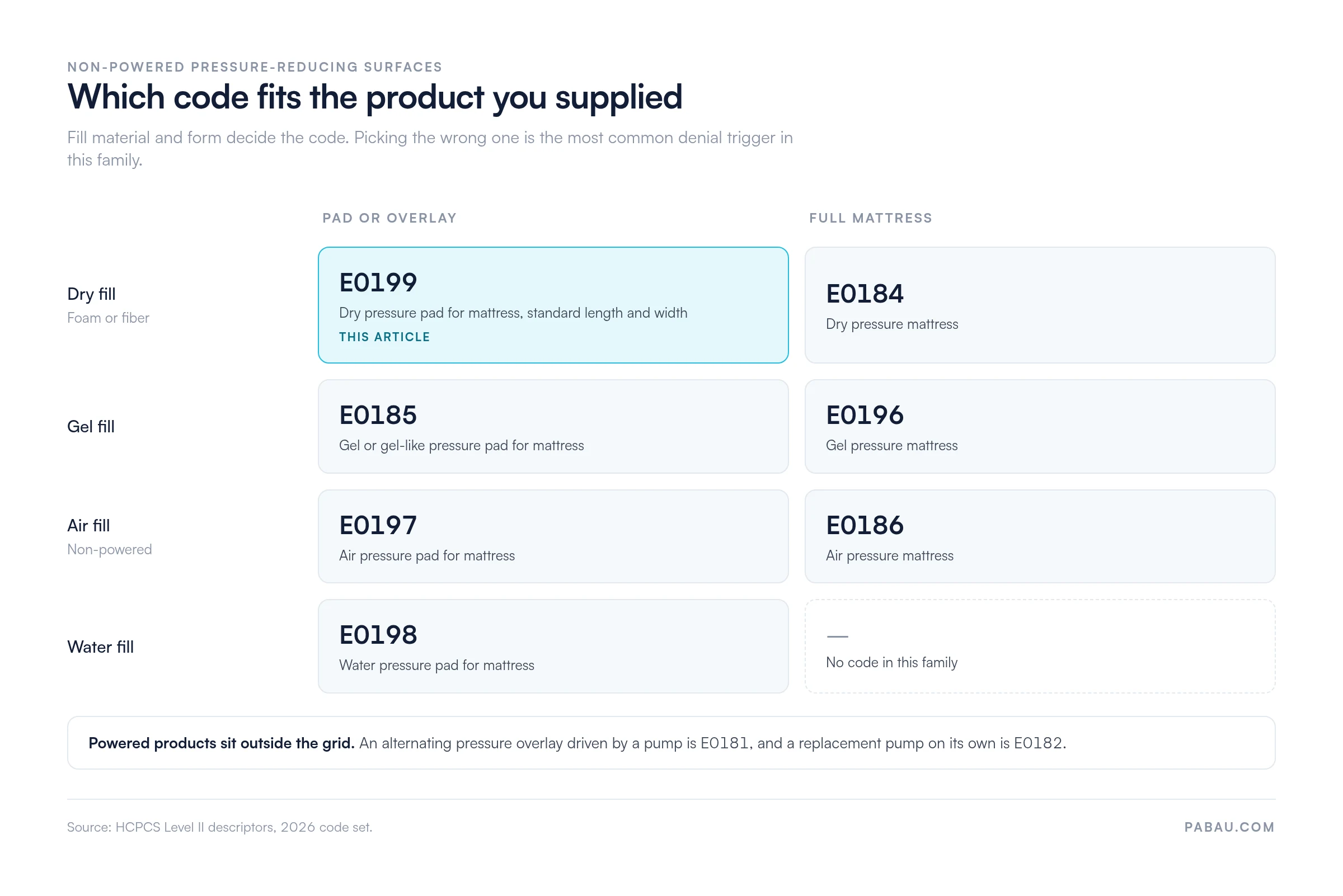
Where the product supplied is a full replacement mattress, E0184 or E0196 applies instead. Matching product specifications to the code descriptor before billing is the cheapest way to protect your clean claims rate.
DME billing teams working across dozens of open orders repeat the same checks by hand. They confirm the code matches the product, the modifier is attached, and the record supports medical necessity. Running those checks in a spreadsheet, separate from the patient record, is where detail gets lost.
Practice management software like Pabau keeps the claim attached to the record it came from. Pabau’s claims management software builds each claim from the patient file and submits it to the payer. The status of that claim then stays visible in the same system, so nobody chases it by email. Policy and authorization details are validated before submission, so a claim does not bounce on a membership number.
Code selection stays with your billing team. Nothing in the software decides that E0199 is right for the pad you delivered, or that KX belongs on the line. What it removes is the rekeying between the clinical record, the order, and the claim. That is where most transcription errors start.
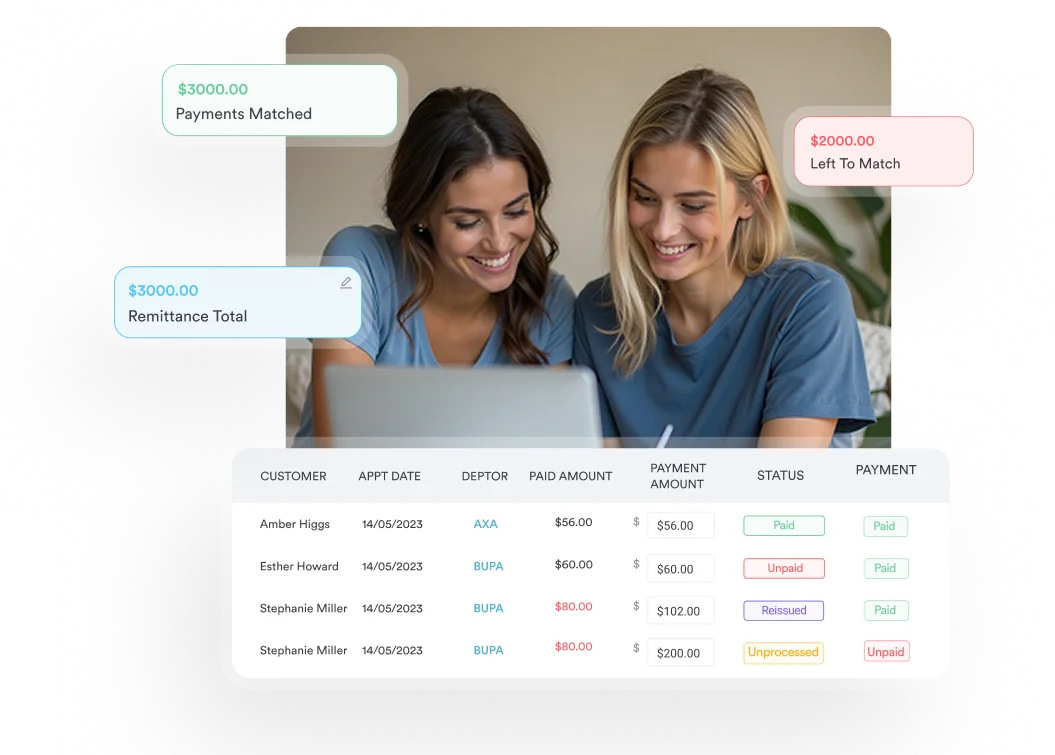

Pabau claims management software builds each insurance claim from the patient record, submits it, and tracks its status in one place. Policy and authorization details are checked before submission, so fewer claims bounce back to your queue.

E0199 is a narrow code, and most of the work sits before the claim is built. Confirm the product is dry, non-powered, and a pad rather than a mattress. Then confirm the record carries the order, the risk factors, and a diagnosis that supports Group 1 coverage.
One trade-off is worth remembering. The KX modifier asserts that your documentation already meets the LCD, so an audit reads the chart rather than the claim. Build the chart first, then bill.
Pabau keeps each submission and its status attached to the patient record. Your team can then see which E0199 claims are still open without leaving the system. Book a demo to see how that works for a DME billing queue.

Want to reduce claim denials across your DME practice? Denial management in healthcare covers the systematic approach to tracking, appealing, and preventing common DMEPOS claim denials.
Need guidance on HCPCS coding compliance documentation? Medical billing compliance outlines the recordkeeping and audit-readiness requirements for Medicare DME suppliers.
Looking to understand the full billing cycle from order to payment? Revenue cycle management explains how each step from coding through remittance connects in a high-performing practice.
HCPCS Code E0199 bills a dry pressure pad for mattress at standard mattress length and width. DME suppliers use it for non-powered foam or fiber overlays supplied to patients at risk of pressure injury. It applies to Medicare, Medicaid, and commercial payers.
Yes, Medicare Part B covers E0199 when the Group 1 criteria are met. The patient must be bed- or chair-confined, or have severely limited mobility. The record must show pressure injury risk factors, or a Stage 1 or higher ulcer. A treating physician must establish medical necessity, and the applicable DME MAC Local Coverage Determination governs.
You need a signed physician order dated before delivery, plus wound assessment notes giving the ulcer stage where one is present. The record must also document mobility limitation or risk factors such as incontinence, nutritional impairment, or altered sensation. A paired ICD-10-CM diagnosis code is required, and some DME MAC jurisdictions also want a Certificate of Medical Necessity.
All four are pressure-reducing surfaces that differ by fill material and form. E0196 is a gel pressure mattress, and E0197 is a non-powered air pressure pad. E0198 is a water pressure pad, and E0199 is a dry foam or fiber pad. Supplying one and billing another is a common denial trigger.
Append KX when the LCD coverage criteria are documented and met, which tells Medicare the claim satisfies medical necessity. Use GA when an Advance Beneficiary Notice has been signed because a denial is expected. Use GY when the item is statutorily excluded from Medicare coverage.
Yes. E0199 sits in Group 1, which covers basic non-powered surfaces for patients at risk of or with Stage 1 to 2 pressure ulcers. Patients with multiple or higher-stage ulcers, or a failed Group 1 trial, may need a Group 2 or Group 3 surface.