

HCPCS code E0198: Water pressure pad billing guide
HCPCS code E0198 is a water pad for a standard mattress HCPCS code E0198 is the ...

Last Updated: Oct 13, 2026
E0196 is the HCPCS Level II code for a gel pressure mattress, a non-powered support surface billed as durable medical equipment. It applies only to a full mattress that replaces the bed mattress, built with gel inserts or gel-impregnated foam.
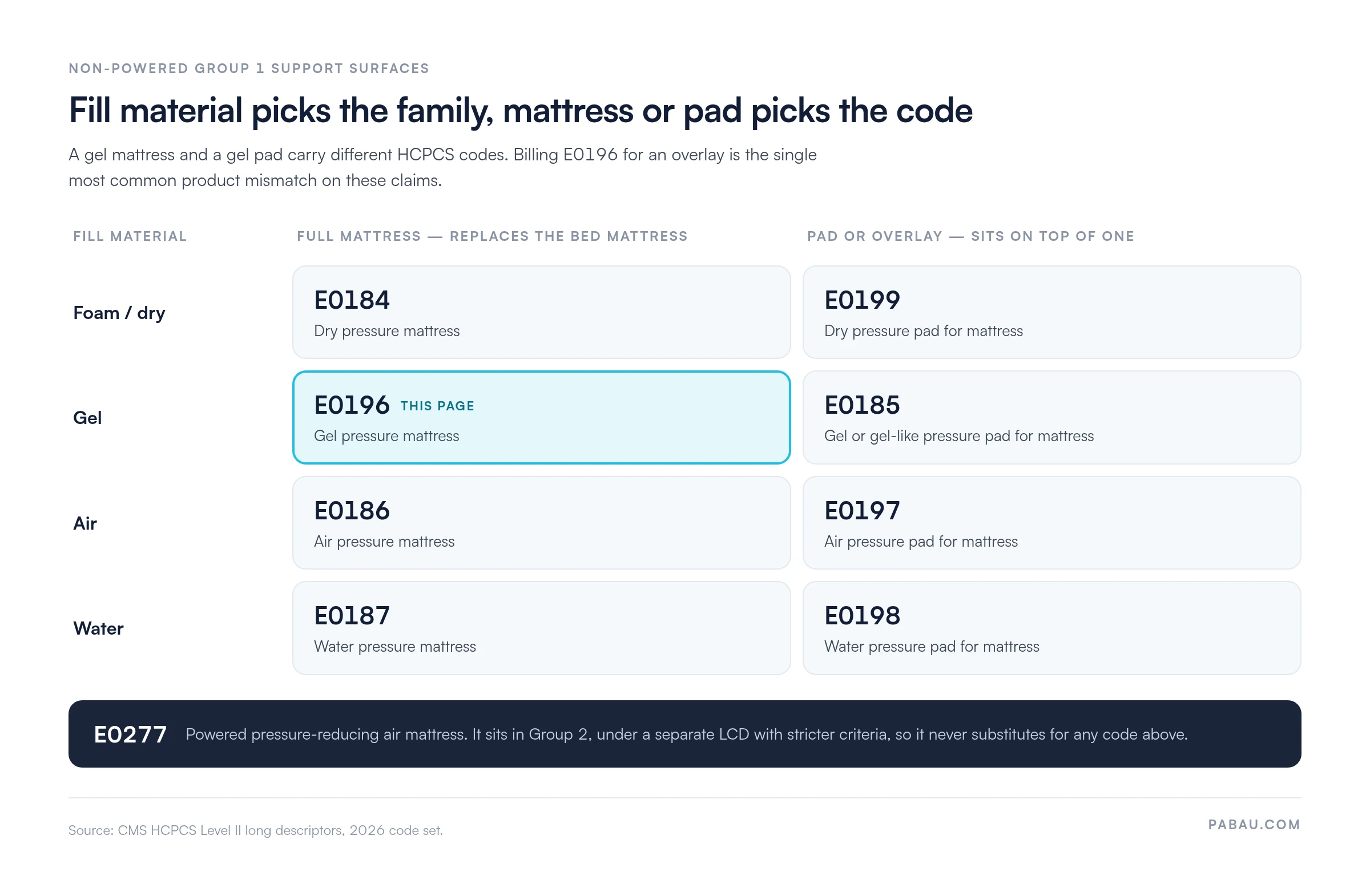
CMS places E0196 in Group 1 pressure-reducing support surfaces, governed by policy article A52489. The gel pad that lies on top of an existing mattress bills under a separate code, E0185. Mixing the two is the most common product error on these claims.
Let Pabau's smart automation suggest the right codes, reduce claim denials, and keep your practice compliant—effortlessly.
Automate repetitive tasks and focus on what matters most—your patients.
Reduce coding errors and ensure compliance with the latest regulations.
Clean claims, fewer denials, and faster reimbursements.
Powerful insights and reporting to help your practice thrive.
HIPAA compliant SOC 2 certified GDPR-compliant Trusted by 4,000+ clinics worldwide

HCPCS code E0196 describes a non-powered gel pressure mattress in CMS Group 1 pressure-reducing support surfaces.
The gel pad that sits on top of a mattress is E0185, and that mix-up drives most product-mismatch denials on this code.
Group 1 coverage turns on complete immobility, limited mobility with a risk factor, or a trunk or pelvis ulcer with one.
Every E0196 claim line carries KX, GA, or GZ. A line with none of the three is rejected as missing information.
Pabau’s claims management software flags a missing modifier or an unsupported diagnosis before the claim leaves your system.
HCPCS code E0196 is the billing code for a gel pressure mattress, a non-powered support surface supplied as durable medical equipment.
The Centers for Medicare and Medicaid Services maintains the HCPCS Level II code set. Its E-codes cover equipment, orthotics, and supplies that CPT does not describe. E0196 sits in the pressure-reducing support surfaces range alongside E0184 through E0199.
The official CMS descriptor for E0196 is: Gel pressure mattress. Three elements decide whether it applies. The product must be a full mattress rather than an overlay or a cushion. It must be gel-filled or gel-constructed, not foam, air, or water. And it must be non-powered.
Miss any one of the three and E0196 is the wrong code for what was supplied. E0196 belongs to CMS Group 1 pressure-reducing support surfaces under the durable medical equipment benefit, a grouping governed by CMS policy article A52489. Group 1 items are non-powered devices that reduce interface pressure across bony prominences.
That classification decides which Local Coverage Determination applies, which ICD-10 codes establish medical necessity, and which modifiers the claim needs.
CMS updates the DME fee schedule annually. The 2026 Medicare national payment amounts for E0196 come from the rental and purchase rates in the CMS DMEPOS fee schedule file. Verify the current figures there before you submit, because geographic adjustment factors apply and MAC-specific rates can differ from the national averages.
Remittance advice files show the allowed amount after adjudication. That is the most reliable way to track what your MAC actually pays for the code.
Medicare Part B pays 80% of the allowed amount after the Part B deductible. The beneficiary or their secondary insurance covers the remaining 20%. Suppliers must accept assignment on DME items for beneficiaries in the competitive bidding program, where it applies.
HCPCS code E0196 covers a non-powered, gel-filled mattress used on a standard or hospital bed frame to reduce interface pressure. The boundaries matter, because billing the wrong product under E0196 is incorrect coding and creates audit exposure.
A frequent billing error is submitting E0196 for a gel overlay. An overlay is a separate product laid on top of a bed mattress, and it carries its own code. E0196 requires a full mattress replacement, not a supplemental layer.
That split runs through the whole range. Each fill material has one code for the full mattress and a second code for the pad that sits on one.
Medicare covers E0196 as a Group 1 pressure-reducing support surface when the beneficiary meets the criteria in LCD L33830. Those criteria are narrower than many suppliers assume, and they are not the Group 2 criteria that govern E0277.
Group 1 coverage requires one of three clinical pictures, documented in the ordering physician’s records:
The same four risk factors apply to both of the qualifying combinations above:
Documentation has to show which of the three pictures applies and name the risk factor behind it. A note that records an ulcer stage and nothing further gives the reviewer no basis for approving the order.
The written order must state the length of need. For an ulcer diagnosis that usually matches the expected healing period. For a chronic condition carrying ongoing risk, a longer duration can be right, but the notes have to justify it.
Every E0196 claim needs at least one ICD-10-CM diagnosis code that establishes medical necessity under the governing LCD. Pressure ulcer and pressure injury codes are the primary supporting diagnoses. Comorbidity codes carry the risk factors the Group 1 criteria turn on.
Use the most specific ICD-10-CM code the documentation supports. Stage-specific sacral pressure ulcer codes, L89.151 through L89.154, carry the strongest signal for E0196. They match the clinical picture the LCD was written around. Unspecified codes invite an additional documentation request from the MAC.
Documentation is where most E0196 claims succeed or fail. The same medical billing compliance rules that govern any claim apply here, with a heavier evidence burden. The MAC needs a paper trail it can follow from the clinical need, through the product specification, to the delivery record.
CGS Medicare, the DME Administrative Contractor for Jurisdictions B and C, publishes its own documentation guidance for Group 1 support surfaces. Keep the clinical notes, the written order, the product specifications, and the delivery receipt for at least seven years. DME claims stay open to post-payment review by Recovery Audit Contractors.
Three codes sit close enough to E0196 to be swapped for it on a claim. The table sets E0196 against the two non-powered mattresses that share its Group 1 classification, then against E0277, the powered Group 2 comparator.
E0277 is the one worth extra care. Powered mattresses fall under Group 2 support surfaces, which carry stricter medical necessity criteria and their own authorization rules. Billing E0196 when a powered mattress was supplied is incorrect coding. Billing E0277 for a non-powered gel mattress overstates the product and inflates the claim.
Prior authorization requirements for E0196 vary by payer and by jurisdiction. Check the beneficiary’s active coverage and the payer’s authorization rules for this item before the product leaves your warehouse.
Modifiers tell the MAC how to read the claim, and they decide the payment outcome. CMS policy article A52489 requires KX, GA, or GZ on every E0196 claim line. A line carrying none of the three is rejected as missing information. Modifier selection therefore belongs in the submission workflow, not in a review after the fact.
KX and GA are mutually exclusive. A line carries KX when the LCD criteria are met and coverage is expected. It carries GA when an ABN was signed because coverage looks unlikely. GZ covers the remaining case, where no ABN is on file and the supplier expects a denial.
Applying KX where the documentation does not support the LCD criteria creates exposure under the federal False Claims Act. Use it only where the chart would withstand a records review.
Build a modifier decision tree into your E0196 submission workflow. Where the chart confirms the LCD criteria are met, KX goes on the Medicare claim automatically. Where there is any doubt, pull the chart notes before the claim leaves the queue. A 60-second documentation check costs far less than a CO-50 denial and the rework behind it.
E0196 denies more often than many DME codes. The coverage criteria are narrow, the documentation demands are specific, and the product category draws steady audit attention. Knowing where these claims fail is what lets you stop them before submission.
Reading the medical billing denial codes on the remittance tells a billing team which correction the denial actually calls for. CO-50 (non-covered service) and CO-167 (diagnosis not covered) are the two most frequent returns on E0196. CO-50 points to a KX review. CO-167 points to a diagnosis review against the LCD’s covered condition list.
Medicaid coverage for gel pressure mattresses billed under E0196 varies by state. Each program sets its own DME coverage policy, prior authorization thresholds, and documentation rules. Some are stricter than Medicare’s Group 1 criteria and some are looser.
When a beneficiary is dually eligible, bill Medicare first as the primary payer. Medicaid coordinates as the secondary payer for the cost-sharing, but it does not pick up items Medicare denied for medical necessity.
Most DME billing teams check the modifier, the diagnosis, and the order at three different moments, in three different places. The chart sits in one system, the delivery ticket in another, and the claim in a third. By the time a CO-50 lands, the person who could explain it has moved on.
Practice management software like Pabau keeps the clinical record and the claim in one system. That single record is what turns error-proof claims management from a review step into a check that runs as the claim is built.
The check runs on the fields that decide an E0196 claim. A line without KX, GA, or GZ is flagged before submission. So is a diagnosis outside the LCD’s covered list, and an order that never confirmed gel construction. Your billing team sees the problem while the chart is still open.
When a denial does come back, the CARC arrives attached to the original claim data. Staff can read the pattern across a batch of E0196 denials instead of working each one alone.

Pabau’s claims management tools flag missing modifiers, incomplete orders, and diagnosis mismatches before a claim leaves your system. See how it works for DME billing teams.

E0196 is a narrow code with a wide margin for error. Run three checks before submission. Confirm the product is a full mattress and not a pad. Confirm the chart names a Group 1 qualifying condition and its risk factor. Confirm the line carries KX, GA, or GZ.
Doing that at submission is cheaper than doing it at appeal. A resubmission costs the same staff time as the original claim and delays payment by weeks. The supplier who checks the order against the delivery ticket once, before the product ships, rarely has to check it twice.
The trade-off worth remembering is that E0196 pays modestly and attracts audit attention out of proportion to the payment. Documentation discipline is the whole margin on this code. Book a demo to see how Pabau keeps DME orders, modifiers, and claims aligned from the order to the remittance.

Need to understand how claims move from submission to payment? Medical billing workflows explained covers the end-to-end process from patient encounter to remittance advice.
Getting repeated CO-50 and CO-167 denials? Denial management in healthcare outlines a systematic approach to spotting denial patterns and reducing rework.
Want a reference for the CARCs that land on DME claims? Denial codes in medical billing maps the most common codes to their corrective actions.
Want fewer E0196 claims coming back at all? What makes a clean claim sets out the fields payers check first and the errors that stop a claim at the gate.
Tracking what your MAC actually paid? Electronic remittance advice explains how to read an ERA file and reconcile it against the fee schedule.
HCPCS code E0196 covers a non-powered gel pressure mattress, classified under Medicare Part B as Group 1 durable medical equipment. It applies only to a full mattress with gel construction. Gel overlay pads, foam mattresses, and wheelchair cushions bill under other codes.
E0196 is a full gel pressure mattress that replaces the bed mattress. E0197 and E0198 are overlay pads that sit on top of one, in air and water respectively. The full-mattress versions of those two are E0186 and E0187. All five are non-powered Group 1 surfaces, so the product form and the fill material decide the code.
Traditional Medicare does not currently require prior authorization for E0196, but Medicare Advantage plans often do. Suppliers must still hold a compliant written physician order and clinical documentation supporting medical necessity before delivery. Post-payment review by RACs and MACs means the file has to be complete even where no authorization is required.
The strongest supporting diagnoses are stage-specific pressure ulcer codes in the L89 range, particularly the sacral codes L89.151 through L89.154. Comorbidity codes covering the Group 1 risk factors include E43 for malnutrition, R32 for incontinence, and mobility-limiting diagnoses such as G82.50. Use the most specific code the documentation supports, then verify it against your MAC’s current LCD list.
Every E0196 claim line to Medicare carries KX, GA, or GZ. KX says the LCD criteria are met. GA says an ABN was signed because coverage looked unlikely. GZ says no ABN was obtained and a denial is expected. NU, RR, and UE separately show whether the item was bought new, rented, or sold used.
The most common causes are a missing KX modifier and a diagnosis outside the MAC’s LCD list. An incomplete physician order and a gel overlay billed under the mattress code account for most of the rest. Each returns a specific CARC: CO-50 signals the missing modifier and CO-167 signals a non-covered diagnosis. Read the CARC before deciding whether to correct and resubmit or to appeal.



