HCPCS Code L0472: Hyperextension TLSO billing guide
HCPCS code L0472: Official descriptor and device definition HCPCS code L0472 des...

Last Updated: Nov 5, 2026
C1877 is the HCPCS Level II code for stent, non-coated/non-covered, without delivery system. Hospital outpatient departments report it under OPPS when the stent is supplied without a delivery catheter.
Denials on C1877 most often come from reporting it for a stent supplied with a delivery system, which is C1876. The other common cause is an operative report that does not document the device as supplied without one.
Let Pabau's smart automation suggest the right codes, reduce claim denials, and keep your practice compliant—effortlessly.
Automate repetitive tasks and focus on what matters most—your patients.
Reduce coding errors and ensure compliance with the latest regulations.
Clean claims, fewer denials, and faster reimbursements.
Powerful insights and reporting to help your practice thrive.
HIPAA compliant SOC 2 certified GDPR-compliant Trusted by 4,000+ clinics worldwide

HCPCS Code C1877 identifies a non-coated, non-covered stent supplied without a delivery system, reported on hospital outpatient claims under OPPS.
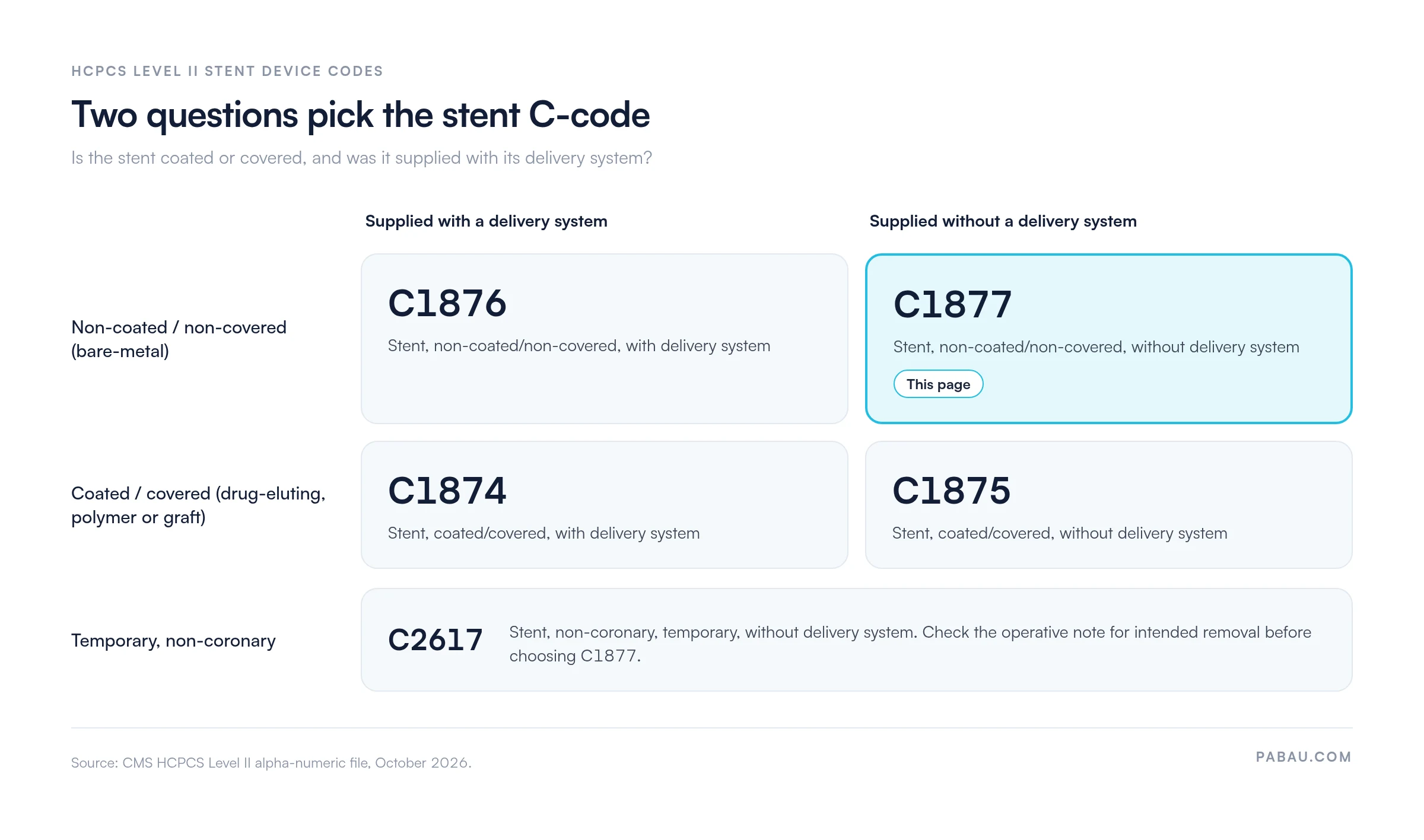
The selection rule is how the stent was supplied: a stent supplied without a delivery system is C1877, and one supplied with it is C1876.
Denials usually follow the wrong stent code or thin operative documentation. A modifier matters only where a device credit or payer rule calls for one.
C1877 is generally packaged (status indicator N) under OPPS, so confirm its status in the current Addendum B before expecting separate payment.
Pabau’s claims management software helps outpatient billing teams submit and track claims and manage denial follow-up on device lines like C1877.
HCPCS Code C1877 is the Centers for Medicare and Medicaid Services (CMS) Level II device code for a stent, non-coated/non-covered, without delivery system. The C-code series sits within HCPCS Level II, which CMS maintains to classify supplies, drugs, and medical devices. C1877 belongs to the C-series of device codes reported on hospital outpatient claims under the Outpatient Prospective Payment System (OPPS).
The table below captures the key classification fields coders and billers need at a glance.
Non-coated/non-covered means no drug-eluting or polymer coating and no graft covering. Without delivery system means the stent is supplied without a delivery catheter. Both descriptors must match what the operative report and device label document for C1877 to be the right code. Understanding these fundamentals is part of solid medical billing practice for any outpatient facility handling interventional procedures.
C1876 and C1877 describe the same device type, a non-coated, non-covered stent. They differ on one point: whether the stent was supplied with a delivery system. C1876 covers a stent supplied with its delivery system, and C1877 covers a stent supplied without one. Selecting the wrong one of the two is the most frequent source of C1877 claim denials.
The delivery system is part of the C1876 descriptor and is never reported as a separate line. So the coding question is how the device was supplied, not whether a catheter appeared during the procedure. The device label or implant sticker, with its lot or serial number, is the most reliable source for confirming which descriptor applies.
Beyond C1876 and C1877, several other HCPCS codes apply to stent devices. Knowing their descriptors prevents miscoding when procedure notes describe coated, covered, or temporary stents.
C2617 is the non-coronary temporary stent supplied without a delivery system. Before choosing C1877, check the operative note for whether the stent is temporary, meaning it was placed with planned removal. The grid below shows how two questions, coating and delivery system, separate the four permanent stent codes from each other and from C2617.
HCPCS Code C1877 is reported on hospital outpatient claims under OPPS. ASC payment treats device costs as packaged into the procedure payment, so verify the ASC payment indicator before reporting it there. Physician office claims and inpatient hospital encounters do not use C-series device codes.
The procedures most likely to generate a C1877 line item include:
CMS does not limit C1877 to a single clinical specialty. Any OPPS facility implanting a non-coated stent supplied without a delivery system can report this code, provided the operative documentation supports it.
C-series codes are device codes used under OPPS. CMS publishes each code’s payment status in the OPPS Addendum B file. C1877 is generally packaged (status indicator N). Its cost is bundled into the APC payment for the associated procedure, and it receives no separate payment.
Key reimbursement facts for outpatient billing teams:
For HCPCS code lookups, the AAPC HCPCS code database is a reliable commercial reference. The CMS HCPCS page linked above provides the quarterly alpha-numeric file download.
Check the CMS OPPS Addendum B for C1877 each November, when CMS releases the OPPS final rule for the following calendar year. The status indicator column tells you whether the code is separately payable, packaged, or non-payable. Billing a packaged code while expecting separate reimbursement is a common source of unexpected write-offs.
Most C1877 lines need no modifier. The OPPS device-credit modifiers FB and FC apply only when the facility received the stent free of charge or with a credit. A manufacturer recall is the usual example.
Where a modifier does apply, confirm it against the current Medicare Claims Processing Manual (Pub. 100-04) and your Medicare Administrative Contractor (MAC) guidance. An incorrectly appended modifier can trigger a denial in its own right.
The operative report is the primary supporting document for a C1877 claim. Every element of the code descriptor must be traceable to something the operative note or device record states. A claim that arrives without that traceability is either denied outright or flagged for medical review.
The operative record should include each of the following to support a clean claim submission:
Facilities audited under OPPS should keep the implant sticker in the operative record. Where a stent could be temporary (see C2617), the procedure note should say so, because coders cannot infer intended permanence from the procedure type alone.
C1877 denials cluster around three root causes: Wrong code selection, insufficient documentation, and claims whose setting or diagnosis codes do not support the device. Modifier errors add to these only where a device credit or payer rule calls for a modifier. Strong denial management workflows catch these patterns before they compound across a billing cycle.
Facilities tracking denial patterns across device codes can review common denial codes in medical billing alongside this code reference. Together they show where claims are failing and why.
Coverage for HCPCS Code C1877 under Medicare is governed primarily by OPPS payment rules rather than a single national coverage determination (NCD). No standalone NCD specifically addresses non-coated stents as a category. Instead, coverage is evaluated in the context of the procedure performed and any applicable Local Coverage Determinations (LCDs) from the MAC serving the facility’s jurisdiction.
Several factors vary by payer and by MAC jurisdiction:
Sound medical billing compliance practices include reviewing the applicable MAC’s LCD list and HCPCS code lookup tools before submitting claims for devices like C1877. Annual status changes can shift what a facility should expect from the device line.
On a C1877 claim, the device facts sit in the operative note and implant record, while the billing team builds the claim later. Each hand-off between the two is a chance for the wrong stent code or a missing lot number to reach the payer.
Pabau, the practice management platform we build, includes claims management software. Your billing team can submit and track claims and manage denial follow-up in one workflow. A denied C1877 line is followed up from its claim record rather than a separate spreadsheet.
Your coders still choose the code and any modifier. Pabau gives them a clear view of each claim’s progress, so a documentation fix reaches the payer sooner.

Pabau’s claims management tools let outpatient billing teams submit and track claims and manage denial follow-up in one workflow. See how it works for your facility.

C1877 is a narrow code, and the coding decision rests on one documented fact: The non-coated stent was supplied without a delivery system. Build that check into the procedure note and the implant record, and C1876 mix-ups stop reaching the payer.
Keep payment expectations in line with the code’s status. Because C1877 is generally packaged under OPPS, accurate coding keeps the claim clean without adding a separately paid line. Check its status in the current Addendum B each November.
Book a demo to see how Pabau helps your billing team submit, track and follow up on outpatient device claims.

Want to understand how medical billing workflows fit together? What is medical billing walks through the end-to-end revenue cycle from patient encounter to payment posting.
Tracking denial trends across your facility? Denial management in healthcare covers root-cause analysis and appeal workflows for outpatient billing teams.
Need a reference for denial reason codes? Denial codes in medical billing lists the most common CARC and RARC codes with explanation and response guidance.
Did the stent come with its delivery system? HCPCS Code C1876 covers the non-coated stent supplied with a delivery system.
Is the stent coated or covered? HCPCS Code C1875 covers the coated or covered stent supplied without a delivery system.
HCPCS Code C1877 is a Level II device code for a non-coated, non-covered stent supplied without a delivery system. Hospital outpatient departments report it under OPPS when the stent was supplied on its own, without a delivery catheter.
Both codes describe non-coated, non-covered stents. C1876 applies when the stent was supplied with its delivery system, and C1877 applies when it was supplied without one. The delivery system is part of the C1876 descriptor and is not reported separately.
Most C1877 lines need no modifier. FB and FC apply only when the facility received the stent free or with a credit, such as after a recall. GY marks a statutorily excluded item and needs no ABN, while GZ signals an expected denial with no ABN issued.
The most common reason is reporting C1877 for a stent supplied with its delivery system. Operative notes that do not show how the stent was supplied come next. Claims also deny when C1877 is reported outside OPPS or the diagnosis codes do not support the device.