

HCPCS Code L0472: Hyperextension TLSO billing guide
HCPCS code L0472: Official descriptor and device definition HCPCS code L0472 des...

Last Updated: Nov 5, 2026
C1817 is the HCPCS Level II code for a septal defect implant system, intracardiac. It reports the occluder a hospital implants during transcatheter closure of an atrial septal defect, patent foramen ovale or ventricular septal defect.
C1817 covers the device only. The hospital reports it on the UB-04 beside the 93580 or 93581 procedure line, and payment follows the code's current OPPS status.
Let Pabau's smart automation suggest the right codes, reduce claim denials, and keep your practice compliant—effortlessly.
Automate repetitive tasks and focus on what matters most—your patients.
Reduce coding errors and ensure compliance with the latest regulations.
Clean claims, fewer denials, and faster reimbursements.
Powerful insights and reporting to help your practice thrive.
HIPAA compliant SOC 2 certified GDPR-compliant Trusted by 4,000+ clinics worldwide

HCPCS Code C1817 reports an intracardiac septal defect implant system, the device left in place during transcatheter ASD, PFO or VSD closure.
C1817 is a device-only charge on the hospital’s UB-04, reported alongside the 93580 or 93581 procedure line and never on its own.
Missing device documentation is the main denial trigger, so the operative report, UDI label, manufacturer details and an ICD-10-CM diagnosis must accompany the claim.
Medicare payment depends on C1817’s current OPPS Addendum B status indicator and APC, and the code is not separately payable in an ambulatory surgery center.
A prior authorization for the closure procedure does not automatically cover the device, so confirm both before the patient is scheduled.
HCPCS Code C1817 is the Level II device code for a septal defect implant system, intracardiac. It belongs to the C-code series of the CMS HCPCS Level II code set. Hospitals use these codes to report devices under the Outpatient Prospective Payment System (OPPS). The descriptor names no device material, so it covers intracardiac septal occluders as a group.
It covers implants for atrial septal defect (ASD), patent foramen ovale (PFO) and ventricular septal defect (VSD) closure. In each case, a catheter-delivered occluder closes the opening without open-heart surgery. C1817 captures the cost of the implant itself. The physician’s procedural work is billed separately with the matching CPT code.
C1817’s scope is easier to see with inclusions and exclusions side by side. Both the device type and the anatomy matter at claim review.
Coders in structural heart programs sometimes confuse C1817 with codes for stents or vascular closure devices. The anatomical target is the clearest differentiator. If the device was not left across a septal defect inside the heart, C1817 does not apply.
Coders who know the procedure can spot a thin operative note before submission rather than after a denial. For an ASD or PFO, the closure follows a predictable sequence that maps onto the claim.
The C1817 charge is generated at step 4, when the implant is deployed. The operative report must state that an implant was placed and left in position. A report describing only catheter navigation and echocardiographic confirmation does not support C1817.
Several C-codes sit near C1817 in the HCPCS Level II listing and describe other implantable devices. Misassignment between them is a consistent denial trigger and, in some payer audits, a compliance flag.
C1820 is worth a specific note. Despite the numeric proximity, it describes a neurostimulator generator, not a cardiac implant. A biller who picks codes by scrolling a HCPCS list rather than searching by descriptor can land on it. Always check the full descriptor before assigning any C-code.
C1817 captures the device cost only. The closure procedure itself is reported with a CPT code, and that code appears on two different claims. Reporting C1817 with no matching procedure, or with the wrong one, invites a payer review or a denial.
PFO closure is reported with 93580, because that code covers congenital interatrial communications. On the hospital’s UB-04, the C1817 line sits beside the hospital’s procedure line for 93580 or 93581. C1817 never goes on the CMS-1500, where the physician reports the same CPT code for the professional fee.
The split below shows which form carries which code. Good revenue cycle management workflows catch a C1817 line with no matching procedure line before the claim goes out.
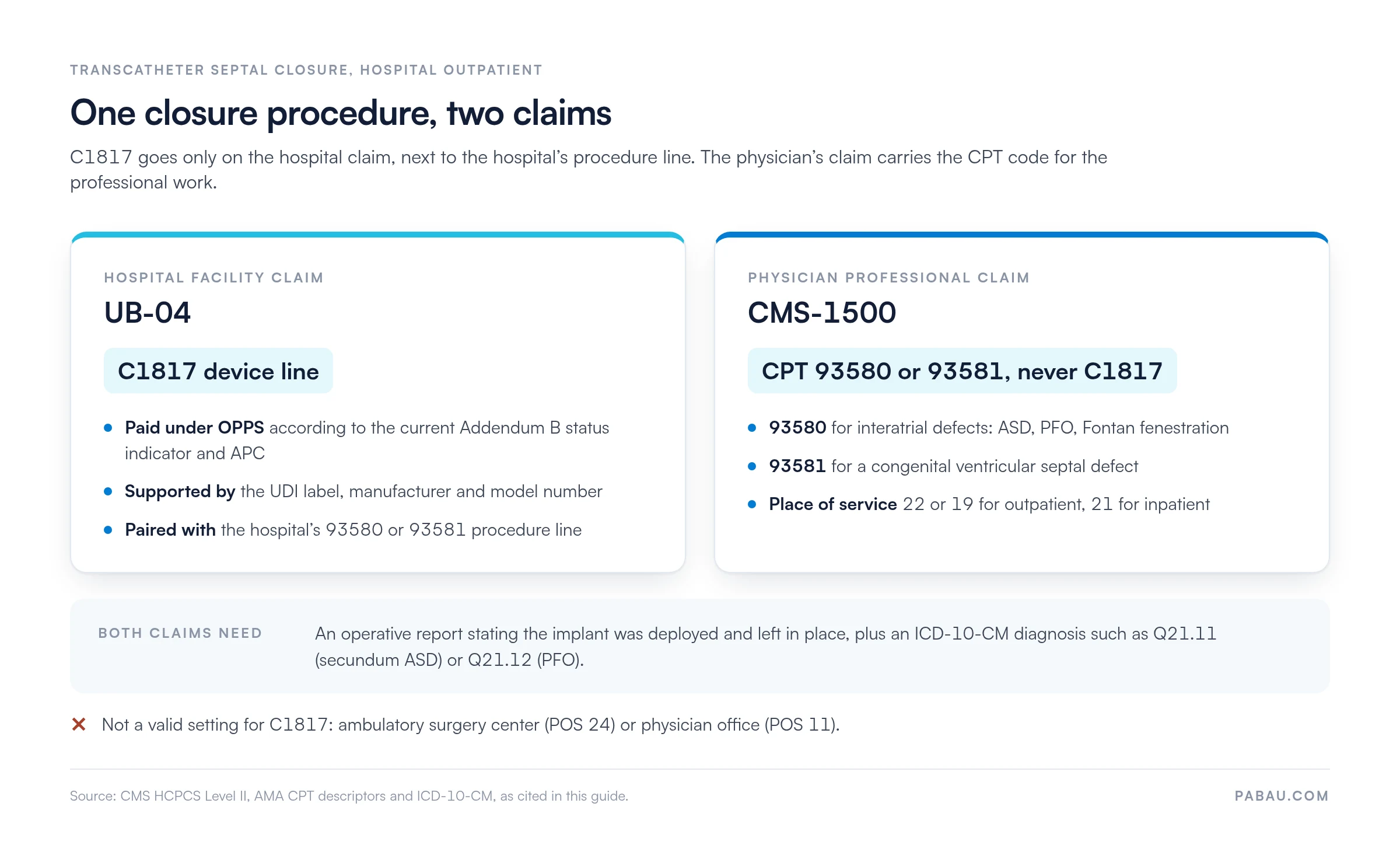
Run a pre-submission edit on the hospital claim that flags any C1817 line not paired with CPT 93580 or 93581. This one rule stops the most common pairing denials before the claim leaves your system.
Medicare pays hospitals for C1817 under the Hospital Outpatient Prospective Payment System (OPPS) when the closure is done in a hospital outpatient department. C-codes are hospital outpatient reporting codes, so C1817 is not separately payable in an ambulatory surgery center (ASC). Whether the device is paid separately or packaged into the procedure’s APC depends on its current status indicator.
Transitional pass-through status is granted per device category and is time-limited. CMS publishes status indicators and APC assignments in OPPS Addendum B and updates them quarterly. Check C1817’s current entry at the start of each calendar year and after each quarterly update.
Use the CMS OPPS quarterly addenda to confirm C1817’s status indicator and APC for the payment year.
Commercial payer rules for C1817 vary more than Medicare’s. The biggest variable is whether a prior authorization covers the device charge as well as the procedure.
A common error starts with a prior authorization for CPT 93580, the ASD or PFO closure procedure. The authorization covers the procedure only, so the C1817 device line is denied. Medical billing compliance here means confirming that the authorization covers both procedure and device before the patient is scheduled.
Each element below belongs in the claim file before submission. Missing any one of them is a common reason for a C1817 denial.
Reviewing clean claim submission standards helps catch payer-specific requirements beyond this baseline list. When the indication falls outside Q21.1x, look it up among the ICD-10-CM codes before the claim goes out.
C1817 is a hospital outpatient device code, and the closure is not performed in a physician office. The wrong place of service (POS) code is a fast route to a denial. The physician’s CMS-1500 shows the setting as a POS code, while the hospital’s UB-04 shows it through the type of bill.
Few modifiers apply to C1817. Two considerations come up most often:
Verify modifier requirements with the MAC or commercial payer before submitting, and never add a modifier just to get the device line paid. Guidance that holds for one payer can be wrong for another.
Most C1817 denials fall into a small number of repeating categories. The category behind a denied claim decides the appeal strategy.
For a medical necessity denial tied to an LCD, the appeal should include the procedure report and the echocardiographic findings. Add a physician letter that answers each criterion the payer cited. Denial management workflows that sort C1817 denials by reason code expose recurring patterns, so teams can fix root causes before claims ship.
Track C1817 denial reason codes in a monthly report. If missing device documentation drives more than 30% of denials, fix it upstream. Require UDI label confirmation on a checklist before the claim is released.
C1817 denials usually trace back to one of three records. The UDI label is missing, the operative note never says the implant stayed in place, or the authorization skipped the device. In many billing teams those records sit in separate systems, and someone pieces them together the day the claim is due.
Pabau, the practice management platform we build, keeps operative notes, uploaded device labels and authorization references on the patient record. Its claims management software pulls that record data into a pre-filled professional claim, then submits and tracks it. Your team checks the file once, before submission, rather than after a denial.
Claim status tracking also shows which claims stall and why. Recurring denial reasons become visible without a separate spreadsheet.

Pabau keeps operative notes, device labels and authorization references on the patient record, then submits and tracks claims from that data. Fewer claims go out missing the documents payers ask for.

C1817 rewards billing teams that treat the device and the procedure as linked lines on separate claims. Confirm the authorization names the device, file the UDI label with the operative note, and check the Addendum B status before each new year.
Those three checks take minutes before submission. Skipping them costs a denial, an appeal letter and weeks of delay on a high-value implant. Book a demo to see how Pabau keeps operative notes, device records and claim status together for your billing team.

Want to understand how denials are categorized and recovered? Denial management in healthcare covers the full denial lifecycle from root-cause categorization to appeal strategy.
Billing the physician side of the closure? CPT code 93580 explains how the interatrial closure procedure is reported and documented.
Need a foundation in device charge billing rules? Medical billing fundamentals explains how device codes, procedure codes and facility charges fit together.
Looking to tighten your end-to-end billing operations? Revenue cycle management outlines the workflow stages where device claims are most exposed to errors.
HCPCS Code C1817 is a Level II device code for a septal defect implant system, intracardiac. It reports the occluder implanted during transcatheter closure of an ASD, PFO or VSD. It covers only the device cost, while the physician’s work is billed with a separate CPT code.
Report a code from Q21.10-Q21.19, because Q21.1 itself is a non-billable category. Q21.11 covers secundum ASD, Q21.12 covers PFO, and Q21.14-Q21.16 cover sinus venosus ASD. PFO closure for stroke prevention may need additional neurological codes, so check your MAC’s LCD for covered diagnoses.
Medicare pays for C1817 under the OPPS when the closure is medically necessary and done in a hospital outpatient department. Its status indicator and APC in OPPS Addendum B decide whether the device is paid separately or packaged. Check that entry for the payment year.
Many commercial payers require prior authorization for C1817 procedures, and an authorization for CPT 93580 does not automatically cover the device charge. Confirm with the payer before the procedure that the authorization covers both the CPT procedure code and the C1817 device charge. Document the payer representative’s name, date, and reference number.
C1817 belongs to hospital outpatient cases, where the physician’s claim shows POS 22 or POS 19. Inpatient cases use POS 21, with the device cost bundled into the DRG. C1817 is not valid for an ambulatory surgery center (POS 24) or a physician office (POS 11).
The most common reasons are missing device documentation, an incorrect place of service, and an authorization that covers the procedure but not the device. Diagnosis codes that do not establish medical necessity are another frequent cause. Some commercial payers also leave C1817 off their covered implant code list.



