CPT code 46255: Hemorrhoidectomy billing and coding guide
CPT code 46255 covers one column, inside and out CPT code 46255 reports a hemorr...

Last Updated: Oct 9, 2026
C1782 is the HCPCS Level II code for a morcellator, the powered device that cuts and extracts tissue through a laparoscopic port. It sits in the C-series that CMS maintains for the Outpatient Prospective Payment System. Hospital outpatient departments and ambulatory surgery centers report it alongside the CPT code for the surgery.
The claim holds up when the operative note confirms the device was deployed, not merely available. On gynecologic cases, the note should also name the containment system, in line with the FDA's 2020 recommendation to use contained morcellation. Missing either detail is a common cause of documentation-related denials.
Let Pabau's smart automation suggest the right codes, reduce claim denials, and keep your practice compliant—effortlessly.
Automate repetitive tasks and focus on what matters most—your patients.
Reduce coding errors and ensure compliance with the latest regulations.
Clean claims, fewer denials, and faster reimbursements.
Powerful insights and reporting to help your practice thrive.
HIPAA compliant SOC 2 certified GDPR-compliant Trusted by 4,000+ clinics worldwide

HCPCS code C1782 is a device code for a morcellator, billed alongside a CPT surgical procedure code and never instead of one.
FDA’s 2020 safety communications recommend contained morcellation when laparoscopic power morcellation is appropriate. Documentation should show the containment system used.
The most common documentation problem is an operative note that lists the morcellator as available but never confirms it was deployed.
Pabau’s claims management software tracks each insurance claim from pending to paid and validates required details before you send it.
HCPCS code C1782 is the CMS HCPCS Level II code for a morcellator, the powered device that cuts and extracts tissue through a laparoscopic port. It sits in the C-series, the temporary codes CMS maintains for the Outpatient Prospective Payment System (OPPS). Hospital outpatient departments and ambulatory surgery centers (ASCs) report it alongside the CPT code for the surgery.
C1xxx codes are device-category codes, and C1782 reports the device itself. The surgical procedure is always reported separately with the matching CPT code. Submitting C1782 without a companion CPT code triggers a claim edit or denial, because the device has no reimbursable context on its own.
C1782 covers a powered morcellator device deployed during a laparoscopic or minimally invasive surgical procedure. The device mechanically cuts and extracts tissue through a small port.
FDA guidance shapes the documentation too. The FDA issued power morcellation updates on February 25 and December 29, 2020. They recommend contained morcellation when laparoscopic power morcellation is appropriate in gynecologic surgery. These are safety recommendations, not a coding or claims rule. Even so, payers may question a C1782 line on a gynecologic case whose operative note names no containment system.
Morcellators are most commonly used in gynecologic laparoscopic surgery, though they appear in other specialties performing minimally invasive tissue removal.
The morcellator is coded separately from the CPT procedure code because it is a facility device cost that sits outside the surgeon’s professional fee. Facilities bear the acquisition cost and report it with C1782. Whether Medicare pays that line separately depends on its payment status, covered below.
HCPCS code C1782 supplements the CPT surgical code and never replaces it. Submit both on the same claim for the same date of service.
Total laparoscopic hysterectomy with removal of the tubes or ovaries, for a uterus of 250 g or less, is CPT 58571. That page walks through the full claim.
Check the OPPS status indicator before you expect separate payment for C1782. If the code is packaged (status N), no separate payment is made, and the device cost rolls into the surgical ambulatory payment classification (APC). Some commercial payers also treat facility supply codes as bundled into the global surgical payment, so verify each payer’s supply-code policy. Running every C1782 line through claims management checks before submission catches a bundling mismatch early.
Check your payer’s remittance advice for Claim Adjustment Reason Code (CARC) 97 on any C1782 line. Code 97 means the payment was bundled into another service already on the claim. That’s a strong signal the payer treats C1782 as part of the surgical APC.
Where the procedure happens determines which payment system governs C1782 and how much the facility collects.
Under OPPS, CMS can grant a C-series device code transitional pass-through payment status. When active, pass-through status pays the device cost separately from the surgical APC, typically on a cost-to-charge ratio basis.
Pass-through status is time-limited under 42 CFR Part 419. CMS grants it for two to three years, and then the device cost is packaged into the APC or the code is deleted. C1782’s status can change with each annual OPPS final rule. Verify current status in CMS’s HCPCS code set and the current-year OPPS Addendum B before filing claims.
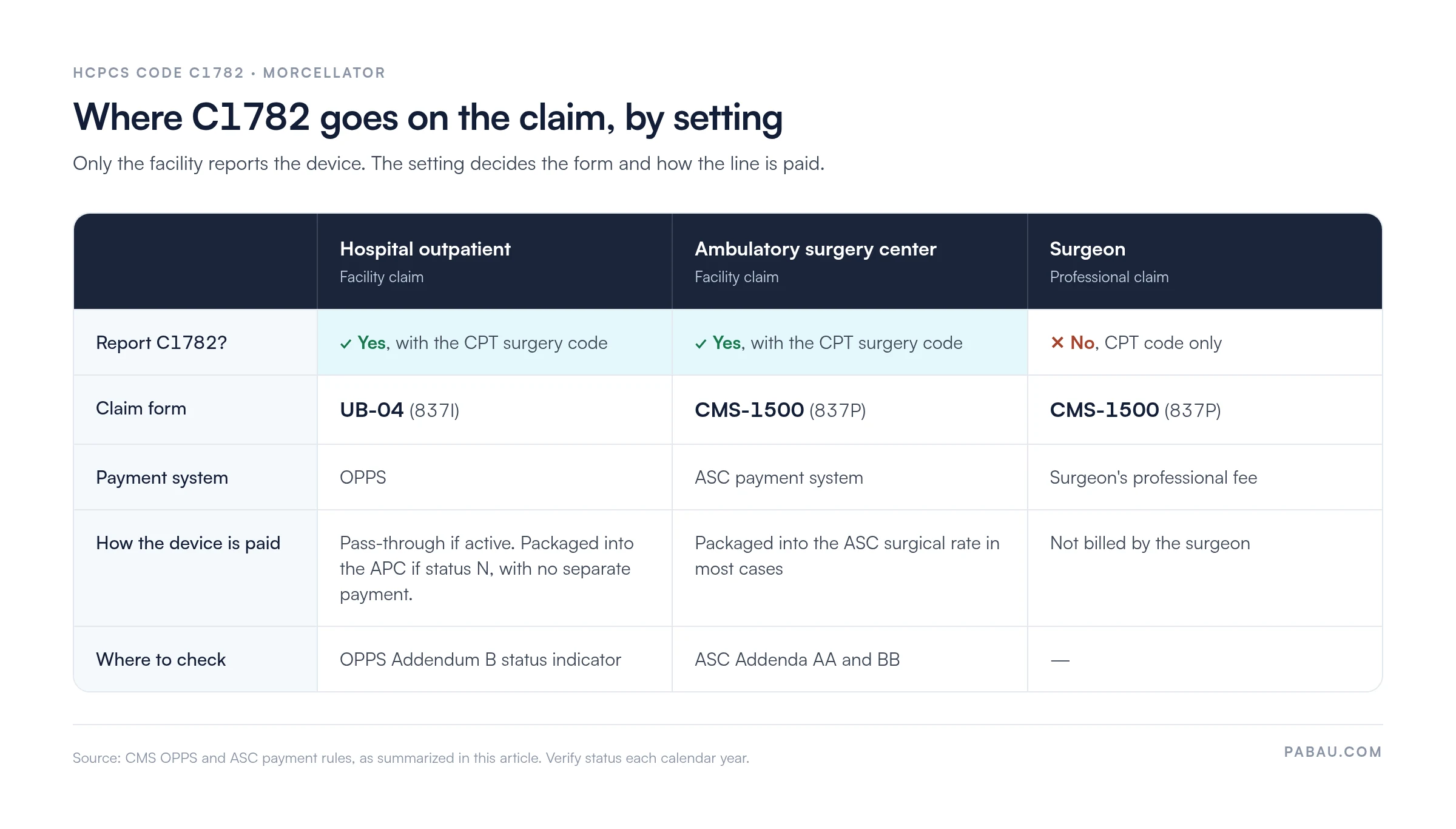
Physicians do not bill C1782, because it is a facility device code. The surgeon’s professional work goes on a CMS-1500 with the CPT code. A hospital outpatient department reports C1782 on the UB-04 (837I), and an ASC reports it on the CMS-1500 (837P). The matrix below sets the three claims side by side.
CMS publishes annual HCPCS payment rates in the OPPS Addendum B, released each November with the OPPS final rule for the upcoming calendar year. For HCPCS code C1782, the payment rate and indicator depend on whether pass-through status is active in the current rule year.
Do not rely on any static dollar figure for C1782. Rates change annually. The authoritative source for 2026 rates is CMS OPPS Addendum B, with ASC Addenda AA and BB for ambulatory surgery centers. Commercial payers set their own rates independently of Medicare, and contract-specific rates govern in those encounters.
Every C1782 claim needs a supporting ICD-10-CM diagnosis code that reflects the clinical indication for the procedure. The table below covers the codes most frequently paired with C1782 across the procedures in the clinical table above.
Some commercial payers publish medical necessity criteria that require specific diagnosis codes for C1782 to be covered. For gynecologic procedures, always code to the greatest specificity available in the operative and pathology documentation. Reporting D25.9 when the operative note names an intramural fibroid leaves out detail the payer can check against the pathology report.
Keep diagnosis and procedure documentation in one record. The coder can then pick the specific code at the point of care instead of fixing it at claim edit.
The operative note is the primary document that supports a C1782 claim. Payers auditing device code claims look for specific elements. An operative note that lists the morcellator in the equipment tray without confirming it was used does not support the claim.
Good documentation for C1782 follows the same pattern as any implantable or single-use device. Record what it was, confirm it was used, and state why it was necessary. Our guide to medical billing compliance covers how payers audit device claims after payment.
C1782 denials cluster around a short list of correctable errors. The CARC on the remittance tells the biller what to fix on appeal, and our reference on denial codes and fixes decodes each one.
When C1782 denials pile up, sort them by reason across claims instead of working each one alone. Repeated CARC 97 from the same payer points to a contract or policy issue. Repeated missing deployment confirmation means the operative note template needs a deployment line, which the billing desk can’t add. Structured denial management workflows help ASC billing teams separate systemic issues from one-off errors.
C1782 is specific to a morcellator device. Coders sometimes use adjacent codes when the device details are ambiguous.
Using A4649 when C1782 exists is a common error in facilities without a device-specific chargemaster entry for the morcellator. The “not otherwise classified” code invites manual review and almost always pays less than the specific code. Verify the chargemaster maps to C1782 directly. For HCPCS code lookup and crosswalk verification, the PGM Billing HCPCS lookup tool provides free access to CMS-sourced code data.
Audit your chargemaster annually for morcellator entries. If the chargemaster still maps to A4649 instead of C1782, every morcellator claim is being under-coded and under-paid. A single chargemaster correction applies to every future claim without touching individual encounters.
Without a claims dashboard, a facility biller tracks C1782 lines across spreadsheets, payer portals and remittance files. A denial surfaces weeks later, and the team has to reconstruct which form, diagnosis or note caused it.
Pabau’s claims management software puts every insurance claim on one dashboard, sorted into Pending, Submitted, Processing, Paid and Error. US claims go out through Claim.MD, and validation checks run on each claim before it is sent.
So required claim details get checked before submission instead of after a denial. Your team spends its time on the claims that need judgment, such as a payer that keeps packaging C1782.

Pabau’s claims management software tracks every insurance claim from pending to paid and runs validation checks before you send it. Your billing team spends less time on rework and resubmissions.

C1782 rarely fails because a coder picked the wrong code. It fails when the operative note, the chargemaster or the payment status doesn’t back up the line.
So put the fix where the error starts. Add a deployment and containment line to the operative note template. Map the chargemaster to C1782 instead of A4649, and check the OPPS status indicator each January.
That is a few minutes of setup a year, set against a steady stream of avoidable rework. Book a demo to see how Pabau tracks your C1782 claims from pending to paid.

Need to understand how denial codes work across your claims? Denial codes in medical billing covers the most common CARC and RARC codes with resolution steps for each.
Looking for a clear overview of the medical billing process? What is medical billing explains the end-to-end cycle from charge capture to payment posting.
Want to understand compliance requirements for device code claims? Medical billing compliance covers documentation standards, audit triggers, and payer-specific rules for facility claims.
Coding an implantable joint device instead? HCPCS code C1776 covers the descriptor, claim pairing, and documentation for joint implants.
HCPCS code C1782 covers a morcellator, a powered surgical device that cuts and extracts tissue during laparoscopic procedures. Facilities bill it alongside the CPT surgical code for the same date of service, never as a standalone charge.
Pass-through payment status for C1782 under OPPS is time-limited and changes with each annual CMS OPPS final rule. Check the current-year OPPS Addendum B to confirm whether C1782 carries active pass-through status before assuming separate device payment from Medicare.
Use both. The CPT code reports the surgical procedure and the surgeon’s work, and HCPCS code C1782 reports the morcellator as a facility device cost. They are not interchangeable, and billing one without the other triggers an edit or denial.
Medicare recognizes C1782 in an ASC when the device was used during a covered laparoscopic procedure at a Medicare-enrolled ASC. Payment is usually packaged into the ASC surgical rate rather than paid as a separate device line.
The operative note must confirm the device manufacturer and model, the serial or lot number, and that the morcellator was deployed, not just available. It should also name the containment system where the FDA recommends contained morcellation (gynecologic procedures), and state why morcellation was chosen.
The most common reasons are missing deployment confirmation in the operative note and APC bundling (CARC 97). Others include an invalid ICD-10 pairing, a missing companion CPT code, and the wrong claim form for the setting.
C1782 remains a valid HCPCS Level II code in 2026 with its descriptor unchanged. Confirm its 2026 payment indicator and any pass-through status in the 2026 OPPS final rule. Check CMS’s published files directly rather than relying on prior-year documentation.