HCPCS Code J1110: Dihydroergotamine mesylate injection billing guide
HCPCS Code J1110: Official descriptor and drug overview HCPCS Code J1110 is the ...

Last Updated: Oct 29, 2026
C1763 is the HCPCS Level II code for connective tissue, non-human (includes synthetic). Under the CY2026 hospital outpatient prospective payment system (OPPS), status indicator N packages its cost into the procedure's APC. The line gets no separate payment.
Hospital outpatient departments still report it on the UB-04 under revenue code 027x. That keeps device charges in the cost data CMS uses to set APC rates. Human connective tissue, including fascia lata, is reported with C1762 instead.
Let Pabau's smart automation suggest the right codes, reduce claim denials, and keep your practice compliant—effortlessly.
Automate repetitive tasks and focus on what matters most—your patients.
Reduce coding errors and ensure compliance with the latest regulations.
Clean claims, fewer denials, and faster reimbursements.
Powerful insights and reporting to help your practice thrive.
HIPAA compliant SOC 2 certified GDPR-compliant Trusted by 4,000+ clinics worldwide

HCPCS code C1763 reports non-human connective tissue, including synthetic products, while human tissue such as fascia lata is reported with C1762.
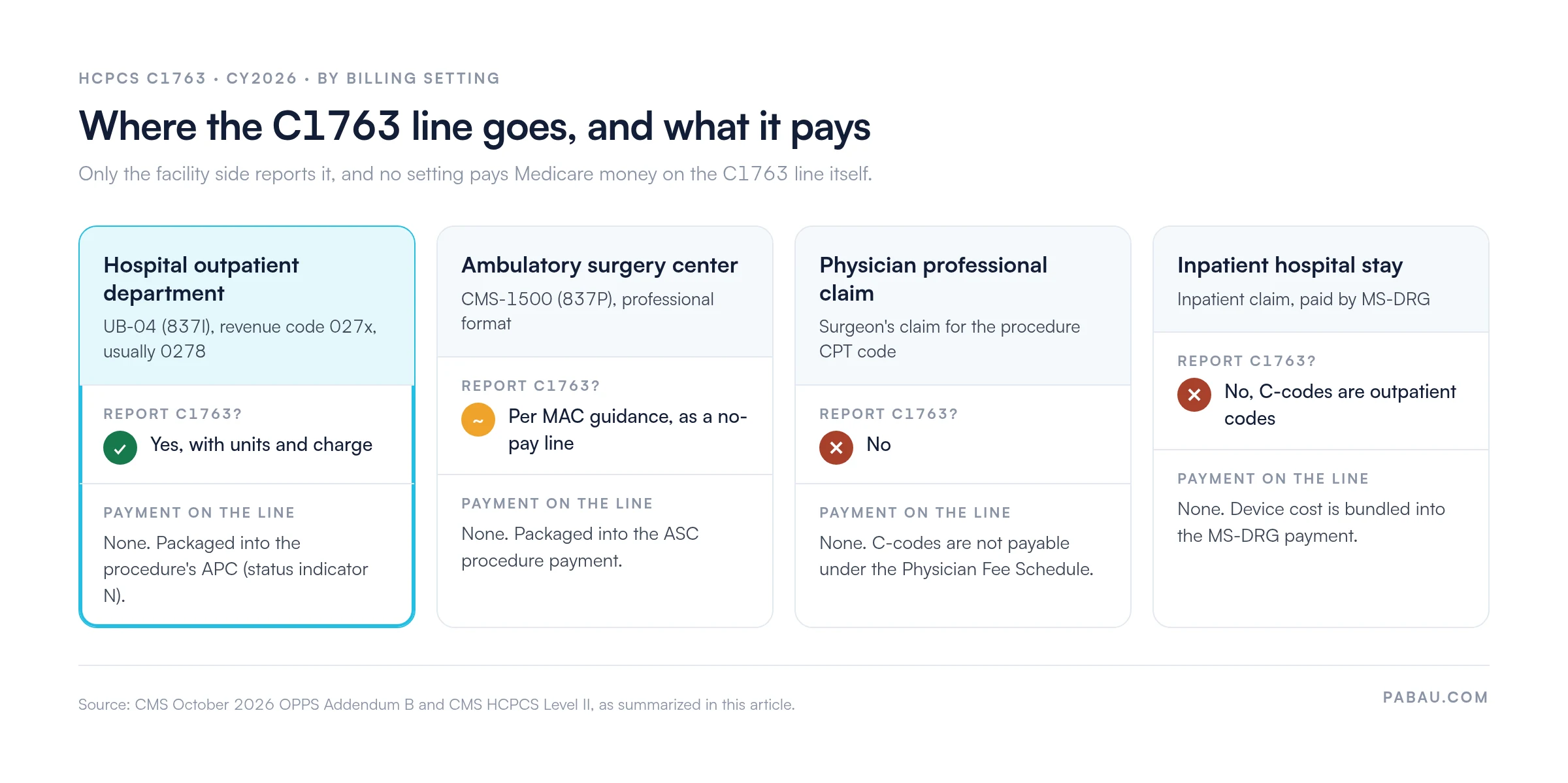
Under the CY2026 OPPS, C1763 carries status indicator N, so its cost is packaged into the procedure’s APC with no separate payment.
Hospital outpatient departments still report C1763 on the UB-04 under revenue code 027x, which captures device charges for cost reporting.
Ambulatory surgery centers bill Medicare on the professional-format claim (CMS-1500 or 837P), and packaged devices earn no separate ASC payment either.
Keep the operative note, product name, lot number and invoice together, because auditors and some payers ask what was implanted.
HCPCS code C1763 is the CMS Level II code for connective tissue, non-human (includes synthetic). Hospitals use it to report porcine, bovine, equine or synthetic tissue implanted during an outpatient procedure. Medicare packages its cost into the procedure payment, so the line carries a charge but no separate payment.
The official descriptor itself carries the parenthetical “(includes synthetic)”. That wording brings fully synthetic matrices into scope alongside acellular dermal matrices processed from animal sources. Its counterpart, C1762, covers connective tissue of human origin, including fascia lata.
C1763 belongs to the C-code series, which CMS maintains within HCPCS Level II for the hospital outpatient prospective payment system (OPPS). C-codes identify devices, drugs and services for OPPS reporting, and only some of them carry pass-through status at any one time. C1763 was added to HCPCS on April 1, 2001, and it is not payable under the Medicare Physician Fee Schedule.
Coders sometimes misread the descriptor as covering any non-human biological material. The scope is narrower: connective tissue specifically, meaning structural matrix products used to reinforce or replace fascial, dermal, or pericardial tissue planes. Products that primarily deliver cells, growth factors, or pharmaceuticals code differently.
A C1763 product is defined by two things. Its origin is non-human or synthetic, and it works as a connective tissue replacement or reinforcement. Porcine dermis, bovine and equine pericardium, and synthetic matrices designed to mimic fascial or dermal tissue all fall within the descriptor.
A common exclusion error is reporting C1763 for a human cadaveric allograft. Human connective tissue, including fascia lata, has its own code, C1762. Both codes are packaged under the CY2026 OPPS, so the mix-up rarely changes payment. It still misstates the device on the claim and skews the cost data tied to the procedure.
C1763 is a packaged code. The October 2026 OPPS Addendum B lists it with status indicator N, with no APC and no payment rate. Medicare pays for the tissue through the APC of the procedure it was used in.
Device pass-through payment under 42 CFR 419.66 is a transitional status that lasts at least two and no more than three years. C1763 has been reportable since 2001, so any early pass-through period ended long ago. The code stays in the file because hospitals still use it to report the device.
Packaged status changes what billing teams should expect. On the remittance, the C1763 line shows a charge and a zero payment. That zero is how packaging works, so appealing it only costs staff time. There is no pass-through offset to calculate and no pass-through audit exposure for this code.
C1763 is an OPPS reporting code, so where it appears depends on who bills the facility side of the procedure. The grid below compares the four settings at a glance, and the list after it covers each one in detail.
Accurate device reporting still matters on OPPS claims. For procedures CMS classes as device-intensive, the claim must carry a device HCPCS code alongside the procedure. Reporting C1763 when non-human tissue was implanted keeps those claims complete.
Under the CY2026 OPPS, C1763 has no separate payment rate. Its cost is built into the APC payment for the procedure, which CMS sets each year in the OPPS final rule. The hospital’s reported charges for C1763 flow into the claims data behind those APC rates.
Because the tissue is never paid on its own line, C1763 documentation serves accuracy and audit readiness. A claim file that holds up to review includes the following, in line with general billing compliance requirements:
Many facilities keep the product sticker or invoice in the patient’s record, so a coder can confirm the descriptor before the claim goes out. Retaining that copy also speeds up any audit response.
Create a tissue-product implant log for each procedure room. When the circulating nurse opens a C1763 product, they record the lot number, product name, and acquisition cost before the case closes. Coders then have the product details for the claim without chasing the supply chain team days later.
Modifiers rarely change how a C1763 line processes, because the line is packaged either way. Some payers ask for RT or LT on device lines to show which side received the tissue. Check the payer’s billing guidance before adding them.
Modifiers 59, XE, XS, XP, XU and 50 describe procedures. Appending one to the C1763 line does not unpackage it or create separate payment. Where a procedure pair hits an NCCI edit, the modifier belongs on the procedure line and needs operative note support.
Medicare sets the reference treatment for C1763 because the code exists for OPPS reporting. Other payers set their own rules, and the reimbursement path depends on the patient’s coverage.
Check each payer’s policy before assuming C1763 is recognized. Some commercial contracts carve out high-cost implants for separate payment, while others bundle them as Medicare does. Some commercial and Medicare Advantage plans also require prior authorization for connective tissue implants.
Most C1763 problems come from expecting a payment that packaged status never produces, or from describing the wrong product. The medical billing denial codes that appear on C1763 claims share three causes. They are the wrong product code, the wrong claim format, and missing records.
Effective denial management for C1763 starts before the claim is submitted. A pre-bill check of the product code, claim format, diagnosis link and prior authorization prevents the errors above. Medical billing workflows that separate facility claims from professional claims also keep C-codes off the surgeon’s claim.
Practices whose surgeons operate in hospital outpatient departments or ASCs still produce the clinical record those facility claims depend on. The operative note, the product used and the diagnosis often sit in different systems, so coders end up chasing them.
In Pabau, the EHR and billing platform we build, the treatment note, consent forms and diagnosis sit in one patient record. Pabau’s claims management software submits your professional claims from that existing record data through Claim.MD, then tracks each one until it is paid or rejected.
The facility’s UB-04 for C1763 stays with the hospital or ASC billing team. Your notes give them the product details they need, and your own claim status sits in one place.

Pabau keeps treatment notes and diagnoses in one patient record, then submits and tracks your claims through Claim.MD. Your team spends less time chasing claim status.

C1763 earns no money on its own line, so treat it as a reporting duty. The tissue is paid through the procedure’s APC, which leaves two jobs: describe the product accurately and keep the record behind it.
Get the product right first. Non-human and synthetic tissue goes to C1763, while human tissue, including fascia lata, goes to C1762. Then route the claim correctly: the UB-04 under revenue code 027x for hospital outpatient departments, and the professional-format claim for ASCs.
A zero-paid C1763 line is the expected result, so spend appeal time on the procedure line instead. Book a demo to see how Pabau keeps your clinical records and claim status in one place.

Need a framework for reducing claim rejections across supply codes? Superbill documentation guide explains what every line of a complete claim package must include to pass payer edits.
Working through a denial backlog on implant codes? Revenue cycle management overview maps the end-to-end process from encounter to payment, including where supply-code denials most often originate.
Trying to understand HCPCS code structure for staff training? Medical billing fundamentals covers how HCPCS Level I and Level II codes fit into the broader claims workflow.
HCPCS code C1763 covers connective tissue of non-human origin, including fully synthetic products. That includes porcine and bovine acellular dermal matrices, animal pericardial grafts and synthetic scaffolds. Human tissue, including fascia lata, is reported with C1762, and autograft tissue has no separate supply code.
No. The CY2026 OPPS Addendum B lists C1763 with status indicator N, so its cost is packaged into the APC of the procedure. It has no APC of its own, no payment rate and no pass-through offset.
Modifiers rarely affect a C1763 line because it is packaged. Some payers ask for RT or LT to show the treated side. Modifiers 59, the X modifiers and 50 apply to procedure lines, and none of them creates separate payment for C1763.
It varies by payer. Medicare Advantage plans follow their contract with the facility and may require prior authorization. Commercial payers set their own implant terms, and some carve out implants for separate payment. Medicaid coverage varies by state, so check the state fee schedule.