CCSD code K4902: IVUS-guided coronary angioplasty billing guide
CCSD code K4902 covers IVUS-guided coronary angioplasty CCSD code K4902 covers p...

Last Updated: Oct 26, 2026
C1890 is the HCPCS Level II code for no implantable/insertable device used with device-intensive procedures. An ambulatory surgical center (ASC) reports it alongside the device-intensive procedure code when no device was furnished.
CMS created C1890 effective January 1, 2019, and it is payable in the ASC setting only. Hospital outpatient departments must not report it on institutional claims, where it carries OPPS status indicator E1.
Let Pabau's smart automation suggest the right codes, reduce claim denials, and keep your practice compliant—effortlessly.
Automate repetitive tasks and focus on what matters most—your patients.
Reduce coding errors and ensure compliance with the latest regulations.
Clean claims, fewer denials, and faster reimbursements.
Powerful insights and reporting to help your practice thrive.
HIPAA compliant SOC 2 certified GDPR-compliant Trusted by 4,000+ clinics worldwide

HCPCS Code C1890 tells Medicare that an ambulatory surgical center (ASC) performed a device-intensive procedure without furnishing the implantable or insertable device.
It is a temporary Level II C-code, effective January 1, 2019, that ASCs report alongside the device-intensive procedure code.
C1890 is payable in the ASC setting only. Hospital outpatient departments must not report it, and the OPPS assigns it status indicator E1.
The operative note must state that no device was furnished, so the C1890 line holds up if the payer asks for records.
Pabau, practice software that holds clinical notes and billing in one patient record, lets coders confirm device status before the claim goes out.
HCPCS Code C1890 is the code an ambulatory surgical center (ASC) reports when it performs a device-intensive procedure without an implantable or insertable device. CMS created it as a temporary Level II C-code, effective January 1, 2019, in CMS Transmittal R4204CP.
A device-intensive procedure is one where the device makes up a large share of the cost. Since 2019, CMS has set that line at a device offset above 30 percent of the procedure’s mean cost. Medicare packages the device into the ASC procedure payment, and ASCs do not report packaged codes.
That left Medicare with no way to see when an ASC performed a device-intensive procedure without the device. C1890 is the flag CMS created for that case. The ASC reports it on the same claim as the device-intensive procedure code.
C1890 is an ASC-only code. It is payable in the ASC setting, and hospital outpatient departments must not report it on institutional claims. Under the Outpatient Prospective Payment System (OPPS), it carries status indicator E1.
CMS publishes two descriptors for C1890. The long descriptor is No implantable/insertable device used with device-intensive procedures, and the short descriptor is No device w/dev-intensive px.
CMS updates its ASC payment files every quarter. Check the current CMS ASC payment files before you bill a device-intensive procedure.
Report C1890 when all three of these conditions hold for the same claim.
CMS states that ASCs must report C1890 in this situation, so it is a required code. Leaving it off makes the claim look like a standard device-intensive case with the device included. The diagram below runs the three checks in order.
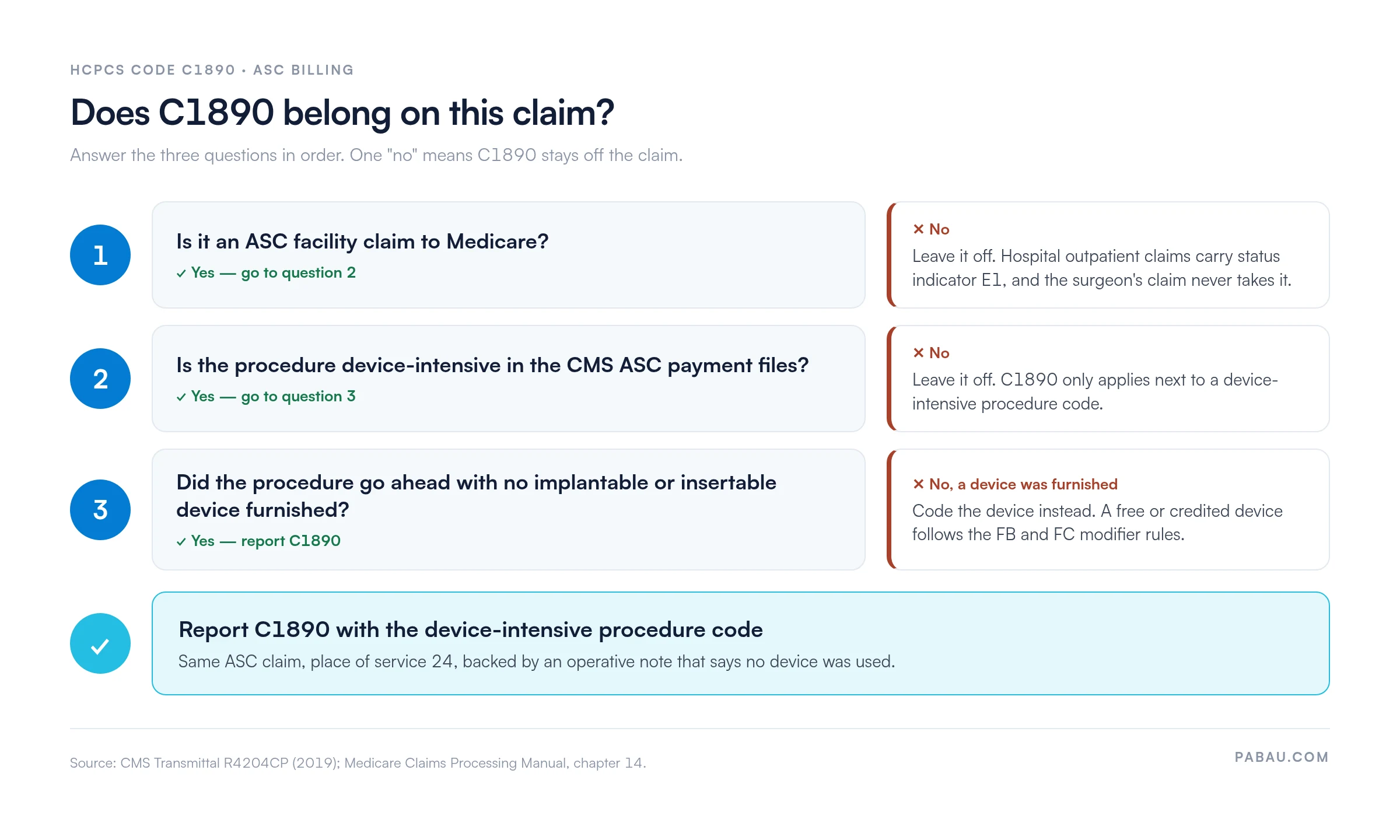
C1890 has a narrow scope. These are the cases where it does not belong.
Chapter 14 of the Medicare Claims Processing Manual has ASCs bill Medicare on the ASC X12 837 professional claim format. Form CMS-1500 is used only in rare cases. C1890 goes on that claim, and these steps keep it accurate.
Before the claim drops, check every ASC claim that carries a device-intensive procedure code. Confirm the operative note records device status, and add C1890 only where it says no device was used.
C1890 reports the absence of a device, while C1769 and C1889 report devices that were used. Coders confuse them because all three sit in the same C-series range.
If a device was used, C1890 is off the table. Look for the most specific device code first, and fall back to C1889 only when none fits. Because ASCs do not report packaged codes, follow your Medicare Administrative Contractor’s instructions on listing device codes.
The AAPC HCPCS code lookup lets coders browse the full C-series descriptor list. Use it to confirm which device code matches the device that was used. Our HCPCS guides for coders walk through other C-series codes in the same format as this page.
C1890 is only as defensible as the documentation that supports it. The operative note must contain three elements before C1890 can be coded compliantly.
ASCs using claims management software can build a documentation prompt into their pre-claim workflow. A required field confirming device status before a C1890 line is approved stops errors at the source rather than at the payer.
Good medical billing compliance practice also means keeping the full operative record with the claim. Retain it for as long as your payer contracts and state law require.
Medicare recognizes C1890 on ASC claims only. CMS made it payable in the ASC setting and assigned it status indicator E1 under the OPPS, so hospital outpatient claims do not pay it.
The code exists because of how Medicare pays ASCs for device-intensive procedures. That payment method applies when the procedure is furnished with an implanted or inserted device. C1890 is how the ASC reports the cases where no device was furnished.
Commercial payers set their own rules. Before the first claim, check whether each payer recognizes C1890 on ASC claims and what it expects if it does not.
Tracking electronic remittance advice (ERA) on claims that carry C1890 shows how each payer handles the code. A run of rejections from one payer is worth raising with its provider relations team.
Each error below breaks a rule CMS set for C1890. The table pairs it with the fix.
A structured denial management workflow that tags each rejected C1890 line by cause shows whether the problem is coding, documentation or payer policy. Only a coding or documentation error needs a corrected claim.
Submitting clean claims, with the operative note checked before the claim drops, keeps these errors from reaching the payer at all.
For C1890’s reporting rules, go to the document CMS used to create the code: CMS Transmittal R4204CP, section 4.
Device status often sits in the operative note while the claim is built in a separate system. A coder then has to cross-check the two by hand. Each missed check risks a C1890 line that is missing, or one that should not be there.
In Pabau, the clinical note and the claim sit in the same patient record. Your billing team can confirm device status in the operative note before a claim is submitted, without switching systems.
The result is fewer corrected claims and a record that answers a payer’s request without a search through separate systems.

Pabau’s claims management tools help ASC billing teams check documentation before claims drop and track denial patterns by payer, so device-coding errors get caught early.

Treat C1890 as a documentation question first and a coding question second. Once the operative note states plainly that no device was furnished, the code follows from the three checks.
Build that check into your review of device-intensive ASC claims. Most of the errors in the table above then get caught before the payer sees them.
The trade-off is one extra review step on every device-intensive claim, which is quicker than reworking a claim after a records request. To see how Pabau helps your billing team check device status before claims go out, book a demo.

Need a structured overview of denial code categories? Denial codes in medical billing covers the CARC and RARC codes that appear most often on ASC facility claims.
Want to understand the full claims cycle before a claim reaches the payer? What is medical billing walks through the end-to-end process from charge capture to payment posting.
Looking for a compliance framework for your billing operations? Medical billing compliance covers the documentation standards, audit risk areas, and payer policy alignment that affect ASC claims.
HCPCS Code C1890 means “No implantable/insertable device used with device-intensive procedures.” An ambulatory surgical center reports it alongside a device-intensive procedure code when no device was furnished. CMS created the code effective January 1, 2019.
Use C1890 only when an ASC performed a device-intensive procedure and furnished no implantable or insertable device. If a device was used, C1890 does not apply, and the device has its own code, such as C1769 or C1889. Never report C1890 and a device code for the same procedure.
Yes, but only from an ASC. CMS made C1890 payable in the ASC setting only. Under the OPPS it carries status indicator E1, so Medicare does not pay it on any hospital outpatient bill type.
The operative note must contain three elements. It needs an explicit statement that no implantable or insertable device was placed and the clinical reason why. It also needs a date of service that matches the claim. A note that only describes the surgical approach leaves the C1890 line unsupported if the payer requests records.
C1890 claims fail when the code breaks one of the rules CMS set for it. Typical causes are a hospital outpatient claim, a procedure that is not device-intensive, or a device that was in fact furnished. An operative note that never addresses device use also leaves the line unsupported.
No. CMS states that C1890 should not be reported on institutional claims by hospital outpatient departments. It is payable in the ASC setting only, and its OPPS status indicator E1 means Medicare does not pay it on outpatient claims.