

CCSD code G5100: Bypass of duodenum billing guide
CCSD code G5100 bills a bypass that leaves the duodenum in place CCSD code G5100...

Last Updated: Oct 16, 2026
C1759 is the HCPCS Level II code for catheter, intracardiac echocardiography. Hospitals report it on outpatient facility claims to capture the single-use ICE catheter used during cardiac procedures.
Coders most often meet C1759 during atrial fibrillation ablations and structural heart interventions, where the ICE catheter guides the procedure from inside the heart. It is often confused with adjacent catheter C-codes, particularly C1753 (intravascular ultrasound catheter) and EP catheter codes such as C1733.
Let Pabau's smart automation suggest the right codes, reduce claim denials, and keep your practice compliant—effortlessly.
Automate repetitive tasks and focus on what matters most—your patients.
Reduce coding errors and ensure compliance with the latest regulations.
Clean claims, fewer denials, and faster reimbursements.
Powerful insights and reporting to help your practice thrive.
HIPAA compliant SOC 2 certified GDPR-compliant Trusted by 4,000+ clinics worldwide

HCPCS code C1759 describes an intracardiac echocardiography (ICE) catheter, which images the heart from inside rather than mapping or ablating it.
C1759 is reported only on hospital outpatient claims under OPPS, so physician office and ASC claims are not valid.
Most denials trace to the wrong care setting, missing medical necessity documentation, or another catheter code such as C1753 billed in its place.
The physician’s ICE imaging service is reported separately with add-on CPT code 93662, while the catheter stays on the facility claim.
Pabau, the practice management system we build, helps billing teams attach documentation, validate claims, and track every C-code claim to payment.
HCPCS code C1759 is the Centers for Medicare and Medicaid Services (CMS) code for a catheter, intracardiac echocardiography (ICE). It belongs to the HCPCS Level II C-series, which hospitals use to report devices on outpatient claims under the Outpatient Prospective Payment System (OPPS). Procedure codes describe the work, not the single-use device. The C-code lets the hospital report the catheter on the same facility claim.
The ICE catheter is a single-use, sterile imaging device inserted through a vein into the cardiac chambers. It produces live ultrasound images and does not deliver energy or map electrical activity. That difference drives the code choice. Billing an EP catheter code such as C1733 for an ICE catheter is a specification error. So is billing C1753, the intravascular ultrasound catheter code, and either one can trigger a denial.
Intracardiac echocardiography uses a catheter-mounted ultrasound transducer to produce live images from within the cardiac chambers. Transthoracic and transesophageal echocardiography image the heart from the chest wall or the esophagus. ICE places the imaging element right beside the structure being viewed, which improves resolution. It also avoids the general anesthesia that transesophageal guidance often needs.
The catheter is inserted through a femoral vein and advanced into the right atrium or right ventricle. From there, the electrophysiologist can see the interatrial septum, pulmonary veins, left atrial appendage, and valve structures as the case runs. That view makes complex structural heart interventions and catheter ablations safer and more precise.
C1759 commonly applies in these procedures:
Correct use of C1759 needs the right device and the right setting. The code fits when the device was an ICE catheter and the procedure took place in a hospital outpatient department. The medical record also has to document why ICE guidance was needed.
Each case splits into a facility line and a professional line. The hospital reports C1759 on the UB-04 alongside the procedure. The physician reports the procedure itself, such as 93580 for an ASD closure or 93654 for a VT ablation.
When the physician performs and interprets the ICE imaging, that professional service is reported with add-on code 93662. The catheter itself stays on the facility claim as C1759, so one ICE case can produce two ICE-related codes on two different claims.
C1759 cannot be billed in the physician office or ambulatory surgical center (ASC) setting. The code is designated for hospital outpatient prospective payment and has no value under the Medicare Physician Fee Schedule. Submitting C1759 on a professional claim form instead of a facility UB-04 leads to a rejection at the payer level.
Document the specific clinical indication for ICE guidance in the procedure note, not just the procedure name. Payers reviewing medical necessity look for specific wording. An example is ‘ICE used to guide transseptal puncture and confirm catheter tip position at left superior pulmonary vein ostium’. A generic statement that ICE was used does not meet that bar.
Several catheter and device C-codes sit close to C1759, either numerically or in the same cardiac cases. Each descriptor is tied to what the device does, not to the procedure it supports. EP catheters have their own codes, C1730 to C1733, and they are the easiest ones to mix up with ICE in an EP lab.
Within that range, HCPCS code C1731 covers a diagnostic EP catheter with 20 or more electrodes and no 3D mapping. It records electrical signals instead of producing images, so it never substitutes for C1759.
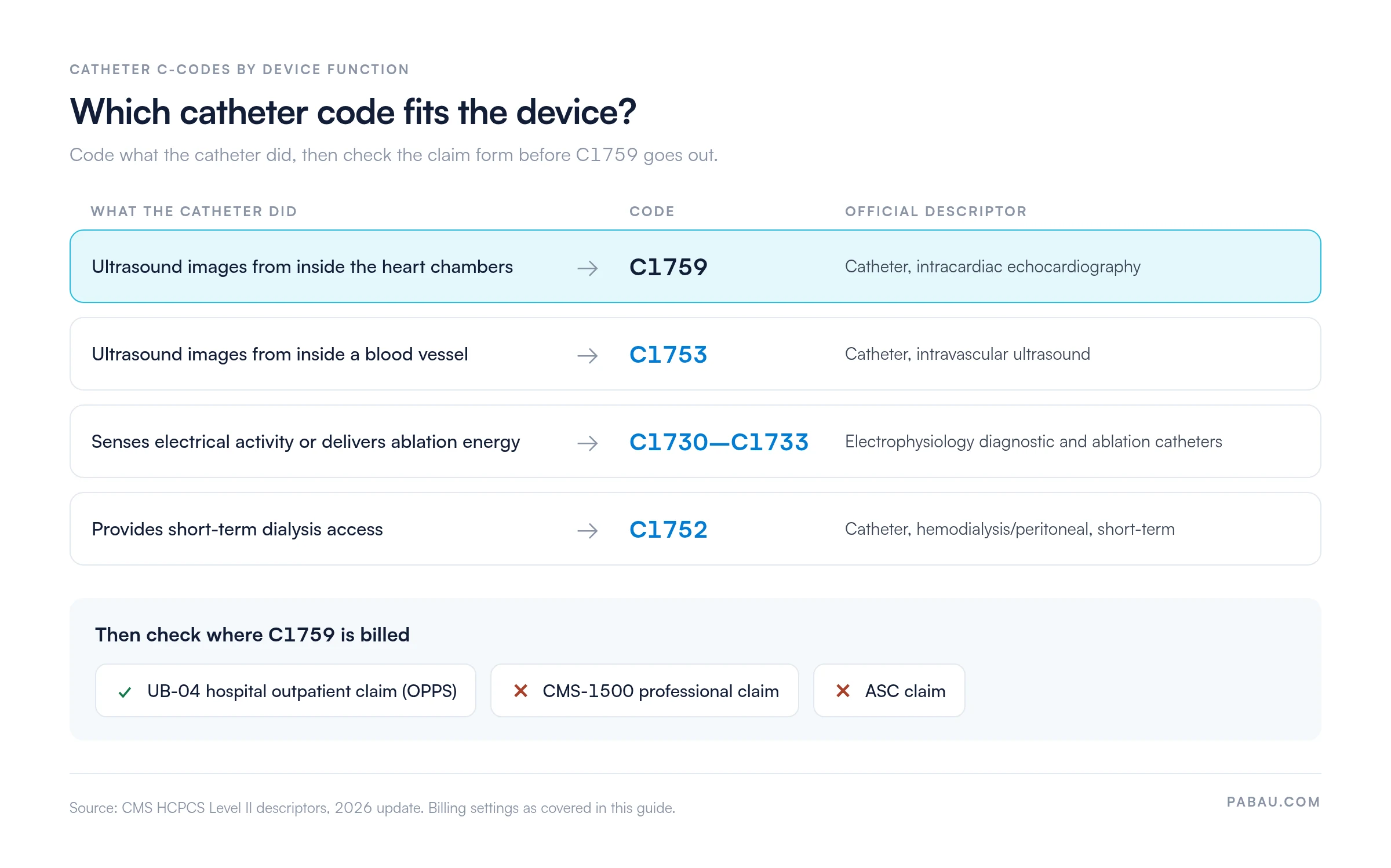
The key distinction for C1759 is function, because the ICE catheter produces ultrasound images from inside the heart. A different code applies if the device imaged a vessel wall, delivered energy, mapped electrical activity, or provided dialysis access. Check the device label and the operative note before assigning the code. The chart below sorts the codes by what the catheter did.
Under OPPS, CMS assigns each HCPCS code a status indicator that decides how it is paid. For a device code like C1759, the indicator shows whether the device cost is packaged into the procedure’s ambulatory payment classification (APC) or paid separately. That can change with each annual OPPS final rule. It also depends on whether the code carries transitional pass-through status.
Check the current status indicator for C1759 in CMS OPPS Addendum B for the year of service. Addendum B is the definitive source for facility-side payment. A device C-code has no Physician Fee Schedule value, so a fee schedule lookup will not show a rate for C1759. Recheck the code every January, because packaging and APC rates change with each annual update.
C1759 is an active code in the 2026 HCPCS Level II update. Its Medicare payment depends on the APC assignment and status indicator in effect for 2026. Confirm dollar figures in CMS OPPS 2026 Addendum B before you submit claims or set chargemaster rates. The table below lists the payment variables to confirm.
A C1759 claim is only as strong as the documentation behind it. Payers reviewing outpatient device claims want proof of the device, the clinical indication, and the procedure record.
Keep the invoice, implant log, and procedure note together in the patient record. When a payer requests records, the full set goes out in one response and adjudication moves faster.
C1759 denials fall into predictable categories. Most can be prevented with front-end coding edits and a documentation checklist applied before submission.
Match each C1759 rejection to its reason code with this guide to medical billing denial codes. Bundling denials need a check of the current APC status instead of an appeal. Packaging is CMS payment policy, so an appeal will not reverse it.
Run a quarterly audit of all C1759 claims submitted in the prior 90 days. Filter denials by reason code and sort them into setting, device-type, and documentation denials, since each needs a different fix. A structured denial log reduces repeat errors and supports a targeted appeal strategy.
Medicare’s coverage of C1759 under OPPS is governed by the annual OPPS final rule. Commercial payers and Medicaid managed care plans apply their own policies. Some require prior authorization for procedures that routinely use ICE catheters, such as AF ablation or LAAO.
Prior authorization rules for ICE catheter use are not universal. Some commercial payers authorize the ablation procedure itself, which covers the ICE device as part of the case. Others require a separate device authorization, and Medicaid policies vary by state and managed care organization.
Never assume Medicare policy applies to a commercial or Medicaid claim. Check the plan’s current prior authorization tool or contact the payer directly.
A C1759 denial often surfaces weeks after the procedure, when the remittance arrives. By then, the invoice, implant log, and procedure note can sit in three different places. Every appeal then starts with a records hunt.
Pabau keeps that paperwork in the patient record the claim is built from. Its outpatient claims management software pre-fills claims from the record and runs validation checks in the background before anything is sent.
Each claim then moves through five statuses on one dashboard: Pending, submitted, processing, paid, or error. A rejected device line shows up the day it fails, so your team can fix the code or attach the invoice before the claim ages.
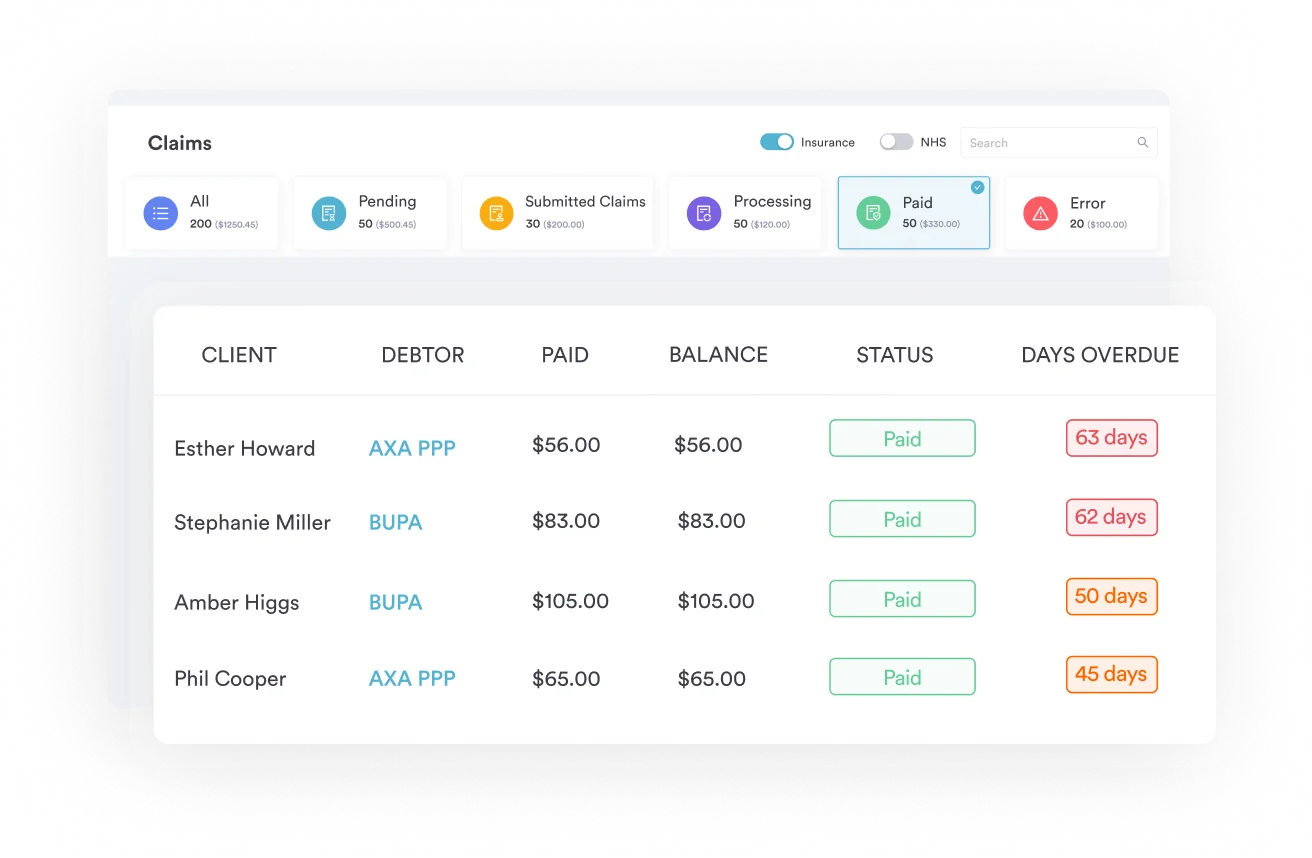

Pabau pre-fills claims from the patient record, validates them before submission, and tracks each one to payment. Your billing team spots a rejected C1759 line early and resubmits it with the right documentation.

C1759 rewards one habit. Confirm what the catheter did, and which claim it belongs on, before the code is assigned.
Build that check into charge capture and the C1753 and EP-code mix-ups become rare, along with most setting rejections. The trade-off is a few extra minutes per EP case to match the device label to the note. That time costs far less than reworking a denied device claim.
Book a demo to see how Pabau tracks device claims from submission to payment, so denials get fixed while they are still fresh.

Need to reduce claim rejections on device codes? Pabau claims management software tracks device charges and supports clean submission for HCPCS C-codes.
Confused about which denial code applies to a rejected C1759 claim? Denial codes in medical billing explains the most common CARC and RARC codes and how to respond to each one.
Billing the physician side of an ICE case? CPT code 93662 covers the professional intracardiac echocardiography service that pairs with the C1759 device line.
Was the catheter an EP mapping or ablation device instead? HCPCS code C1733 covers the electrophysiology catheter most often confused with ICE.
HCPCS code C1759 is a Level II device code for an intracardiac echocardiography (ICE) catheter. It covers the single-use imaging catheter placed in the heart during AF ablation, LAAO, ASD closure, and VT ablation. It applies only to hospital outpatient claims under OPPS. The physician’s professional service is reported separately with the appropriate CPT code.
C1759 covers a catheter that produces ultrasound images from inside the heart chambers. C1753 covers an intravascular ultrasound catheter, which images blood vessels from inside. EP catheter codes such as C1733 cover diagnostic or ablation catheters that sense electrical activity or deliver energy. If the catheter provided ICE imaging, report C1759.
Yes. Medicare covers C1759 on hospital outpatient claims under OPPS when medical necessity is documented and the claim is filed on a UB-04. Payment depends on the current APC assignment and status indicator. Check the 2026 rate in CMS OPPS Addendum B, because packaging status and payment rates change every year.
The APC assignment for C1759 can change with each annual OPPS final rule, so check CMS OPPS Addendum B for the year of service. A packaged status indicator means the device cost is bundled into the procedure APC rate. A separately payable status generates a device payment on top of the procedure APC.
No. C1759 is designated for hospital outpatient use under OPPS only. Submitting it on a professional claim (CMS-1500) or as part of an ASC claim leads to a rejection. If an ICE catheter is used outside a hospital outpatient department, ask the payer for coding guidance. No standard C-code path exists for non-OPPS settings.
Most C1759 denials come from the wrong care setting or another catheter code, such as C1753 (intravascular ultrasound), used instead. Missing medical necessity documentation and payer bundling of a packaged code are the other common causes. Prevention starts before submission. Restrict C1759 to UB-04 facility claims, match the device label to the code descriptor, and make sure the procedure note states the ICE indication.



