HCPCS Code G0163: Skilled nursing observation and assessment
What is HCPCS Code G0163? HCPCS Code G0163 is a deleted Level II code for skille...

Last Updated: Oct 15, 2026
B9000 is the HCPCS Level II code for enteral nutrition infusion pump - without alarm. CMS terminated it with effect from 31 December 2016, so it is no longer valid for claims after that date.
DMEPOS suppliers once used it to bill Medicare and Medicaid for home enteral nutrition equipment. CMS terminated the code and replaced it with B9002.
B9002 covers enteral nutrition infusion pumps of any type, and the crosswalk from B9000 is one-to-one. Any claim carrying B9000 today is rejected. The documentation rules moved as well. CMS retired Certificate of Medical Necessity forms for dates of service on or after January 1, 2023.
Let Pabau's smart automation suggest the right codes, reduce claim denials, and keep your practice compliant—effortlessly.
Automate repetitive tasks and focus on what matters most—your patients.
Reduce coding errors and ensure compliance with the latest regulations.
Clean claims, fewer denials, and faster reimbursements.
Powerful insights and reporting to help your practice thrive.
HIPAA compliant SOC 2 certified GDPR-compliant Trusted by 4,000+ clinics worldwide

HCPCS Code B9000 is deleted and no longer billable, so submit claims using successor code B9002 instead.
B9000 covered an enteral nutrition infusion pump without alarm, while B9002 covers enteral nutrition infusion pumps of any type.
Only Medicare-enrolled DMEPOS suppliers may bill enteral nutrition pump codes, and billing without enrollment is fraud.
Certificate of Medical Necessity forms ended on January 1, 2023, so the physician order and clinical notes must carry medical necessity.
Proof of delivery with the beneficiary’s signature is mandatory, and a missing one cannot be fixed later.
HCPCS Code B9000 is the deleted HCPCS Level II code for an enteral nutrition infusion pump without alarm. DMEPOS suppliers used it to bill Medicare and Medicaid for home enteral nutrition therapy equipment. Its status is Deleted, so it cannot be submitted on any current claim.
Billers who find this code on an older claim template or in legacy billing software should switch to B9002 now. Continued use of B9000 generates automatic rejections with no path to appeal. The deletion affected both purchase and rental billing for enteral pump equipment.
If the patient receives nutrition intravenously rather than through a feeding tube, the stationary pump bills under HCPCS Code B9006 instead.
B9000 was retired because CMS consolidated enteral pump coding into a single, broader descriptor. The original code separated pumps with alarms from pumps without alarms and billed them as different items. CMS dropped that separation. B9002 now covers enteral nutrition infusion pumps of any type.
The crosswalk is direct, because B9000 maps one-to-one to B9002. Patients already receiving home enteral nutrition therapy need no clinical reclassification and no new paperwork. The supplier bills B9002 going forward. The table below sets the two codes side by side.
According to the Centers for Medicare and Medicaid Services (CMS), HCPCS Level II codes cover items and services that CPT does not describe. That includes durable medical equipment, supplies, and drugs given outside a physician’s office. B-series codes cover enteral and parenteral therapy equipment and supplies.
The B-code range (B4000-B9999) spans the full set of enteral and parenteral nutrition items: nutrients, administration sets, pumps, and accessories. B9000 and B9002 sit in the pump sub-range. CMS maintains HCPCS Level II codes, while the American Medical Association (AMA) maintains CPT codes.
Suppliers billing enteral nutrition equipment must be enrolled in Medicare’s DMEPOS program and hold a valid supplier number. Billing teams who know how the B-series is laid out avoid pulling a code from the wrong range.
Medicare Part B covers home enteral nutrition (HEN) therapy as a prosthetic device benefit, not under the standard DME benefit. The patient must have a non-functioning gastrointestinal tract, or a disease that prevents adequate oral nutrition. A physician must certify that enteral feeding is medically necessary.
Verify patient eligibility before every claim cycle. Checking coverage at the point of ordering stops denials on claims that reach the payer weeks later.
Only Medicare-enrolled DMEPOS suppliers may bill enteral nutrition pump codes. The National Supplier Clearinghouse (NSC) administers enrollment. Billing without a valid DMEPOS supplier number constitutes healthcare fraud and may trigger False Claims Act liability.
Medicaid coverage for enteral nutrition pumps varies by state. Most state programs cover home enteral therapy where it is medically necessary, but criteria, prior authorization rules, and reimbursement rates differ. Check the state Medicaid fee schedule and any state-specific coverage determination before billing.
Documentation is the single biggest lever in reducing enteral nutrition claim denials. Claims that arrive at the MAC incomplete are denied on first submission, and appeals cost time and staff hours. The checklist below applies to current B9002 claims, and to any historical B9000 audit.
Audit the documentation package before delivery, not after. A missing proof of delivery is the fastest route to a denial. So is an order signed after the delivery date. Neither can be fixed once the timely filing window closes.
Medicare reimburses enteral nutrition pumps under the DMEPOS fee schedule, which CMS updates annually. Payment runs on either a purchase or a rental model, depending on the equipment classification and the length of medical need. Enteral pumps usually follow capped rental for the first 13 months, after which ownership may transfer to the beneficiary.
Reimbursement rates vary by MAC jurisdiction. The CMS DMEPOS fee schedule lists the current allowed amount for each HCPCS code by state.
Competitive bidding does not change what an enteral pump pays. The equipment went into the Round 2021 bid, but CMS never moved it to the contracting phase, and it sits outside the next round too. Every enrolled supplier bills the applicable DMEPOS fee schedule rate, inside a bidding area or not.
Fee schedule figures change each year, so check current rates against the CMS DMEPOS file before quoting reimbursement to patients or finance teams. Presenting a prior-year rate as current creates reconciliation problems downstream. A billing workflow that pulls the current rate at claim creation removes that risk.
Modifiers tell the payer how the equipment was supplied and what the coverage record holds. The six that apply to enteral pumps fall into two groups, and a clean claim carries one from each. Using the wrong modifier, or leaving out a required one, is among the most common denial triggers for DMEPOS claims.
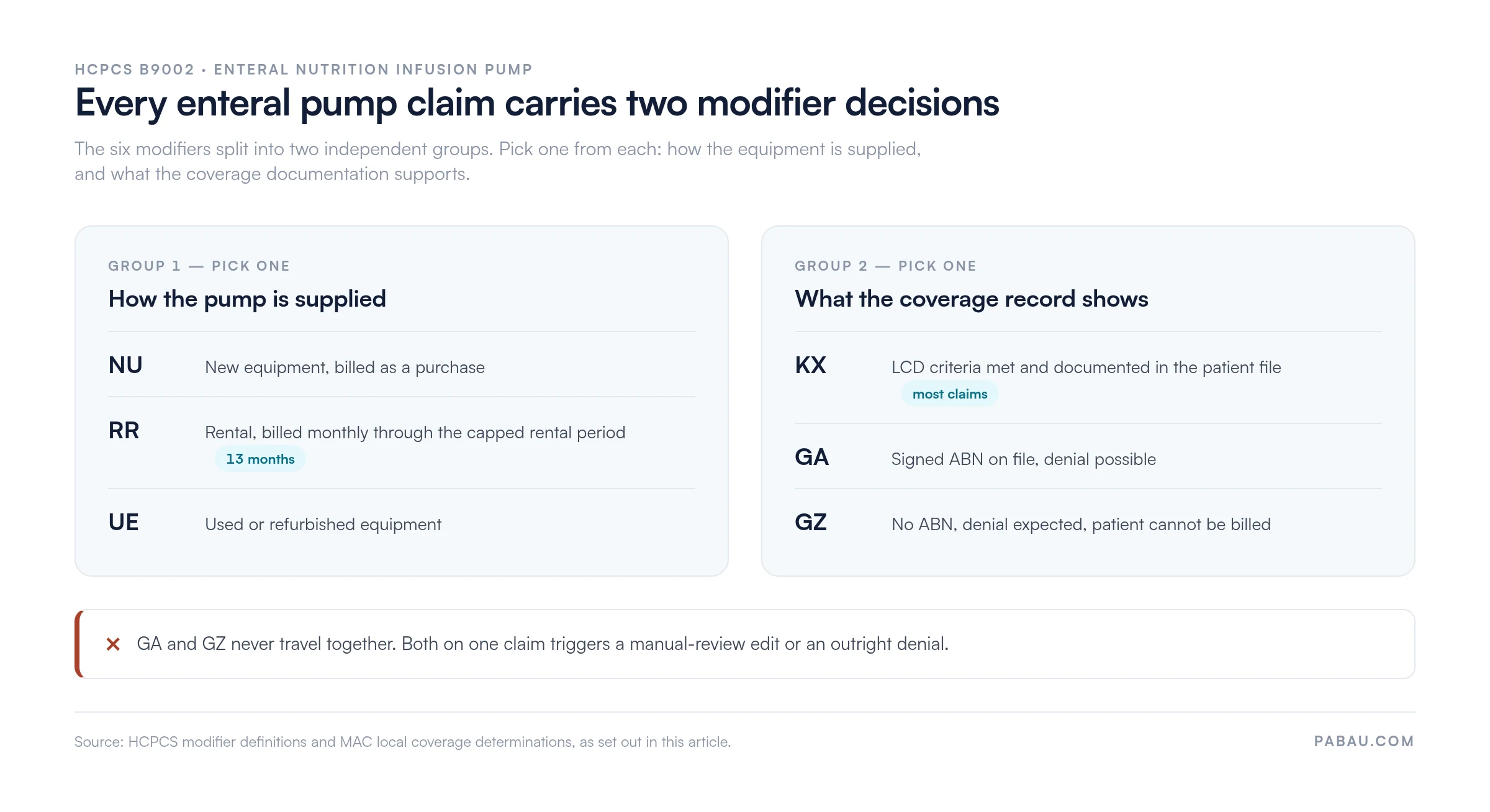
Check each modifier against your MAC’s local coverage determination before you append it to a claim. The table below gives the full definition of each one.
Using the KX modifier without satisfying the underlying LCD criteria is a false representation on a federal claim. Confirm that the patient’s file supports every modifier before submission. Ask your MAC or a certified coder when applicability is unclear.
Enteral nutrition pump claims deny at higher rates than many other DME categories. They carry several documentation touchpoints, supplier enrollment rules, and modifier logic that all have to line up. These are the most frequent failure points.
Review the denial codes guide to learn which remittance adjustment reason codes arrive with each denial. Your team can then route them correctly on receipt.
Run a quarterly audit of your active HCPCS codes against the current CMS code file. Deleted codes like B9000 often sit in billing software for years, because nobody removed them from the system’s active code list. A 30-minute audit prevents months of denial rework.
DMEPOS billing carries more moving parts than most claim types. Supplier enrollment, medical necessity documentation, proof of delivery, modifier rules, and annual code updates all have to hold together. When one of them lives in a spreadsheet or a disconnected system, denials follow.
Practice management software like Pabau brings those pieces into one place. Pabau’s software for billing teams flags outdated codes before a claim reaches the clearinghouse. It also checks documentation at the point of order and tracks each claim through to payment.
A code alert in the workflow keeps a deleted code like B9000 off a live claim. That matters most for suppliers running enteral nutrition therapy across many patients.
Cleaner claims mean faster payment cycles and less staff time spent on rework. For teams filing high volumes of enteral nutrition claims, every denial avoided is an hour handed back to the billing desk.

Pabau’s claims tools help DMEPOS suppliers track code changes, check documentation before submission, and cut rejections from outdated codes like B9000.

HCPCS Code B9000 is no longer billable. Any team still sending it on Medicare or Medicaid claims for enteral nutrition pumps is generating rejections it could avoid. The fix is one code update to B9002.
The harder part sits under the code. A claim with the right code still denies if the medical necessity notes are thin. The same goes for a missing proof of delivery or the wrong modifier. Build that check into the order, not into the appeal.
Pabau’s claims management tools flag those problems before submission. Book a demo to see how Pabau handles DMEPOS claims from the first order to the posted payment.

Need to understand how medical billing works end to end? What is medical billing breaks down the full claim lifecycle from patient encounter to payment posting.
Working through a high volume of claim denials? Denial management in healthcare covers the workflows and tools that reduce denial rates across DMEPOS and medical claims.
Want to see how revenue cycle teams reduce claim rework? What is revenue cycle management explains the end-to-end process and where software fits in.
HCPCS Code B9000 is a deleted HCPCS Level II code that described an enteral nutrition infusion pump without alarm. Medicare-enrolled DMEPOS suppliers used it to bill for home enteral nutrition therapy equipment. It is no longer billable, and B9002 has replaced it.
B9000 is deleted and cannot be submitted on any current Medicare or Medicaid claim. Claims using B9000 are rejected automatically. Suppliers must use successor code B9002 for all current enteral nutrition infusion pump billing.
B9002 replaced B9000. Its official descriptor is enteral nutrition infusion pump, any type, which consolidated two separate codes into one active descriptor. The crosswalk is direct, because B9000 maps one-to-one to B9002.
B9000 was limited to pumps without an alarm. B9002 covers enteral nutrition infusion pumps of any type. B9000 is deleted, while B9002 is active and billable. Patients moving from B9000 billing to B9002 need no clinical reclassification.
Required documentation includes a signed physician order, proof of delivery with the beneficiary’s signature, and clinical records showing the need for enteral nutrition. CMS discontinued Certificate of Medical Necessity and DIF forms for dates of service on or after January 1, 2023. The patient’s medical record now carries the medical necessity evidence.
Yes. Only Medicare-enrolled DMEPOS suppliers with a valid supplier number from the National Supplier Clearinghouse (NSC) may bill Medicare for enteral nutrition pump codes. Billing without enrollment constitutes healthcare fraud. Accreditation from a CMS-approved organization is also required.
CPT codes are maintained by the AMA and describe physician services and procedures. HCPCS Level II codes are maintained by CMS and cover items not described by CPT, including durable medical equipment, supplies, and drugs. B9000 and B9002 are HCPCS Level II codes, not CPT codes.