

CCSD code G5100: Bypass of duodenum billing guide
CCSD code G5100 bills a bypass that leaves the duodenum in place CCSD code G5100...

Last Updated: Oct 16, 2026
B4178 is the HCPCS Level II code for amino acid parenteral nutrition solution stronger than 8.5%, supplied as a home mix. Each 500 ml counts as one unit.
It reports only the amino acid part of a home mix regimen, where amino acids, dextrose, lipids and additives are dispensed separately. Weaker amino acid solutions are billed as B4168, B4172 or B4176, and dextrose has its own codes.
Let Pabau's smart automation suggest the right codes, reduce claim denials, and keep your practice compliant—effortlessly.
Automate repetitive tasks and focus on what matters most—your patients.
Reduce coding errors and ensure compliance with the latest regulations.
Clean claims, fewer denials, and faster reimbursements.
Powerful insights and reporting to help your practice thrive.
HIPAA compliant SOC 2 certified GDPR-compliant Trusted by 4,000+ clinics worldwide

HCPCS code B4178 covers parenteral nutrition amino acid solution stronger than 8.5%, supplied as a home mix and billed per 500 ml.
Amino acid strength sets the code. B4168 is 3.5%, B4172 is 5.5% through 7%, B4176 is 7% through 8.5%, and B4178 is above 8.5%.
In a home mix, dextrose, lipids and additives go on their own claim lines under B4164 or B4180, B4185 or B4187, and B4216.
Medicare covers home parenteral nutrition under the prosthetic device benefit, with coverage criteria set by LCD L38953.
For dates of service on or after July 2, 2023, every B4178 claim line needs a KX, GA, GY or GZ modifier. The DME MAC rejects a line without one as missing information.
HCPCS code B4178 is the HCPCS Level II code for parenteral nutrition amino acid solution stronger than 8.5%. It applies when that solution is supplied as part of a home mix regimen. The official descriptor reads Parenteral nutrition solution: amino acid, greater than 8.5% (500 ml = 1 unit) – home mix.
Amino acids are the protein source in parenteral nutrition. Stock solutions above 8.5% come in strengths such as 10%, 15% and 20%. They deliver more protein in less volume, which helps when a patient needs a high protein dose on a fluid limit.
In a home mix, the amino acids, dextrose, lipids and additives are dispensed as separate components. Each component carries its own HCPCS code. B4178 reports only the amino acid portion, and it is used almost entirely by home infusion suppliers and IV therapy teams.
B4178 applies to one component of a home mix regimen. Check the strength on the amino acid stock solution and how the regimen is supplied before you select it.
Included under B4178:
Not covered under B4178, so use a different code:
Medicare coverage for home parenteral nutrition now rests on the local coverage determination LCD L38953, Parenteral Nutrition. CMS retired the national coverage determination, NCD 180.2, effective January 1, 2022. Under the LCD, the patient must have one of two conditions.
The impairment must also be permanent. Under policy article A58836, that test is met when the medical record shows the impairment will be of long and indefinite duration. It does not require proof that the condition can never improve.
The treating practitioner must document that enteral nutrition was considered and ruled out, tried and found ineffective, or worsens GI dysfunction. The practitioner must also evaluate the patient within 30 days before parenteral nutrition starts.
The LCD treats 0.8 to 2.0 g/kg/day of protein and 20 to 35 cal/kg/day as reasonable and necessary. A dose outside those ranges needs its medical necessity documented in the record. High-strength amino acids are one way to reach a protein target within a limited daily volume.
Billing B4178 correctly comes down to the strength, the units and the modifier. Claims management software that checks those fields before submission cuts the manual review on every monthly claim.
One unit equals 500 ml of amino acid solution. A 1,000 ml container is two units, and a 2,000 ml container is four. Report the total volume dispensed for the claim period, converted to 500 ml units.
Count units by volume, not by infusion day. A patient on 500 ml of 15% amino acids a day for 30 days receives 15,000 ml. That is 30 units of B4178 on the claim line, with KX when the LCD criteria are met.
Policy article A58836 requires one of these modifiers for dates of service on or after July 2, 2023. A claim line without KX, GA, GY or GZ is rejected as missing information. Put one of the four on every B4178 line, every month.
Original Medicare does not run a prior authorization program for B4178. The DME MAC checks medical necessity against LCD L38953 instead, through the KX attestation and on medical review.
Medicare Advantage and commercial plans often require prior authorization for home parenteral nutrition. Confirm each plan’s rules before the first delivery, and keep the approval with the order.
Every B4178 claim must be backed by a complete record before it goes out. Good medical billing compliance practice means keeping these documents in the patient record, not gathering them after a request arrives.
The DME Information Form (CMS-10126) is no longer required for dates of service on or after January 1, 2023. Older checklists may still list it, so update yours to match the current policy article.
Among the Level II HCPCS codes, B4178 sits at the top of the four home mix amino acid codes. Strength sets the code within that group, while dextrose has two codes of its own split at 50%. The chart below shows that ladder and the other lines a home mix claim carries.
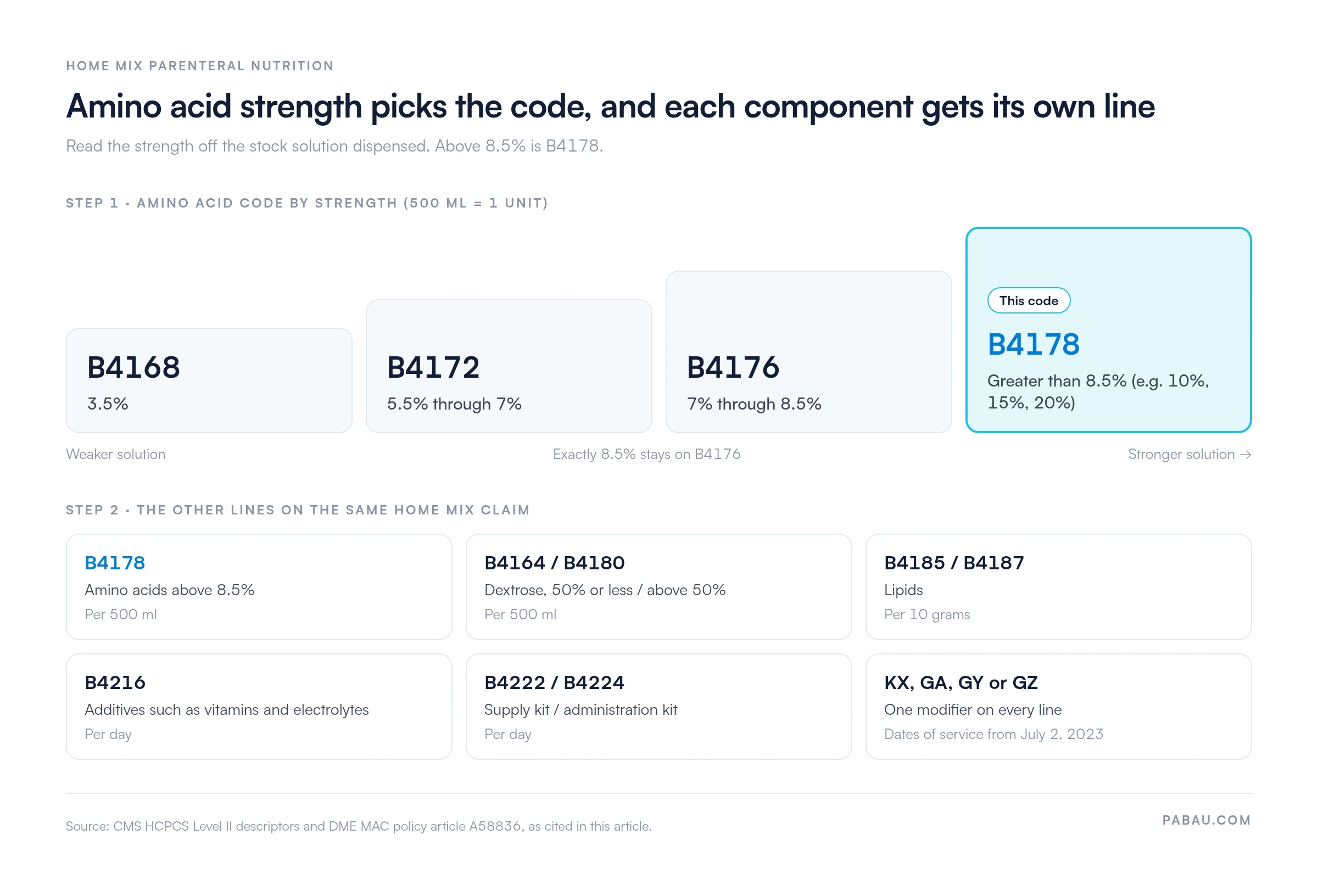
Read the strength off the amino acid product as dispensed. A solution at exactly 8.5% is B4176, while anything above 8.5% is B4178.
Most B4178 problems are preventable. Sound denial management in healthcare for parenteral nutrition starts with the few errors that recur month after month.
A clean claim for B4178 has the correct strength code, a unit count built from volume and a modifier on every line. It also has the order and delivery records on file before billing.
When a B4178 line comes back, check the modifier first, then the strength on the delivery record. Those two fields account for most corrections on home mix amino acid claims. Fix the record behind the line before you resubmit.
Medicare pays B4178 from the CMS DMEPOS fee schedule, which CMS updates each January with quarterly revisions. Look up the current allowable for your state in the fee schedule files. A published figure can be out of date by the next update.
After the Part B deductible, Medicare pays 80% of the allowed amount. The patient or a secondary payer covers the remaining 20%.
DME suppliers bill B4178 to the DME MAC on the professional claim, which has no revenue code field. Medicaid and commercial plans set their own rates and rules for home parenteral nutrition, so check each plan’s policy before billing.
A home mix month rarely carries B4178 alone. These are the codes most often billed with it for the same patient.
Build the claim from the order, one component at a time. A home mix month can carry six or more lines, from dextrose and amino acids to the supply kit. Each line needs its own modifier.
A single B4178 claim draws on several people’s records. The order sits with the prescriber, the nutrition assessment with the dietitian, and the delivery records with the pharmacy. Billing staff then convert volumes into units by hand, every month.
Pabau, the practice management platform we build, keeps the order, clinical notes and billing in one patient record. Its claims management software builds each claim from that record. The amino acid units then match the order before the claim goes out.
Claim status and rejections are tracked in the same place. When a line comes back, your team fixes the record behind it and resubmits without rebuilding the claim. You spend less time chasing monthly claims and more time on patient care.

Pabau’s claims management tools keep orders, records and HCPCS lines like B4178 in one place. Your team spends less time fixing rejections and more time on patients.

B4178 is one of the easier B-series codes to choose, because the label on the stock solution decides it. Rejections tend to come from the lines around it instead. Units get counted by day, a modifier goes missing, or a component lands on the wrong line.
If your team bills home parenteral nutrition every month, build a pre-submission check around three points. Those are the strength match, the 500 ml unit conversion and the modifier on each line. That check takes minutes per claim, while one rejection can hold up a full month of payment.
Book a demo to see how Pabau links orders, records and parenteral nutrition claims for home infusion teams.

Need a structured approach to managing claim denials? Denial management strategies for healthcare practices covers the full workflow from remittance review to appeal submission.
Want to understand how HCPCS fits into the broader billing picture? What is medical billing? explains the end-to-end revenue cycle context for codes like B4178.
Looking to improve first-pass claim rates? Clean claim submission guide walks through the pre-submission checklist that prevents the most common DMEPOS errors.
HCPCS code B4178 is the Level II code for parenteral nutrition amino acid solution greater than 8.5%, supplied as a home mix. One unit equals 500 ml. Medicare covers it under the prosthetic device benefit when the LCD L38953 criteria are met.
B4176 covers amino acid solution from 7% through 8.5%, and B4178 covers any strength above 8.5%. Both are home mix codes billed per 500 ml. A 10% or 15% amino acid product therefore goes to B4178.
No. B4178 is an amino acid code. Dextrose in a home mix is billed as B4164 at 50% or less, or B4180 above 50%. No code in the B4164 to B4180 series splits dextrose any finer than that.
You need a Standard Written Order on file before you bill, plus proof of delivery. The record must show a qualifying absorption or motility condition and that the impairment is permanent. It must also show that enteral nutrition was ruled out, tried without success, or worsens GI dysfunction. The treating practitioner must evaluate the patient within 30 days before parenteral nutrition starts.
Use KX when every coverage criterion in LCD L38953 is met. When criteria are not met, use GA with a valid ABN on file and GZ without one. GY marks a statutorily non-covered item. For dates of service on or after July 2, 2023, a line without one of these four is rejected as missing information.
No. The parenteral nutrition DME Information Form (CMS-10126) is not required for dates of service on or after January 1, 2023. The Standard Written Order and the medical record now carry the coverage evidence.
Not on a typical claim. DME suppliers bill B4178 to the DME MAC on the professional claim, which has no revenue code field. A revenue code only applies when a facility bills parenteral nutrition on an institutional claim, under that payer’s own rules.



