CPT code 93503: Swan-Ganz catheter billing and modifiers
CPT code 93503: Official descriptor and procedure overview In the AMA CPT code s...

Last Updated: Oct 23, 2026
B4199 is the HCPCS Level II code for premixed parenteral nutrition when the ordered protein dose is over 100 grams per day. The compounded solution contains amino acids, carbohydrates, electrolytes, trace elements, and vitamins, and the code includes preparation.
It is the top tier of the premix protein codes, above B4197 at 74 to 100 grams. One unit is one day's supply, whatever the volume or bag count. Claims go to the DME MAC with the KX modifier when LCD L38953 criteria are met.
Let Pabau's smart automation suggest the right codes, reduce claim denials, and keep your practice compliant—effortlessly.
Automate repetitive tasks and focus on what matters most—your patients.
Reduce coding errors and ensure compliance with the latest regulations.
Clean claims, fewer denials, and faster reimbursements.
Powerful insights and reporting to help your practice thrive.
HIPAA compliant SOC 2 certified GDPR-compliant Trusted by 4,000+ clinics worldwide

B4199 is a premix parenteral nutrition code. It applies when the ordered protein dose is over 100 grams per day.
It is the top tier of four per-day premix codes, above B4189, B4193, and B4197. Orders under 10 grams a day go to B9999.
One unit is one day’s supply, whatever the fluid volume or the number of bags.
The January 2026 Medicare PEN fee schedule lists B4199 at $472.87 per day. That is $59.04 a day more than B4197.
Medicare claims rest on a standard written order, LCD L38953 records, proof of delivery, and the KX modifier. CMS retired the DIF in 2023.
Pabau, our practice software, keeps the order, the clinical notes, and the claim in one patient record. Billers can check the gram dose before submitting.
HCPCS code B4199 is the Level II billing code for premixed parenteral nutrition when the ordered protein dose is over 100 grams per day. The pharmacy compounds the solution from amino acids and carbohydrates, with electrolytes, trace elements, and vitamins included. It sits in the CMS HCPCS Level II B-series and is billed to the DME MAC.
Two words in the descriptor shape the billing. “Premix” means the solution arrives fully compounded, so its components never appear as separate claim lines. “Including preparation” puts the compounding work inside the B4199 rate.
B4199 is not a miscellaneous or not otherwise classified code. It has a fixed descriptor and a national fee schedule amount. The not otherwise classified code in this family is B9999, which Policy Article A58836 uses for solutions under 10 grams of protein a day.
The four per-day premix codes split by the grams of protein ordered per day. B4199 has no upper limit, so every premix order above 100 grams lands here. The table maps the tiers and the neighboring codes billers confuse with them, using the January 2026 PEN fee schedule.
The boundaries are exact. A 100 gram order belongs to B4197, so billing B4199 at that dose overbills by $59.04 a day. A 101 gram order belongs to B4199, and billing B4193 or another lower tier leaves money unclaimed.
B4216 never belongs on a B4199 claim. It codes the additives in a home-mix regimen, and premix solutions already include them. Renal, hepatic, and stress formulas have their own premix codes, B5000, B5100, and B5200, billed per gram of amino acid.
Policy Article A58836 sets the bundling rule for every premix code. Once B4199 is billed, the components inside the solution cannot be billed again on separate lines.
A separate line for B4216, vitamins, or electrolytes next to B4199 is unbundling. Lipids are the one nutrient exception, so 500 ml of 20% lipids bills as 10 units of B4185 or B4187.
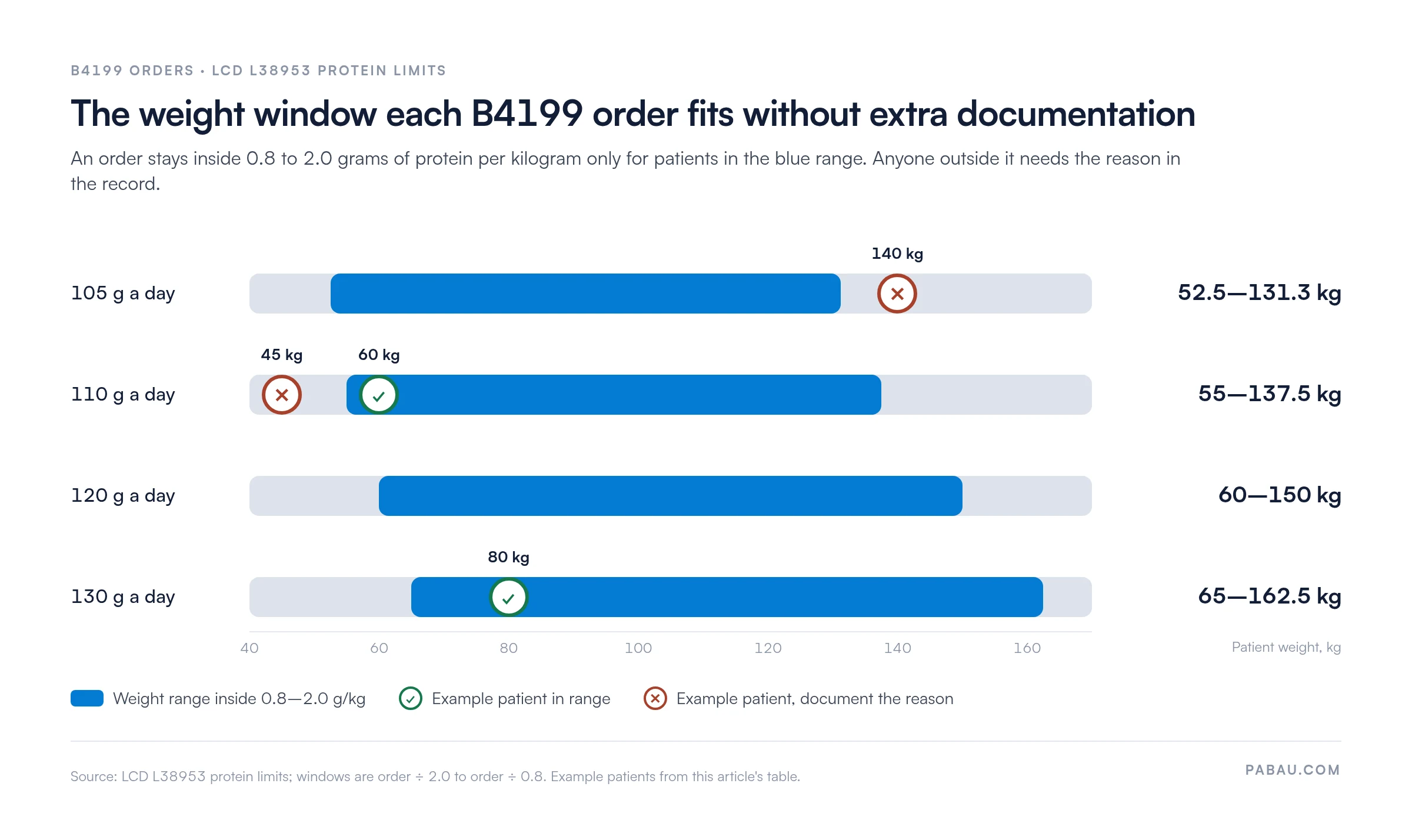
LCD L38953 requires extra documentation for any protein order outside 0.8 to 2.0 grams per kilogram per day. Because B4199 starts above 100 grams, the patient’s weight decides which side of that line an order falls on.
At the 2.0 gram ceiling, an order just over 100 grams stays in range only for a patient above 50 kilograms. A lighter patient on a B4199 dose needs the clinical reason written into the record.
Read the other way, the same limits give every B4199 order a weight window. A patient inside it needs no extra justification, and a patient outside it needs a written reason.
Calories follow the same pattern. The LCD treats 20 to 35 calories per kilogram per day as reasonable and necessary. Intake outside that range needs documented medical necessity for the individual patient.
Medicare covers parenteral nutrition under the prosthetic device benefit when the patient meets LCD L38953. Enteral nutrition is usually tried first, so the record has to show why it will not work.
Two contractors process B4199 claims across the four DME MAC jurisdictions. Noridian runs Jurisdictions A and D, and CGS Administrators runs B and C. Route each claim by the state where the beneficiary permanently resides.
Part B pays nothing for parenteral nutrition during a Part A covered stay. In that case the skilled nursing facility bills the solution through its own Part A claim.
Neither LCD L38953 nor Policy Article A58836 sets a prior authorization step for Medicare parenteral nutrition. The supplier attests to coverage on the claim with KX, and reviewers test that attestation against the records later.
Medicaid programs and commercial plans set their own rules, and some require prior authorization for B4199. When a supplier expects Medicare to deny a line as not reasonable and necessary, a signed Advance Beneficiary Notice lets it bill the patient instead.
CMS no longer uses a form to certify parenteral nutrition. The DME information form, CMS-10126, was retired for dates of service on or after January 1, 2023, as CGS confirms. Claims sent with one attached are rejected, and four records carry the claim instead.
Records that tie the dose to measured need make the file stronger. A dietitian assessment of weight, calorie needs, and protein needs does that directly, and progress notes support continued therapy.
Record the patient’s current weight next to the ordered grams of protein. A reviewer divides one by the other. An order above 2.0 grams per kilogram with no stated reason fails the LCD check.
LCD L38953 and Policy Article A58836 publish no list of covered diagnosis codes. Medical necessity rests on the record, so the codes below are examples rather than a list that guarantees payment. Check each code’s full descriptor and coding notes in the ICD-10-CM code library before you pair it with B4199.
K90.821 and K90.83 carry an Excludes1 note for malabsorption after GI surgery, which is coded to K91.2 instead. The notes should still name the condition, describe how it impairs absorption, and explain why enteral nutrition failed.
Policy Article A58836 requires a coverage modifier on every parenteral nutrition line. A B4199 line without KX, GA, GZ, or GY is rejected as missing information.
Units above the treating practitioner’s order get separate treatment. Since January 1, 2023, suppliers calculate units from the order, and excess units must not carry KX. Bill those units with GA or GZ instead.
CMS prices B4199 per day on the Parenteral and Enteral Nutrition (PEN) fee schedule. The January 2026 file lists $472.87 per unit, the same amount in every state. Check the current quarter’s file before you bill.
Medicare pays 80% of the allowed amount after the Part B deductible. The patient or a secondary payer covers the 20% coinsurance.
Units follow the calendar. A 30 day supply at 120 grams of protein a day is 30 units of B4199, whatever the bag count. At the January 2026 rate, that month is allowed at $14,186.10 before coinsurance.
Before a B4199 claim goes out, check that the order says more than 100 grams. An order that reads exactly 100 grams supports B4197, and the $59.04 daily difference becomes an overpayment on review.
Each denial below starts with a missing number or document that can be fixed before submission.
For a wider framework on rejections, the denial management guide covers appeal workflows and root-cause analysis. Modifier placement and diagnosis pairing are covered in the clean claim reference.
The records behind a B4199 claim rarely sit together. The written order arrives in one inbox, the weight lives in the chart, and the delivery record sits with the pharmacy. Nobody divides grams by kilograms until a reviewer asks.
With Pabau’s claims management software, the order, the clinical notes, and the claim share one patient record. Billing staff can read the ordered grams and the current weight, then confirm the premix tier before the claim leaves the practice.
The result is fewer claims sent with a document missing, and a file that is ready when a reviewer asks for it. For a team billing high-protein regimens, that shows up as fewer recoupments.

Pabau keeps the written order, the clinical notes, and the claim in one patient record. Your billing team can confirm the B4199 tier before submitting.

Two numbers decide a B4199 claim. The ordered protein must exceed 100 grams a day, and the unit count equals the number of covered days.
Orders at this dose also sit closest to the LCD’s 2.0 grams per kilogram ceiling. Weight on file is therefore as important as the order itself.
Put the gram dose and the weight on every order, count units by the day, and keep the order and delivery record with the claim. Book a demo to see how Pabau keeps orders, notes, and claims together for parenteral nutrition billing.

Ordering 74 to 100 grams of protein a day? HCPCS code B4197 covers the premix tier directly below B4199.
Ordering 52 to 73 grams of protein a day? HCPCS code B4193 explains the same per-day unit rule for the middle tier.
Billing a home-mix regimen instead? HCPCS code B4216 covers the additives billed with home-mix solutions.
Coding a solution under 10 grams of protein? HCPCS code B9999 covers the miscellaneous parenteral code.
Need to understand denial patterns across codes? Denial management in healthcare covers root-cause analysis and appeals for DMEPOS claims.
HCPCS code B4199 covers a premixed parenteral nutrition solution for patients who need over 100 grams of protein per day. The compounded solution contains amino acids, carbohydrates, electrolytes, trace elements, and vitamins, and the code includes preparation. It is billed per day to the DME MAC under the Medicare prosthetic device benefit.
No. B4199 has a fixed descriptor and a national fee on the PEN fee schedule. It is the top tier of the premix protein codes. The not otherwise classified code for parenteral supplies is B9999, which Policy Article A58836 uses for solutions under 10 grams of protein a day.
One unit covers one day’s supply of protein and carbohydrate, whatever the fluid volume or the number of bags. Bill the number of covered days in the billing period. A 30 day supply at 120 grams a day is 30 units.
The January 2026 PEN fee schedule lists B4199 at $472.87 per day, the same amount in every state. Medicare pays 80% of the allowed amount after the Part B deductible. Check the current quarter’s file on the CMS DMEPOS fee schedule page before billing.
Lipid emulsion is billed on its own line, under B4185 or B4187, at one unit per 10 grams of lipids. The infusion pump and the daily supply allowance have their own codes too. Amino acids, carbohydrates, vitamins, trace elements, heparin, and electrolytes are bundled, so B4216 is never billed with a premix.
No. CMS retired the DME information form, CMS-10126, for dates of service on or after January 1, 2023. A B4199 claim now rests on the standard written order, the LCD L38953 records, proof of delivery, and the KX modifier. Some Medicaid and commercial plans require prior authorization, so check each plan’s policy.
The order reads 100 grams or less, which belongs to B4197. Units were counted from bags rather than days. The written order or delivery record is missing, or KX was appended without support. An order above 2.0 grams per kilogram with no recorded reason also fails review.