

CCSD code G5100: Bypass of duodenum billing guide
CCSD code G5100 bills a bypass that leaves the duodenum in place CCSD code G5100...

Last Updated: Oct 16, 2026
A4932 is the HCPCS Level II code for a rectal thermometer, reusable, any type, each. It covers one reusable rectal thermometer dispensed to a patient, whatever its design.
Medicare gives A4932 coverage code C, so the contractor decides coverage case by case, and the code is carrier priced. A thermometer used during an office visit isn't billed separately. The most common error is reporting A4931, the reusable oral thermometer, instead.
Let Pabau's smart automation suggest the right codes, reduce claim denials, and keep your practice compliant—effortlessly.
Automate repetitive tasks and focus on what matters most—your patients.
Reduce coding errors and ensure compliance with the latest regulations.
Clean claims, fewer denials, and faster reimbursements.
Powerful insights and reporting to help your practice thrive.
HIPAA compliant SOC 2 certified GDPR-compliant Trusted by 4,000+ clinics worldwide

HCPCS code A4932 reports one reusable rectal thermometer of any type, billed per unit under the descriptor “Rectal thermometer, reusable, any type, each.”
Medicare assigns A4932 coverage code C and carrier pricing, so the contractor decides both coverage and the allowable on each claim.
A thermometer used during an office visit is practice equipment, so A4932 belongs only on a thermometer the patient takes home.
Most A4932 errors come from swapping it with A4931, the reusable oral thermometer, or billing a thermometer the visit payment already covers.
HCPCS code A4932 covers one reusable rectal thermometer, of any type, dispensed to a patient. The Centers for Medicare and Medicaid Services (CMS) lists it among the HCPCS Level II codes it maintains.
The long descriptor reads “Rectal thermometer, reusable, any type, each,” and the short descriptor is “Reusable rectal thermometer.” “Reusable” and “any type” do most of the work in that wording. The device is meant for repeated use, and the code stays the same whatever the thermometer’s design.
Those exclusions come down to three questions, and the decision path below runs them in the order a biller meets them.
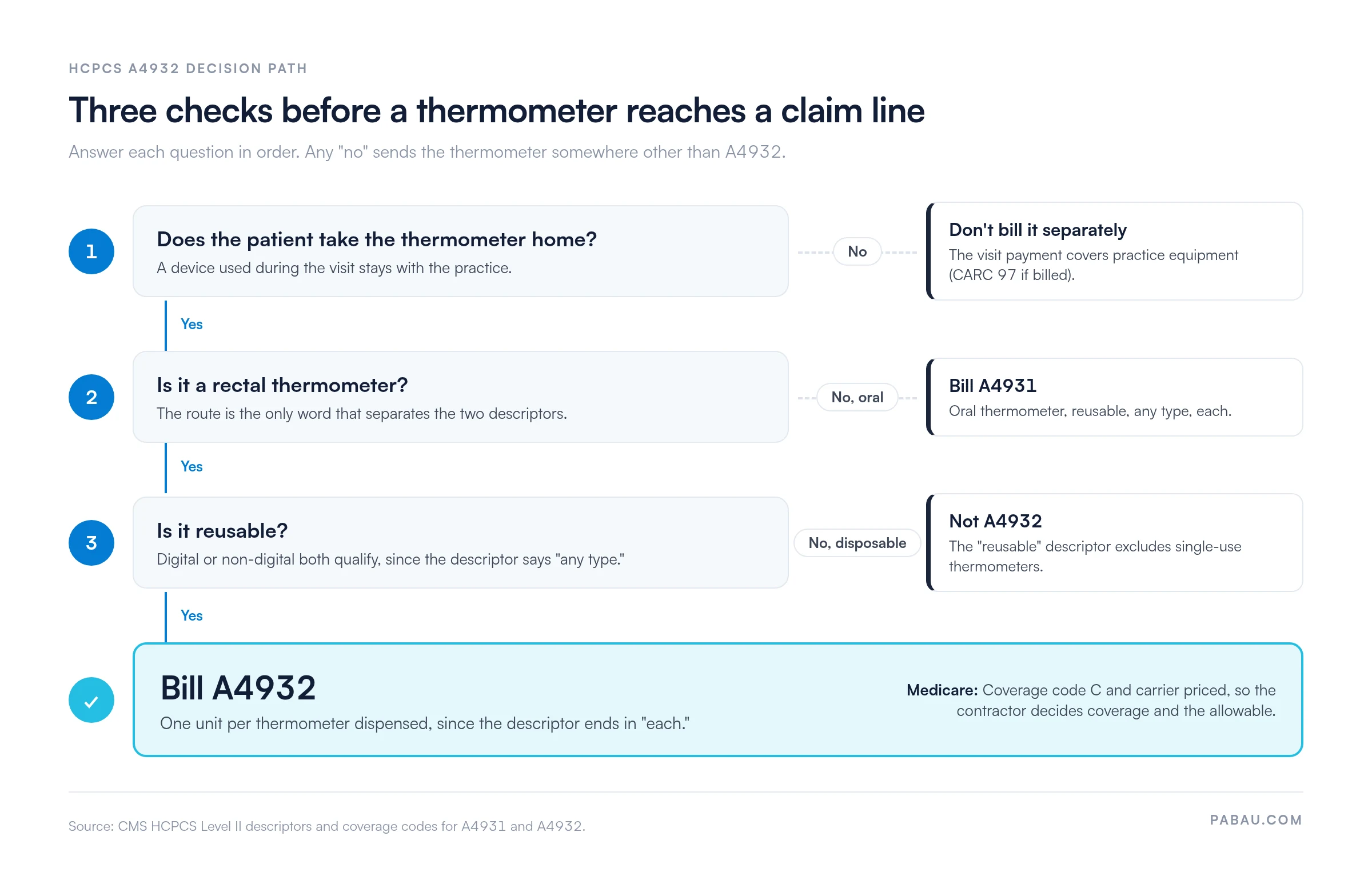
The range heading can mislead. Code lookups such as AAPC file A4932 at the end of the A4653-A4932 dialysis equipment and supplies range. Its descriptor names no dialysis condition, so code it on the device dispensed rather than on the range heading.
A4932 and HCPCS code A4931 share every word of their descriptors except the route. Pick the code from the thermometer you hand the patient. If the order and the device don’t match, clarify the order before you bill.
Medicare sets no automatic coverage for HCPCS code A4932. The CMS HCPCS file assigns it coverage code C, so the Medicare contractor decides coverage case by case.
The code is also carrier priced. No national payment amount applies, so the contractor sets the allowable when it pays the line.
Setting decides whether a claim makes sense at all. Taking a temperature during an office visit is part of that visit, and the visit payment covers the equipment. A4932 fits only when a thermometer is dispensed for the patient to keep.
Before you submit, check which contractor takes the claim in the DMEPOS HCPCS jurisdiction list that the DME MACs publish. Then read that contractor’s guidance rather than assuming the line will pay.
Medicaid programs set their own supply coverage, so A4932 may be covered in one state and excluded in the next. Check your state Medicaid fee schedule for the code before you dispense. Get prior authorization wherever the program asks for it.
Commercial plans follow their own medical policies. Some may treat a home thermometer as a personal convenience item rather than a medical supply. Check the plan’s supply or DME benefit before the patient leaves with the device.
Because coverage is decided case by case, the record has to show why the patient needs a rectal thermometer at home. Keep these items on file for each claim.
A clean A4932 claim depends on six fields. Pabau’s claims management software can flag a missing field before submission, which supports clean claim submission on the first pass.
Check the contractor’s guidance for any modifier it requires on supply lines. The three below cover the cases where you expect Medicare not to pay.
Most A4932 denials trace back to setting, coverage or missing claim details. Effective denial management starts before submission. The table pairs each cause with its claim adjustment reason code (CARC) and the fix.
A swap between A4931 and A4932 may pay at first and surface later. It shows up when an audit compares the dispensing record with the billed code.
Medicare offers five levels of appeal for a denied claim. Most A4932 appeals turn on documentation, so send the order, the medical-need note and the dispensing record at the first level.
Keep the reusable thermometers in your exam rooms out of the supply billing workflow. Tag them as practice equipment in your inventory, so only a thermometer handed to a patient can reach a claim line as A4932.
Many practices track dispensed supplies on paper or in a spreadsheet, apart from the patient record. A thermometer handed over at checkout then never reaches the claim, or it lands on the wrong code.
Pabau, the practice management platform we build, records the dispensed item, the order and the diagnosis against the same patient. Billing teams can review the supply line before the claim goes out and follow it through to payment. The result is fewer avoidable denials and less rework.

Pabau keeps orders, dispensing records and diagnoses together for each patient, so supply claims like A4932 go out complete.

Bill A4932 only when a patient leaves with a reusable rectal thermometer. A thermometer that stays in your exam room belongs to the visit, and a separate line just invites a bundling denial.
With coverage code C and carrier pricing, no national rule says whether the claim pays. A clear order, a supporting diagnosis and the correct code for the route give the contractor what it needs to decide.
Pabau’s claims management workflows keep the order, the dispensing record and the claim together for each patient. Book a demo to see how Pabau keeps supply claims complete before they go out.

New to the claim lifecycle? What is medical billing walks through the end-to-end claim lifecycle from patient eligibility through payment posting.
Dealing with persistent claim rejections? Denial management in healthcare covers root-cause analysis frameworks and how to build a denial-prevention workflow.
Want to reduce rework on first-pass submissions? Clean claim submission explains the edit checks and field-level requirements that determine whether a claim pays on first submission.
Dispensing an oral thermometer instead? HCPCS code A4931 covers the reusable oral thermometer, with the same coverage and documentation rules.
Billing supplies to Medicare? Medicare billing explains contractors, claim forms and the rules that decide whether a supply line pays.
HCPCS code A4932 covers one reusable rectal thermometer of any type, billed per unit. It applies when a thermometer is dispensed to the patient, not when the practice uses its own thermometer during a visit.
Medicare decides A4932 coverage case by case. The CMS HCPCS file gives it coverage code C, so the contractor reviews each claim. The code is carrier priced rather than paid at a national rate.
A4931 is a reusable oral thermometer, and A4932 is a reusable rectal thermometer. Both descriptors end “reusable, any type, each,” so the route of the device you dispense decides the code.
No. Taking a temperature during a visit is part of that visit, and its payment covers the practice’s equipment. Bill A4932 only for a thermometer the patient takes home.
Keep a dated order, a note on why rectal readings are needed at home, and a supporting ICD-10-CM diagnosis. Add the dispensing record, proof of delivery for supplier claims, and any signed ABN.
Code lookups such as AAPC place A4932 at the end of the A4653-A4932 dialysis equipment and supplies range. The descriptor names no dialysis condition, so code it on the thermometer dispensed.



