HCPCS Code L0472: Hyperextension TLSO billing guide
HCPCS code L0472: Official descriptor and device definition HCPCS code L0472 des...

Last Updated: Nov 5, 2026
A4773 is the HCPCS Level II code for occult blood test strips, for dialysis, per 50. One unit covers 50 strips, and the code applies only to strips used in dialysis monitoring.
Dialysis billing teams most often trip over A4773 by confusing it with its neighbor A4772. That code covers blood glucose strips for the same setting and the same unit size. The one-digit difference is a common cause of wrong-code rejections. A4773 is also on the CMS ESRD PPS consolidated billing list, so a dialysis facility's supply is paid in its bundled rate.
Let Pabau's smart automation suggest the right codes, reduce claim denials, and keep your practice compliant—effortlessly.
Automate repetitive tasks and focus on what matters most—your patients.
Reduce coding errors and ensure compliance with the latest regulations.
Clean claims, fewer denials, and faster reimbursements.
Powerful insights and reporting to help your practice thrive.
HIPAA compliant SOC 2 certified GDPR-compliant Trusted by 4,000+ clinics worldwide

HCPCS code A4773 covers occult blood test strips used in dialysis, billed per 50 strips rather than per individual strip.
A4772 is the neighboring code for blood glucose test strips for dialysis, with the same unit but a different clinical purpose.
A4773 is on the CMS 2026 ESRD PPS consolidated billing list, so a dialysis facility’s supply is paid in its bundled rate.
Pabau, the practice management platform we build, raises claims from the patient’s invoice and checks them for missing details before submission.
HCPCS code A4773 is a Level II alphanumeric supply code in the Healthcare Common Procedure Coding System. The Centers for Medicare and Medicaid Services (CMS) maintains it. The official descriptor is: Occult blood test strips, for dialysis, per 50.
That descriptor contains three billing-critical qualifiers: the strip type (occult blood, not glucose), the clinical setting (dialysis), and the unit of measure (per 50 strips). All three must be reflected in the claim and supporting documentation. For patients on dialysis, Medicare pays the strips inside the facility’s bundled ESRD PPS rate rather than as a separate line.
Occult blood test strips under A4773 detect hidden blood in dialysate fluid or patient specimens during hemodialysis monitoring. Dialysis nurses use guaiac-based or similar chemical strip tests to check whether blood is contaminating the dialysate. Blood there can indicate a membrane breach or circuit leak.
Early detection matters because undetected blood loss during a dialysis session carries serious patient safety risks.
The code applies only to strips used in dialysis monitoring, not to any other occult blood testing. Billing teams should confirm all three scope conditions before submitting a claim under HCPCS code A4773:
Several common billing mistakes stem from applying A4773 outside its intended scope. The code does not cover:
The ESRD bundling rule is the most consequential exclusion. CMS updates the consolidated billing list each calendar year, so dialysis billing teams should still recheck it every January.
A4773 and A4772 are easy to confuse in dialysis supply billing. Both are HCPCS Level II A-series codes, both bill per 50 units, and both apply to the dialysis setting. The difference is the strip type and its clinical function.
Getting the wrong code on a claim triggers a denial that requires manual correction and resubmission, which costs staff time on every occurrence.
The practical rule: if the strip detects blood in the circuit, use A4773. If the strip measures the patient’s blood glucose, use A4772. Documenting the strip type and its clinical purpose in the patient dialysis record prevents wrong-code denials before the claim is submitted.
The chart below adds A4774, the third strip code in the same family, and the payment check that follows the code choice.
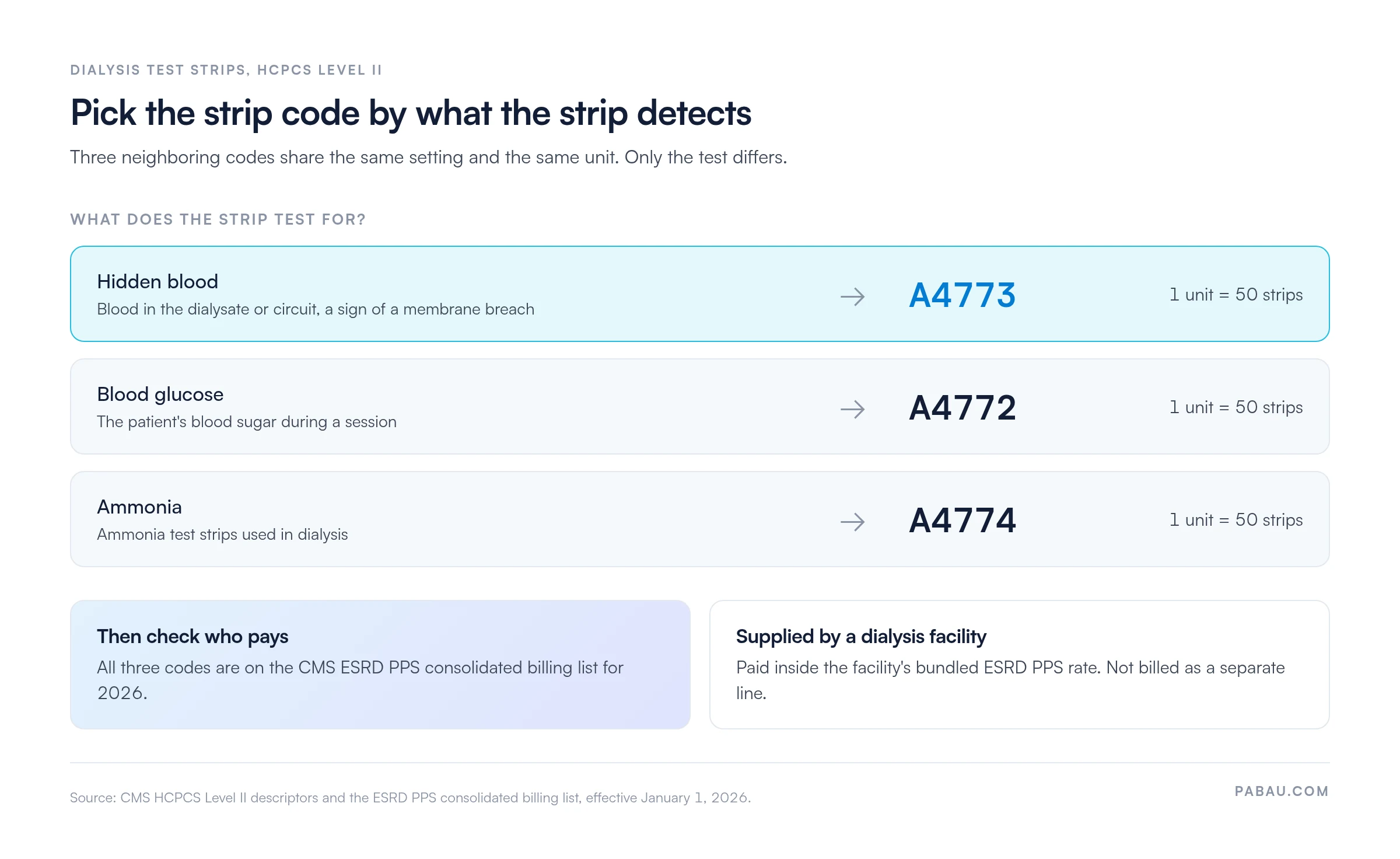
Medicare covers the strips billed under HCPCS code A4773 through its ESRD benefit. A4773 is on the CMS ESRD PPS consolidated billing list for 2026. When a renal dialysis facility supplies the strips, Medicare pays for them in the facility’s bundled rate. They are not separately billable by the facility or by any other supplier for that patient.
A4773 is a DMEPOS and ESRD supply code with no separate facility payment. Where a payer does pay it separately, the rate comes from the DMEPOS fee schedule. CMS updates those amounts each year, and they vary by state, so this article does not quote a dollar figure.
Two coverage caveats apply to Medicare billing for A4773:
Medicaid coverage (including Medi-Cal in California) varies by state. State Medicaid programs publish their own fee schedules and coverage criteria for HCPCS supply codes. Dialysis billing teams working with Medicaid patients should verify A4773 coverage and rates through the applicable state Medicaid fee schedule.
Recheck the CMS ESRD PPS consolidated billing list each January before you change how you bill A4773. The 2026 list includes A4773. While the code stays on the list, a separate Medicare claim for a dialysis patient creates an overpayment that triggers a recoupment demand.
Accurate billing for HCPCS code A4773 requires the right unit count, correct diagnosis codes, and a complete documentation record. Missing any element is the fastest route to a medical necessity denial. Pabau’s claims management software keeps the invoice, the claim and the patient record in one system, so the documentation sits next to each claim.
A4773 is billed per 50 occult blood test strips. One unit on the claim equals 50 strips dispensed or consumed. If 100 strips were used, bill two units. Never bill per individual strip; the payer’s system will reject or down-code a claim where the unit quantity does not align with the per-50 structure.
A4773 must be paired with a diagnosis code that supports medical necessity. The most commonly paired ICD-10-CM codes for dialysis supply claims include:
Check the payer’s coverage guidelines to confirm which diagnosis codes they accept in conjunction with A4773. Some Medicare Administrative Contractors (MACs) publish Local Coverage Determinations (LCDs) for dialysis supplies that specify accepted diagnosis codes.
Every A4773 claim should be supported by the following documentation, kept on file and available for audit:
Good medical billing compliance practice means retaining all supporting documentation for a minimum of seven years, consistent with Medicare medical record retention requirements.
Traditional Medicare (fee-for-service) does not require prior authorization for HCPCS code A4773. For patients on dialysis, the strips are paid inside the facility’s bundled ESRD PPS rate, so there is no separate supply claim to authorize.
Medicare Advantage and commercial payers operate differently. Prior authorization requirements vary by plan and contract year. Some managed care plans require PA for dialysis supply codes, including A4773, particularly when claims exceed expected quantity thresholds.
Before submitting A4773 claims to a Medicare Advantage or commercial plan, check whether PA is required. The payer’s provider manual or provider services line will confirm it.
When a payer does require prior authorization for A4773, the documentation package typically includes the physician order and evidence of ESRD diagnosis. It also carries the dialysis monitoring protocol and a short clinical justification for the strip quantity requested. Keep a copy of any approved PA on file alongside the claim.
Most A4773 denials fall into a small number of repeatable categories. Understanding why each denial occurs makes it possible to prevent them at the coding and documentation stage rather than resolving them on the back end. Effective denial management starts before the claim leaves the practice.
For denials that do occur, review the denial reason codes returned on the remittance advice before appealing. Each CARC (Claim Adjustment Reason Code) points to the specific reason for denial and guides the correction needed on the resubmission. Always address the root cause before resubmitting. A corrected claim that repeats the original error will deny again.
Dialysis billing teams typically work with several HCPCS Level II supply codes alongside A4773. Knowing the neighboring codes reduces wrong-code errors. The closest is A4774, which covers ammonia test strips for dialysis, also billed per 50.
A full HCPCS reference is available through the AAPC HCPCS code lookup and the PGM Billing HCPCS lookup tool.
An organized approach to dialysis supply billing starts with clean claims. Reviewing the principles of a clean claim submission before you submit supply codes reduces payer-side edits and processing delays.
Build an internal quick-reference card pairing each dialysis strip type with its HCPCS code, and post it at the charge-entry workstation. Occult blood strips bill as A4773, blood glucose strips as A4772, and ammonia strips as A4774. A one-page reference stops the most common wrong-code denial before it reaches the payer.
Many billing teams pick between A4772, A4773 and A4774 from memory at charge entry. A slip then shows up on the remittance advice weeks later, and each fix means pulling the record, correcting the code and resubmitting.
Pabau raises each claim from the patient’s invoice, so the supply line, the units and the diagnosis code travel together. Its claim validation scrubs every claim for missing or invalid details before it leaves the system. A rejected claim is flagged Needs action, with a link straight to the field that needs correcting.
Where a Medicare Advantage or commercial plan requires prior authorization, Pabau stores the approval as a case on the appointment. The authorization code then follows the appointment through to the claim.

Pabau raises claims from the patient’s invoice and scrubs each one for missing or invalid details, so dialysis supply codes reach the payer complete.

Treat A4773 as a two-question code. First, confirm the strip detects blood rather than glucose or ammonia. Then confirm who pays, because a dialysis facility’s supply sits inside the ESRD PPS bundle.
Build both checks into charge entry instead of catching them at the denial stage. A strip-type field in the usage log and a yearly look at the consolidated billing list take minutes. A recoupment demand for a year of separate A4773 claims takes far longer to unwind.
Book a demo to see how Pabau checks each dialysis supply claim for missing details before it reaches the payer.

Billing the glucose strips as well? HCPCS code A4772 covers blood glucose test strips for dialysis and how to keep them apart from A4773.
Using ammonia strips in the same unit? HCPCS code A4774 explains the third dialysis strip code and its per-50 billing.
Need to understand denial codes on your remittance advice? Denial codes in medical billing explains the most common CARC codes and how to respond to each one.
Want a broader overview of HCPCS supply code billing? What is medical billing covers the end-to-end claims cycle for specialty practices.
Looking to reduce claim rejections across your HCPCS codes? Medical billing compliance outlines the documentation and process standards that reduce denial rates.
HCPCS code A4773 covers occult blood test strips used in dialysis settings, billed per 50 strips. The strips detect hidden blood contamination in dialysate fluid or patient specimens during hemodialysis monitoring. The code does not apply to blood glucose strips, fecal occult blood screening outside dialysis, or any non-dialysis clinical setting.
A4772 covers blood glucose test strips for dialysis, and A4773 covers occult blood test strips for dialysis. Both apply to dialysis facilities and both bill per 50, but they serve different clinical functions. Using one when the other strip was dispensed results in a wrong-code denial that needs manual correction and resubmission.
Traditional Medicare does not require prior authorization for A4773 as a standard rule. Medicare Advantage and commercial payers may require prior authorization depending on the plan and contract year. Always verify PA requirements with the specific plan’s provider services before submitting A4773 claims to managed care payers.
Yes. A4773 is on the CMS ESRD PPS consolidated billing list for 2026. When a renal dialysis facility supplies the strips, Medicare pays for them in the facility’s bundled rate, so they are not separately billable. CMS revises the list each year, so recheck it every January.
The most common reason is a wrong strip code, with A4772 billed instead of A4773. Another is a separate claim for strips already paid in the ESRD PPS bundle. Others are a missing physician order or usage log, and units billed per strip rather than per 50. A diagnosis code that doesn’t support dialysis medical necessity also triggers denials. Fix the root cause before resubmitting to prevent a repeat denial.
A4773 is most commonly paired with N18.6 (end-stage renal disease) or Z99.2 (dependence on renal dialysis). Some payers accept N18.5 (chronic kidney disease, stage 5) for patients approaching dialysis. Check the applicable Local Coverage Determination (LCD) published by your Medicare Administrative Contractor for the accepted diagnosis code list specific to your region.