A4611 is the HCPCS Level II code for battery, heavy duty; replacement for patient owned ventilator.
Medicare does not pay for this code, even when the patient owns the ventilator, because CMS lists it as not covered by statute. Suppliers bill A4611 to Medicaid, commercial plans or the patient, so verify coverage with each payer before delivery.
Related Information
Level
Level II
Category
A — Transportation, medical and surgical supplies
Status
Coverage code S, not covered by Medicare by statute
Billable
No
Code also known as
ventilator backup battery, home ventilator battery, lithium-ion ventilator battery, patient-owned ventilator power supply
Save time. Improve accuracy. Get paid faster.
Automate coding with Pabau
Let Pabau's smart automation suggest the right codes, reduce claim denials, and keep your practice compliant—effortlessly.
A4611Heavy-duty ventilator battery replacementHigh match
Confidence score
98%
Why this code?
Matches patient diagnosis
Supported by clinical notes
Commonly used for this condition
Why practices choose Pabau
Save hours every week
Automate repetitive tasks and focus on what matters most—your patients.
Improve accuracy
Reduce coding errors and ensure compliance with the latest regulations.
Get paid faster
Clean claims, fewer denials, and faster reimbursements.
Grow with confidence
Powerful insights and reporting to help your practice thrive.
HIPAA compliant•SOC 2 certified•GDPR-compliant•Trusted by 4,000+ clinics worldwide
Key takeaways
HCPCS code A4611 describes a heavy-duty replacement battery for a ventilator the patient owns, not a rented one.
Medicare does not pay A4611 separately, because CMS lists the code as not covered by statute.
Bill A4611 to Medicaid, a commercial plan or the patient, and verify coverage with each payer before delivery.
Two batteries delivered on the same date are two units of A4611, while A4612 covers cables and A4613 covers chargers.
Pabau, the billing and practice management platform we build, keeps the order, ownership proof and payer details together for each battery claim.
HCPCS code A4611: Official descriptor and quick-reference data
HCPCS code A4611 is a Level II supply code maintained by the Centers for Medicare & Medicaid Services (CMS). It sits with A4612 and A4613 in a short group of replacement parts for patient-owned ventilators. You can look up the neighboring supply codes in our HCPCS code library. The table below summarizes the reference data a coder needs before submitting a claim.
Field
Detail
Code
A4611
Official descriptor
Battery, heavy duty; replacement for patient owned ventilator
Code type
HCPCS Level II supply code
Related codes
A4612 (battery cables) and A4613 (battery charger), both for a patient-owned ventilator
Medicare status
Coverage code S (not covered by statute); pricing indicator 00 (not separately priced)
Payer
Not payable by Medicare; verify coverage with Medicaid, commercial plans or bill the patient
Place of service
Typically 12 (Home); may vary by payer policy
What A4611 covers and what it does not
A4611 covers a heavy-duty battery supplied as a replacement for a ventilator that the patient already owns. The key word is “replacement.” The code describes a supply item, not the ventilator itself or a rental accessory.
What qualifies
A heavy-duty battery designed for the patient’s home ventilator model
Replacement of a battery that has reached the end of its useful life, as documented in the medical record
Delivery to a patient who owns the ventilator outright, rather than renting or leasing it
A supply ordered by the treating physician and dispensed by a DME supplier the billed payer recognizes
What does not qualify under A4611
Rented ventilators: Batteries for a rented machine fall under the rental arrangement, so A4611 does not apply
Battery cables and chargers: Replacement cables are billed with A4612, and a replacement charger is billed with A4613
Non-ventilator DME: Batteries for CPAP, BiPAP, nebulizers and other respiratory equipment have their own supply codes
Internal ventilator batteries: A battery built into the ventilator unit is part of the device, not a separate supply
HCPCS A4611 vs A4612 and adjacent ventilator codes
Selecting the wrong code in this small group is a common error on ventilator supply claims. The table below shows A4611 alongside its neighbors so coders can tell them apart at a glance.
Code
Descriptor (short form)
Key distinction
Typical use
A4611
Battery, heavy duty; replacement for patient owned ventilator
The battery itself; patient owns the ventilator
Replacing a worn-out ventilator battery
A4612
Battery cables; replacement for patient-owned ventilator
Cables, not the battery
Replacing damaged or worn battery cables
A4613
Battery charger; replacement for patient-owned ventilator
Charger, not the battery
Replacing a failed battery charger
E0467
Home ventilator, multi-function respiratory device
Equipment code for the ventilator itself, not a supply code
Providing the ventilator unit
Units follow the items dispensed. If two heavy-duty batteries were delivered on the same date, bill two units of A4611. Cables and a charger delivered in the same order go on their own lines as A4612 and A4613.
Medicare, Medicaid and commercial coverage for HCPCS code A4611
Medicare does not pay for A4611. The CMS HCPCS quarterly update file assigns it coverage code S, meaning not covered by statute, and pricing indicator 00, meaning not separately priced. A4612 and A4613 carry the same status. That holds even when the patient owns the ventilator.
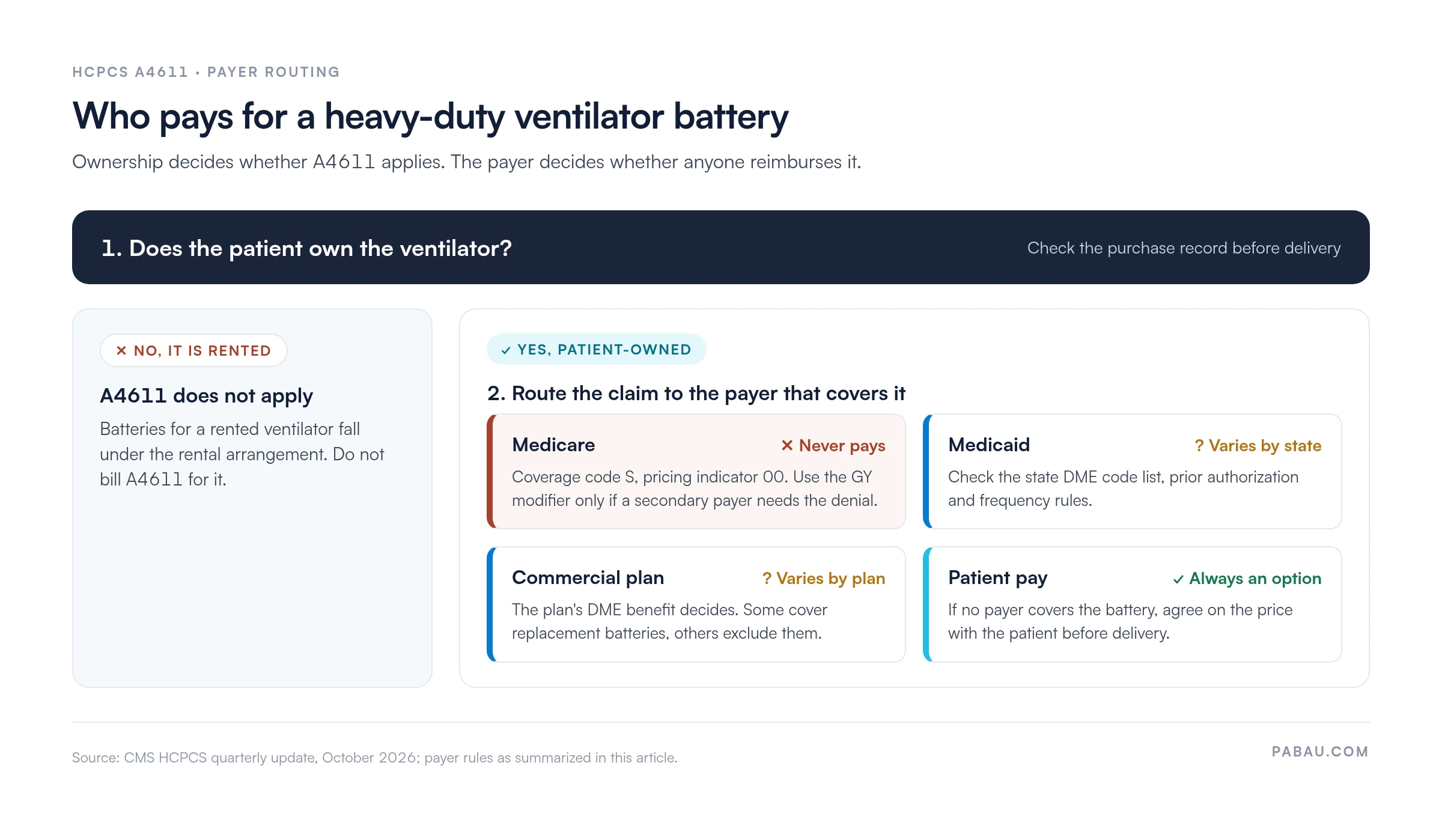
The routing below starts with ownership, because A4611 never applies to a rented ventilator. It then sends the claim to the payer that covers the battery.
Ownership decides whether A4611 applies, and the payer decides who reimburses it. Medicare status comes from the CMS HCPCS quarterly update, October 2026.
Medicare: There is no allowable, no coverage pathway and no 80% payment for A4611. The patient is responsible for the cost unless another payer covers it.
Medicaid: Many state programs list A4611 on their DME code lists, but coverage, prior authorization and frequency rules vary by state. Colorado Medicaid, for example, includes the code in its DME HCPCS list.
Commercial payers: Coverage depends on the plan and its DME benefit. Some plans cover ventilator replacement batteries, and others exclude them.
Patient pay: If no payer covers the battery, bill the patient directly. Agree on the price before delivery.
Secondary insurance: Some secondary plans want a Medicare denial on file first. Suppliers usually append the GY modifier, which flags a statutorily excluded item, so check your DME MAC guidance before submitting.
A4611 documentation requirements
Each payer that covers A4611 sets its own documentation rules, so read the policy of the plan you are billing. Most coverage policies ask for the records below. Thorough billing compliance documentation also protects the supplier during audits.
Written order: A signed, dated order from the treating physician that names the replacement battery and the ventilator model. Obtain it before delivery and never backdate it.
Proof of patient ownership: A purchase record, paid invoice or note in the medical record showing that the patient owns the ventilator.
Medical necessity notes: Physician notes that confirm ongoing ventilator dependency and the reason for replacement, such as a battery that no longer holds a charge.
Delivery confirmation: A signed delivery receipt or proof of delivery from the patient or their designee on the date of service.
Prior authorization: The approval number, where the payer requires one, obtained before the battery is dispensed.
Replacement history: The date of the previous battery replacement, so the claim can be checked against the payer’s frequency limit.
Pro Tip
Confirm the payer before you deliver an A4611 battery. If the patient has Medicare only, agree on patient payment up front. If Medicaid or a commercial plan is involved, check its coverage, prior authorization and frequency rules first.
A4611 billing guidelines and claim submission
Billing HCPCS code A4611 correctly starts with choosing the right payer, then filling the claim fields and units accurately. Pabau supports cleaner claims management for DME suppliers. It fills these fields the same way each time and flags common errors before submission.
Pabau’s claims screen lets billing staff submit each battery claim electronically and follow its status with the payer in one place.
Pick the payer: Medicare will not pay A4611, so direct the claim to Medicaid, a commercial plan or the patient. Verify coverage with that payer before delivery.
Who can bill: Bill as a DME supplier enrolled with the payer you are claiming from. Each Medicaid program and commercial plan sets its own enrollment rules.
Claim form: Most payers accept the CMS-1500 or its 837P electronic equivalent. Place of service 12 (Home) is standard for home ventilator patients.
Units of service: One unit equals one battery. If two batteries were delivered on the same date, bill two units of A4611.
Modifiers: Apply only the modifiers the billed payer requires. Do not use the RR rental modifier, because A4611 applies only to a patient-owned ventilator.
Frequency and authorization: Check the payer’s replacement interval and prior authorization list before each claim. Record the date of the last replacement on the patient’s file.
A4611 reimbursement: No Medicare allowable
There is no Medicare fee schedule amount for A4611. Because the code is not separately priced, Medicare pays nothing for it, and there is no 80% payment or 20% coinsurance split. Any payment comes from Medicaid, a commercial plan or the patient.
Field
Value
Code
A4611
Medicare coverage code
S (not covered by statute)
Medicare pricing indicator
00 (not separately priced)
Medicare allowable
None
Medicaid rate
Set by each state’s DME fee schedule; check your state program
Commercial rate
Set by the plan’s contract with the supplier
Source
CMS HCPCS quarterly update, October 2026
Rates for Medicaid and commercial plans differ by state and contract. Look up the figure in the payer’s own fee schedule before quoting a price to a patient or to finance staff.
Common reasons A4611 claims are denied and how to fix them
Most A4611 denials share a few root causes. The table below pairs each denial reason with its fix, drawing on the denial management processes that reduce rework across DME claim types.
Denial reason
Root cause
Corrective action
Not covered by Medicare
Claim sent to Medicare expecting payment for a statutorily excluded code
Bill Medicaid, a commercial plan or the patient instead; use the GY modifier only when a secondary payer needs a Medicare denial
No proof of patient ownership
Payer cannot confirm the ventilator is patient-owned, not rented
Obtain and attach purchase documentation, then rebill with supporting records
Frequency limit exceeded
Battery replaced before the payer’s allowed interval without documented justification
Appeal with physician documentation of early battery failure
Wrong code selected
A4612 (cables) or A4613 (charger) billed for a battery, or the reverse
Correct the code to match the item delivered and resubmit
Missing prior authorization
Payer requires approval that was not obtained before delivery
Request authorization through the payer’s retro-review process if it offers one; obtain it before future deliveries
Missing or unsigned physician order
No signed written order on file at the time of delivery
Never backdate an order. Follow the payer’s appeal rules, and obtain the signed order before any future delivery
How Pabau simplifies A4611 billing
Without a shared record, DME billing staff track payers and paperwork by hand, which is where errors build up. Pabau keeps the order, ownership proof and payer details on one patient record. Its claims tools then follow each A4611 claim from submission to payment.
The practical gains for A4611 specifically:
Payer checks at intake: Billing staff can see the patient’s insurer before delivery. A Medicare-only patient then gets a patient-pay quote rather than a claim that cannot be paid.
Documentation on file: The signed order, ownership proof and delivery receipt sit on the patient record, ready to attach when a payer asks.
Replacement tracking: Staff can see when a patient last received a battery and check the next claim against the payer’s allowed interval.
Claim status visibility: Billing teams know when an A4611 claim is paid, rejected or pending, so a stalled claim gets followed up rather than forgotten.
The outcome is fewer A4611 claims sent to a payer that will never pay them, and fewer denials for missing paperwork. Our guide to medical billing workflows shows how each claim moves from intake to payment.
Route every A4611 claim to the right payer
Pabau helps DME suppliers keep orders, ownership records and payer details on one patient record, then track each claim to payment. See how it works for your practice.
The central fact about HCPCS code A4611 is that Medicare does not pay for it, even when the patient owns the ventilator. Suppliers who treat it as a Medicare supply chase claims that cannot be paid. Suppliers who confirm the payer first get paid by Medicaid, a commercial plan or the patient.
Settle the payer, the order and the ownership proof before the battery leaves your stockroom. Pabau keeps those records and the claim in one place, so your team bills A4611 to the payer that covers it. To see how it fits your billing workflow, book a demo.
Continue your research
Need a framework for managing DME claim denials systematically?Denial management in healthcare covers the end-to-end process for identifying, appealing, and preventing claim rejections across billing code types.
Want to understand how A4611 fits within broader DME billing operations?Medical billing workflows explained walks through the full claim lifecycle from patient intake to payment posting.
Looking for compliance guidance to support audit-ready A4611 records?Billing compliance documentation outlines the record-keeping standards that protect DME suppliers during payer audits.
Billing the ventilator itself rather than its battery?HCPCS code E0466 explains how the home ventilator unit is coded and billed.
Replacing a rechargeable battery for other equipment?HCPCS code A4601 covers replacement rechargeable batteries billed outside the ventilator codes.
Frequently asked questions
What does HCPCS code A4611 cover?
HCPCS code A4611 covers a heavy-duty replacement battery for a ventilator that the patient owns outright. It does not apply to rented ventilators, battery cables, battery chargers or batteries for other respiratory equipment such as CPAP machines.
What is the difference between A4611, A4612 and A4613?
A4611 is the heavy-duty battery itself. A4612 is the replacement battery cables, and A4613 is the replacement battery charger, both for a patient-owned ventilator. Bill the code that matches the item delivered.
Does Medicare cover HCPCS code A4611?
No. CMS assigns A4611 coverage code S, which means Medicare does not cover it by statute. The code is not separately priced, so there is no Medicare allowable, even for a patient-owned ventilator. Check Medicaid or commercial coverage instead.
Can A4611 be billed for a rented ventilator?
No. The descriptor limits A4611 to a ventilator the patient owns. Batteries for a rented ventilator fall under the rental arrangement, so billing A4611 for one is a coding error.
Does A4611 require prior authorization?
That depends on the payer. Some Medicaid programs and commercial plans require prior authorization for ventilator supplies, while others do not. Check the payer’s current authorization list before delivering the battery.
How often can A4611 be billed for replacement batteries?
Medicare sets no replacement interval for A4611, because it does not pay for the code. Any frequency limit comes from the Medicaid program or commercial plan you bill. Document the reason for each replacement, such as a battery that no longer holds a charge.