CPT code 46255: Hemorrhoidectomy billing and coding guide
CPT code 46255 covers one column, inside and out CPT code 46255 reports a hemorr...

Last Updated: Oct 9, 2026
A4559 is the HCPCS Level II code for coupling gel or paste, for use with ultrasound device, per oz. It covers the gel that carries sound waves from the transducer to the skin during therapeutic or diagnostic ultrasound.
Medicare claims route by setting. Gel used incident to a physician's service goes to the Part B MAC and isn't paid separately. In other cases, the DME MAC processes the claim, and the contractor decides coverage case by case. Common denials come from billing the wrong contractor or confusing A4559 with A4558, the conductive gel for electrical devices.
Let Pabau's smart automation suggest the right codes, reduce claim denials, and keep your practice compliant—effortlessly.
Automate repetitive tasks and focus on what matters most—your patients.
Reduce coding errors and ensure compliance with the latest regulations.
Clean claims, fewer denials, and faster reimbursements.
Powerful insights and reporting to help your practice thrive.
HIPAA compliant SOC 2 certified GDPR-compliant Trusted by 4,000+ clinics worldwide

HCPCS code A4559 covers coupling gel or paste for ultrasound devices, billed per ounce, not conductive gel for electrical stimulation devices.
Gel used incident to a physician’s service goes to the Part B MAC unpaid, while other A4559 claims go to the DME MAC.
A4558 is conductive gel for TENS and NMES devices, so billing it for ultrasound gel, or A4559 for TENS gel, is a coding error.
Medicare has no national coverage policy for A4559, so the contractor decides coverage case by case.
Pabau’s claims management software keeps the A4559 supply line on the treatment note’s record, so the order and dispensing details travel with the claim.
HCPCS code A4559 carries the official descriptor “Coupling gel or paste, for use with ultrasound device, per oz.” It belongs to the A-series of HCPCS Level II codes, which cover medical and surgical supplies and other items CPT doesn’t capture. The Centers for Medicare & Medicaid Services (CMS) maintains them as permanent national codes.
The code is active and has no listed end date. Medicare treats it as a DMEPOS supply with dual jurisdiction, so the setting decides which contractor processes the claim.
A4559 covers one specific supply: Coupling gel or paste that carries sound waves between the transducer and the patient’s skin during an ultrasound session. It’s billed per ounce.
Several similar supplies fall outside the code, and each has its own HCPCS code or payment rule.
A4559 applies in any clinical encounter where a provider uses an ultrasound device that needs acoustic coupling between the transducer head and the patient’s skin. The two most common settings are therapeutic ultrasound in physical therapy and rehabilitation, and diagnostic ultrasound in outpatient imaging.
In physical therapy, the gel goes on before each therapeutic ultrasound session because sound waves need it to pass through the skin. Without it, the ultrasound energy reflects at the skin surface instead of reaching the target tissue.
Documentation must show that an ultrasound device was used in the encounter and that the gel was dispensed or applied during the session. A chart note that records only the procedure code, with no mention of the device type, leaves A4559 open to a medical necessity query.
Medicare has no national coverage policy for HCPCS code A4559. The CMS HCPCS file gives it coverage code C, so the contractor decides coverage case by case.
Payment also depends on the setting. Gel used during an in-office ultrasound service is part of that service and isn’t paid separately. Hospital outpatient and ASC claims typically bundle supply costs into the facility payment as well.
Where Medicare pays A4559 as a separate supply, the allowable comes from the annual CMS DMEPOS fee schedule. CMS updates the fee schedule each January, and amounts are set by state or region, not by MAC. Look up the current-year A4559 amount in the CMS DMEPOS fee schedule file before you submit.
A billed charge that differs from the fee schedule won’t cause a denial on its own. Medicare pays the lower of the billed charge or the fee schedule amount.
State Medicaid programs don’t have to mirror Medicare’s DMEPOS coverage for A4559. Some states list the code on their home health or DME fee schedule at a published rate. Others bundle ultrasound supplies into the procedure allowable and don’t reimburse A4559 separately.
North Carolina DHHS, for example, publishes A4559 on its Medicaid home health fee schedule with a stated allowable. That doesn’t mean other states do the same. Before billing A4559 to Medicaid, check the fee schedule your state’s Medicaid agency publishes. If the code isn’t there, contact the state DME program desk before submitting a claim.
A4559 has dual jurisdiction under Medicare, so the setting decides which contractor gets the claim. The DMEPOS HCPCS jurisdiction list that the DME MACs publish sets two rules for the code.
The decision below puts the code question and the contractor question side by side, since both have to be right before the line goes out.
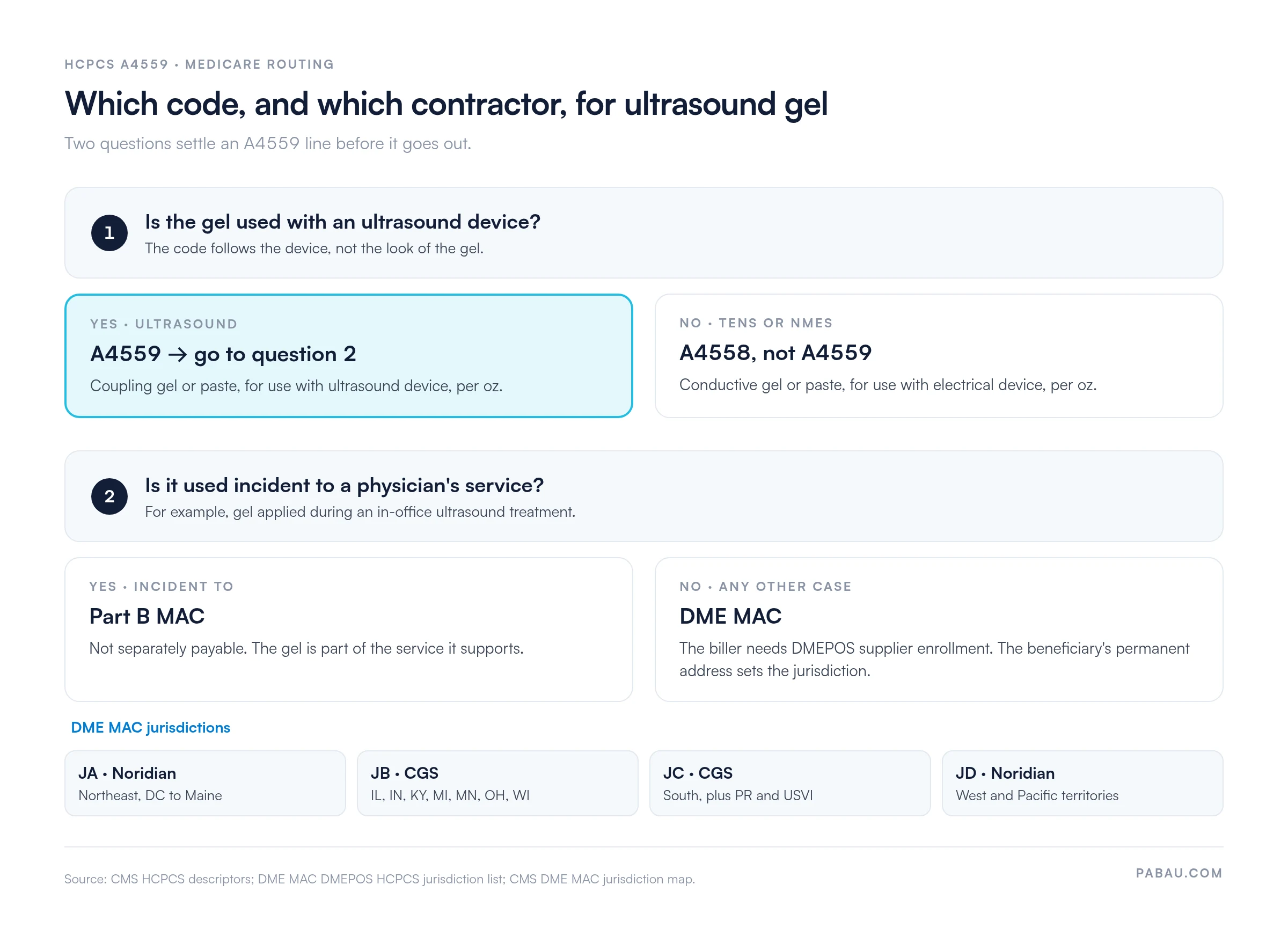
When a claim does go to the DME MAC, the beneficiary’s permanent address decides the jurisdiction, not the practice’s location. CMS splits the country into four DME MAC jurisdictions.
The Pricing, Data Analysis and Coding (PDAC) contractor supports CMS with product classification for DMEPOS supplies. If you’re unsure whether a specific gel product qualifies under A4559, PDAC can issue a coding verification.
A4559 sits among A-series supply codes for electrodes, conductive media, and stimulator supplies. The supplies look alike in a treatment room, which is how the codes get mixed up. The table below sets A4559 against its nearest neighbors.
The practical rule: If the supply is a gel or paste and the device is an ultrasound unit, the code is A4559. If the device delivers electrical current, conductive gel goes under A4558 and the monthly stimulator supplies under A4595.
Medicare and most commercial payers expect specific documentation behind an A4559 claim. Missing any of these elements leaves the line open to a medical necessity denial.
Good medical billing workflows keep the physician order and dispensing record linked to the claim at submission, instead of assembling them during a post-payment audit. Building that link into encounter documentation saves rebuilding the paper trail under audit pressure.
Run a monthly audit of your A4559 lines against your ultrasound treatment logs. Check that each line went to the right contractor for its setting. Then confirm no gel used during an in-office session was billed to Medicare as a separate charge. Any A4559 claim without a matching ultrasound record needs review before the payer flags it.
A4559 claims touch several billing rules at once: DME supplier enrollment, DMEPOS fee schedules, bundling edits, and contractor routing. Each one is a separate failure point.
Systematic denial management on HCPCS supply codes pays off. A4559 denials tend to repeat the same root causes, so one workflow fix can clear a whole batch. Routing each A4559 line by setting at the clearinghouse level is a good place to start.
The billing workflow for A4559 differs from standard professional service codes. These steps reduce claim errors and speed up payment for ultrasound supply charges.
Maintaining medical billing compliance on HCPCS supply codes also means tracking AAPC’s annual HCPCS Level II code updates. Cross-check the current HCPCS code descriptor each year to confirm no revision affects your claims.
Without a connected system, someone has to match each A4559 line to a treatment note, an order, and the right contractor after the session ends. That after-the-fact matching is where routing slips and missing paperwork creep in.
Pabau, the practice management platform we build, includes claims management software that tracks supply codes as their own billing lines. The A4559 line sits on the same patient record as the ultrasound treatment note and the order behind it.
Because the supply code is attached at documentation time, the claim goes out with its evidence already in place. Nobody has to rebuild the trail when a payer asks for records.

Pabau’s claims management software keeps A4559 supply lines, treatment notes and orders on one patient record. Claims reach the payer with the documentation already attached.

Two decisions settle an A4559 claim before it goes out. The first is the code, since ultrasound gel is A4559 and TENS or NMES gel is A4558. The second is the contractor, and the setting decides that one.
If your practice applies gel during in-office treatments, expect Medicare to treat it as part of the service, not a separate payment. Put your effort into the documentation that supports the ultrasound treatment itself. Separate A4559 billing is mainly a DMEPOS supplier’s job.
Pabau keeps supply lines next to the treatment record, so supply charges surface at billing time instead of during a post-payment audit. Book a demo to see how it handles your ultrasound supply workflow.

Need to understand how denials get resolved? Denial management in healthcare walks through the end-to-end process for identifying, appealing, and preventing recurring claim rejections.
Want a structured framework for clean claim submission? Clean claim best practices covers the elements a claim must contain before it reaches the payer to avoid a return without adjudication.
Looking for guidance on the broader billing compliance picture? Revenue cycle management explained sets out how supply code billing fits into the full patient-to-payment workflow.
Billing gel for a TENS or NMES unit? HCPCS code A4558 covers conductive gel for electrical stimulation devices, with its own coverage and billing rules.
HCPCS code A4559 covers coupling gel or paste used with an ultrasound device, billed per ounce. It’s the gel that carries sound waves between the transducer and the skin during therapeutic or diagnostic ultrasound. Conductive gel for TENS or NMES devices is A4558 instead.
Medicare has no national coverage policy for A4559, so coverage is decided case by case by the contractor. Gel used incident to a physician’s service goes to the Part B MAC and isn’t paid separately. Other A4559 claims go to the DME MAC, and the billing entity needs active DMEPOS supplier enrollment.
A4559 covers coupling gel or paste for ultrasound devices. A4558 covers conductive gel or paste for electrical stimulation devices such as TENS and NMES. Electrodes and lead wires are separate codes, and A4556 and A4557 are apnea monitor items. Billing one gel code for the other is a coding error that leads to denial.
It depends on the setting. Under Medicare, gel used incident to a physician’s service isn’t separately payable, and hospital outpatient and ASC payments bundle supplies too. A DMEPOS supplier billing the DME MAC may be paid for A4559 as a separate line, subject to the contractor’s coverage decision. Check each commercial payer’s billing policy before submitting.
A4559 has dual jurisdiction. Gel used incident to a physician’s service goes to the Part B MAC. Other claims go to the DME MAC for the beneficiary’s permanent address. Noridian Healthcare Solutions runs DME MAC Jurisdictions A and D, and CGS Administrators runs Jurisdictions B and C.
Medicaid coverage for A4559 varies by state. Some states, such as North Carolina, include the code on their home health or DME fee schedule. Others bundle ultrasound supplies into the procedure rate and don’t reimburse A4559 separately. Always check your state Medicaid agency’s DMEPOS fee schedule before billing.