CPT code 63081: Vertebral corpectomy, cervical spine
CPT code 63081: official descriptor and procedure overview CPT code 63081 descri...

Last Updated: Oct 6, 2026
A4556 is the HCPCS Level II code for electrodes, (e.g., apnea monitor), per pair.
Medicare does not pay A4556 separately. The code has not been valid for Medicare since November 1, 1996, and apnea monitor electrodes are included in the E0618 or E0619 monitor rental. Some Medicaid and commercial payers still accept it, so check the patient's plan before you bill.
Let Pabau's smart automation suggest the right codes, reduce claim denials, and keep your practice compliant—effortlessly.
Automate repetitive tasks and focus on what matters most—your patients.
Reduce coding errors and ensure compliance with the latest regulations.
Clean claims, fewer denials, and faster reimbursements.
Powerful insights and reporting to help your practice thrive.
HIPAA compliant SOC 2 certified GDPR-compliant Trusted by 4,000+ clinics worldwide

A4556 describes disposable electrodes for apnea monitors, per pair, but it has not been valid for Medicare since November 1, 1996.
Medicare includes apnea monitor electrodes and lead wires in the E0618 or E0619 monitor rental, so they are not billed separately.
For TENS and NMES devices, electrodes are bundled into A4595, and A4556 is not payable in the same month as A4595.
Some Medicaid and commercial payers still accept A4556, so verify the patient’s plan before you bill it.
Pabau’s billing software keeps payer details on each claim, so A4556 only goes to plans that recognize it.
HCPCS Code A4556 describes “electrodes, (e.g., apnea monitor), per pair.” It belongs to the HCPCS Level II A-series, which CMS maintains for medical and surgical supplies not captured by CPT. The A-series prefix marks it as a supply code rather than a procedure code.
A4556 is not a separately payable Medicare item. The CGS DME MAC Jurisdiction C Supplier Manual, Appendix A, lists it as “not valid for Medicare as of 11/1/1996”. The code still sits in the HCPCS set, and some Medicaid and commercial payers still accept it. Where they do, one unit equals one pair of electrodes, not one electrode.
A4556 describes disposable surface electrodes used with a monitoring device. Whether a payer pays for them separately depends on the payer, and for Medicare the answer is no.
For Medicare patients, the electrodes are part of the apnea monitor rental. That holds for the starter pack on delivery and for every replacement pair after it. The supplier is paid for them through the E0618 or E0619 rental, not through a separate A4556 line.
Medicare does not pay A4556 separately. The CGS supplier manual flags the code as not valid for Medicare as of November 1, 1996. A4557, the lead-wire code beside it, carries no such flag.
Medicare covers home apnea monitors as rental items under E0618 (without a recording feature) and E0619 (with a recording feature). Payer policies such as Northwood’s DMEPOS apnea monitor policy state that electrodes and lead wires are included in the rental. They cannot be billed separately, so an A4556 line on a Medicare claim can be expected to deny.
For TENS and NMES devices, Medicare bundles the electrodes into A4595, the monthly supply allowance. A4556 is not payable in the same month as A4595, so it cannot be used to add extra electrodes on top.
Some Medicaid programs and commercial plans still accept A4556. Others follow Medicare’s bundling rule and deny it. Verify the payer’s coverage policy before the first delivery, and record that check in the patient file.
Texas workers’ compensation fee disputes show the same split. Texas Division of Workers’ Compensation rulings describe A4556 denials as “a bundled or non covered procedure based on Medicare guidelines; no separate payment allowed”. The exception is the DME supplier that furnishes the monitor billing the electrodes directly.
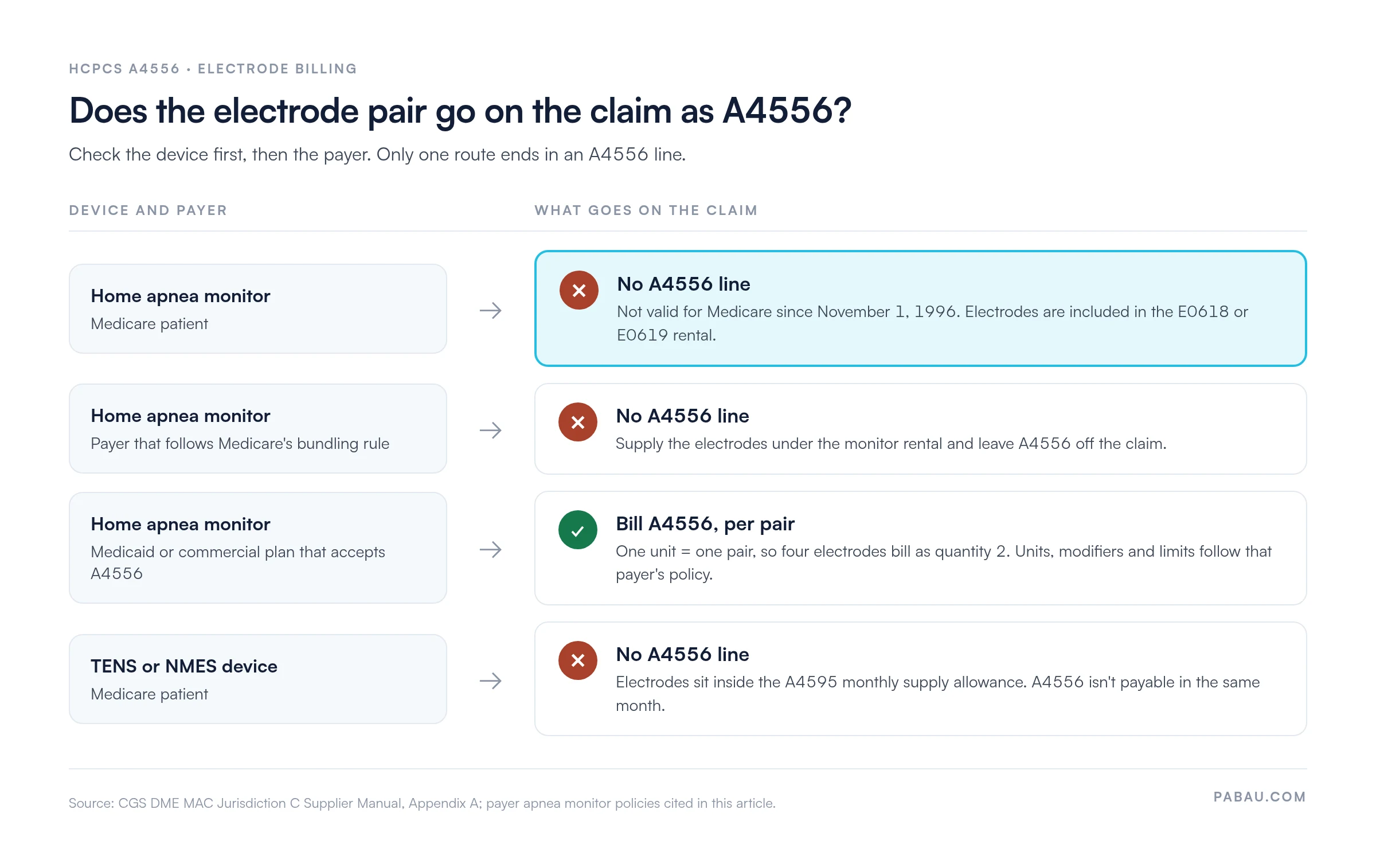
Bill A4556 only after you confirm that the patient’s payer recognizes the code. For a Medicare beneficiary, the electrodes go out under the E0618 or E0619 rental and no A4556 line goes on the claim. The chart below maps each device and payer to what belongs on the claim.
Where a Medicaid or commercial payer accepts A4556, four elements decide the outcome: units, modifier, diagnosis linkage, and place of service. In Pabau’s billing software, claims tracked to payment carry the insurer from the patient’s file. An electrode line then goes only to a plan you’ve already confirmed.
One unit equals one pair of electrodes. A patient receiving four individual electrodes is billed at quantity 2, not 4. Frequency limits, where they exist, come from the payer’s own policy, so check them before each shipment.
Modifier rules for A4556 come from the accepting payer, not from Medicare. The table shows the DME modifiers a payer may ask about.
Follow the payer’s billing manual on whether A4556 needs a modifier at all. RR and UE describe durable equipment, so applying them to a disposable supply is likely to trigger a claim edit.
A4556 is a home supply, so the claim normally shows the patient’s home as the place of service. The linked diagnosis must support medical necessity for the monitor itself. Common ICD-10-CM codes include P28.30 (primary sleep apnea of newborn, unspecified) and R06.81 (apnea, not elsewhere classified).
The diagnosis on the A4556 claim should match the diagnosis supporting the monitor. A mismatch between the two is a frequent cause of clean claim submission failures.
Before each electrode shipment, check the patient’s payer against your list of plans that accept A4556. If the payer follows Medicare’s rule, supply the electrodes under the monitor rental and leave A4556 off the claim.
Medicare has no separately payable rate for A4556. The code has not been valid for Medicare since November 1, 1996, so there is no Medicare allowed amount to bill against. Some third-party code lookup sites show a nominal fee schedule price for A4556. That figure does not mean Medicare pays the code separately.
For payers that accept A4556, the rate comes from their own fee schedule or contract. A Medicaid program publishes its rate in the state fee schedule, and a commercial plan sets it in the supplier’s contract. Confirm the figure with the payer before you rely on it.
Workers’ compensation claims follow the state’s own fee guideline. In Texas, fee dispute rulings have upheld A4556 denials where Medicare treats the electrodes as bundled. Check the state rules before billing a workers’ compensation carrier.
The A4550s cluster contains several electrode and lead-wire codes that are easy to confuse. The table below sets A4556 against the codes it is most often mixed up with, including the monitor rental codes.
A4556 and A4595 cover different devices. A4595 is the monthly supply allowance for TENS and NMES units, and it already includes the electrodes. A4556 is not payable in the same month as A4595, so it cannot top up a stimulator supply claim.
For apnea monitors, the comparison that matters for Medicare is A4556 against the E0618 or E0619 rental, which absorbs the electrodes. The AAPC HCPCS code lookup includes descriptor comparisons that help coders distinguish adjacent codes in the A-series.
Payers that accept A4556 expect the supplier to keep records supporting each supply claim. The usual set includes:
For replacement electrodes, also document that the patient is still using the monitor and that the quantity sits within the payer’s limits. For Medicare patients, keep the same records against the E0618 or E0619 rental claim.
Good medical billing compliance practice means retaining these records for at least seven years, in line with CMS audit look-back windows. Without the physician order for the monitor, no supply claim for that patient holds up in an audit.
Most A4556 denials come from sending the code to a payer that does not pay it separately. The rest trace back to units, diagnosis linkage and modifiers. Effective denial management strategies start with understanding which root causes generate the most volume.
The Medicare Informatics HCPCS tables provide additional code-level detail, including coverage indicators and cross-references, that can help billers identify denial risk before submission. When a denial does come back, look up its reason code in our guide to decoding claim denial codes before you resubmit.
Run a monthly report of A4556 denials grouped by reason code. If “bundled” or “non-covered” codes repeat for one payer, add that payer to your no-A4556 list and supply its patients’ electrodes under the monitor rental.
Whether A4556 belongs on a claim depends on the payer. Without a record of which plans accept it, a biller has to remember the rule claim by claim. One Medicare patient’s electrodes keyed as a separate line turns into a denial weeks later.
Pabau, the practice management and billing platform we build, keeps each patient’s insurance details, orders and claim history in one record. The payer and the monitor order are checked before an electrode claim goes out.
The result is fewer bundling denials, less rework, and electrode claims sent only to plans that pay them.

Pabau keeps each patient’s payer, orders and claim history in one record, so electrode claims go only to plans that accept A4556.

Decide A4556 payer by payer, before each electrode shipment. For Medicare and every plan that follows its bundling rule, the E0618 or E0619 rental already pays for the electrodes. A4595 does the same for stimulator electrodes.
Keep a short list of plans that still accept A4556, and bill those per pair. The code then stops producing denials, and the cost is one payer check per patient.
Pabau keeps the payer on every supply claim, so that check happens before the claim leaves the system. Book a demo to see how it fits your DME billing workflow.

Need to understand how clearinghouse submissions work for DMEPOS claims? Medical claims clearinghouse guide walks through how claims move from submission to adjudication.
Looking for a broader overview of billing error prevention? Revenue cycle management explained covers the full claim lifecycle from patient intake to payment posting.
Want to see how electronic remittance data can flag denial patterns? Electronic remittance advice (ERA) guide explains how to read 835 files and use them to reduce repeat denials.
Billing Medicare for other home equipment? Medicare billing guide explains how Medicare claims, coverage rules and payment timelines work.
Supplying conductive gel with the electrodes? HCPCS code A4558 covers conductive paste or gel, billed per ounce rather than per pair.
HCPCS Code A4556 describes disposable electrodes for apnea monitors, billed per pair. It does not describe reusable electrodes, lead wires (A4557), conductive gel (A4558), or TENS electrodes (A4595). Medicare does not pay it separately, so it applies only to payers that still accept it.
Medicare has no reimbursement rate for A4556, because the code has not been valid for Medicare since November 1, 1996. Apnea monitor electrodes are included in the E0618 or E0619 monitor rental. A price shown for A4556 on a third-party lookup site is not a Medicare allowed amount.
Some Medicaid programs and commercial plans still accept A4556, while others follow Medicare and treat the electrodes as bundled. Check the payer’s fee schedule or coverage policy before the first delivery. Where the code is accepted, bill it per pair under that payer’s rules.
A4556 describes apnea monitor electrodes, per pair. A4595 is the monthly supply allowance for TENS and NMES devices, and it already includes the electrodes. Medicare does not pay A4556 in the same month as A4595, so neither code can stand in for the other.
Where a payer accepts A4556, one unit equals one pair of electrodes. Any limit on pairs per period comes from that payer’s own policy. For Medicare patients, no A4556 units are billed, because the electrodes are part of the monitor rental.
Payers that accept A4556 typically expect a physician order for the monitor, clinical notes supporting medical necessity, and a signed delivery receipt. The receipt shows the date and the number of pairs delivered. Supplier records identifying the product complete the set.
The most common cause is billing A4556 to Medicare, which has not accepted the code since 1996. Other causes include billing it alongside A4595, counting electrodes instead of pairs, and a diagnosis that does not match the monitor order. Checking the payer’s policy before submission prevents most of them.