

HCPCS code E0198: Water pressure pad billing guide
HCPCS code E0198 is a water pad for a standard mattress HCPCS code E0198 is the ...

Last Updated: Oct 13, 2026
A4480 is the HCPCS Level II code for the Vabra aspirator, a sterile, single-use vacuum device that collects endometrial tissue for diagnostic study. It reports the supply only, so the endometrial biopsy goes on its own line under a CPT code such as 58100.
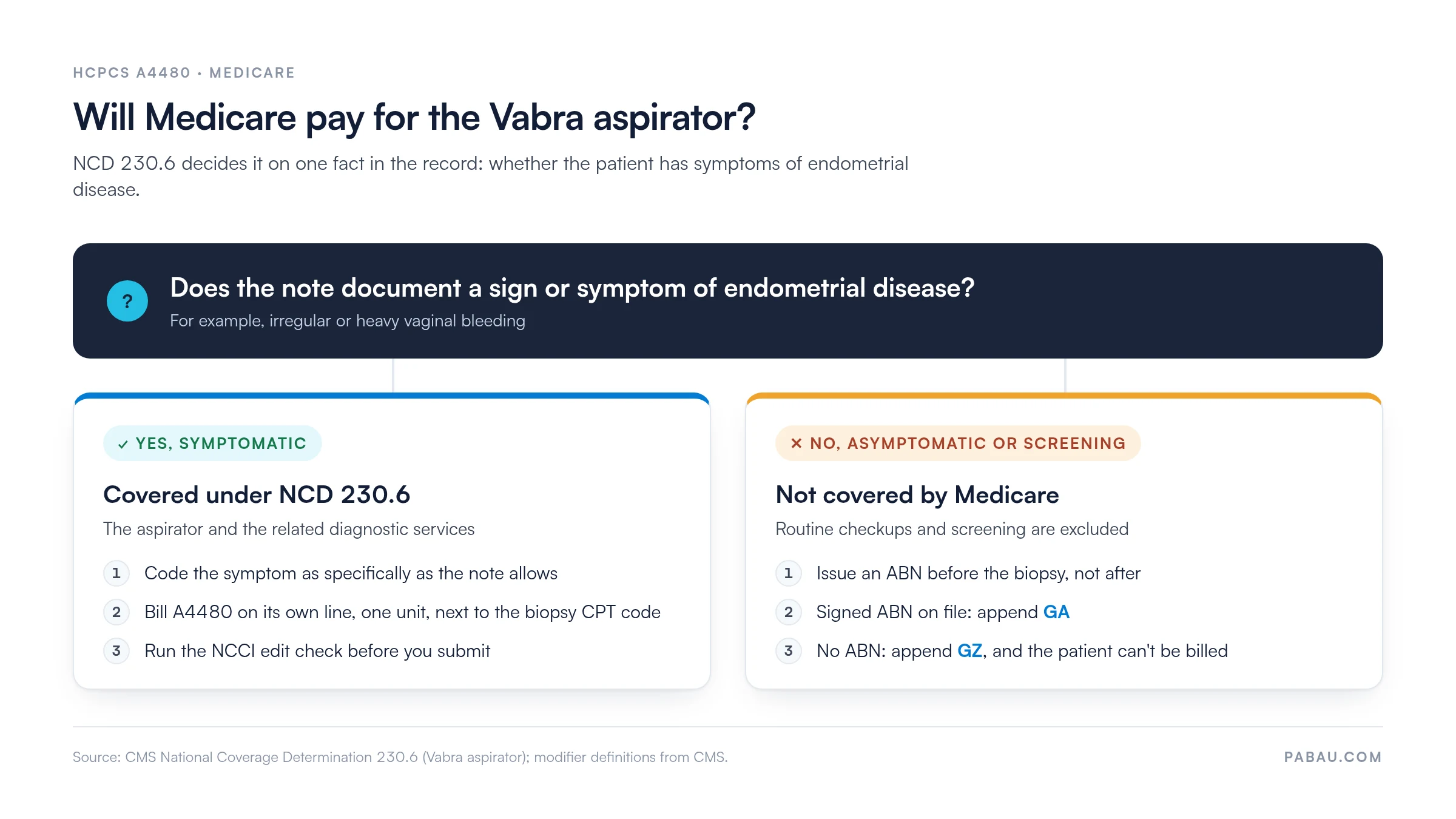
Medicare covers the aspirator under National Coverage Determination 230.6 when the patient has symptoms of endometrial disease, such as irregular or heavy bleeding. Screening an asymptomatic patient isn't covered.
Let Pabau's smart automation suggest the right codes, reduce claim denials, and keep your practice compliant—effortlessly.
Automate repetitive tasks and focus on what matters most—your patients.
Reduce coding errors and ensure compliance with the latest regulations.
Clean claims, fewer denials, and faster reimbursements.
Powerful insights and reporting to help your practice thrive.
HIPAA compliant SOC 2 certified GDPR-compliant Trusted by 4,000+ clinics worldwide

HCPCS code A4480 reports the Vabra aspirator as a disposable supply, billed on its own line beside the endometrial biopsy CPT code.
Medicare covers the aspirator under National Coverage Determination 230.6 when the patient has symptoms such as irregular or heavy bleeding.
Medicare won’t pay for the aspirator or the related services for an asymptomatic patient or a routine screening exam.
When you expect a medical necessity denial, issue an Advance Beneficiary Notice (ABN) before the biopsy and append the GA modifier.
Pabau’s claims management software checks each claim for missing details before it can be sent, so fewer A4480 lines come back rejected.
HCPCS code A4480 is the Level II code for the Vabra aspirator, a sterile, single-use vacuum device that collects endometrial tissue for diagnostic study. It belongs to the A section of HCPCS Level II, which runs from A0000 through A9999. The Centers for Medicare and Medicaid Services (CMS) maintains the code set. Within that section, A4480 sits among the medical and surgical supplies, A4000 through A8999.
Medicare covers A4480 under National Coverage Determination 230.6, but only for patients with symptoms of endometrial disease. Routine screening of an asymptomatic patient isn’t covered.
The official CMS descriptor for A4480 reads: Vabra aspirator. The code identifies the device, not the procedure performed with it. The supply and the biopsy travel on the same claim, but each has its own code and its own fee schedule.
The Vabra aspirator is a negative-pressure endometrial sampling device used in office-based gynecological procedures. A small-bore cannula goes through the cervical os and connects to a vacuum source. The suction draws endometrial cells and tissue into a collection chamber without dilation or general anesthesia.
Gynecologists and women’s health providers bill it most often when a patient’s symptoms point to endometrial disease:
The device is designed for single use. Reprocessing a Vabra aspirator and rebilling A4480 is a compliance violation. One unit equals one procedure encounter, however many passes the provider makes in the same session.
Medicare covers the Vabra aspirator under National Coverage Determination (NCD) 230.6. An NCD is a national rule, so it applies the same way in every Medicare Administrative Contractor (MAC) jurisdiction. The aspirator is covered when the patient shows signs or symptoms of endometrial disease, such as irregular or heavy vaginal bleeding.
The NCD draws a firm line at asymptomatic patients. Medicare won’t pay for the aspirator or the related diagnostic services when they’re part of a routine checkup or screening exam. That one rule decides most A4480 claims, as the diagram below shows.
The payment amount depends on the payer’s fee schedule for supplies. For Medicare, that’s your MAC’s supply fee schedule or its durable medical equipment, prosthetics, orthotics and supplies (DMEPOS) fee schedule. Confirm the current allowed amount with your MAC before you set your chargemaster rate.
Commercial payer policies vary. Some plans follow the Medicare NCD criteria, while others apply their own medical necessity standards or require prior authorization for gynecological supply codes. Check each payer’s supply policy before you submit. A detailed superbill with diagnosis codes attached can speed up the prior authorization review.
A4480 is a supply code, so it never travels alone on a claim. The procedure that used the Vabra aspirator gets its own code. The table below shows the codes most often submitted with A4480.
Always run a current NCCI edit check before you submit 58100 alongside A4480. Bundling edits change every year, and a pair that passed last year may be flagged this cycle.
For the diagnosis, code the bleeding pattern the note describes. Fall back on N93.9 only when the record names no more specific pattern, because a vague code invites a medical necessity review.
A4480 has no modifier of its own. On Medicare claims, the modifiers that matter most are the liability modifiers GA and GZ. They tell the payer whether the patient signed an ABN before the service.
Medicare’s decision on A4480 rests on the patient’s symptoms, and the diagnosis code and procedure note have to show them. When the record shows none, issue the ABN before the biopsy and append GA. Don’t append KX to an A4480 claim unless a payer’s written policy asks for it.
A payer audit of an A4480 claim looks for a specific set of clinical documents. Missing any one of them can lead to a denial or a post-payment recoupment. Each document has to connect the device to the clinical indication.
Our guide to medical billing compliance shows how to build pre-service checklists that catch a missing document before the date of service.
Denials for HCPCS code A4480 trace back to a handful of recurring errors. Each one below comes with the fix to make before you resubmit.
Set your claim scrubber to check the diagnosis on every Medicare A4480 line. If it names no symptom of endometrial disease, hold the claim and confirm whether the patient signed an ABN.
A denied A4480 claim under Medicare follows the five-level appeals process set by CMS. Each level has a statutory deadline, and missing it forfeits the right to appeal at that level.
Most A4480 denials come from a coding or documentation error, and a Level 1 redetermination with corrected records usually resolves them. Supply code denials rarely go beyond Level 2. Good denial management fixes the root cause before resubmission, not only the claim line.
Accurate charge entry for HCPCS code A4480 comes down to five fields. Each is easy to overlook when a billing team processes a high volume of gynecological procedure claims.
In many gynecology practices, a biller keys the supply line by hand and finds out weeks later that a detail was missing. Each rejected A4480 line means a correction, a resubmission and another wait for payment.
Pabau, the practice management platform we build, includes claims software for practices that bill insurance. It runs validation checks every time someone goes to send a claim. If a required detail is missing, the Send button stays disabled until it’s fixed.
In the US, Pabau connects to Claim.MD, so you can submit claims electronically, run real-time eligibility checks and track claim status from one dashboard. Electronic remittance advice (ERA) posts back to the same place, so an unpaid A4480 line is easy to spot.
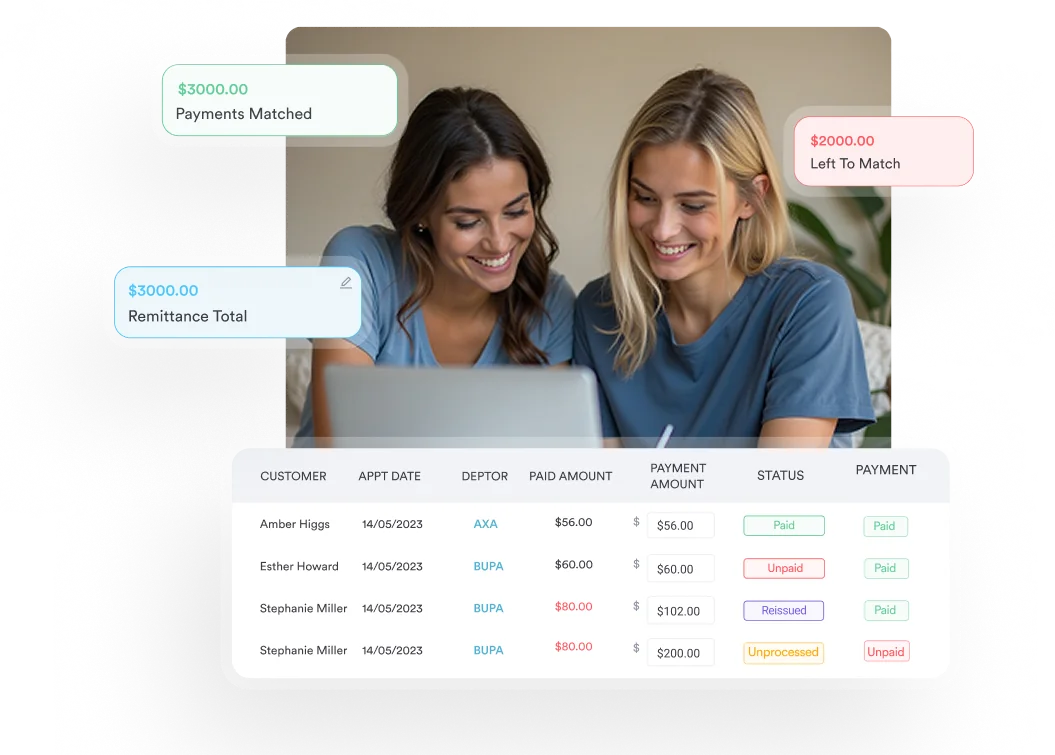

Pabau checks every claim for missing details before it can be sent. ERA remittances post back to the same dashboard, so you see which A4480 lines were paid.

A4480 claims succeed or fail on one fact: Whether the record shows a symptom of endometrial disease. Code that symptom precisely, and NCD 230.6 coverage follows.
When the patient has no symptoms, settle who pays before the biopsy rather than after the denial. A signed ABN and the GA modifier keep the cost collectible from the patient.
Book a demo to see how Pabau catches missing claim details before your A4480 lines reach the payer.

Need to understand what goes wrong in medical billing before it hits the payer? Denial management in healthcare walks through the most common denial categories and how to resolve each one systematically.
Want to build a compliant billing documentation process? Medical billing compliance covers the audit trails, record retention rules, and pre-submission checks that keep supply code claims clean.
Looking for context on how HCPCS codes fit into the broader revenue cycle? What is revenue cycle management explains how supply codes, procedure codes, and diagnosis codes work together from charge entry through payment posting.
HCPCS code A4480 covers the Vabra aspirator, a single-use negative-pressure device that collects endometrial tissue during in-office biopsy procedures. The code reports the supply only. The endometrial biopsy itself is billed separately under a CPT code such as 58100.
Yes, for symptomatic patients. Medicare covers the Vabra aspirator under National Coverage Determination 230.6 when the patient has signs of endometrial disease. Irregular or heavy bleeding is the classic example. It doesn’t cover the aspirator or related services for asymptomatic patients or routine screening.
A4480 needs no modifier of its own. Append GA when you expect a medical necessity denial and the patient signed an Advance Beneficiary Notice before the service. Use GZ when no ABN was issued. Append KX only if a payer’s written policy asks for it.
The most common reason is a screening or non-specific diagnosis, since NCD 230.6 covers only symptomatic patients. Other causes include an NCCI bundling edit with the paired CPT code, a wrong place of service, or more than one unit per encounter. Most are resolved at Level 1 redetermination with a corrected claim and the clinical note.
Prior authorization requirements for A4480 vary by payer. Medicare does not universally require prior authorization for this supply code. Some Medicare Advantage plans and commercial payers do apply prior authorization to DME or supply codes. Check each payer’s current policy before the date of service, as requirements can change mid-year.
CPT 58100 (endometrial biopsy without cervical dilation) is the procedure code most often paired with A4480. CPT 58110 applies when the biopsy is performed with colposcopy. Check the current NCCI edit table before you submit both codes together, because bundling rules change every year.



