

CCSD code G5100: Bypass of duodenum billing guide
CCSD code G5100 bills a bypass that leaves the duodenum in place CCSD code G5100...

Last Updated: Oct 16, 2026
A4463 is the HCPCS Level II code for surgical dressing holder, reusable, each.
It looks like a minor supply code, yet it gets denied constantly. Almost every rejection traces back to one of three problems: no PDAC verification on file, the wrong modifier, or documentation that never quite proves medical necessity. Each one has a straightforward fix once you know where it hides.
Let Pabau's smart automation suggest the right codes, reduce claim denials, and keep your practice compliant—effortlessly.
Automate repetitive tasks and focus on what matters most—your patients.
Reduce coding errors and ensure compliance with the latest regulations.
Clean claims, fewer denials, and faster reimbursements.
Powerful insights and reporting to help your practice thrive.
HIPAA compliant SOC 2 certified GDPR-compliant Trusted by 4,000+ clinics worldwide

HCPCS code A4463 describes a surgical dressing holder, reusable, each – a Level II HCPCS supply code in the A4000-A4999 medical and surgical supplies range.
Medicare coverage requires PDAC verification before any DME supplier may bill A4463; submitting claims without a verified product listing risks claim denial or audit recoupment.
Documentation must include a physician order establishing medical necessity, a supporting ICD-10-CM diagnosis code, and the PDAC verification letter for the specific product billed.
Only two codes in the A446x range are still active for dressing holders: A4461 (non-reusable) and A4463 (reusable). A4462 and A4464 were both deleted years ago.
This is the official CMS HCPCS Level II descriptor, sitting inside the A4000-A4999 range for medical and surgical supplies that DME suppliers bill to Medicare and most commercial payers. The billing unit is “each,” so one claim line covers one holder.
A reusable surgical dressing holder is a device designed to hold, secure, or retain wound dressings in place over multiple uses. The “reusable” designation is what separates A4463 from the non-reusable holder billed under an adjacent code.
Confirm the product’s reusability status before selecting the code. Downcoding to a non-reusable code, or upcoding from one, misrepresents the item supplied and creates compliance risk.
Medicare coverage for A4463 is governed by DME MAC coding verification guidance and the CMS Surgical Dressings Policy Article. Coverage is not automatic. Three conditions must all be met before a claim gets paid.
Medicare does not cover surgical dressing holders used mainly for comfort or hygiene without a documented wound-related need. Suppliers should retain all eligibility evidence for audit purposes, typically for a minimum of seven years under CMS record retention expectations.
Quick question: What do DME MACs mean by a coverage indicator? CMS DMEPOS pricing files use a lettered coverage-code field, not a numeric scale. A “C” means the carrier makes a manual medical-necessity judgment, a “D” flags special coverage instructions, and an “I” or “M”/”S” means the item is not separately payable. None of that changes what the claim itself needs: documented medical necessity plus the right modifier from the KX, GA, or GZ set covered in the billing section below. Patients paying up front and claiming later need a superbill, which itemizes the service, the code and the charge.
The Pricing Data Analysis and Coding (PDAC) contractor, under contract with CMS, verifies that a specific DME product meets the definition of the HCPCS code a supplier intends to bill. For surgical dressing holders like A4463, PDAC verification is mandatory before billing Medicare.
Billing without a verified product listing is a billing error under DME MAC policy, and it exposes the supplier to claim denial and recoupment.
Here is the verification workflow suppliers should follow.
Noridian Healthcare Solutions, the DME MAC for Jurisdictions A and D, has published explicit guidance stating that suppliers billing surgical dressing holder codes must have a PDAC-verified product. The same requirement applies across all four DME MAC jurisdictions.
Good practice management software for medical practices turns supplies used in a visit into billed line items automatically.
Poor documentation is the second most common reason A4463 claims get denied on audit. Capturing the right information at the right time prevents the scramble that happens when a DME MAC requests records. The required documentation set for A4463 includes:
One document you will not need is a Certificate of Medical Necessity (CMN). CMS eliminated CMNs and DIFs across every DME category for dates of service on or after January 1, 2023. The Standard Written Order, the physician order already listed above, is what suppliers keep on file today.
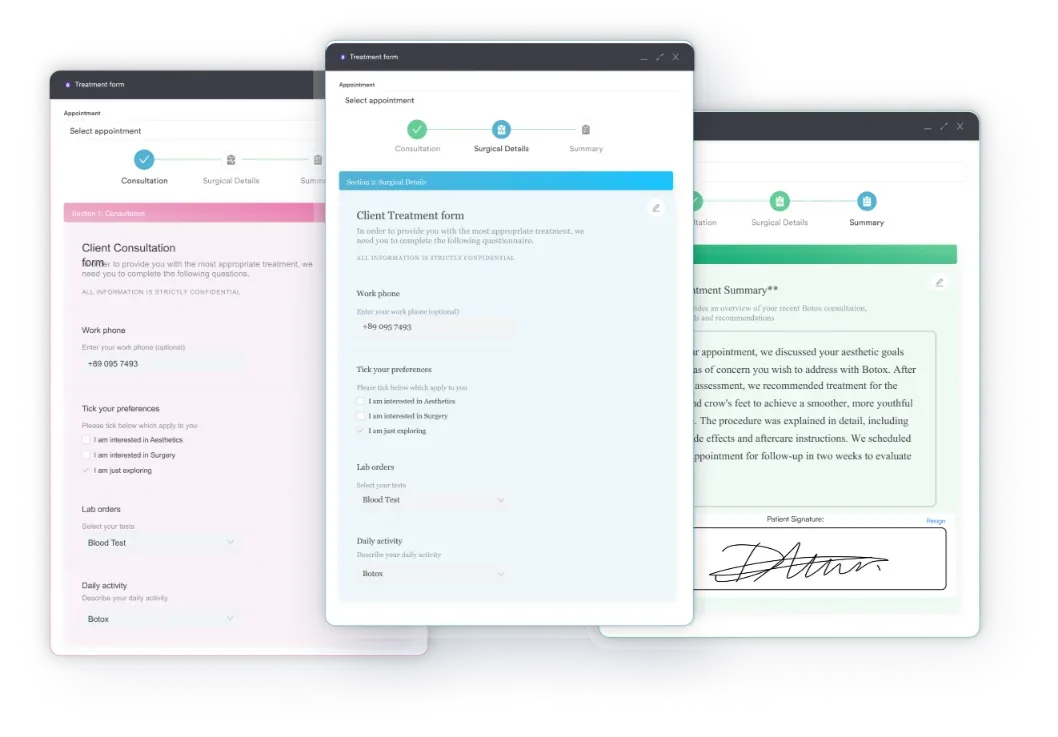
Using digital intake forms to standardize the collection of physician orders and patient acknowledgments reduces documentation gaps before claims go out. Suppliers should also maintain records showing the beneficiary received and acknowledged the item, which satisfies the proof-of-delivery requirement.
Audit your A4463 documentation package before submitting each claim. Run a checklist: physician order present and pre-dated? PDAC verification letter on file for the specific product? ICD-10 code documented in the clinical note? Proof of delivery signed? One missing document can turn a clean claim into a costly recoupment.
Correct billing of HCPCS code A4463 goes beyond selecting the right code. Modifier usage, claim form selection, and place-of-service coding all affect whether Medicare processes the claim cleanly.
Practice management software like Pabau can help by gating claim submission until the required fields are complete and giving the team a single status dashboard, which catches gaps before a claim reaches the payer.
Submit A4463 claims on the CMS-1500 professional claim (the 837P electronic transaction). DME suppliers do not use the CMS-1450 (UB-04); that form is reserved for institutional and facility billing, which does not apply to DME suppliers. The place of service code should reflect the patient’s home setting for home-use DME.
Here is how it plays out on a real claim. A supplier ships a reusable dressing holder to a patient recovering from a post-surgical wound (T81.30XA). The physician’s order is on file, the PDAC verification letter matches the exact product, and medical necessity is documented, so the biller appends modifier KX.
The claim processes without a documentation request. Drop any one of those three elements, and the same claim is far more likely to pend or deny.
Checking against a short internal list before submitting helps catch the same few errors that repeat across DME billing teams. The most frequent mistakes billers make with A4463 include:
That reusable-versus-disposable test is not unique to dressing holders. A4458 covers an enema bag with tubing only when the set is built for repeated use, so a single-use kit falls outside the code.
Medicare reimbursement for HCPCS code A4463 comes from the annual DMEPOS fee schedule that CMS publishes, not the Physician Fee Schedule. Rates vary by geographic locality because CMS applies location-specific adjustments. The CMS DMEPOS fee schedule page has the current year-specific rates by HCPCS code and jurisdiction.
Rather than publishing a specific dollar amount that changes with each annual update, follow this process to find the current 2026 allowed amount:
Commercial payers set their own rates independently of Medicare. Many reference Medicare allowed amounts as a benchmark, but rates can vary significantly by payer contract. Always verify contract-specific rates when billing A4463 to commercial insurance.

Pabau’s claims management software helps practice teams organize billing documentation, track claim status, and reduce errors on supply code claims like A4463. See how it works in a live demo.

The A446x range covers the surgical dressing holder family of HCPCS codes, though not every code in that range is still active. The AAPC HCPCS lookup is a useful reference index for checking a code’s current descriptor and status, though it is a lookup index, not a tool that flags a wrong code selection for you; that responsibility still sits with the biller.
The table below shows the adjacent codes and their current status.
Only A4461 and A4463 are active today. A4462 and A4464 were both removed from the code set years ago, so if a payer remittance or a legacy chart references either one, treat it as a red flag rather than a valid billing option. For the non-reusable version of this same product family.
Pairing A4463 with the correct ICD-10-CM diagnosis code is essential for establishing medical necessity. Tools like the PGM Billing HCPCS lookup tool return a code and its official descriptor, which is a handy quick reference, but they do not suggest which diagnosis code to pair with it. That judgment call still belongs to the coder reviewing the chart.
Practices with a heavy post-surgical caseload. Practices managing chronic pressure injuries or diabetic foot ulcers.
The table below lists ICD-10-CM codes that billers most frequently use to support claims for surgical dressing holders.
Use the most specific ICD-10-CM code available for the patient’s condition. Coding to an unspecified code when a more specific one exists is a documentation weakness auditors frequently flag. Verify each code against the current fiscal year’s ICD-10-CM tabular list published by the CDC.
Review A4463 claims quarterly for ICD-10 code specificity. If your practice is consistently using unspecified codes (those ending in 9 or 0) when more specific options exist, that pattern signals a documentation workflow gap. Coders should cross-reference the clinical note for the wound site, depth, and cause before selecting the final diagnosis code.
Billing HCPCS code A4463 correctly comes down to three things: confirming the product is PDAC-verified before the first claim goes out, pairing the code with a specific ICD-10-CM diagnosis that reflects the documented wound, and attaching the right modifier based on whether medical necessity is established. Miss any of these, and a clean supply claim becomes an audit finding.
Practice management software like Pabau helps DME-adjacent practices keep this documentation organized in one place. It gates claim submission until the required fields are complete, gives the team a status dashboard so nothing sits unnoticed, and stores the physician orders, PDAC letters, and proof-of-delivery records an auditor will ask for.
To see how it fits your billing workflow, book a demo with the team.

Billing a different supply code alongside A4463? A4459 breaks down that code’s Medicare coverage rules, PDAC status, and common billing errors.
Renting or purchasing durable equipment for the same patient? E0140 covers the billing requirements for that HCPCS code, including documentation and modifier guidance.
Working through more DME supply billing this week? A4720 walks through the coverage and documentation requirements for that code.
HCPCS code A4463 describes a surgical dressing holder, reusable, each. DME suppliers bill it under Medicare Part B and most commercial payers for a device that holds wound dressings in place and is designed for repeated use rather than single-use disposal.
A4461 is the non-reusable surgical dressing holder. A4463 is the reusable version. The product’s actual reusability, confirmed by its PDAC verification letter, determines which code applies. Billing the wrong one is an upcoding or downcoding error.
Yes. DME MAC policy requires the exact product billed under A4463 to appear on the PDAC’s verified product list before a supplier submits any claim. Keep the verification letter on file, since auditors ask for it by name.
The DME supplier bills A4463, not the treating physician. The physician’s role is limited to writing the order that documents medical necessity. The supplier then submits the CMS-1500 claim once the product is PDAC-verified and the order is on file.
A4463 is not on Medicare’s current DMEPOS prior authorization master list, so most claims do not need one. Check the current list before billing, since CMS updates it periodically, and some commercial payers apply their own prior authorization rules regardless of Medicare’s list.



