CPT code 46255: Hemorrhoidectomy billing and coding guide
CPT code 46255 covers one column, inside and out CPT code 46255 reports a hemorr...

Last Updated: Oct 9, 2026
A4435 is the HCPCS Level II code for ostomy pouch, drainable, high output, with extended wear barrier (one-piece system), with or without filter, each.
It is billed per pouch to the DME MAC under Medicare Part B's prosthetic device benefit. Two-piece high-output pouches bill as A4412 or A4413, and standard drainable pouches use A4424 through A4427. This reference covers how to tell A4435 from those neighbors, the covered diagnoses, the documentation the DME MAC expects, and current fee schedule rates.
Let Pabau's smart automation suggest the right codes, reduce claim denials, and keep your practice compliant—effortlessly.
Automate repetitive tasks and focus on what matters most—your patients.
Reduce coding errors and ensure compliance with the latest regulations.
Clean claims, fewer denials, and faster reimbursements.
Powerful insights and reporting to help your practice thrive.
HIPAA compliant SOC 2 certified GDPR-compliant Trusted by 4,000+ clinics worldwide

HCPCS code A4435 covers one-piece drainable ostomy pouches built for high output, with an extended wear barrier attached and with or without a filter.
Medicare Part B covers A4435 under its prosthetic device benefit, billed to the DME MAC under LCD L33828. Covered diagnoses include ileostomy status (Z93.2) and colostomy status (Z93.3).
LCD L33828 lists no usual monthly maximum for A4435, so billed units must match the written order and the need documented in the record.
Neither LCD L33828 nor policy article A52487 requires a modifier on A4435. KX applies only where a specific payer policy asks for it.
Pabau, the practice management platform we build, flags missing claim elements before submission and routes each A4435 claim to the correct payer.
The Centers for Medicare & Medicaid Services (CMS) maintains HCPCS code A4435. CMS defines it as “Ostomy pouch, drainable, high output, with extended wear barrier (one-piece system), with or without filter, each.” The code sits in the A-range of HCPCS Level II, which CMS maintains for supplies, materials, and durable medical equipment (DME) not captured by CPT. A4435 is a purchase code billed per unit, not a rental code.
The descriptor locks in three features at once. The pouch is high output, the barrier is extended wear, and the two come as one piece. High output is the feature that sets A4435 apart, since most drainable pouch codes describe standard-capacity pouches. A product missing any one of the three belongs under a different code.
A4435 covers one-piece drainable ostomy pouches built for high output, with an extended wear skin barrier bonded to the pouch. High-output pouches collect and drain the larger volume of liquid output some stomas produce, most often after an ileostomy. The extended wear barrier is designed to stay on peristomal skin for several days.
Covered configurations include pouches with or without an integrated odor filter. The pouch must still be high output, with the extended wear barrier attached. Products that do not belong under A4435:
The term “drainable” means the pouch has a bottom opening that can be emptied without removing the pouch from the stoma. That opening separates drainable pouches from closed-end pouches, which are replaced entirely after each use.
A4435 gets miscoded in two ways. It is billed for a drainable pouch that is not high output, or for a two-piece product. Two questions settle the code, as the decision path below shows.
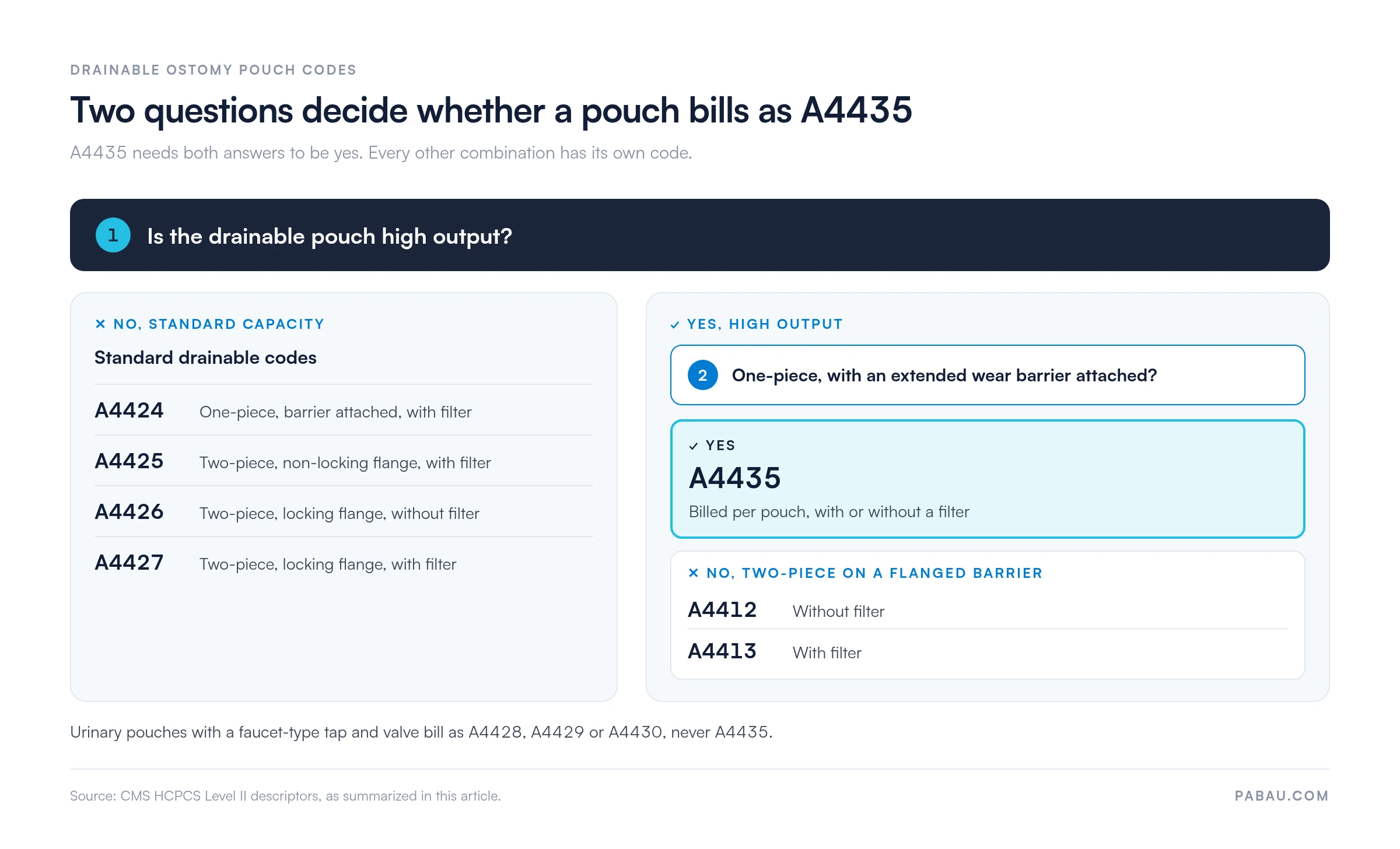
The table below maps each neighboring code to its distinguishing features.
A4435 vs A4427 and the other drainable codes: The key distinction. A4435 is the code for a one-piece, high-output pouch with an extended wear barrier attached. A4427 is a standard drainable pouch that fits a separate barrier with a locking flange, so it is two-piece and not high output. A high-output pouch for a two-piece system bills as A4412 or A4413, depending on the filter. A standard one-piece drainable pouch with a filter bills as A4424. Billing A4435 for any of these products is a descriptor mismatch and will be flagged on audit.
Medicare Part B covers A4435 under its prosthetic device benefit, billed to the DME MAC. LCD L33828 (Ostomy Supplies) and its policy article A52487 set the rules. Coverage requires three conditions to be satisfied before the claim is submitted.
Policy article A52487, which accompanies LCD L33828, lists the ICD-10-CM codes that support ostomy supplies. Covered diagnoses for A4435 claims include:
Group 1 of A52487 also lists Z93.6, Z43.6, K94.00, K94.03, K94.10 and K94.13. Confirm the complete list against the current A52487 at your DME MAC’s website before submitting, since codes are added and removed. Submitting a diagnosis not on the covered list is a direct denial trigger.
LCD L33828 lists no usual monthly maximum for A4435. Its table of usual maximum quantities has no entry for A4435, or for the two-piece high-output codes A4412 and A4413. The LCD also sets no pouch change frequency for these codes.
That puts the weight on the record. The units billed must match the written order and the need documented in the medical record. Bill the quantity the order specifies and the patient uses.
Quantities above the documented need require additional notes in the medical record showing why the patient needs more frequent pouch changes. Typical reasons include peristomal skin complications or patient-specific anatomical factors.
The treating physician’s notes must specifically address the elevated need. Without that documentation, the DME MAC will deny the units the record does not support.
DME suppliers billing A4435 must maintain a complete documentation file for each beneficiary. Submitting a clean claim for ostomy supplies requires the following records to be in place before the first shipment.
Neither LCD L33828 nor policy article A52487 requires a modifier on A4435. The modifiers below apply only in the situations shown.
The only modifier rule in A52487 is AU, and it applies to the tape and adhesive codes A4450, A4452 and A5120, not to A4435. Append KX only where another payer’s policy asks for it, since billing KX without meeting that policy’s criteria is a compliance risk.
A4435 claims go to the DME MAC for the beneficiary’s state of residence, not the state where the supplier is located. Below is the standard billing workflow for HCPCS code A4435.
The underlying medical billing workflow for HCPCS supply codes follows the same 837P transaction set used for all Medicare DME claims.
CMS sets A4435 payment through the DMEPOS fee schedule, which lists a rate for each state between a national floor and ceiling. CMS publishes the fee schedule files as downloadable ZIP packages. The official file always carries the current figures, while third-party rate databases may lag the CMS update.
Per the CMS DMEPOS fee schedule, A4435 pays about $7 to $8.21 per pouch in the contiguous states. Some non-contiguous areas pay up to about $9. Check the rate for the beneficiary’s state in the current CMS DMEPOS fee schedule before submitting claims, since rates update on January 1 each year.
There are four DME MAC jurisdictions. A4435 claims must be submitted to the MAC covering the beneficiary’s state, not the supplier’s state.
Suppliers that ship nationally route each claim by the beneficiary’s state, so one supplier can bill all four DME MACs in the same month. Use the receiving MAC’s payer ID on each claim.
Most A4435 denials trace back to one of five causes, mapped below to the fix. For the wider process of working and appealing them, see our guide to denial management in healthcare.
A4435 is not on CMS’s Required Prior Authorization List for DMEPOS items, as updated July 29, 2026. It is not on the 2018 Master List of items potentially subject to prior authorization either. CMS changes the list over time, so check the required prior authorization list for the claim date. When prior authorization is required, it must be obtained before the product is shipped.
Run a monthly internal audit on your A4435 claims before the DME MAC does it for you. Pull every claim billed in the prior 30 days and check it against the signed written order on file. Confirm the code, the units and the order date match, and that the diagnosis appears in A52487. Fixing a mismatch internally takes minutes, while a post-payment audit can mean returning funds plus interest.
Many suppliers check claims by hand, across spreadsheets and payer portals. An A4435 claim can then go out under the wrong pouch code or without a covered diagnosis. Its units may not match the order either.
Pabau’s error-catching claims management software checks each claim before it is submitted. It flags missing claim elements and routes each claim to the correct payer. Practices that bill supplies keep their claims in one system instead of several.
The result is fewer claims coming back for rework. Errors get fixed at your desk, before the DME MAC sees them.
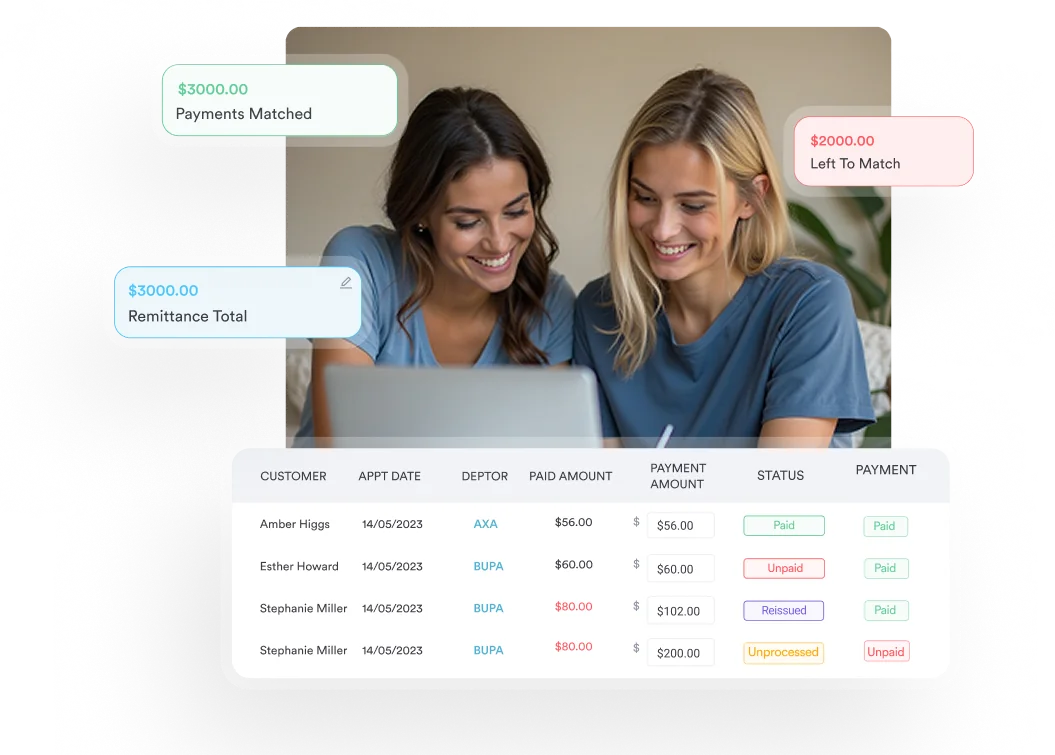

Pabau’s claims management checks each claim for missing elements and routes it to the correct payer. Practices that bill supplies run their claims from one system, so fewer come back for rework.

Most A4435 problems start at code selection, before a claim is ever built. Code selection starts with one question: Is the pouch high output, and is it one piece? If either answer is no, A4435 is the wrong code, and the decision path above points to the right one.
Once the code is right, three checks decide whether the claim pays on first submission. The diagnosis must appear in A52487, the written order must be on file, and the billed units must match that order. Run those checks when the order comes in, and an audit request becomes a file pull rather than a scramble.
Book a demo to see how Pabau’s claims management catches missing claim elements before your A4435 claims go out.

Need a broader overview of DME billing rules? Understanding medical billing covers the end-to-end claim lifecycle from order to payment posting.
Seeing recurring ostomy claim denials? Denial codes in medical billing maps the most common remittance advice codes to root causes and appeal steps.
Want to reduce claim errors before submission? What makes a clean claim outlines the pre-submission checklist that keeps DME claims from bouncing at the clearinghouse.
Billing a standard two-piece drainable pouch instead? HCPCS code A4425 covers the non-locking flange pouch with a filter.
Is the pouch urinary, with a faucet-type tap? HCPCS code A4430 explains the convex, extended wear urinary pouch code.
HCPCS code A4435 covers a one-piece drainable ostomy pouch built for high output, with an extended wear barrier attached and with or without a filter. It is paid per unit under Medicare Part B’s prosthetic device benefit, billed to the DME MAC. Two-piece high-output pouches use A4412 or A4413, and standard drainable pouches use other codes.
A4435 is a one-piece, high-output drainable pouch with an extended wear barrier attached. A4427 is a standard drainable pouch with a filter, made for a separate barrier with a locking flange in a two-piece system. Billing A4435 for an A4427 product is a descriptor mismatch that will be flagged on audit.
Covered ICD-10-CM codes include Z93.2 (ileostomy status), Z93.3 (colostomy status), Z43.2 (attention to ileostomy) and Z43.3 (attention to colostomy). The full list sits in Group 1 of policy article A52487, which accompanies LCD L33828. Check it at your DME MAC before submitting, as covered codes are updated periodically.
LCD L33828 lists no usual monthly maximum for A4435. The units you bill must match the written order and the need documented in the medical record. Quantities above that documented need require physician notes explaining the clinical reason.
No modifier is required on A4435 by LCD L33828 or policy article A52487. Add KX only where a specific payer policy requires it. Apply GA if the beneficiary has signed an Advance Beneficiary Notice (ABN) for a claim expected to be denied.
Per the CMS DMEPOS fee schedule, A4435 pays about $7 to $8.21 per pouch in the contiguous states. Some non-contiguous areas pay up to about $9. Each state has its own rate between a national floor and ceiling. Confirm the current figure in the CMS DMEPOS fee schedule file, which updates each January 1.