CPT Code 28005: Foot bone cortex incision
CPT Code 28005: Definition and clinical scope CPT Code 28005 is the Current Proc...

Last Updated: Oct 22, 2026
A4424 is the HCPCS Level II code for ostomy pouch, drainable, with barrier attached, with filter (1 piece), each.
It describes a one-piece pouch with the skin barrier and gas filter built in, billed per pouch. Medicare covers it under the prosthetic device benefit, with a usual maximum of 20 pouches a month under LCD L33828.
Let Pabau's smart automation suggest the right codes, reduce claim denials, and keep your practice compliant—effortlessly.
Automate repetitive tasks and focus on what matters most—your patients.
Reduce coding errors and ensure compliance with the latest regulations.
Clean claims, fewer denials, and faster reimbursements.
Powerful insights and reporting to help your practice thrive.
HIPAA compliant SOC 2 certified GDPR-compliant Trusted by 4,000+ clinics worldwide

HCPCS code A4424 is a one-piece drainable ostomy pouch with the skin barrier attached and a gas filter built in, billed per pouch.
Medicare covers A4424 under the prosthetic device benefit for a beneficiary with a permanent ostomy, following LCD L33828.
The usual maximum is 20 pouches a month, and higher use needs a clear explanation in the medical record.
The 2026 DMEPOS fee is $6.78 per pouch in the contiguous states, $1.74 more than the unfiltered twin code A5061.
Never bill the A4366 ostomy vent with A4424, because the filter is already built into the pouch.
HCPCS code A4424 covers one drainable ostomy pouch with the skin barrier attached and a gas filter built in, made as a single piece. CMS’s official descriptor reads: Ostomy pouch, drainable, with barrier attached, with filter (1 piece), each.
Each pouch is one unit of service. The attached barrier seals to the skin around the stoma, and the open end lets the patient empty output without taking the pouch off. The filter lets trapped gas escape, so the pouch does not balloon between emptyings.
Some older billing references attach a per-ounce liquid adhesive descriptor to A4424. That product is A4364, adhesive, liquid or equal, any type, per oz. Billing a pouch under the adhesive code, or the reverse, sends the wrong item and the wrong unit to the payer.
Four features decide the code for a pouch: one piece or two, drainable or closed, the barrier type, and whether a filter is built in. A4424 is the one-piece drainable pouch with a filter and a standard barrier attached. Pouches with an extended wear barrier or built-in convexity have codes of their own. The flow below takes the four questions in order.
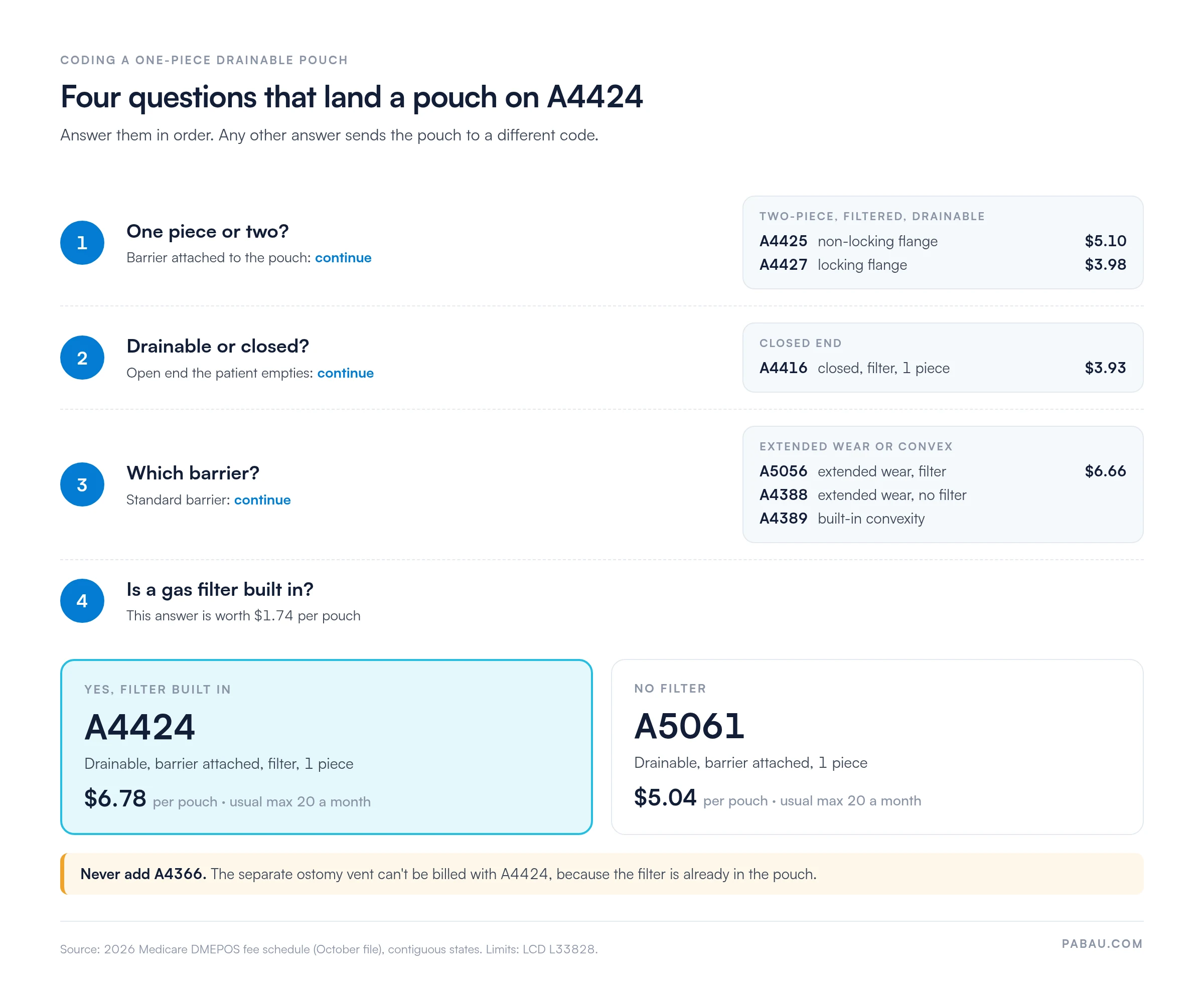
A few more codes come up in the same orders. A4366 is a separate vent the patient adds to a pouch, and the policy article bars billing it with A4424. A4421 is the miscellaneous ostomy code, and A4422 is absorbent material that thickens output inside the pouch.
Adhesive removers bill under A4455, a solvent per ounce, or A4456, wipes billed each. For the two-piece filtered pouches, see our guides to HCPCS code A4425 and HCPCS code A4427.
Medicare covers A4424 under the prosthetic device benefit, not the durable medical equipment benefit. The rules sit in the Ostomy Supplies LCD L33828 and its policy article A52487.
Coverage applies to a beneficiary with a surgically created stoma that diverts urine or fecal contents outside the body. The impairment must be permanent, which CMS reads as long and indefinite in duration. Certainty that it will never improve is not required.
Two DME MACs process these claims. Noridian Healthcare Solutions handles Jurisdictions A and D, while CGS Administrators handles the other two jurisdictions. Palmetto GBA runs the Pricing, Data Analysis and Coding (PDAC) contractor, which classifies products to HCPCS codes.
Ostomy supplies are not separately payable during a covered home health episode. The home health agency provides the pouches, and its Medicare rate includes them. The supplier should not bill A4424 to the DME MAC for those dates.
The policy article lists these diagnosis codes as supporting medical necessity for ostomy pouches. Each one can be checked against its full entry in our ICD-10-CM code library.
A listed code does not guarantee payment by itself. The medical record still has to show the ostomy and the need for the number of pouches billed.
The supplier needs a standard written order (SWO) on file before the claim is submitted. It names the beneficiary, the order date, the item, the quantity, and the treating practitioner with their signature. Strong billing compliance habits keep the rest of the file in order:
Refills cannot ship on an automatic schedule, even when the beneficiary agreed to one. Items delivered without a documented refill request are denied as not reasonable and necessary.
The 2026 Medicare fee schedule amount for A4424 is $6.78 per pouch in the contiguous states, Alaska and Hawaii. Puerto Rico pays $7.44. The figures come from the October 2026 DMEPOS fee schedule.
Medicare pays 80% of the lower of the supplier’s charge or the fee, after the Part B deductible. At $6.78, that is $5.42 from Medicare and $1.36 in coinsurance per pouch. A month at the usual maximum of 20 pouches comes to $135.60 allowed.
Fees are the contiguous-state amounts in the October 2026 DMEPOS file, and the monthly limits come from LCD L33828. A4424 carries no competitive bidding adjustment, so rural and non-rural ZIP codes share the same fee. Price it from the DMEPOS file, never the physician fee schedule.
Match the pouch to the code before the first claim. A filtered one-piece drainable pouch billed as A5061 leaves $1.74 per pouch unpaid, or $34.80 a month at 20 pouches. An unfiltered pouch billed as A4424 is an overpayment the DME MAC can recoup.
LCD L33828 sets a usual maximum of 20 A4424 pouches per month, the same as A5061, A4425 and A4427. The closed filtered pouch, A4416, has a usual maximum of 60 a month.
Billing above 20 is allowed when the medical record clearly explains the higher use. If that explanation is missing when the DME MAC asks for it, the excess pouches are denied. Neither the LCD nor the policy article asks for the KX modifier on ostomy pouches.
If you expect pouches above 20 to be denied, issue an ABN before delivery. That keeps the GA modifier available for the excess lines.
Most A4424 denials trace back to product selection or refill paperwork, not the claim form. Building denial management workflows around these causes cuts rework.
A pre-submission check of the code, the monthly count, the refill note and the episode status catches most of these. Aim for a clean claim on the first pass rather than fixing it on appeal.
Search the PDAC’s DMEPOS Classification System for the exact pouch before you bill it. The PDAC, run by Palmetto GBA, assigns HCPCS codes to named products. Its listing settles whether a filtered drainable pouch is A4424, A5056 or another code.
Medicare does not require prior authorization for A4424, since ostomy pouches are not on its DMEPOS Required Prior Authorization List. CMS revises that list from time to time, so check it before you rely on that.
State Medicaid programs set their own ostomy rates and limits, and Medicaid managed care plans can add prior authorization. Check the state fee schedule and the plan’s supply policy before the first shipment.
Commercial plans usually cover ostomy pouches under a supply or durable medical equipment benefit, each with its own cost sharing. Monthly limits and authorization rules vary by plan, so confirm the member’s benefit before you dispense.
Ostomy suppliers and practices often hold the order, the stoma history, refill calls and the claim in separate places. One missing piece, such as an unrecorded refill contact, turns a routine A4424 line into a denial.
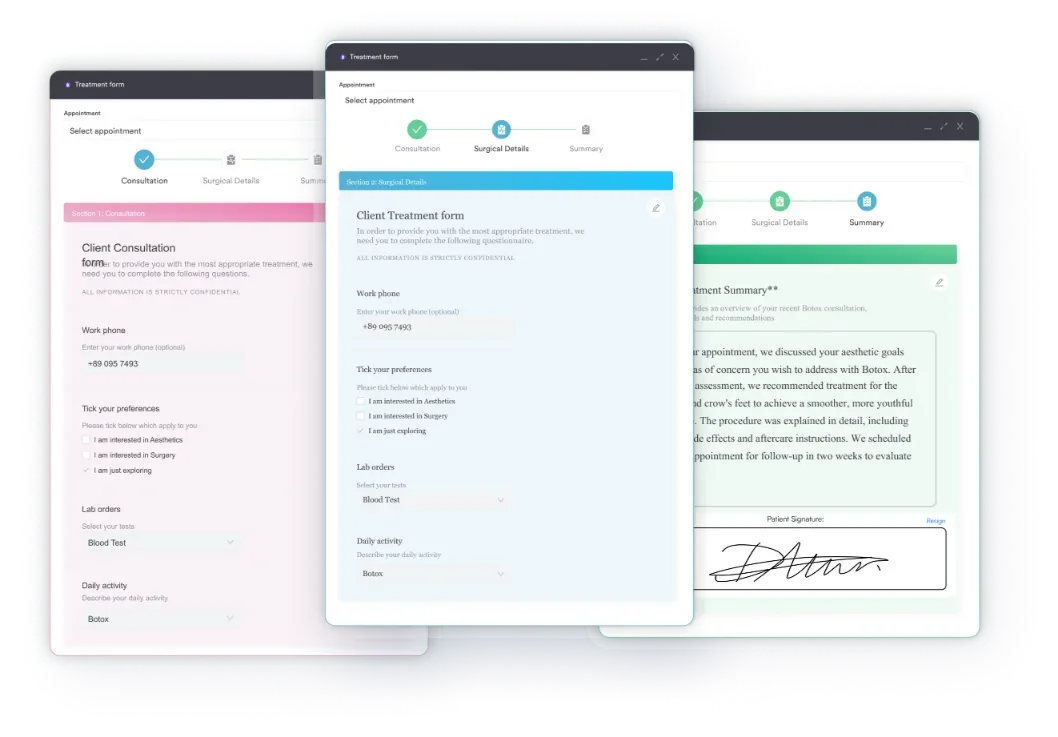
Pabau, the practice management platform we build, keeps those records on one patient file. Digital forms capture order details and refill confirmations, and recall reminders prompt your team to make each refill call on time.
Its claims management software pulls the details already on the patient record into a pre-filled claim. It then submits and tracks the claim through Claim.MD, so your team follows each status in one place.

Pabau keeps orders, refill confirmations and claim status on one patient record, so A4424 claims go out with the paperwork in place.

Most A4424 errors start at product selection, long before the claim form. Code the pouch by its four features, hold the monthly count at 20 unless the record explains more, and never pair it with a vent.
Use A5061 as your quick check. If the box lists a filter, the claim should read A4424, and the extra $1.74 per pouch is yours to collect. Book a demo to see how Pabau keeps ostomy orders, refills and claims together on one record.

Need a primer on how DME claims move through the system? Medical billing fundamentals covers the end-to-end claims lifecycle from order to remittance.
Seeing patterns in your denied DME claims? Denial management in healthcare explains how to categorize, appeal, and prevent recurring denials by CARC code.
Want to reduce claim errors before submission? What makes a clean claim outlines the pre-submission checks that prevent the most common DMEPOS rejection reasons.
HCPCS code A4424 covers one drainable ostomy pouch with the skin barrier attached and a built-in filter, made as a single piece. It is billed per pouch. Liquid ostomy adhesive is a different code, A4364, billed per ounce.
Yes. Medicare covers A4424 under the prosthetic device benefit for a beneficiary with a permanent, surgically created stoma. The claim needs a standard written order, a supporting medical record and a documented refill request. The rules are in LCD L33828.
Both are one-piece drainable pouches with the barrier attached. A4424 has a built-in filter and A5061 does not. In 2026, A4424 pays $6.78 per pouch and A5061 pays $5.04 in the contiguous states.
LCD L33828 sets a usual maximum of 20 A4424 pouches per month. Higher quantities can be paid when the medical record clearly explains the need. Without that explanation, the excess pouches are denied.
Common causes are a pouch billed under the wrong code, an A4366 vent billed with it, and more than 20 pouches without documentation. Refills shipped without a documented request and claims during a covered home health episode are denied too.
Medicare does not require prior authorization for A4424, because ostomy pouches are not on its DMEPOS Required Prior Authorization List. Medicaid plans and commercial insurers set their own rules, so check the member’s plan first.