CPT Code 86431: Rheumatoid factor quantitative test
CPT code 86431: official descriptor and procedure overview CPT code 86431 is the...

Last Updated: Oct 27, 2026
99509 is the CPT code for a home visit for assistance with activities of daily living and personal care. It covers non-skilled help in the patient's home, such as bathing, dressing, toileting, transfers, and meal preparation, billed as one unit per visit.
The descriptor names no provider type, but payers apply 99509 to custodial aide visits. State Medicaid programs are the main payer. Medicare Part B does not separately pay for custodial care, so aide-only claims to Part B are denied.
Let Pabau's smart automation suggest the right codes, reduce claim denials, and keep your practice compliant—effortlessly.
Automate repetitive tasks and focus on what matters most—your patients.
Reduce coding errors and ensure compliance with the latest regulations.
Clean claims, fewer denials, and faster reimbursements.
Powerful insights and reporting to help your practice thrive.
HIPAA compliant SOC 2 certified GDPR-compliant Trusted by 4,000+ clinics worldwide

CPT 99509 is a code for home visits assisting with ADLs and personal care, typically custodial, such as bathing, dressing, ambulation, and meal preparation.
Medicare Part B does not separately reimburse non-skilled custodial care. State Medicaid programs and select commercial payers cover most 99509 claims.
Documentation must include a physician plan of care, a functional ADL assessment, the specific ADLs provided each visit, total visit time, and aide credentials.
Place of service code 12 (home) is required. The most common denial triggers are missing physician orders, wrong POS, and custodial-care-only claims to Medicare Part B.
Pabau, the practice management platform we build, submits claims electronically through Claim.MD and tracks their status.
The AMA’s CPT code set defines CPT code 99509 as “Home visit for assistance with activities of daily living and personal care.” The code belongs to the Home Health Procedures/Services subsection of the Medicine section. It is intended for non-skilled, custodial assistance delivered in the patient’s residence.
The descriptor names no provider type. Payers, mainly state Medicaid programs, apply 99509 to non-skilled aide visits rather than to nursing or therapy. The custodial nature of that care is what drives the Medicare Part B denial.
The ADLs billable under 99509 are the basic self-care tasks a patient cannot safely perform independently due to illness, injury, or functional decline.
Mixing a billable ADL task with a non-billable companion task in the same visit does not disqualify the visit. The documentation must still identify which tasks were ADL assistance and the time spent on each.
99509 sits within a cluster of home services and personal care codes that coders routinely conflate, including two HCPCS Level II codes. The differences determine payer coverage and compliance exposure.
A common error is billing 99509 on top of 99601 when a home health aide accompanies a nurse during an infusion visit. Only the nurse’s skilled infusion service is billed with 99601. Under most payer policies, the aide’s concurrent ADL assistance does not separately justify 99509 on the same date.
Medicare is where most CPT 99509 claims go wrong. Billing it correctly means separating the Part A home health benefit from the Part B benefit. The routing below shows where a 99509 visit lands with each payer.
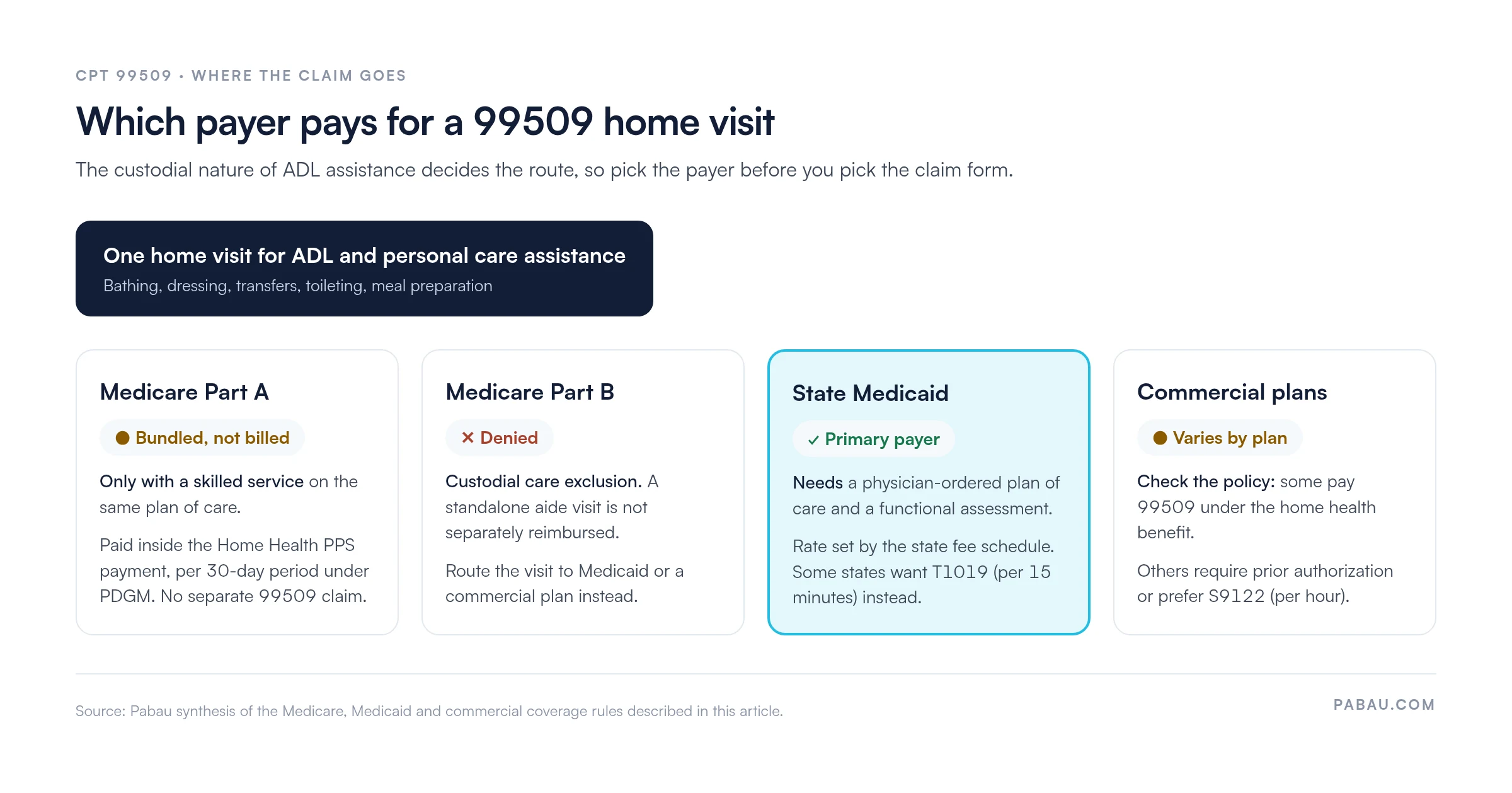
Medicare Part A covers home health aide services when the plan of care also includes a skilled nursing or therapy service. The aide’s visit is bundled into the Home Health PPS payment (paid per 30-day period under PDGM). Agencies bill under that payment, not by submitting individual CPT 99509 claims to Medicare Part A.
Medicare Part B does not separately reimburse non-skilled custodial home aide services. This is the statutory custodial care exclusion. Aide-only visits to assist with ADLs are not covered under Part B when no qualifying skilled service is also being rendered.
A standalone CPT 99509 claim to Medicare Part B without a documented skilled care trigger is denied under the custodial care exclusion.
Flag Medicare Part B claims for CPT 99509 during pre-claim review. If there is no concurrent skilled nursing or therapy service on the same plan of care, the claim is almost certain to deny. Route those visits to Medicaid or the applicable commercial payer instead.
State Medicaid programs are the primary payer for CPT 99509 services. Coverage rules, prior authorization requirements, and reimbursement rates vary by state. Most state Medicaid programs require a physician-ordered plan of care and a functional assessment establishing the need for ADL assistance.
Some states prefer HCPCS T1019 (per 15 minutes) over 99509 (per visit) for personal care services. Verify your state’s preferred code before billing.
Commercial payers vary widely. Some, such as Blue Cross Blue Shield plans in specific states, reimburse 99509 for home health aide services under the enrollee’s home health benefit. Others require prior authorization or substitute S9122 as their preferred code. Always check the applicable payer policy before submitting.
What you are paid for CPT 99509 depends on the payer, and state Medicaid fee schedules set the rate for most claims. For Medicare, check the CMS Physician Fee Schedule lookup for the code’s payment status indicator.
For Medicaid, reimbursement rates are state-determined and are not published in a single national fee schedule. Each state’s Medicaid fee schedule sets the rate, so check your state’s schedule or contact the state Medicaid agency for the current figure.
Commercial payer rates for 99509 are negotiated as part of the provider contract and are not publicly disclosed. Rates generally track the Medicaid fee schedule for comparable services or are set as a percentage of a regional usual-and-customary fee.
Inadequate documentation is the leading cause of 99509 claim denials after the custodial care exclusion. Every billable visit requires a complete and contemporaneous record. A structured approach to clean claim submission starts with having these documentation elements in place before the claim is generated.
Build these elements into the visit workflow as the aide works, rather than adding them at billing time. A claim submitted without a current physician POC will deny even if every other element is perfect.
CPT 99509 is a per-visit code, not a time-based code. One unit equals one home visit, regardless of the visit length. Billing multiple units of 99509 for the same patient on the same date is not appropriate under standard guidelines. The exception is a payer policy that explicitly permits multiple aide visits in one day.
Place of service code 12 (home) is required for CPT 99509 claims. Using an incorrect POS code, such as 11 (office) or 21 (inpatient hospital), is a common denial trigger and a compliance risk. The patient’s private residence, an assisted living facility unit, or a group home qualifies as POS 12 for most payers. A skilled nursing facility does not.
CPT 99509 does not routinely require therapy modifiers (GO, GN, GP). The service is performed by a non-therapist aide, not under a therapy plan of care. However, some Medicare Administrative Contractors (MACs) and commercial payers may require specific modifiers under local coverage determinations (LCDs). Verify modifier requirements with the applicable MAC or payer prior authorization guidance for your jurisdiction.
Medicaid programs and commercial payers commonly impose visit frequency limits, such as a maximum number of 99509 visits per month or per care plan period. Exceeding the authorized frequency triggers automatic denials.
Count each patient’s visits against the authorization before the claim goes out. Claims management software then tracks claim status, so a frequency denial shows up as soon as the payer returns it.
CPT 99509 denials cluster around a predictable set of triggers. Effective denial management workflows for home health billing address each trigger at the point of service, not after the denial arrives.
Agencies billing CPT 99509 through Medicaid or commercial payers need a superbill that captures every required field before the claim is generated. Accurate superbill preparation for 99509 visits includes:
The AAPC CPT code lookup and the PGM Billing free CPT search tool help coders verify the current 99509 descriptor before submitting. They also help catch payer-specific edits. Both tools reference current CMS data and are useful for double-checking code combinations and MUE values.
Many billing teams still key 99509 claims into each payer portal one at a time, then check back days later to see what paid. A frequency or authorization denial can sit unnoticed until the next remittance arrives.
Pabau submits claims electronically through Claim.MD and tracks their status. The claim draws on the patient, provider, and service details already on the record, so staff don’t retype them.
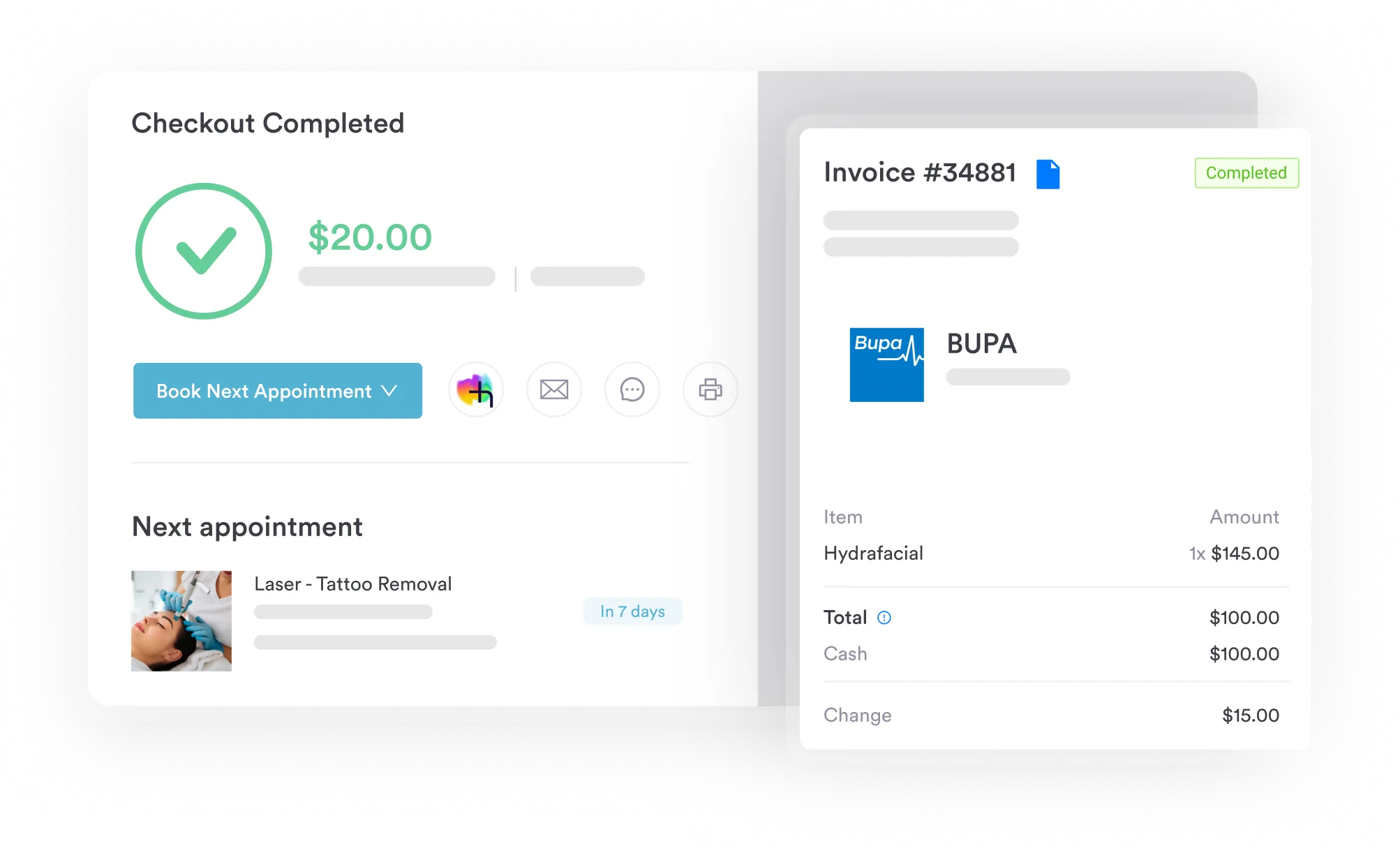
The outcome is a shorter loop between denial and fix. Your team sees a rejected claim when the payer returns it and corrects it while the visit note is still fresh.

Pabau submits claims electronically through Claim.MD and tracks their status, so your team can correct a rejected 99509 claim before it ages.

CPT code 99509 is a code for home visits assisting with ADLs and personal care, typically custodial. That custodial nature decides where the claim goes. Send it to Medicaid or the commercial plan that covers the service, not to Medicare Part B as a standalone aide visit.
Before the first claim, confirm three points with each payer. Ask which code it wants (99509, T1019, or S9122), whether the visit needs prior authorization, and how many visits the authorization allows. Settling those up front saves more revenue than any appeal after a denial.
Pabau submits claims electronically through Claim.MD and tracks their status. Book a demo to see how Pabau follows each 99509 claim from submission to the payer’s response.

Need to understand clearinghouse submission for home health claims? Our medical claims clearinghouse guide explains how electronic claim routing works across payers.
Struggling with claim denials across your billing team? Electronic remittance advice (ERA) processing covers how to read and act on 835 remittance files to resolve denials faster.
Want to verify payer eligibility before submitting home health claims? Insurance eligibility verification outlines the real-time eligibility check process that prevents coverage-related denials.
CPT code 99509 is the procedure code for a home visit to help a patient with activities of daily living (ADLs) and personal care. Typical tasks include bathing, dressing, ambulation, meal preparation, and toileting. It is mostly billed for non-skilled, custodial aide services to Medicaid and select commercial payers.
No, not as a standalone Part B claim. Medicare Part B does not separately reimburse non-skilled custodial care under the statutory custodial care exclusion. Under Part A, aide visits are covered when skilled care is also part of the plan of care. They are bundled into the Home Health PPS payment (paid per 30-day period under PDGM), not billed individually using 99509.
It depends on the payer. State Medicaid fee schedules set the rate for most 99509 claims, so check your state’s schedule for the current figure. For Medicare, check the CMS Physician Fee Schedule lookup for the code’s payment status indicator. Commercial payer rates are contract-negotiated.
The most common denial is the Medicare Part B custodial care exclusion for aide-only visits. Others include a missing or expired physician plan of care and a place of service code other than POS 12. Visit notes that don’t list the exact ADLs performed, and visits beyond the authorized frequency, round out the list.
CPT 99509 does not routinely require therapy modifiers (GO, GN, GP) because home health aide services are not provided under a therapy plan of care. Some MACs or commercial payers may require payer-specific modifiers under local coverage determinations. Verify modifier requirements with the applicable MAC or your payer contract before submitting.