



HCPCS code E0198: Water pressure pad billing guide
HCPCS code E0198 is a water pad for a standard mattress HCPCS code E0198 is the ...

Last Updated: Oct 13, 2026

CPT Code 99386 covers the initial comprehensive preventive medicine evaluation for new patients aged 40 to 64.
The note must document history, physical exam, counseling, risk factor reduction, and any lab orders.
The AMA counts a patient as new when no same-specialty physician in that group has seen them for three years.
Medicare Part B does not cover CPT 99386. Use G0438 or G0439 for the Annual Wellness Visit, and G0402 for the Welcome to Medicare exam.
Practice management software like Pabau checks eligibility, submits 99386 claims, and tracks denials in one workflow.
CPT Code 99386 is the billing code for a new patient comprehensive preventive medicine evaluation, ages 40 to 64. It sits in the American Medical Association’s preventive medicine series (99381-99397). Primary care and internal medicine bill it more than almost any other code in that series.
Three inputs decide whether a 99386 claim pays: the patient’s status, the primary diagnosis, and the payer. Traditional Medicare Part B does not cover the code at all, so a Medicare patient needs a G-code instead. All three inputs are knowable before the visit starts.
The American Medical Association (AMA) descriptor for CPT Code 99386 begins: “Initial comprehensive preventive medicine evaluation and management of an individual.” It continues: “including an age and gender appropriate history, examination, counseling/anticipatory guidance/risk factor reduction interventions.” It closes: “and the ordering of laboratory/diagnostic procedures, new patient, 40-64 years.”
Three elements of that descriptor matter most for billing. First, “initial” means this is a new patient visit. Second, the evaluation must be “comprehensive,” covering history, physical, and counseling in full. Third, “ordering of laboratory/diagnostic procedures” is listed as part of the code’s scope. The AMA clarifies that ordering is required only when clinically indicated, not for every visit.
Two eligibility conditions must both be true before billing CPT Code 99386. The patient must be aged 40 to 64 on the date of the visit. They must also qualify as a new patient under the AMA’s definition.
The AMA defines a new patient through a three-year look-back. The patient must not have received any face-to-face professional service from the physician in that window. The same test applies to another physician of the same specialty and subspecialty in that group practice. So a patient who saw a different internist at the same group eight years ago, then left, qualifies as new again.
The AMA descriptor is specific about what the visit must encompass. Each component below must be documented. Missing even one opens the claim to a medical necessity denial.
Documentation failure is the leading cause of 99386 denials on post-payment audit. The chart note must support every component of the visit on its face, without the auditor having to infer what happened.
A well-structured note carries a billing trail that matches the encounter, a discrete counseling section, and a review of systems written for this patient. Copying a generic review of systems from a prior visit invites a refund demand. It is one of the most common triggers on a RAC or MAC audit.
Selecting the wrong primary diagnosis is a fast path to a denied claim. Preventive visits must lead with a Z-code. A symptom-based or chronic condition code in the primary position converts the claim from preventive to problem-focused. That triggers different coverage rules, and often a denial.
Secondary chronic condition codes (hypertension, diabetes, hyperlipidemia) may be added when those conditions are assessed or managed during the same encounter. They must never appear as the primary diagnosis on a 99386 claim. Screening and family-history Z-codes run deeper than the five rows above, and the ICD-10-CM code index lists the rest by subcategory.
The 2025 Medicare Physician Fee Schedule does not reimburse CPT 99386 under traditional Medicare Part B. The Medicare section below explains why. For commercial payers, reimbursement is negotiated contract by contract, and it varies by region and plan type. The figures below are national estimates from available 2025 fee schedule data. Verify current rates with the CMS Physician Fee Schedule lookup tool, your MAC, and your carrier contracts.
Practices that submit electronically through a clearinghouse can confirm payer-specific rates and eligibility in real time, before the patient arrives. That is where most billing surprises get caught.
Before billing CPT Code 99386 to a commercial payer, run an eligibility check. Confirm that the preventive medicine benefit is active, whether a deductible applies, and whether the plan’s yearly visit limit is already used. The check takes under two minutes, and it prevents the most common cause of a surprise patient bill.
Traditional Medicare Part B does not cover CPT Code 99386. This is one of the most frequently misunderstood facts in preventive medicine billing. Billing 99386 to a traditional Medicare patient will result in a denial because the code is not on the CMS covered preventive services list. Instead, Medicare has created dedicated wellness visit codes that cover comparable services.
Checking eligibility before a preventive visit prevents the common error of billing 99386 against a plan that will not cover it. Some Medicare Advantage plans do cover 99386 through their supplemental benefit structure. That is plan-specific, so verify it individually.
Medicaid coverage of 99386 varies by state. Many state Medicaid programs cover preventive medicine services for adults, but fee schedules and frequency limits differ significantly. Check your state Medicaid agency’s published fee schedule for the current rate and any prior authorization requirements.
The most common code selection error in the preventive medicine series is swapping 99386 and 99396. Both cover adults aged 40 to 64. Patient status is the only distinction. Getting it wrong produces a denial, and a repeating error pattern becomes a compliance problem.
Age band, payer, and patient status settle the code between them, and the order matters. The path below runs those three checks in the order that fails a claim fastest.
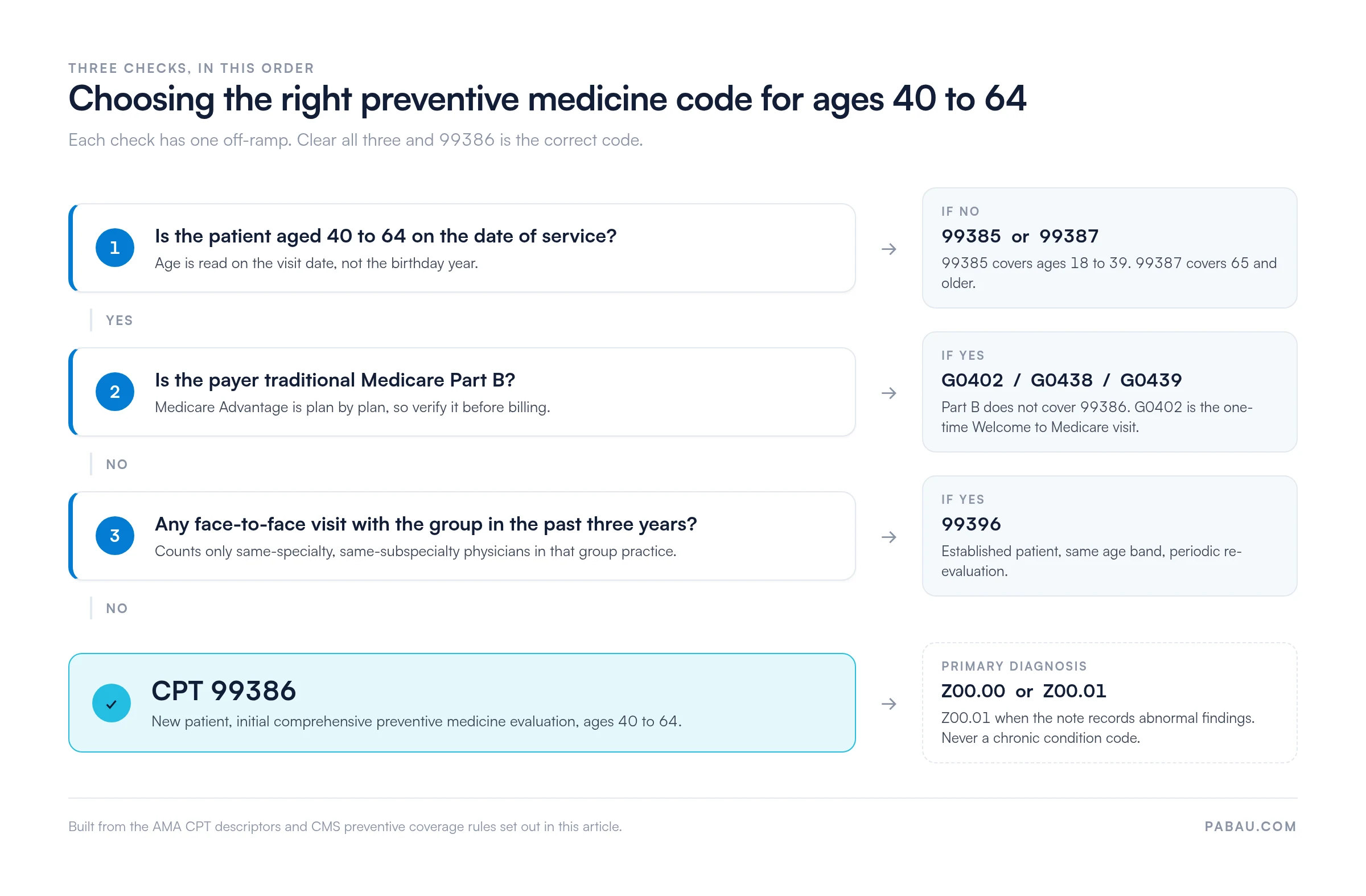
CPT 99386 is one code in a series of 14 preventive medicine codes covering patients from infancy through age 65 and older. The series splits into new patients (99381-99387) and established patients (99391-99397). Knowing where 99386 sits prevents age-band errors when a patient moves from one band to the next.
At the early-childhood end of the same new-patient series, 99382 covers the initial comprehensive preventive evaluation for children aged 1 through 4. Picking between the two comes down to the patient’s age on the date of service.
Practices that also bill preventive counseling add-on codes (99401-99404) can report those separately when counseling is the exclusive purpose of a visit. For most payers, the National Correct Coding Initiative (NCCI) edits do not bundle them into 99386.
Modifier 25 is the mechanism for billing a separate evaluation and management service on the same day as a preventive medicine visit. It is also one of the most frequently misused modifiers in primary care, and one of the Office of Inspector General’s documented audit targets.
The rule works like this. A patient presents for a preventive visit, and the physician finds a new problem needing significant work beyond the preventive exam. That extra evaluation and management service can be billed with modifier 25 appended. The two services have to be documented separately in the chart.
A worked example makes the split clear. A 52-year-old new patient arrives for her first annual physical. The physician records blood pressure readings consistent with hypertension, runs a focused cardiovascular assessment beyond the routine exam, and starts a treatment plan.
The preventive visit is billed as 99386. The hypertension evaluation carries its own focused history, assessment, and plan, so it is billed as 99213 or 99214 with modifier 25. The chart needs two distinct documentation sections, written separately.
Most 99386 denials fall into one of six categories. Practices that track denial reason codes systematically can see which error pattern dominates. Fixing that root cause once beats working each rejected claim by hand.
Practices running high volumes of preventive visits can structure their own internal audits around these six categories. Finding the pattern yourself is cheaper than having a MAC or a commercial payer find it.
The requirements for 99386 create two workflow problems for a primary care practice. The chart note has to capture every required component before the patient leaves. The claim then has to go out with the right code, the right ICD-10 pairing, and the right modifier logic.
Practice management software like Pabau works on both. Digital intake forms and structured note templates can be set up to prompt clinicians for each required element. That covers history, review of systems, exam findings, counseling topics, and lab orders. A note that is complete at the point of care produces a cleaner claim downstream.
On the billing side, cleaner claims management starts with a real-time eligibility check before the visit. Claim submission and remittance tracking follow it. Denials surface in the system instead of aging in a queue.
99386 denials are preventable at each of those steps. Eligibility gets checked before the visit, the note gets structured during it, and the claim goes out clean afterward. Running the three steps in one system is what stops any of them from being skipped on a busy morning.

Pabau’s practice management platform integrates with Claim.MD to automate eligibility checks, streamline 99386 claim submission, and flag denial patterns before they repeat. See how primary care and internal medicine practices keep more of every preventive visit.

Run the three checks at scheduling, not at billing. Patient status, payer, and primary diagnosis are all knowable before the patient sits down. All three are expensive to correct once a claim has been denied.
That moves work forward onto the front desk, which is the trade-off worth naming. A practice willing to take it stops writing off preventive visits that were documented properly and coded wrong.
To see how Pabau verifies eligibility, submits 99386 claims, and tracks denials in one place, book a demo.

Want a structured framework for preventive billing compliance? Medical billing compliance practices covers audit-readiness, RAC preparation, and internal review processes for primary care billing teams.
Need to understand how clearinghouse claim submission works? Revenue cycle management fundamentals explains the end-to-end flow from eligibility check to remittance posting.
Looking for denial management guidance? Denial codes in medical billing breaks down the most common reason codes and how to respond to each one.
Want to catch a non-covered preventive benefit before the visit? Insurance eligibility verification walks through the checks that flag a Medicare patient at scheduling.
Billing a preventive visit for a patient over 64? CPT Code 99387 covers the same initial comprehensive evaluation for new patients aged 65 and older.
CPT Code 99386 is the billing code for an initial comprehensive preventive medicine evaluation for new patients aged 40 to 64. The code covers a complete history, an age and gender appropriate physical examination, and counseling with anticipatory guidance. It also covers risk factor reduction interventions and the ordering of labs or diagnostic procedures when clinically indicated. It is maintained by the American Medical Association and falls within the preventive medicine services series (99381-99397).
No. Traditional Medicare Part B does not cover CPT 99386. Medicare patients require different codes. Use G0402 for the one-time Welcome to Medicare physical. Use G0438 for the initial Annual Wellness Visit, and G0439 for subsequent ones. Some Medicare Advantage plans may cover 99386 as a supplemental benefit, but this must be verified plan by plan before billing.
Yes, but only when the E/M service is significant, separately identifiable, and documented in a distinct section of the chart note. Append modifier 25 to the E/M code. The additional service must go beyond what is inherent to the preventive visit itself. Routine counseling within the preventive exam does not qualify, and some payers restrict same-day E/M billing with preventive codes, so verify before submitting.
Commercial payer reimbursement for CPT 99386 typically ranges from $160 to $280 nationally. Rates vary by carrier contract and by geographic region. Traditional Medicare does not reimburse this code. Verify current rates using the CMS Physician Fee Schedule lookup tool and your specific payer contracts, as rates change annually with each fee schedule update.



